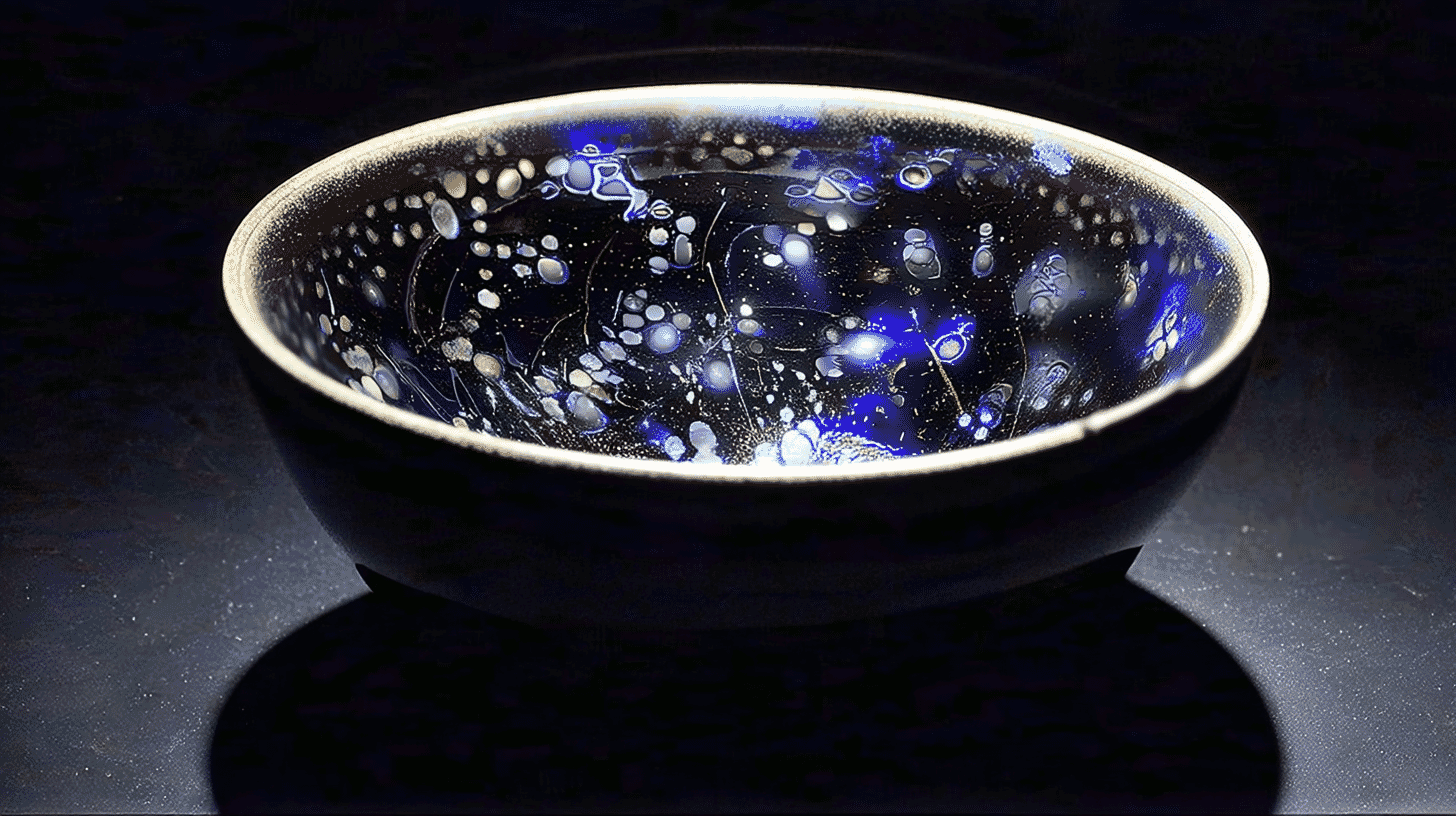
The Universe in a Tea Bowl: Discovering Japan's Most Mysterious National Treasure
In the tranquil grounds of Rikkoin Temple, hidden within Kyoto's sprawling Daitokuji Temple complex, rests one of the world's most enigmatic art treasures. The Yohen Tenmoku tea bowl, a ceramic masterpiece created over 800 years ago in Song Dynasty China, holds within its dark interior what many describe as "the cosmos itself" - a mesmerizing display of iridescent spots that shimmer like distant galaxies against the night sky.
This extraordinary artifact represents not just the pinnacle of ceramic artistry, but also embodies centuries of Japanese tea ceremony culture, Zen Buddhist philosophy, and the aesthetic pursuit of finding profound beauty in humble objects. For international visitors seeking to understand the depth of Japanese cultural appreciation, the Yohen Tenmoku offers an unparalleled window into the soul of traditional Japan.
Understanding the Yohen Tenmoku: A Miracle of Ceramic Art
The term "Yohen Tenmoku" combines multiple layers of meaning. "Tenmoku" derives from Tianmu Mountain in China's Zhejiang Province, where Japanese Buddhist monks first encountered these black-glazed tea bowls during their spiritual training. "Yohen" (曜変) literally means "stellar transformation," referring to the bowl's extraordinary crystalline patterns that resemble stars and nebulae.
What makes this particular tea bowl so remarkable is its accidental creation. During the firing process in China's Jian kilns between the 12th and 13th centuries, an incredibly rare combination of temperature, minerals, and atmospheric conditions produced these cosmic patterns. The exact mechanism remains a mystery even today, despite numerous attempts by modern potters to recreate the effect. Only three complete Yohen Tenmoku bowls survive in the world, all preserved in Japan and designated as National Treasures.
The Rikkoin specimen displays what experts describe as the most subtle yet profound beauty among the three. While it may appear less flashy than its counterparts at Seikado Bunko Art Museum or Fujita Museum, connoisseurs praise its deep spiritual quality, comparing its quiet elegance to moonlight reflected on water or the serene depths of mountain valleys.
Why This Bowl Became a National Treasure
The designation of the Yohen Tenmoku as a National Treasure reflects multiple layers of cultural and artistic significance. First designated as an Important Cultural Property in 1908 and elevated to National Treasure status in 1951, this tea bowl represents the apex of ceramic achievement and the deep cultural exchange between China and Japan.
The bowl's value extends beyond its rarity and beauty. It embodies the Japanese aesthetic concept of finding the universe in small things - a philosophical approach central to tea ceremony culture. The random yet perfect arrangement of its crystalline spots demonstrates the Buddhist principle of enlightenment arising from chance encounters. Each viewing angle reveals different patterns and colors, making every encounter with the bowl a unique experience.
Furthermore, its unbroken provenance at Rikkoin Temple for over 400 years adds immense historical value. Unlike the other two Yohen Tenmoku bowls that changed hands multiple times, this one has remained in the same location since the early Edo period, carefully preserved by generations of monks who understood its irreplaceable cultural significance.
The Mystical Appeal: What Makes It So Special
Viewing the Yohen Tenmoku is often described as a transcendent experience. The bowl's interior surface is covered with clusters of spots called "seimon" (star patterns) that appear to float above the black glaze. These spots are surrounded by iridescent halos that shift from blue to purple to silver depending on the viewing angle and lighting conditions.
Under natural sunlight, the bowl reveals its true magnificence - the spots seem to pulse with inner light, creating an effect that viewers compare to looking into deep space. The irregular distribution of these crystalline formations creates a sense of natural randomness that paradoxically feels perfectly balanced, embodying the Zen concept of controlled spontaneity.
Art historians note that while photography can capture the bowl's appearance, no image truly conveys the three-dimensional depth and luminosity experienced in person. The interplay of light across the curved surface creates an almost holographic effect, with patterns seeming to emerge and recede as one moves around the bowl.
Historical Journey: From Chinese Kiln to Japanese Temple
The bowl's journey to Japan reflects centuries of cultural exchange and appreciation. Originally created in the Jian kilns of Fujian Province during the Southern Song period (1127-1279), it likely arrived in Japan during the Kamakura or early Muromachi period when Zen Buddhism was flourishing and Chinese ceramics were highly prized.
The bowl's earliest known Japanese provenance traces to the Tennojiya merchant family of Osaka and Sakai. Tsuda Sogyu, one of the three great tea masters of the 16th century alongside Sen no Rikyu, owned this treasure. His son, Kogetsu Sogan, who became the de facto founder of Rikkoin Temple, brought the bowl to its current home when the temple was established in 1606.
Rikkoin was founded by Kuroda Nagamasa to honor his father, Kuroda Josui (also known as Kuroda Kanbei), a renowned samurai strategist. The temple's connection to both warrior culture and merchant wealth created an environment where such precious artifacts could be properly preserved and appreciated within a spiritual context.
Rikkoin Temple: Guardian of the Sacred Bowl
Rikkoin Temple stands as one of the most exclusive sub-temples within the Daitokuji complex. Unlike many temples that have opened to tourism, Rikkoin maintains a strict policy of non-public access, making it perhaps the most difficult National Treasure to view in Japan. This exclusivity has helped preserve not only the physical artifacts but also the spiritual atmosphere that has surrounded them for centuries.
The temple itself is an architectural treasure, featuring a National Treasure study hall (shoin) with the famous Mittan tea room designed by the legendary tea master Kobori Enshu. This intimate four-and-a-half tatami mat space was specifically created to display the Yohen Tenmoku, with a special alcove called the "Mittan-doko" designed solely for this purpose.
While the temple remains closed to casual visitors, it hosts three regular study groups: the Kansho-kai for tea ceremony literature, the Sunsho-juku for parent-child Zen practice, and the Kanshin-kai for studying the temple founder's Zen teachings. These activities maintain the temple's role as a living center of spiritual and cultural practice rather than a mere repository of artifacts.
Viewing Opportunities: When Can You See This Treasure?
Given Rikkoin's strict non-public policy, opportunities to view the Yohen Tenmoku are extremely rare and precious. The bowl typically appears in major exhibitions only once or twice per decade, making each public display a cultural event of national significance.
Recent notable exhibitions include the Kyoto National Museum's "National Treasure Exhibition" in 2017, MIHO Museum's groundbreaking "Daitokuji Rikkoin: National Treasure Yohen Tenmoku and Hasowai" in 2019, and the "Tea Culture of Kyoto" exhibition at Kyoto National Museum in 2022. When exhibitions are announced, they typically draw massive crowds and require advance planning to attend.
For those fortunate enough to view the bowl during these rare exhibitions, museums often create special lighting conditions to best display the Yohen effect. Some venues have experimented with natural light displays, allowing visitors to see how the patterns change throughout the day - an experience that closely mimics how the bowl would have been appreciated in traditional tea ceremony settings.
Exploring the Surroundings: Daitokuji Temple Complex
While Rikkoin itself remains closed, the greater Daitokuji Temple complex offers visitors one of Kyoto's most authentic Zen experiences. This vast complex covering 23 hectares contains 24 sub-temples, with four regularly open to the public: Daisenin, Ryogenin, Zuihoin, and Kotoin (though Kotoin is currently under renovation).
Each accessible sub-temple features distinctive Zen gardens and important cultural properties. Daisenin, founded in 1509, houses gardens designed to represent a Chinese landscape painting in three dimensions. Ryogenin, the oldest sub-temple, contains five different garden styles within its compact grounds. Zuihoin features a unique Christian-influenced stone garden, reflecting its founder's conversion to Christianity.
The complex is particularly stunning during autumn when the maple trees create a canopy of red and gold. Spring brings cherry blossoms and fresh green leaves, while winter's spare beauty emphasizes the architectural lines and garden compositions. Each season offers a different perspective on Zen aesthetics.
Practical Visitor Information
Daitokuji Temple complex is located in Kita-ku, northern Kyoto, easily accessible by public transportation. From Kyoto Station, take the Karasuma Subway Line to Kitaoji Station (13 minutes, ¥260), then either walk 15 minutes west or take a city bus to Daitokuji-mae stop. Alternatively, buses 101, 205, or 206 run directly from Kyoto Station to Daitokuji-mae (40 minutes, ¥230).
The main temple grounds are free to enter and open daily from 9:00 AM to 4:30 PM (4:00 PM in winter). Individual sub-temples charge separate admission fees, typically ¥400-600 per temple. Photography policies vary by temple, with some prohibiting all photography while others allow non-flash photography in gardens only.
For the best experience, allocate 2-3 hours to explore the complex thoroughly. Early morning visits offer the most serene atmosphere, while afternoon light creates beautiful effects in the gardens. Consider combining your visit with nearby attractions like Kinkakuji (Golden Pavilion), a 25-minute walk or short bus ride away, or Imamiya Shrine, famous for its aburi-mochi (grilled rice cakes) shops that have been operating for over 1,000 years.
Cultural Context: Tea Ceremony and Zen Buddhism
Understanding the Yohen Tenmoku's significance requires appreciating its role in Japanese tea ceremony culture. The tea ceremony, or chanoyu, elevates the simple act of preparing and drinking tea into a spiritual practice emphasizing harmony, respect, purity, and tranquility. Within this context, the tea bowl becomes not just a vessel but a focal point for aesthetic contemplation and spiritual connection.
The Tenmoku style bowls were particularly prized during the development of wabi-cha, the refined tea ceremony style pioneered by Sen no Rikyu. Despite their Chinese origin, these bowls embodied the Japanese aesthetic ideal of finding profound beauty in simplicity and imperfection. The Yohen Tenmoku, with its accidentally perfect imperfections, represents the ultimate expression of this philosophy.
The bowl's residence at a Zen temple is no coincidence. Zen Buddhism and tea ceremony culture are deeply intertwined, both emphasizing mindfulness, presence, and the discovery of enlightenment in everyday activities. The act of contemplating the Yohen Tenmoku's cosmic patterns becomes a form of meditation, inviting viewers to lose themselves in its infinite depths while remaining grounded in the present moment.
Frequently Asked Questions
- Can visitors enter Rikkoin Temple to see the Yohen Tenmoku tea bowl?
- No, Rikkoin Temple maintains a strict non-public policy and does not offer regular visits or special tours. The Yohen Tenmoku can only be viewed during rare museum exhibitions, typically occurring once or twice per decade at major institutions like the Kyoto National Museum or MIHO Museum.
- What makes this tea bowl worth visiting Japan to see?
- The Yohen Tenmoku represents a unique convergence of natural accident and human appreciation that cannot be recreated. Its cosmic patterns, visible only in person, offer a transcendent aesthetic experience that photographs cannot capture. As one of only three surviving examples worldwide, viewing it is a once-in-a-lifetime cultural experience that provides deep insight into Japanese aesthetics and values.
- How can I find out about future exhibition opportunities?
- Follow major Japanese museums' websites and social media, particularly Kyoto National Museum, Tokyo National Museum, and MIHO Museum. Major exhibitions are typically announced 6-12 months in advance. The Japan National Tourism Organization (JNTO) and cultural websites also publicize significant exhibitions featuring National Treasures.
- Are there replicas or similar bowls I can see more easily?
- While nothing matches the original Yohen Tenmoku, several museums display other types of Tenmoku bowls. Tokyo National Museum has an excellent collection of various Tenmoku styles regularly on display. Modern potters like Kamada Koji and Touan's fourth generation have created remarkable reproductions, though they acknowledge these cannot fully capture the original's mysterious beauty.
- What other attractions near Daitokuji Temple are worth visiting?
- The area offers several notable sites: Kinkakuji (Golden Pavilion) is a 25-minute walk west, Imamiya Shrine with its thousand-year-old aburi-mochi shops is immediately north, and the Kyoto Botanical Gardens are 20 minutes southeast. The Kitayama area also features numerous traditional craft shops and cafes, making it ideal for a full day of cultural exploration.
Essential Information
| Name | Yohen Tenmoku Tea Bowl (曜変天目茶碗) |
|---|---|
| Location | Rikkoin Temple, Daitokuji Complex, Kyoto |
| Period | Southern Song Dynasty (12th-13th century) |
| Dimensions | Height: 6.6cm, Diameter: 12.1cm, Base: 3.8cm |
| Designation | National Treasure (since 1951) |
| Access | Temple not open to public; viewable only during special exhibitions |
| Nearest Station | Kitaoji Station (Karasuma Line) or Daitokuji-mae Bus Stop |
| Admission (Daitokuji sub-temples) | ¥400-600 per temple |
References
- Yohen Tenmoku Tea Bowl (Rikkoin) - Wikipedia
- https://ja.wikipedia.org/wiki/曜変天目茶碗_(龍光院)
- WANDER National Treasure - Yohen Tenmoku
- https://wanderkokuho.com/201-00311/
- Daitokuji Temple - Kyoto Travel Guide
- https://www.japan-guide.com/e/e3910.html
- MIHO Museum Special Exhibition Archives
- https://www.miho.jp/exhibition/daitokuji-ryokoin/
- Seikado Bunko Art Museum
- https://www.seikado.or.jp/
- Kyoto National Museum - Tenmoku Teabowls
- https://www.kyohaku.go.jp/eng/learn/home/dictio/touji/tenmoku/