
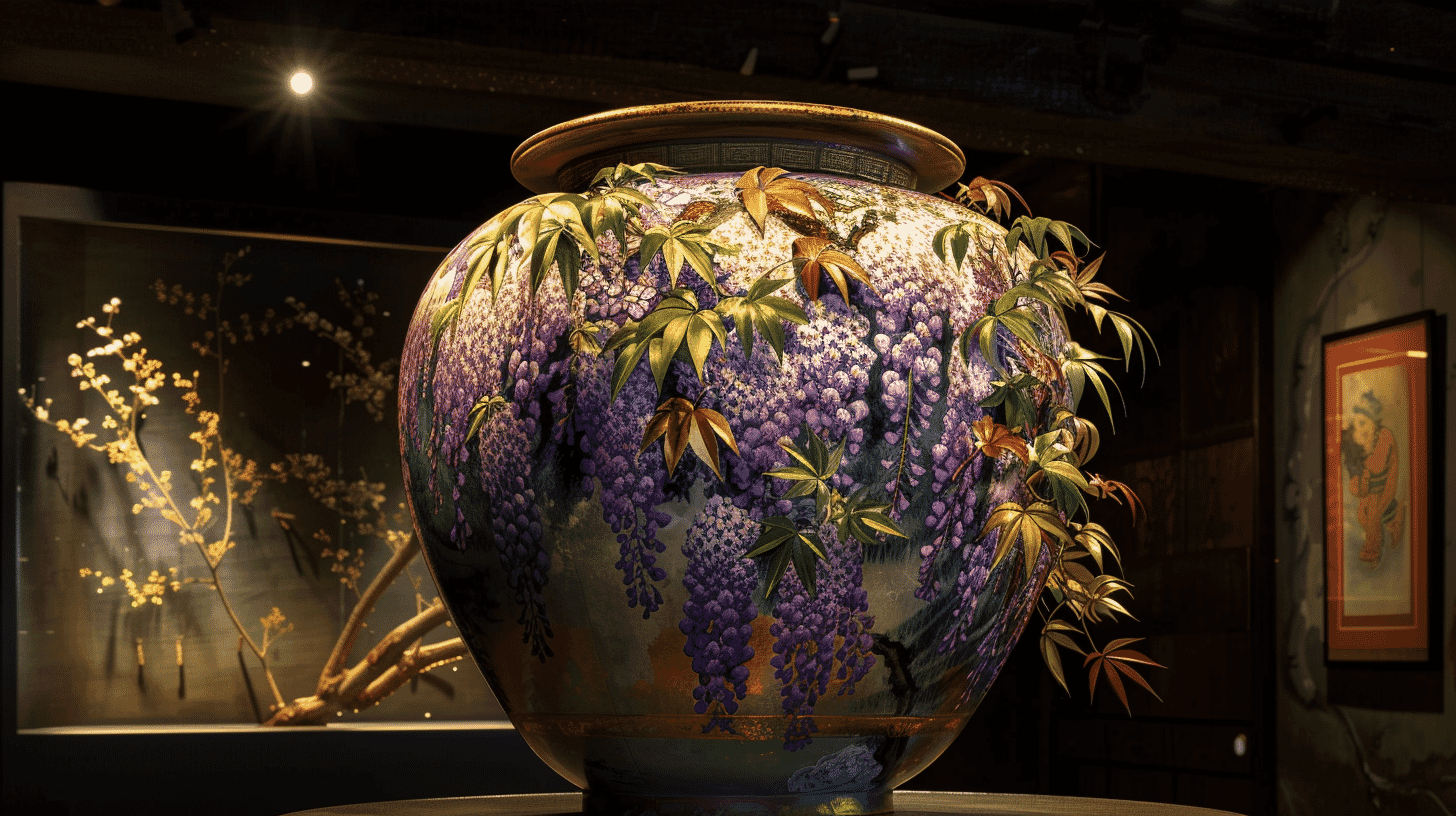
One Jar, National Treasure since 1951
Teapot with a Colorful Wisteria Design (by Ninsei) (色絵藤花文茶壺, Iroe Fujibana Mon Chatsubo) is an Edo-period craft object at the MOA Museum of Art, 26-2 Momoyama-cho, Atami City, Shizuoka Prefecture, made an Important Cultural Property on 19 January 1917 and designated a National Treasure on 9 June 1951. The quantity is one jar and the owner is Sekai Kyusei Kyo.
It measures 28.8 centimetres high, 10.1 centimetres across the mouth and 10.5 centimetres across the base. The maker's field reads Ninsei.
The listing of 19 January 1917 is among the earliest met here. 9 June 1951 is the day of both Yohen Tenmoku bowls, the Mikazuki Munechika and the Himeji Castle turrets.
The Owner Is a Religious Corporation of Modern Founding
A kind of owner appears here that has not appeared before.
The field names Sekai Kyusei Kyo, a religious corporation.
Owners so far have included temples and shrines, religious corporations, individuals, a foundation, the state, a national institute, a company, an inter-university corporation and a national university. Among religious corporations, temples and shrines predominated.
This owner is neither. A religious body founded in the modern era holds a National Treasure.
The jar is kept in a museum that does not carry the owner's name. Ownership and keeping under different names appeared with the engraved mirror as well, where the owner was one museum and the address that of another.
Many Works by One Maker, Listed Together
Related entries carry the same maker's name in numbers.
Tea jars with young pines, with a mountain temple, with plum and moon; incense burners in the form of a pheasant and of a hen; a tea bowl with a scale-and-wave pattern; a water jar with peonies. All are recorded as his work.
The tea jars alone are several, each distinguished by the pattern on it: wisteria, young pines, mountain temple, plum and moon. Where the ceremonial sword was distinguished by the name of a lacquer technique, these are distinguished by pattern.
One entry, a set of nail covers, carries the word for attributed. As with the writer's field of the cloud-paper Wakan Roeishu, that marks what tradition holds rather than what is established.
Within one maker's body of work, secure attributions and traditional ones stand side by side.
A Family That Once Held Many
The provenance is written in a particular way.
The jar came down in the Kyogoku family, lords of the Marugame domain, who once owned many tea jars by this maker.
The record does not simply name the family. It adds what that family once held.
They no longer hold many. A group that once stood together has scattered, and this jar survives as one of them.
The provenance of the Inaba Tenmoku was four holders joined by dashes. The Goto Toshiro dagger gave the date of a gift and what came with it. This one records what a holder possessed.
Seeing It
The jar is at the MOA Museum of Art, owned by Sekai Kyusei Kyo. It is a museum holding, not kept on permanent display.
The form is closely described: a full, swelling body, the mouth turned slightly outward and carried on a low neck, with four lugs applied at the shoulder and a flat base.
So is the glaze: a distinctive milky glaze finely crazed runs from the mouth down to the foot of the body, giving a soft quality to the surface. Crazing means the fine cracks that form in a glaze.
The colours are named as well: red, green, purple, silver and gold are used to paint the wisteria. Five colours in a row.
One detail is singled out: on the leaves, the veins are drawn with a needle. Exhibition plans can change, so check the museum's information before travelling.
Q&A
- When was the jar designated?
- It became an Important Cultural Property on 19 January 1917 and a National Treasure on 9 June 1951. The quantity is one jar, the location the MOA Museum of Art, and the owner Sekai Kyusei Kyo.
- How large is it?
- 28.8 centimetres high, 10.1 centimetres across the mouth and 10.5 centimetres across the base. The body swells fully, the neck is low, four lugs are applied at the shoulder and the base is flat.
- How is it decorated?
- The Agency records a distinctive milky glaze, finely crazed, with wisteria painted in red, green, purple, silver and gold. On the leaves, the veins are drawn with a needle.
- How did it come down?
- The Agency records that it came down in the Kyogoku family, lords of the Marugame domain, who once owned many tea jars by this maker. Rather than naming the holder alone, the record adds what that holder possessed.
- Are there other works by the same maker?
- Many. Tea jars with young pines, a mountain temple and plum and moon, incense burners in bird form, a tea bowl and a water jar. The jars are distinguished by pattern, and one entry for nail covers is marked as attributed rather than secure.
Basic Information
| Name | Teapot with a Colorful Wisteria Design, by Ninsei (色絵藤花文茶壺, Iroe Fujibana Mon Chatsubo); the holding museum gives the maker's full name |
|---|---|
| Location | MOA Museum of Art, 26-2 Momoyama-cho, Atami City, Shizuoka Prefecture |
| Designation | National Treasure (craft) |
| Year Designated | 1917 (19 January), Important Cultural Property; 1951 (9 June), National Treasure |
| Quantity | 1 jar |
| Dimensions | 28.8 centimetres high, 10.1 centimetres across the mouth, 10.5 centimetres across the base. 4 lugs are applied at the shoulder and the base is flat; a finely crazed milky glaze carries wisteria painted in red, green, purple, silver and gold. The maker is Ninsei and the period Edo |
| Owner | Sekai Kyusei Kyo |
| Public Access | A museum holding, not on permanent display |
References
- Cultural Heritage Online: the wisteria tea jar by Ninsei
- https://bunka.nii.ac.jp/heritages/detail/177932
- Cultural Heritage Online: the same jar in the museum's record
- https://bunka.nii.ac.jp/heritages/detail/230691
- Agency for Cultural Affairs, National Cultural Properties Database
- https://kunishitei.bunka.go.jp/
- Agency for Cultural Affairs: introduction to fine arts and crafts
- https://www.bunka.go.jp/seisaku/bunkazai/shokai/bijutsu_kogei/
Last verified: 2026.09.05