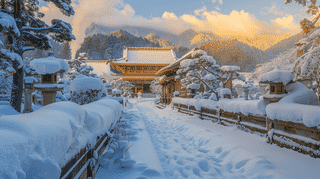
An Amida Hall with Its Year on the Ridge Beam
Chusonji Temple Golden Hall (中尊寺金色堂, Chusonji Konjikido) is an Amida hall of 1124 at Chusonji in Hiraizumi, Nishiiwai District, Iwate Prefecture, designated an Important Cultural Property on 28 December 1897 and a National Treasure on 9 June 1951. The quantity is one building, with four ridge tablets, one votive tablet, six sets of old railing, six pieces of old timber and two old metal fittings as attached property. It belongs to Konjikiin.
The Agency for Cultural Affairs dates the founding step by step. Fujiwara no Kiyohira began building Chusonji after the Later Three-Year War, raised the Saishoin in 1105 and the Two-Storey Amida Hall in 1107, and completed the Golden Hall in 1124 at the end of his life. The year comes from an inscription on the ridge beam.
In 1337 a fire destroyed the founding complex that had spread over the hill and its foot, leaving only the Golden Hall and the sutra repository. As the building that preserves the temple's original form, the Golden Hall holds a place apart at Chusonji.
The National Treasure designation of 9 June 1951 belongs to the first group of buildings designated under the Cultural Properties Protection Law.
Gold Throughout, from Veranda to Eaves
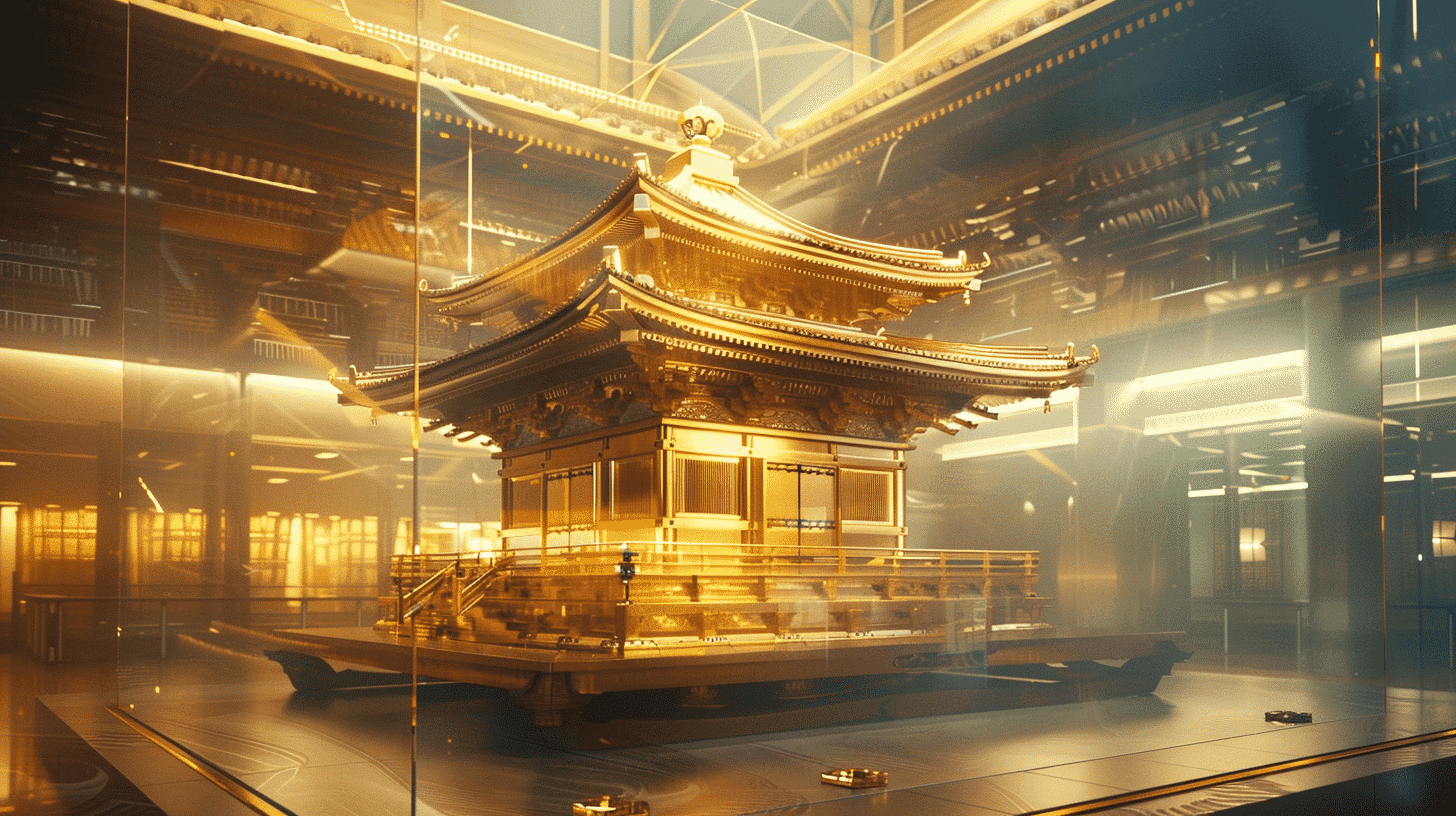
The Golden Hall is a small three-bay hall, about 5.5 metres to a side and 8 metres high, with a single central bay surrounded by an aisle. The Agency describes the structure briefly: bracket sets of the simplest three-block type on round columns, frog-leg struts between them, deeply curved double eaves of square rafters, and a pyramidal roof covered in wooden tiles, a rare choice.
Then one sentence explains the name. The hall is coated inside and out, from the veranda to the tips of the eaves, in black lacquer overlaid with gold leaf. That is what kaikonjiki, gold throughout, means.
The Iwate prefectural record adds the materials. The timber is hiba cypress finished with a spear plane, and the frog-leg struts between the brackets are of the hollowed type, the oldest surviving examples of their kind.
The structure itself is plain. As the Agency says, the brackets and struts are of simple form. The elaboration lies on the surface and in the sanctuary: a plain frame sheathed in lacquer and gold, with the craftsmanship concentrated within.
The Sanctuary: Inlaid Columns and Four Generations of Coffins
The four columns of the sanctuary, the tie beams and the bracket sets carry peony arabesques in mother-of-pearl inlay on a ground of dense gold leaf. The columns bear bodhisattvas in maki-e lacquer, and the altars are covered entirely in metal fittings worked by chasing, casting and forging. The Agency calls this the fullest achievement of architectural decoration in lacquer and metalwork. The mother-of-pearl came from turban shells of the southern seas.
The columns hide a trick. Each is a bound column, eight boards fitted around an octagonal core, so that what reads as a single shaft is in fact assembled.
There are three altars. The central one carries an Amida triad, six Jizo and two guardian kings; the two flanking altars repeat the arrangement, 33 statues in all. The canopies, preaching seats, gong stands, tables and floral pendants survive from the founding as a complete set of furnishings, and the Agency judges their art-historical value to be extremely high.
Beneath the altars lie coffins. After Kiyohira's death the Golden Hall became the mausoleum of four generations of the Fujiwara. His coffin rests inside the central altar; those of his son Motohira and grandson Hidehira lie within the flanking altars, together with the head of the fourth lord, Yasuhira. The hall is a Buddha hall and a family tomb at once.
Preservation: Rain Screens and Sheltering Halls
Nine centuries on, most of the structure and its members survive as built. The Agency gives two reasons: rain screens were fitted beneath the eaves soon after construction, and a sheltering hall was built over the whole in the Kamakura period. Measures to keep weather off a building of lacquer and gold were taken early.
That Kamakura shelter still stands in the precinct as the old sheltering hall, itself an Important Cultural Property. The Golden Hall was moved in 1965 into a new shelter of reinforced concrete, where it stands in a glass enclosure at controlled temperature and humidity.
What visitors see is the Golden Hall inside that modern shelter, cut off from the air and never touched by rain. Nine-hundred-year-old gold leaf can be seen as it was because the hall has been covered twice over, once in Kamakura and once in Showa.
Visiting
Chusonji Temple Golden Hall is one of four ticketed sites at Chūson-ji, covered by a single ticket that also admits you to the Sankozo treasure hall, the sutra repository and the former shelter hall. Tickets are sold at the Sankozo reception, not at the Golden Hall entrance. Opening hours, prices and directions to the temple are gathered on the Chusonji Temple page.
The Golden Hall stands inside a reinforced concrete shelter built in 1965, and visitors view it from the front through glass. Photography inside is prohibited, and the shelter is to be kept quiet. The inlay and lacquer on the altars are fine-grained, so give your eyes a minute at the glass to adjust.
Commemorative events and a special opening of hidden images are planned for 2026, and admission procedures and charges may differ during them. Check the temple's official site before travelling.
Q&A
- When was Chusonji Temple Golden Hall built and designated?
- It was built in 1124, a date fixed by an inscription on the ridge beam. It became an Important Cultural Property on 28 December 1897 and a National Treasure on 9 June 1951, with four ridge tablets, one votive tablet, six sets of old railing, six pieces of old timber and two old metal fittings as attached property.
- Why is Chusonji Temple Golden Hall gold?
- The Agency for Cultural Affairs records that the hall is coated inside and out, from the veranda to the eaves, in black lacquer overlaid with gold leaf, which is what the term gold throughout means. The structure itself is plain, with simple brackets and struts; the elaboration lies on the surface and in the sanctuary.
- What is inside the sanctuary of the Golden Hall?
- Mother-of-pearl arabesques on the columns, tie beams and brackets, maki-e bodhisattvas on the columns, and altars covered in metal fittings. Three altars carry 33 statues in all, with the original furnishings intact. Beneath them lie the coffins of Fujiwara no Kiyohira, Motohira and Hidehira, and the head of Yasuhira.
- How has the Golden Hall survived for 900 years?
- The Agency credits rain screens fitted beneath the eaves soon after construction and a sheltering hall built over it in the Kamakura period. The fire of 1337 spared only the Golden Hall and the sutra repository. Since 1965 the hall has stood inside a reinforced concrete shelter in a glass enclosure.
- What does it cost to visit Chusonji Temple Golden Hall, and when is it open?
- A joint ticket with the Sankozo treasure hall, sutra repository and former shelter hall costs 1,000 yen for adults, 700 for high school students, 500 for junior high and 300 for primary school students. Hours are 8:30 a.m. to 5:00 p.m. from 1 March to 3 November and to 4:30 p.m. from 4 November to the end of February. Photography inside is prohibited.
Basic Information
| Name | Chusonji Temple Golden Hall (中尊寺金色堂, Chusonji Konjikido) |
|---|---|
| Location | 202 Koromonoseki, Hiraizumi, Hiraizumi Town, Nishiiwai District, Iwate Prefecture |
| Designation | National Treasure (structure); component of the World Heritage site Hiraizumi |
| Year Designated | 1897 (28 December), Important Cultural Property; 1951 (9 June), National Treasure |
| Quantity | 1 building; 4 ridge tablets, 1 votive tablet, 6 sets of old railing, 6 pieces of old timber and 2 old metal fittings as attached property |
| Dimensions | Three bays square, about 5.5 m to a side and 8 m high. Single storey, pyramidal roof, wooden tiles. Hiba cypress finished with a spear plane. Black lacquer and gold leaf inside and out. Built 1124 |
| Owner | Konjikiin |
| Public Access | Combined ticket with the Sankozo treasure hall: adults 1,000 yen, high school 700, junior high 500, primary 300. Hours vary by season. No photography inside |
References
- Cultural Heritage Online: Chusonji Golden Hall
- https://online.bunka.go.jp/db/heritages/detail/199039
- Iwate Prefecture, cultural information encyclopaedia: Chusonji Golden Hall
- https://www.bunka.pref.iwate.jp/archive/hist1
- Agency for Cultural Affairs, Japan Heritage portal: Chusonji Golden Hall
- https://japan-heritage.bunka.go.jp/ja/culturalproperties/result/4119/
- Hiraizumi Town: World Heritage, Chusonji
- https://www.town.hiraizumi.iwate.jp/heritage/asset/chusonji.html
- Chusonji: about the Golden Hall
- https://www.chusonji.or.jp/know/konjikido.html
Last verified: 2026.10.05