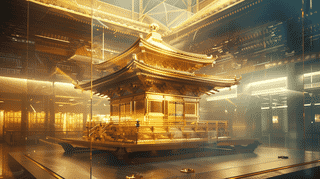
What the Ganjojuin Hoto Pagoda Is
The Ganjojuin Hoto Pagoda (願成就院宝塔, Ganjōjuin Hōtō) is a late Heian-period stone hōtō pagoda standing to the right of the Mine Yakushi Hall, as you face it, in the Chūson-ji temple grounds in Hiraizumi Town, Iwate Prefecture, and it was designated an Important Cultural Property on September 17, 1954.
A hōtō, sometimes translated "treasure pagoda", is a Buddhist stupa with a cylindrical body under a single square roof, a form that spread in Japan with Esoteric Buddhism. Unlike the multi-story wooden pagodas most visitors picture, it has only one roof, and many were carved in stone. The Ganjojuin Hoto Pagoda belongs to Ganjōjuin, one of the sub-temples of Chūson-ji, and is managed by the religious corporation Chūson-ji.
Do not confuse it with the better-known Ganjōjuin in Izunokuni, Shizuoka Prefecture, the temple founded by Hōjō Tokimasa. The Ganjojuin Hoto Pagoda belongs to an unrelated sub-temple of the same name on Chūson-ji's hill in Hiraizumi.
Why the Ganjojuin Hoto Pagoda Is an Important Cultural Property
A stone pagoda from the Fujiwara heyday
The Agency for Cultural Affairs' national database records the Ganjojuin Hoto Pagoda as a single stone hōtō of the late Heian period. Chūson-ji likewise dates the stone pagoda beside the Mine Yakushi Hall to the 12th century.
Hiraizumi Town describes it as a stone pagoda made at the height of the Ōshū Fujiwara and notes that examples from the same era are rare anywhere in Japan. At a temple where most of the timber buildings were lost, many of them in the fire of 1337, the Ganjojuin Hoto Pagoda preserves 12th-century design in stone, above ground. That is the core of its value.
A pair with the Shakuson-in Five-Ringed Pagoda
The Agency's draft World Heritage nomination, introducing the designated buildings of the Chūson-ji grounds, groups the Ganjojuin Hoto Pagoda with the Shakuson-in Five-Ringed Pagoda as monuments that show the character of 12th-century stone pagoda culture. The Shakuson-in pagoda carries a date equivalent to 1169; the Ganjōjuin pagoda carries none. Together they show how stone pagodas were made in Hiraizumi in the age of the Fujiwara.
What to Look for at the Ganjojuin Hoto Pagoda
Seeing it with the Mine Yakushi Hall
The Mine Yakushi Hall, beside which the Ganjojuin Hoto Pagoda stands, originally stood on a separate peak within the grounds. Chūson-ji says repeated wildfires led to its move to the present site in 1689. The large seated Yakushi Buddha now displayed in the Sankōzō Museum was once this hall's principal image and belongs to Ganjōjuin. Seeing that statue in the museum before standing in front of the hall makes the link between pagoda, hall and image easier to follow.
Reading the form
In front of the Ganjojuin Hoto Pagoda, follow its shape from the ground up: the base stone, the rounded body, the roof spreading to four sides, and the finial on top. All the basic parts of a hōtō are present in a compact form. Look from the side as well as the front to see how a 12th-century mason divided the stone.
Visiting the Ganjojuin Hoto Pagoda
The Ganjojuin Hoto Pagoda stands outdoors and is not one of Chūson-ji's ticketed sites. Walk through the grounds to the front of the Mine Yakushi Hall and you can see it at close range.
Because it stands in the open, keep to the path and do not touch the stone. Chūson-ji's official guidance gives no specific photography rule for the pagoda, so follow any signs on site. Hours and directions to the temple are gathered on the Chusonji Temple page.
Q&A
- How old is the Ganjojuin Hoto Pagoda, and when was it designated?
- The Ganjojuin Hoto Pagoda is a 12th-century stone pagoda of the late Heian period. It was designated an Important Cultural Property on September 17, 1954.
- Where is the Ganjojuin Hoto Pagoda within Chūson-ji?
- The Ganjojuin Hoto Pagoda stands in front of the Mine Yakushi Hall in the Chūson-ji grounds, to the right of the hall as you face it.
- Is there a fee to see the Ganjojuin Hoto Pagoda?
- No. The Ganjojuin Hoto Pagoda stands outdoors and is not one of the ticketed sites; you can see it by walking to the Mine Yakushi Hall.
- Is the Ganjojuin Hoto Pagoda connected with Ganjōjuin in Shizuoka?
- No. The Ganjojuin Hoto Pagoda belongs to Ganjōjuin, a sub-temple of Chūson-ji in Hiraizumi, which is a different temple from the Ganjōjuin founded by Hōjō Tokimasa in Izu.
- How does the Ganjojuin Hoto Pagoda differ from the Shakuson-in Five-Ringed Pagoda?
- Both are 12th-century stone pagodas in the Chūson-ji grounds, paired in the Agency for Cultural Affairs' nomination draft as examples of 12th-century stone pagoda culture. The Shakuson-in pagoda is dated 1169; the Ganjojuin Hoto Pagoda has no date.
Basic Information
| Name | Ganjojuin Hoto Pagoda (願成就院宝塔) |
|---|---|
| Location | Hiraizumi, Hiraizumi Town, Nishiiwai District, Iwate Prefecture (Chūson-ji grounds, in front of the Mine Yakushi Hall) |
| Designation | Important Cultural Property (Building) |
| Year Designated | 1954 |
| Quantity | 1 pagoda |
| Dimensions | Unknown (not listed in the Agency for Cultural Affairs database) |
| Owner | Ganjōjuin (managed by the religious corporation Chūson-ji) |
| Public Access | Outdoors, free to view (no ticket needed) |
References
- Database of National Cultural Properties: Ganjojuin Hoto (Agency for Cultural Affairs)
- https://kunishitei.bunka.go.jp/bsys/maindetails/102/112
- Hiraizumi World Heritage Nomination (Draft), Council for Cultural Affairs material (Agency for Cultural Affairs, Japanese)
- https://www.bunka.go.jp/seisaku/bunkashingikai/bunkazai/sekaitokubetsu/17/pdf/shiryo_2_4.pdf
- Cultural Properties of Hiraizumi: Buildings (Hiraizumi Town World Heritage Promotion Office)
- https://www.town.hiraizumi.iwate.jp/heritage/property/kenzou.html
- Chusonji Temple: Guide to the Precinct (Japanese)
- https://www.chusonji.or.jp/around/index.html
- Chusonji Temple: Highlights (Japanese)
- https://www.chusonji.or.jp/around/highlight.html
- Cultural Heritage Online: Ganjojuin Site, Shizuoka (Agency for Cultural Affairs)
- https://online.bunka.go.jp/heritages/detail/162861
Last verified: 2026.10.05