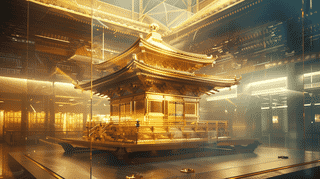
What the Golden Hall Shelter Hall Is
The Golden Hall Shelter Hall (金色堂覆堂, Konjikidō Ōidō) is a mid-Muromachi-period wooden Ōidō in the Chūson-ji temple grounds in Hiraizumi Town, Iwate Prefecture, which protected the Konjikidō (Golden Hall) from wind and snow until a concrete replacement was completed in 1965, and it was designated an Important Cultural Property on April 5, 1917.
An ōidō is a building raised over another building to enclose and protect it. Old records also call this one a sayadō, a "scabbard hall", because it sheathed the Golden Hall the way a scabbard sheathes a blade. Today it is known as the Former Shelter Hall: the Golden Hall stayed where it was, and it was the Golden Hall Shelter Hall that moved, to a new site northwest of its original position.
The Golden Hall Shelter Hall measures five bays by five bays (Ketayuki and Harima), has a single story, and is roofed in the pyramidal Hōgyō-zukuri form with copper sheet (Dōban-buki). It belongs to Konjikiin and is managed by the religious corporation Chūson-ji.
History and Significance of the Golden Hall Shelter Hall
Rain screens first, then a full shelter
When its ridgepole went up in 1124, the Golden Hall stood in the open. Chūson-ji reports that recent research suggests a simple roof was put over it about 50 years later, and that this grew through several rounds of alteration into a true shelter hall. The Agency for Cultural Affairs' draft World Heritage nomination states that the Kamakura shogunate built a shelter in 1288, a century after the fall of the Ōshū Fujiwara, as a memorial to the clan; Chūson-ji gives the same year in its own account.
The present Golden Hall Shelter Hall is a later rebuilding. The national database dates it to the middle Muromachi period, and the nomination draft places it around the 15th century on stylistic grounds.
Roof changes and the move
The roof covering of the Golden Hall Shelter Hall has changed repeatedly. According to the nomination draft, thatch gave way to pantiles in 1890, pantiles to copper in 1897, and copper back to pantiles in 1916. The building was fully dismantled and repaired in 1930 and 1931, and in 1950 the roof went back to copper because of the weight of snow.
The turning point came with the major Shōwa-era repair of the Golden Hall. In 1963 the shelter hall was itself completely dismantled and repaired. Because the aging wooden structure was thought to pose a risk to the Golden Hall, the Golden Hall was placed in a new reinforced concrete shelter, and the old one was moved about 90 meters to the northwest.
Japan's oldest surviving shelter hall
A shelter hall takes the weather so that the building inside does not, which means it is repaired and replaced again and again; old examples rarely survive. The nomination draft describes the Golden Hall Shelter Hall as the oldest surviving shelter hall in Japan and a key example of the traditional method of protecting fragile timber buildings from wind and snow. That rarity is why it is protected as an Important Cultural Property.
What to Look for at the Golden Hall Shelter Hall
An interior without columns
According to the nomination draft, the Golden Hall Shelter Hall has an open front and no interior columns at all: the roof rests only on the perimeter posts. That was what it took to fit the whole Golden Hall inside, and it leaves a clear space five bays square. Looking in from the front gives you a sense of how large the Golden Hall's former enclosure was.
The dim hall Bashō entered
Chūson-ji records that writers such as the poet Matsuo Bashō, as well as the warlord Date Masamune and the Meiji Emperor, stepped into this dim hall to pray before the Golden Hall. When Bashō came to Hiraizumi in 1689 he wrote "Samidare no / furinokoshite ya / hikaridō" ("Have the early summer rains / left it untouched, / the Hall of Light?"). The Hall of Light is the Golden Hall, and the Golden Hall he saw stood inside the Golden Hall Shelter Hall.
Two shelters, side by side in time
The Golden Hall now sits behind glass inside the reinforced concrete shelter built in 1965, with climate control. Walking out of that modern enclosure and over to the timber Golden Hall Shelter Hall shows how the same job was done some 600 years apart. The pyramidal roof reads best from a few paces back.
Visiting the Golden Hall Shelter Hall
The Golden Hall Shelter Hall is one of the four ticketed sites at Chūson-ji, covered by the same ticket as the Konjikidō, the Sankōzō Museum and the Sutra Repository. There is no ticket for the shelter hall alone.
It stands northwest of the Golden Hall, near the Sutra Repository: after seeing the Golden Hall, leave the concrete shelter and walk northwest. Chūson-ji's official guidance gives no specific photography rule for the Golden Hall Shelter Hall, so follow the signs on site. Hours and directions to the temple are gathered on the Chusonji Temple page.
- 📍 Plan Your Visit to Iwate
- Find tours, activities & transport passes near Golden Hall Shelter Hall
- [ Visit Hiraizumi & Chusonji Temple World Heritage ]
Q&A
- When was the Golden Hall Shelter Hall built, and when was it designated?
- The present Golden Hall Shelter Hall dates from the middle Muromachi period and is thought to have been rebuilt around the 15th century; a shelter was first built by the Kamakura shogunate in 1288. It was designated an Important Cultural Property on April 5, 1917.
- How is the Golden Hall Shelter Hall different from the current shelter?
- The Golden Hall Shelter Hall is the old wooden one that enclosed the Golden Hall until the reinforced concrete shelter was completed in 1965. The Golden Hall now sits behind glass in the new shelter, and the old hall was moved about 90 meters northwest.
- Why is the Golden Hall Shelter Hall an Important Cultural Property?
- Shelter halls wear out protecting what is inside, so few old ones survive. The Agency for Cultural Affairs' nomination draft calls the Golden Hall Shelter Hall the oldest surviving shelter hall in Japan and an example of a traditional way to protect fragile buildings.
- Do I need a ticket to see the Golden Hall Shelter Hall?
- Yes. The Golden Hall Shelter Hall is included in the joint ticket with the Konjikidō, Sankōzō Museum and Sutra Repository (1,000 yen for adults); there is no separate ticket.
- Did Matsuo Bashō see the Golden Hall inside the Golden Hall Shelter Hall?
- Yes. Chūson-ji records that Bashō and other visitors, including Date Masamune, entered the dim Golden Hall Shelter Hall to pray before the Golden Hall. Bashō visited Hiraizumi in 1689.
Basic Information
| Name | Golden Hall Shelter Hall (金色堂覆堂) |
|---|---|
| Location | Hiraizumi, Hiraizumi Town, Nishiiwai District, Iwate Prefecture (within the Chūson-ji grounds) |
| Designation | Important Cultural Property (Building) |
| Year Designated | 1917 |
| Quantity | 1 building |
| Dimensions | 5 bays by 5 bays (measured dimensions are not listed in the Agency for Cultural Affairs database) |
| Owner | Konjikiin (managed by the religious corporation Chūson-ji) |
| Public Access | Open (joint ticket with the Konjikidō, Sankōzō Museum and Sutra Repository; 1,000 yen for adults) |
References
- Database of National Cultural Properties: Konjikido Oido (Agency for Cultural Affairs)
- https://kunishitei.bunka.go.jp/bsys/maindetails/102/110
- Hiraizumi World Heritage Nomination (Draft), Council for Cultural Affairs material (Agency for Cultural Affairs, Japanese)
- https://www.bunka.go.jp/seisaku/bunkashingikai/bunkazai/sekaitokubetsu/17/pdf/shiryo_2_4.pdf
- Cultural Properties of Hiraizumi: Buildings (Hiraizumi Town World Heritage Promotion Office)
- https://www.town.hiraizumi.iwate.jp/heritage/property/kenzou.html
- Chusonji Temple: Guide to the Precinct (Japanese)
- https://www.chusonji.or.jp/around/index.html
- Chusonji Temple: English Guide and Admission Fees
- https://www.chusonji.or.jp/language_en/index.html
Last verified: 2026.10.05