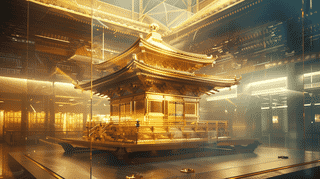
What the Chusonji Temple Sutra Repository Is
The Chusonji Temple Sutra Repository (中尊寺経蔵, Chūson-ji Kyōzō) is a late Heian-period sutra hall standing just northwest of the Konjikidō (Golden Hall) inside the Chūson-ji temple grounds in Hiraizumi Town, Iwate Prefecture, and it was designated an Important Cultural Property on April 23, 1908.
A Kyōzō is a building made to store and protect Buddhist scriptures. According to Chūson-ji, this one held the sutra sets commissioned by the first three lords of the Ōshū Fujiwara clan, Kiyohira, Motohira and Hidehira: a complete Buddhist canon written in alternating gold and silver characters, a second canon written entirely in gold, and a gold-lettered Lotus Sutra, all copied onto paper dyed deep indigo. The temple notes that a gold-lettered canon was a project that, even in the capital, only members of the imperial family and the highest nobility could undertake.
The building itself is small: three bays by three bays in plan (Ketayuki and Harima), about 7.72 meters on each side, single-storied, with a pyramidal Hōgyō-zukuri roof clad in copper sheet (Dōban-buki) and a one-bay Kōhai porch projecting from the front. It belongs to Daichōjuin and is managed by the religious corporation Chūson-ji.
History and Significance of the Chusonji Temple Sutra Repository
Two tiled stories, then one under copper
Kiyohira's dedication text for the temple, the Chūson-ji Konryū Kuyō Ganmon, describes the sutra repository as a two-storied building roofed with tiles. The Chusonji Temple Sutra Repository you see today has one story and a copper roof.
Chūson-ji explains the change through a long-held tradition that the upper story burned in the fire of 1337, and it suggests that the hall was then rebuilt using the old timbers. That fire is recorded in the inscription on the bell of the former belfry, and it destroyed many of the temple's halls and treasures.
What the ridge tags say
The Agency for Cultural Affairs' draft World Heritage nomination goes further on dates. It states that ridge tags show the sutra repository was completed in 1122 as a two-storied building, and that the present hall was rebuilt around the 14th century using only members from the lower story. The two ridge tags (munafuda) included in the national designation as attached items are part of that record.
The nomination's account fits Chūson-ji's tradition of the upper story being lost in 1337. The temple itself, however, does not give a founding year, and Hiraizumi Town says only that the repository went up at about the same time as the Golden Hall. The date of 1122 is the one the nomination draft derives from the ridge tags.
Care continued after the rebuilding. The nomination draft records a repair in 1304, a change from thatch to pantiles in 1893, a switch to copper in 1950, and a full dismantling and repair in 1978.
Hiraizumi Town describes the repository as built at roughly the same time as the Konjikidō and later reconstructed into its present form. Recent dendrochronological dating has confirmed that some of its structural members are original timbers from the first building, physical support for the reuse of lower-story members that the nomination describes. The Konjikidō, built in 1124, is the only structure at Chūson-ji to keep its 12th-century form intact; the sutra repository changed shape, yet it still carries wood from the founding period inside its frame.
A hall whose contents can still be traced
The Agency for Cultural Affairs database dates the Chusonji Temple Sutra Repository to the late Heian period.
Much of the value lies in what surrounded the building's interior. Sutra shelves in seven tiers line three walls, and Hiraizumi Town reports that original paintwork can still be identified on them. The shelves once held the gold-lettered canon on indigo paper, and the principal image was a figure of Monju (Mañjuśrī), the bodhisattva of wisdom, riding a lion, known as Kishi Monju Bosatsu.
Four furnishings used inside the hall, a ceremonial platform for the officiating priest (raiban), an altar table, a gong stand and a lamp stand decorated with Raden mother-of-pearl inlay, are designated separately as the Furnishings of the Sutra Hall of Chusonji Temple. The Cultural Heritage Online commentary regards them, apart from the gong that hangs on the stand, as broadly dating from the hall's founding. Building, fittings and scriptures can all be followed, which makes this hall an unusually concrete guide to how a Heian period temple library was arranged.
Not all of the scriptures stayed in Hiraizumi. Chūson-ji records that, on the orders of Toyotomi Hideyoshi, more than 4,000 scrolls of the gold-and-silver and gold-lettered canons were carried off to Fushimi in Kyoto. Many of them are now kept at Mount Kōya and elsewhere under the name Chūson-ji sutras.
What to Look for at the Chusonji Temple Sutra Repository
See it right after the Golden Hall
A few dozen steps northwest of the Konjikidō bring you to the front of the Chusonji Temple Sutra Repository. Fresh from the gold leaf of the Golden Hall, your eyes will find the greyed timber and plain copper roof surprisingly modest. Chūson-ji itself writes that the hall's original bright colors and ornaments have been washed away by the centuries, leaving a mood that is the opposite of the Konjikidō. That contrast is the point of standing here.
The roof and the porch
Look up first. The four slopes of the hogyo-zukuri roof meet at a single point, so the square plan of the hall reads directly in the roofline. Only the central bay of the front projects forward as the porch. Picture a second story sitting on top of all this and the low, settled profile of the present Kyōzō makes more sense.
Pair the visit with the Sankōzō Museum
The original Kishi Monju Bosatsu and the gold-lettered canon from the three walls of shelving have been moved to the Sankōzō, the temple's museum within the grounds, and a newly made Kishi Monju Bosatsu now occupies the Chūson-ji Kyōzō. Seeing the scrolls and the original figure in the museum first, then returning to the repository, makes it much easier to imagine the shelves filled with sutra boxes.
Visiting the Chusonji Temple Sutra Repository
The Chusonji Temple Sutra Repository is one of the four ticketed sites at Chūson-ji, covered by the same ticket as the Konjikidō, the Sankōzō Museum and the Former Konjikidō Shelter Hall (Ōidō). There is no separate ticket for the repository alone.
The hall stands a few dozen steps northwest of the Golden Hall, and from the porch side you can study the roof and the spacing of the pillars at close range. To see the hogyo-zukuri roof all the way to its peak, step back a few paces from the front. In autumn the maples around the hall turn red, which sharpens the contrast with the grey timber.
Chūson-ji's official guidance gives no specific photography rule for the Chusonji Temple Sutra Repository and does not describe how close visitors may come to the interior, so follow the signs and staff on site. To see the scriptures and the original Kishi Monju Bosatsu that once stood inside, continue to the Sankōzō on the same ticket.
- 📍 Plan Your Visit to Iwate
- Find tours, activities & transport passes near Chusonji Temple Sutra Repository
- [ Visit Hiraizumi & Chusonji Temple World Heritage ]
Q&A
- How old is the Chusonji Temple Sutra Repository, and when was it designated?
- The Chusonji Temple Sutra Repository dates from the late Heian period. The Agency for Cultural Affairs' nomination draft says ridge tags show a two-storied repository completed in 1122, rebuilt around the 14th century with its lower-story members, and Chūson-ji links the loss of the upper story to the fire of 1337. It was designated an Important Cultural Property on April 23, 1908.
- Do I need a ticket to see the Chusonji Temple Sutra Repository?
- Yes. The Chusonji Temple Sutra Repository is included in the joint ticket for the Konjikidō, Sankōzō Museum and Former Shelter Hall (1,000 yen for adults); there is no ticket for the repository alone.
- What was kept in the Chusonji Temple Sutra Repository, and can I still see it?
- The Chusonji Temple Sutra Repository held the gold and gold-and-silver sutra canons commissioned by three generations of the Ōshū Fujiwara, with Kishi Monju Bosatsu as its principal image. The scriptures and the original figure are now in the Sankōzō Museum, and a new Kishi Monju Bosatsu stands in the repository.
- Where is the Chusonji Temple Sutra Repository within the temple grounds?
- The Chusonji Temple Sutra Repository stands just northwest of the Konjikidō, beyond the Hondō and the Sankōzō at the top of the Tsukimizaka slope.
- Can I take photos of the Chusonji Temple Sutra Repository?
- Chūson-ji's official guidance does not give a specific rule for the Chusonji Temple Sutra Repository. Check the signs on site or ask the staff.
Basic Information
| Name | Chusonji Temple Sutra Repository (中尊寺経蔵) |
|---|---|
| Location | Hiraizumi, Hiraizumi Town, Nishiiwai District, Iwate Prefecture (within the Chūson-ji grounds) |
| Designation | Important Cultural Property (Building) |
| Year Designated | 1908 |
| Quantity | 1 building (with 2 ridge tags as attached items) |
| Dimensions | About 7.72 m on each side (3 bays by 3 bays), with a 1-bay front porch |
| Owner | Daichōjuin (managed by the religious corporation Chūson-ji) |
| Public Access | Open (joint ticket with the Konjikidō, Sankōzō Museum and Former Shelter Hall; 1,000 yen for adults) |
References
- Database of National Cultural Properties: Chusonji Kyozo (Agency for Cultural Affairs)
- https://kunishitei.bunka.go.jp/bsys/maindetails/102/111
- Cultural Heritage Online: Furnishings of the Chusonji Kyozo (Agency for Cultural Affairs)
- https://online.bunka.go.jp/heritages/detail/203829
- Hiraizumi World Heritage Nomination (Draft), Council for Cultural Affairs material (Agency for Cultural Affairs, Japanese)
- https://www.bunka.go.jp/seisaku/bunkashingikai/bunkazai/sekaitokubetsu/17/pdf/shiryo_2_4.pdf
- Cultural Heritage Online: World Heritage, Chusonji (Agency for Cultural Affairs)
- https://online.bunka.go.jp/special_content/component/105
- Cultural Properties of Hiraizumi: Buildings (Hiraizumi Town World Heritage Promotion Office)
- https://www.town.hiraizumi.iwate.jp/heritage/property/kenzou.html
- Component Parts of Hiraizumi: Chusonji (Hiraizumi Town World Heritage Promotion Office)
- https://www.town.hiraizumi.iwate.jp/heritage/asset/chusonji.html
- Chusonji Temple: English Guide and Admission Fees
- https://www.chusonji.or.jp/language_en/index.html
- Chusonji Temple: Guide to the Precinct (Japanese)
- https://www.chusonji.or.jp/around/index.html
- Chusonji Temple: Highlights (Japanese)
- https://www.chusonji.or.jp/around/highlight.html
- Chusonji Temple: History (Japanese)
- https://www.chusonji.or.jp/know/history.html
- Chusonji Temple: Visiting Information (Japanese)
- https://www.chusonji.or.jp/worship/index.html
Last verified: 2026.10.05