Chusonji Temple: The Fujiwara Temple Complex of Hiraizumi
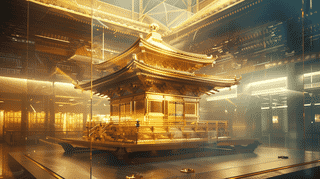
Chusonji Temple (中尊寺, Chūson-ji) is a Tendai school Buddhist temple complex in Hiraizumi Town, Iwate Prefecture, said to have been founded in 850 by the monk Ennin and greatly expanded in the early 12th century by Fujiwara no Kiyohira, whose Konjikidō (Golden Hall), raised in 1124, still stands in the grounds.
Kiyohira was the first of the Ōshū Fujiwara, a clan that governed much of northeastern Japan for nearly a century. The temple explains his purpose as consoling the spirits of everyone killed in the wars that had torn through Tōhoku in the late 11th century, friend and enemy alike, and building a peaceful land founded on Buddhist teaching. The Azuma Kagami, the official chronicle of the Kamakura shogunate, credits Chusonji at its height with more than 40 halls and pagodas and over 300 monks' residences.
The Fujiwara fell in 1189, and the fire of 1337 destroyed many of the temple's buildings and treasures. Even so, the Golden Hall and a remarkable body of Heian-period art survived, and in 2011 Chusonji became part of the World Heritage site "Hiraizumi".
The name Chusonji covers the whole hill. It is a community of temples made up of the head temple and 17 sub-temples, and it serves as the Tendai school's head temple for the Tōhoku region. That is why the historic buildings here have different owners: Konjikiin, Daichōjuin, Ganjōjuin, Shakuson-in and Hakusan Shrine.
The Historic Buildings of Chusonji Temple
Chusonji Temple keeps one National Treasure building, the Golden Hall, and five buildings and stone monuments designated as Important Cultural Properties. Hiraizumi Town lists all six as the temple's historic structures.
The grounds themselves were designated a Special Historic Site in 1979 under the name Chusonji Temple Grounds. Beneath the Kanzan hill lie the remains of the great Ōike pond, the Sanjū Pond and the two-storied Great Hall, all confirmed by excavation, and the designation also covers the Suzusawa kiln site where the temple's roof tiles are thought to have been fired.
- Konjikidō (Golden Hall): an Amida hall raised by Kiyohira in 1124 and covered in gold leaf inside and out. It is the only building at Chusonji that keeps its founding-era form, and its altar platforms hold the remains of four generations of the Ōshū Fujiwara.
- Golden Hall Shelter (Former Ōidō): the protective Ōidō built over the Golden Hall to shield it from wind and snow. Tradition credits the Kamakura shogunate with building it in 1288; the present structure is thought to date from the Muromachi period. It was moved to its current site during the Shōwa-era dismantling and repair of the Golden Hall.
- Chusonji Sutra Repository: the Kyōzō that held the sutras commissioned by three generations of the Fujiwara. It went up at about the same time as the Golden Hall and was later rebuilt as a single-story hall.
- Hakusan Shrine Noh Stage: the stage of Hakusan Shrine, the guardian shrine on the temple's north side, rebuilt by the Date clan of Sendai in 1853.
- Ganjōjuin Hōtō: a 12th-century stone pagoda standing to the right of the Mine Yakushi Hall as you face it.
- Shakuson-in Five-Ringed Pagoda: a stone gorintō carved with a date equivalent to 1169, which Hiraizumi Town identifies as the oldest dated five-ringed pagoda.
The Sankōzō, the temple museum inside the grounds, holds more than 3,000 objects left by the Fujiwara, including many of the statues, sutras and furnishings that once stood in the Sutra Repository and the Golden Hall.
Walking Through Chusonji Temple
Chusonji Temple sits on a long east-west ridge about 130 meters above sea level. Visitors start at the foot of the hill and climb the main approach, the Tsukimizaka (Moon-Viewing Slope), between cedars planted by the Date clan in the Edo period, many of them close to 300 years old. Where the trees open up on the right, the view takes in Mount Tabashine and the Kitakami and Koromo rivers, all closely tied to the Fujiwara.
At the top of the slope stands the Hondō (Main Hall), the center of the temple community, rebuilt in 1909 and housing a seated Shaka Buddha about 2.7 meters tall. Farther in lie the Sankōzō and then the Golden Hall precinct. The Sutra Repository stands just beside the Golden Hall, and the Former Ōidō has been moved nearby. In autumn the Japanese maples lining the path past the Dainichi Hall toward the Golden Hall, and those around the Sutra Repository, turn deep red.
Hakusan Shrine and its Noh stage lie deeper still, where the shrine guards the north of the temple. Once you have seen the Golden Hall area, it is worth the extra walk.
Chusonji Temple Hours, Admission and Access
The grounds of Chusonji Temple are open all year. Four places need a ticket, and one ticket covers all of them: the Golden Hall, the Sankōzō Museum, the Sutra Repository and the Former Ōidō. Hours are 8:30 a.m. to 5:00 p.m. between March 1 and November 3, and 8:30 a.m. to 4:30 p.m. between November 4 and the end of February. Ticket sales stop 10 minutes before closing.
The standard ticket costs 1,000 yen for adults, 700 yen for high school students, 500 yen for junior high school students and 300 yen for elementary school students. Groups of 30 or more get 10 percent off, and visitors with a disability certificate pay half. The temple suggests allowing 1 to 2 hours to see the grounds.
By rail, the Tōhoku Shinkansen reaches Ichinoseki in about 2 hours 20 minutes out of Tokyo, and the JR Tōhoku Line runs on to Hiraizumi in under 10 minutes. Chusonji is about 1.6 km from Hiraizumi Station; local buses and the town loop bus Runrun stop at Chūson-ji, close to the foot of the Tsukimizaka.
Drivers should leave the Tōhoku Expressway at Hiraizumi-Maesawa IC. Hiraizumi Town's No. 1 lot (about 850 m from the Hondō) and No. 2 lot (about 700 m) both charge 400 yen for a car, and the Sakanoue lot, about 240 m from the Hondō, charges 500 yen and spares you most of the climb. There are no coin lockers at the temple, so leave large bags in the lockers at Hiraizumi Station.
References
- Database of National Cultural Properties: Chusonji Kyozo (Agency for Cultural Affairs)
- https://kunishitei.bunka.go.jp/bsys/maindetails/102/111
- Database of National Cultural Properties: Chusonji Keidai (Agency for Cultural Affairs)
- https://kunishitei.bunka.go.jp/bsys/maindetails/401/165
- Cultural Heritage Online: World Heritage, Chusonji (Agency for Cultural Affairs)
- https://online.bunka.go.jp/special_content/component/105
- Component Parts of Hiraizumi: Chusonji (Hiraizumi Town World Heritage Promotion Office)
- https://www.town.hiraizumi.iwate.jp/heritage/asset/chusonji.html
- Cultural Properties of Hiraizumi: Buildings (Hiraizumi Town World Heritage Promotion Office)
- https://www.town.hiraizumi.iwate.jp/heritage/property/kenzou.html
- Chusonji Temple: English Guide, Admission Fees and FAQ
- https://www.chusonji.or.jp/language_en/index.html
- Chusonji Temple: About Chusonji (Japanese)
- https://www.chusonji.or.jp/know/index.html
- Chusonji Temple: History (Japanese)
- https://www.chusonji.or.jp/know/history.html
- Chusonji Temple: Guide to the Precinct (Japanese)
- https://www.chusonji.or.jp/around/index.html
- Chusonji Temple: Highlights (Japanese)
- https://www.chusonji.or.jp/around/highlight.html
- Chusonji Temple: Visiting Information (Japanese)
- https://www.chusonji.or.jp/worship/index.html
- Chusonji Temple: Access (Japanese)
- https://www.chusonji.or.jp/worship/access.html
- Hiraizumi Navi: Access (Hiraizumi Tourism Association, Japanese)
- https://hiraizumi.or.jp/info/access.html
Last verified: 2026.10.05
Basic Information
| Name | Chusonji Temple |
|---|---|
| Location | Hiraizumi, Hiraizumi Town, Nishiiwai District, Iwate Prefecture |
| Owner | Chusonji sub-temples and Hakusan Shrine |
| Designation | National Treasure (1) · Important Cultural Property (5) · Historic Sites, Places of Scenic Beauty, and Natural Monuments (1) |
| Coordinates | 39.00175, 141.09990 |