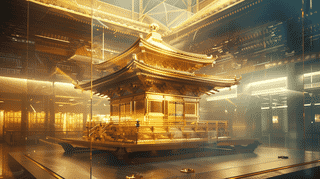
What the Hakusan Shrine Noh Stage Is
The Hakusan Shrine Noh Stage (白山神社能舞台, Hakusan Jinja Nōbutai) is a late Edo-period Noh theater completed in 1853 just south of the halls of Hakusan Shrine, the guardian shrine on the north side of the Chūson-ji temple grounds in Hiraizumi Town, Iwate Prefecture, and it was designated an Important Cultural Property on May 30, 2003.
The Hakusan Shrine Noh Stage has three parts: a combined stage-and-dressing-room building, a hashigakari bridgeway, and a kagami no ma (mirror room) where actors prepare before entering. The main building runs east to west under a thatched hip-and-gable roof, with the stage in the western half and the dressing room in the eastern half. From its north side the bridgeway runs northeast to the mirror room, which sits beside the shrine buildings. The stage belongs to Hakusan Shrine.
The Agency for Cultural Affairs regards it as, in effect, the only complete early modern Noh theater surviving in eastern Japan, with a stage of full, orthodox scale and all of its supporting structures intact.
History and Significance of the Hakusan Shrine Noh Stage
A guardian shrine and its monk performers
According to the Agency's commentary, the origins of Hakusan Shrine are unclear, but the Azuma Kagami entry for 1189 mentions a Hakusan shrine enshrined to the north, so it existed by the late Heian period. Chūson-ji's own tradition holds that the monk Ennin, who founded the temple in 850, enshrined the deity here to guard its northern side.
In the Edo period the shrine festival, held on the first Day of the Horse in the fourth month, became one of the most important events in Chūson-ji's year, and its sacred Noh was learned and performed by the monks of the temple community themselves. Temple tradition says that when Date Masamune toured Chūson-ji in 1618 he replaced the old dengaku performances with sarugaku Noh and had new costumes and masks made.
Fire and rebuilding
The shrine buildings collapsed in the great earthquake of 1646 and were rebuilt with help from the Date domain of Sendai, but fire destroyed them in 1849. The present Hakusan Shrine Noh Stage went up after that fire; rebuilding records kept at Chūson-ji indicate it was completed in 1853, and the temple credits the Date domain with the work.
The only complete early modern Noh theater in eastern Japan
The Hakusan Shrine Noh Stage was designated for its high historical value and for its marked regional character. The Agency points to its orthodox, full-scale stage, its complete set of bridgeway, mirror room and dressing room, and its original touches in design and function, and it values the stage as the setting for performing arts that have continued on Chūson-ji's hill without a break since the Edo period.
What to Look for at the Hakusan Shrine Noh Stage
A stage three kyōma bays square
The stage itself is a square 5.9 meters on a side, three bays in the Kyoto measuring system. Its front faces west, and the north side, facing Hakusan Shrine, serves as the side front. A railed seating area for the chorus lies to the south and the musicians' area to the east. Four square corner posts carry the roof, and above the stage the underside of the roof structure is left exposed.
A painted panel turned around
The back wall behind the musicians carries the usual old pine and young bamboo. The Agency's commentary explains that this painting was made in 1947 by the Noh artist Matsuno Sōfū on the reverse of the original panel. The original stage-side face now looks toward the dressing room and, according to the commentary, was never painted.
Under the floor and overhead
Some Noh stages have large jars set beneath the floor to shape the sound of stamping feet. The Hakusan Shrine Noh Stage has no jars; instead the ground beneath it is dug out in a bowl shape. Take in the whole run of the building as well: the heavy thatched roof, and the bridgeway angling off northeast toward the mirror room.
Visiting the Hakusan Shrine Noh Stage and Seeing a Performance
The Hakusan Shrine Noh Stage stands at Hakusan Shrine on the north side of the Chūson-ji grounds, beyond the Golden Hall area. It is not one of the ticketed sites, so you can walk up to the stage and view it from outside.
Chūson-ji says that the monks of the temple community still offer the ritual dance Kojitsu Shiki Sanban and sacred Noh at the shrine festival every year on May 4 and 5, and Hiraizumi Town adds a performance on November 3. On the evening of August 14, the midsummer Bon period by the old calendar, the stage hosts the Chūson-ji Takigi Noh, with Kita-school Noh and Izumi-school kyōgen performed by firelight. Unlike many torchlit Noh events, it uses a permanent historic stage ringed by cedars. Programs and viewing arrangements can change from year to year, so check the temple's event calendar. Hours and directions to the temple are gathered on the Chusonji Temple page.
- 📍 Plan Your Visit to Iwate
- Find tours, activities & transport passes near Hakusan Shrine Noh Stage
- [ Visit Hiraizumi & Chusonji Temple World Heritage ]
Q&A
- When was the Hakusan Shrine Noh Stage built, and when was it designated?
- The Hakusan Shrine Noh Stage was rebuilt after a fire in 1849 and completed in 1853. It was designated an Important Cultural Property on May 30, 2003.
- What makes the Hakusan Shrine Noh Stage special?
- It is a full-scale early modern Noh theater that keeps its bridgeway, mirror room and dressing room, and the Agency for Cultural Affairs calls it effectively the only complete example in eastern Japan. It is also valued as a stage in continuous use at Chūson-ji since the Edo period.
- When can I see Noh at the Hakusan Shrine Noh Stage?
- According to Chūson-ji, monks perform Kojitsu Shiki Sanban and sacred Noh at the Hakusan Shrine Noh Stage every May 4 and 5, and Hiraizumi Town lists a performance on November 3. The Chūson-ji Takigi Noh is held there on the evening of August 14.
- Is there a fee to see the Hakusan Shrine Noh Stage?
- The Hakusan Shrine Noh Stage is not one of Chūson-ji's ticketed sites. You can walk to Hakusan Shrine on the north side of the grounds and view the stage from outside.
- When was the pine painting on the Hakusan Shrine Noh Stage made?
- The old pine and young bamboo on the Hakusan Shrine Noh Stage were painted in 1947 by the Noh artist Matsuno Sōfū, on the reverse of the original back panel.
Basic Information
| Name | Hakusan Shrine Noh Stage (白山神社能舞台) |
|---|---|
| Location | Hiraizumi, Hiraizumi Town, Nishiiwai District, Iwate Prefecture (within the Chūson-ji grounds) |
| Designation | Important Cultural Property (Building) |
| Year Designated | 2003 |
| Quantity | 1 building |
| Dimensions | Stage and dressing room 14.9 m by 5.9 m; bridgeway 9.8 m by 5.0 m; mirror room 8.9 m by 3.9 m |
| Owner | Hakusan Shrine |
| Public Access | Exterior viewable from the grounds (no ticket needed); sacred Noh on May 4 and 5, Takigi Noh on August 14 |
References
- Database of National Cultural Properties: Hakusan Jinja Nobutai (Agency for Cultural Affairs)
- https://kunishitei.bunka.go.jp/bsys/maindetails/102/1937
- Cultural Heritage Online: Hakusan Jinja Nobutai (Agency for Cultural Affairs)
- https://online.bunka.go.jp/heritages/detail/186086
- Cultural Properties of Hiraizumi: Buildings (Hiraizumi Town World Heritage Promotion Office)
- https://www.town.hiraizumi.iwate.jp/heritage/property/kenzou.html
- Chusonji Temple: Guide to the Precinct (Japanese)
- https://www.chusonji.or.jp/around/index.html
- Chusonji Temple: Annual Events (Japanese)
- https://www.chusonji.or.jp/event/index.html
Last verified: 2026.10.05