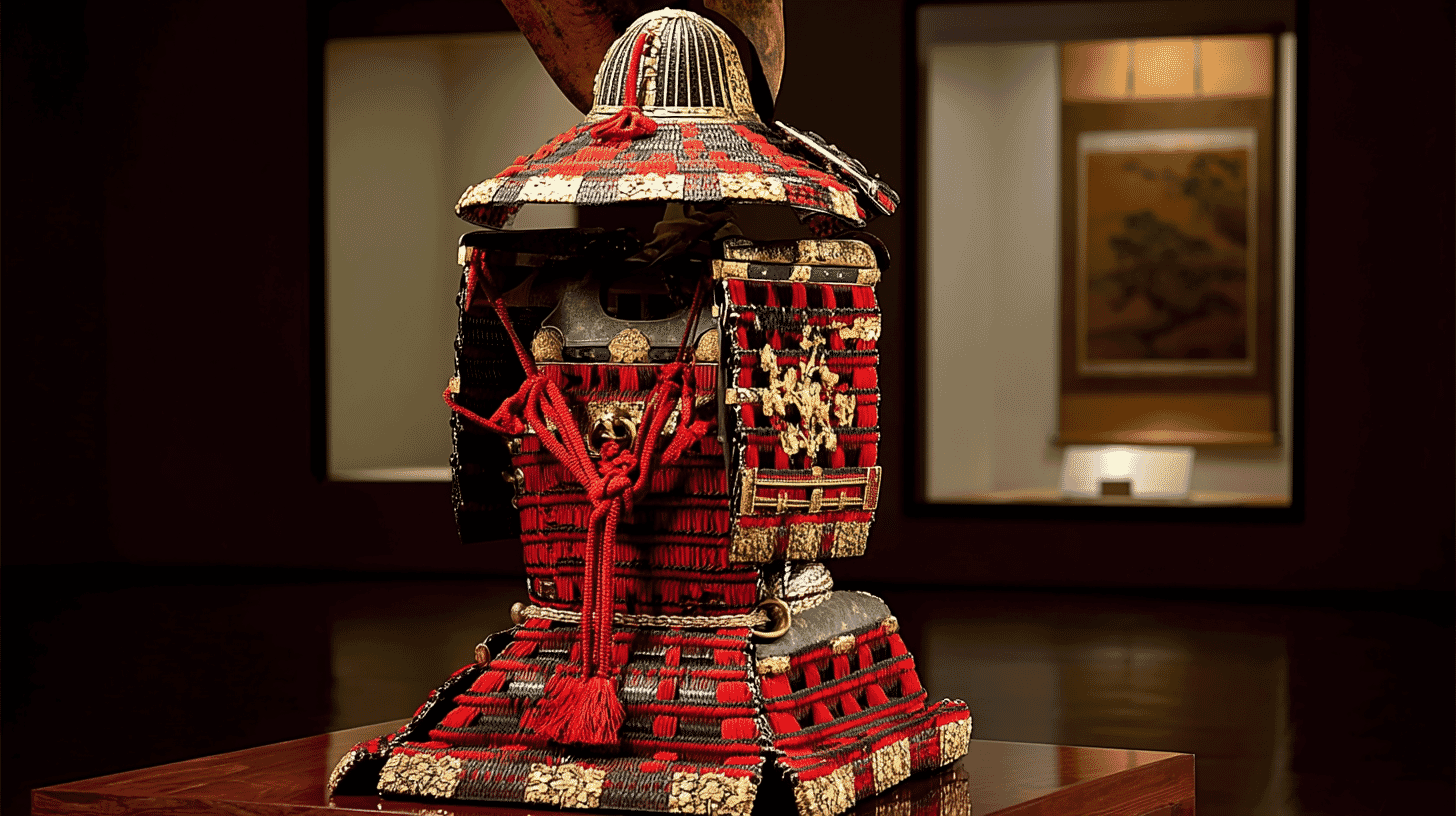
Red-Laced Armor (Akaito Odoshi Yoroi): A Masterpiece of Japanese Samurai Craftsmanship

Deep in the northern reaches of Japan's main island, within the solemn cedar groves of Kushihiki Hachimangu Shrine in Hachinohe, Aomori Prefecture, rests one of the most magnificent suits of samurai armor ever created. Known formally as the Akaito Odoshi Yoroi (赤糸威鎧), and affectionately called the "Kiku Ichimonji Armor" for its resplendent chrysanthemum-and-single-stroke gold ornamentation, this National Treasure represents the pinnacle of Kamakura-period metalwork and armor craftsmanship.

Designated as a National Treasure of Japan in 1953, this remarkable ō-yoroi (great armor) is celebrated alongside the red-laced armor at Kasuga Grand Shrine in Nara as one of the two finest surviving examples of ornamental Japanese armor. For anyone fascinated by samurai heritage, medieval Japanese artistry, or the intersection of martial tradition and fine craft, a visit to see this extraordinary artifact is an unforgettable experience.

What Is the Akaito Odoshi Yoroi?

The Akaito Odoshi Yoroi is a grand armor (ō-yoroi) dating from the late Kamakura period (late 13th to early 14th century). The term "akaito odoshi" refers to its lacing technique: small armor scales (kozane) coated in black lacquer are threaded together with vivid red braided cords dyed with madder root, producing the armor's striking crimson appearance.

What truly sets this armor apart, however, is its astonishingly lavish metalwork. Virtually every surface is adorned with gilt bronze (kondō) fittings featuring elaborate chrysanthemum motifs. The helmet (kabuto) bears imposing horn-shaped crests (ōkuwagata) atop a decorative crest plate (kuwagata-dai), while the large shoulder guards (ōsode) and other components are covered with ornamental fittings depicting chrysanthemum branches set against bamboo fences, along with the bold character for "one" (一). This combination of chrysanthemum and the character "ichi" gives the armor its beloved nickname: "Kiku Ichimonji" — Chrysanthemum One-Character armor. The meaning behind the "one" character remains a scholarly mystery, adding an intriguing layer of enigma to this masterwork.

Why Was It Designated a National Treasure?

The Akaito Odoshi Yoroi earned National Treasure status for several compelling reasons that reflect both its artistic and historical significance.

First, the sheer artistry of its metalwork is unmatched. The gold-plated bronze fittings covering the armor represent the absolute peak of Kamakura-period metalworking techniques, employing high-relief carving (takaniku-bori) and openwork (sukashi-bori) engraving to create chrysanthemum patterns of extraordinary delicacy and precision. The official cultural property database notes that the design is exquisitely refined and the technique superbly accomplished, fully embodying the hallmarks of Kamakura-era decorative metalwork.

Second, the armor exemplifies a fascinating transitional moment in Japanese military history. While it follows the classic ō-yoroi form designed for mounted archery combat, certain features — such as the narrower torso and thinner, smaller armor scales — reflect a period when battlefield tactics were shifting toward hand-to-hand combat with swords and polearms. The extreme degree of ornamentation suggests the armor had transcended practical use, serving instead as a ceremonial or votive piece, which is a significant characteristic of late Kamakura-period armor.

Third, its remarkable state of preservation is extraordinary for an artifact over seven centuries old. The red lacing, golden fittings, and structural integrity all survive in remarkably fine condition, allowing visitors to appreciate the armor almost as its original creators intended.

Historical Background and Legendary Provenance

According to shrine tradition, this armor was once the personal possession of Emperor Chōkei, the third emperor of the Southern Court during the turbulent Nanboku-chō period (14th century) and a grandson of Emperor Go-Daigo. It is said to have been bestowed upon the Nanbu clan, the powerful samurai family who governed the region for centuries.

The armor's first documented recognition as an object of exceptional value came in 1788, when the geographer and travel writer Furukawa Koshōken accompanied shogunate inspectors on a tour of northern Japan. In his travelogue Tōyū Zakki (Eastern Travel Miscellany), he described the treasures of Kushihiki Hachimangu with admiration, declaring them the finest collection of genuine antiquities he had encountered since departing Edo (present-day Tokyo). He marveled at the armor's all-gold bronze fittings, noting that their brilliance seemed to illuminate the surroundings.

The armor was first officially recognized as a cultural treasure in 1915 under the old National Treasures preservation system, and then elevated to National Treasure status under the Cultural Properties Protection Act in 1953.

Highlights and What to Look For

When viewing the Akaito Odoshi Yoroi in person, several features deserve special attention.

The helmet (kabuto) is a star-riveted bowl (hoshi-bachi) assembled from black-lacquered iron plates with 24 rows of decorative rivets. Its brow plate supports a magnificent chrysanthemum-branch crest plate upon which powerful horn-shaped crests are mounted, creating an imposing silhouette that would have been awe-inspiring on the battlefield.

The large shoulder guards (ōsode) are perhaps the most visually striking element, their surfaces completely covered with gilt bronze fittings depicting chrysanthemums and bamboo fences with the character "one" boldly placed on top — the feature that gives the armor its famous name.

Throughout the entire suit, the leather portions feature painted designs of lions and peonies, while the vivid red madder-dyed braided cords create a dramatic contrast against the gleaming gold and somber black lacquer. The overall effect is one of breathtaking opulence, making it clear why this armor is universally regarded as one of the two supreme examples of ornamental samurai armor in existence.

Be sure also to view the second National Treasure housed at the shrine: the Shiroito Odoshi Tsumadori Yoroi (White-Laced Armor with Multicolored Corner Patterns) from the Nanboku-chō period, as well as three Important Cultural Property armors and historic bugaku dance masks. The contrast between the resplendent red armor and the refined elegance of the white-laced armor provides a fascinating study in how aesthetic sensibilities evolved across the medieval period.

Kushihiki Hachimangu Shrine: A Cultural Treasure in Its Own Right

The shrine that houses these extraordinary artifacts is itself steeped in history. Kushihiki Hachimangu was founded in 1222 when the samurai lord Nanbu Mitsuyuki, granted control of the Nukanobu region as reward for his role in defeating the Ōshū Fujiwara clan, enshrined the Hachiman deity from his home province of Kai (present-day Yamanashi Prefecture). For over 800 years, the shrine has served as the chief guardian shrine (sōchinnju) of the Nanbu domain.

The shrine's main hall (honden) and four other buildings, constructed between 1645 and 1648 by the Nanbu lord Shigenao, are designated as National Important Cultural Properties, representing valuable examples of early Edo-period shrine architecture. The grounds, spanning approximately 53,000 square meters, are shaded by ancient cedar trees hundreds of years old, and the entire complex exudes a serene and spiritual atmosphere that visitors describe as genuinely moving.

Also on the grounds is the Meiji Kinenkan (Meiji Memorial Hall), the oldest surviving Western-style building in Aomori Prefecture, originally built in 1881 as a school auditorium and relocated to the shrine in 1962.

The National Treasure Hall (Kokuhōkan)

The National Treasure Hall, which opened its current facility in March 2007, provides a modern, well-designed environment for appreciating these irreplaceable artifacts. The hall stores and displays 25 cultural properties in total, including the two National Treasure armors, three Important Cultural Property armors, nine bugaku masks, a sword, and two bronze waniguchi bells.

Audio guides are available in both Japanese and English, making the collection accessible to international visitors. The spacious layout allows you to examine the armors from multiple angles and appreciate the incredible detail of their craftsmanship at close range. Visitors can also try on replica samurai armor and miko (shrine maiden) attire for photographs — a unique hands-on experience that brings the samurai era vividly to life.

Exploring the Hachinohe Area

A visit to Kushihiki Hachimangu pairs perfectly with exploring the wider Hachinohe area, which offers a rich mix of cultural, culinary, and natural attractions.

Hachinohe is home to all three of Aomori Prefecture's National Treasures. Besides the two armors at Kushihiki Hachimangu, you can see the Gasshō Dogū (Praying Clay Figurine) from the Jōmon era at the Hachinohe City Korekawa Jōmon Museum — a fascinating companion piece from an entirely different epoch of Japanese cultural heritage.

History enthusiasts will also enjoy the Nejō Castle ruins, a National Historic Site where buildings from the Muromachi period have been faithfully reconstructed, offering a glimpse into medieval samurai life in northern Japan.

For culinary adventures, the Hasshoku Center is a massive indoor market spanning 170 meters, where approximately 60 vendors sell fresh seafood, local produce, and regional specialties. Visitors can purchase ingredients and grill them on charcoal braziers in the market's Shichirin-mura area. The Miroku Yokochō alley district in the city center provides an atmospheric setting for sampling local dishes such as senbei-jiru (cracker soup) and fresh sashimi.

Nature lovers should not miss the Tanesashi Coast, part of the Sanriku Fukko National Park. This stunning stretch of coastline features natural grass lawns extending to the water's edge, dramatic rock formations, and seasonal wildflowers. Nearby Kabushima Island, a designated Natural Monument, is the only place in Japan where you can observe the breeding of black-tailed gulls at close range.

Best Times to Visit

The National Treasure Hall is open year-round, making any season suitable for viewing the armors. However, each season brings its own advantages to a Hachinohe visit. Spring (April–May) brings cherry blossoms to the shrine grounds and marks the arrival of black-tailed gulls at Kabushima. Summer (June–August) offers pleasant coastal breezes and the vibrant Hachinohe Sansha Taisai festival in late July and early August. Autumn (September–November) paints the shrine's ancient cedars in warm tones, and the mid-September Autumn Grand Festival at Kushihiki Hachimangu features traditional horseback archery (yabusame) and other sacred ceremonies. Winter (December–March) provides a serene, uncrowded atmosphere and the chance to warm up with Hachinohe's hearty local cuisine.

📍 Plan Your Visit to Aomori
Find tours, activities & transport passes near Red Armor with Helmet and Large Sleeves
[ Discover Hirosaki Castle & Oirase Gorge Tours ]

Q&A

QIs the Akaito Odoshi Yoroi always on display?
AYes, the armor is normally on permanent display at the National Treasure Hall (Kokuhōkan) within Kushihiki Hachimangu Shrine grounds. The hall is open daily from 9:00 AM to 5:00 PM. On rare occasions, the armor may travel for special exhibitions at other museums, so it is advisable to check in advance if you are making a special trip.
QIs English-language support available at the National Treasure Hall?
AYes, audio guides in both Japanese and English are provided, allowing international visitors to fully appreciate the history and artistry of the displayed cultural properties. Visitors have also reported that shrine staff are welcoming and helpful.
QHow do I get to Kushihiki Hachimangu Shrine from Tokyo?
ATake the Tohoku Shinkansen from Tokyo Station to Hachinohe Station (approximately 2 hours 45 minutes). From Hachinohe Station, the shrine is about 10 minutes by taxi or car. Alternatively, take the Nanbu Bus to the "Kushihiki Hachimangu-mae" bus stop. If driving, the shrine is about 10 minutes from the Hachinohe Interchange on the Tohoku Expressway.
QCan I try on samurai armor at the shrine?
AYes, replica samurai armor and miko (shrine maiden) attire are available for visitors to try on and take photographs in the lobby of the National Treasure Hall (for a fee). It is a popular activity and a wonderful way to create memorable photos during your visit.
QWhat other National Treasures can I see in the Hachinohe area?
AAomori Prefecture has three National Treasures, all located in Hachinohe. In addition to the Akaito Odoshi Yoroi and the Shiroito Odoshi Tsumadori Yoroi at Kushihiki Hachimangu, you can visit the Gasshō Dogū (Praying Clay Figurine), a Jōmon-era masterpiece displayed at the Korekawa Jōmon Museum.

Basic Information

Official Name Akaito Odoshi Yoroi (Kabuto, Ōsode-tsuki) — 赤糸威鎧〈兜、大袖付〉
Common Name Kiku Ichimonji Armor (Chrysanthemum One-Character Armor)
Designation National Treasure (designated November 14, 1953; previously designated Important Art Object in 1915)
Category Craft (Armor)
Period Late Kamakura period (late 13th – early 14th century)
Dimensions Torso height: approx. 33.3 cm; Helmet bowl height: approx. 11.5 cm; Large shoulder guard height: approx. 36.4 cm
Owner Kushihiki Hachimangu Shrine
Location 3 Yawata-chō, Yawata, Hachinohe, Aomori 039-1105, Japan
National Treasure Hall Hours 9:00 AM – 5:00 PM (open daily)
Admission Adults ¥400 / Junior & Senior High School Students ¥300 / Elementary School Students ¥200 / Preschoolers Free
Access Approx. 10 min. by car/taxi from JR Hachinohe Station; Nanbu Bus to "Kushihiki Hachimangu-mae" stop; 10 min. from Hachinohe IC
Parking Large free parking lot available
Contact TEL: 0178-27-3053
Website https://www.kushihikihachimangu.com/

References

国宝館 | 櫛引八幡宮(くしひきはちまんぐう)
https://www.kushihikihachimangu.com/treasure/
赤糸威鎧 兜、大袖付 | 青森県庁ウェブサイト
https://www.pref.aomori.lg.jp/soshiki/kyoiku/e-bunka/kokuho_01.html
国宝-工芸|赤絲威鎧(菊一文字の鎧兜)[櫛引八幡宮/青森] | WANDER 国宝
https://wanderkokuho.com/201-00408/
やわたの八幡様を訪ねる | 八戸市
https://www.city.hachinohe.aomori.jp/soshikikarasagasu/shakaikyoikuka/bunka/2/5495.html
国宝「赤糸威鎧 兜、大袖付 附唐櫃」|はちのへヒストリア
https://historia8.org/cultural-property/mda13t0zajdg/
櫛引八幡宮 - Wikipedia
https://ja.wikipedia.org/wiki/櫛引八幡宮
Kushihiki Hachiman Shrine | Visit Hachinohe
https://visithachinohe.com/en/places/kushihiki-hachimangu/
Kushihiki-Hachiman-gu Shrine | Amazing AOMORI
https://aomori-tourism.com/en/spot/detail_434.html
国宝 赤絲威鎧兜・大袖付 白絲威褄取鎧兜・大袖付(櫛引八幡宮) | 旅東北
https://www.tohokukanko.jp/attractions/detail_1003245.html
赤糸威大鎧/櫛引八幡宮 | 刀剣ワールド
https://www.touken-world.jp/search-noted-armor/armor-kokuho/kushihiki-akaito/

Last verified: 2026.02.17