
Before Dawn on the Seventh of January
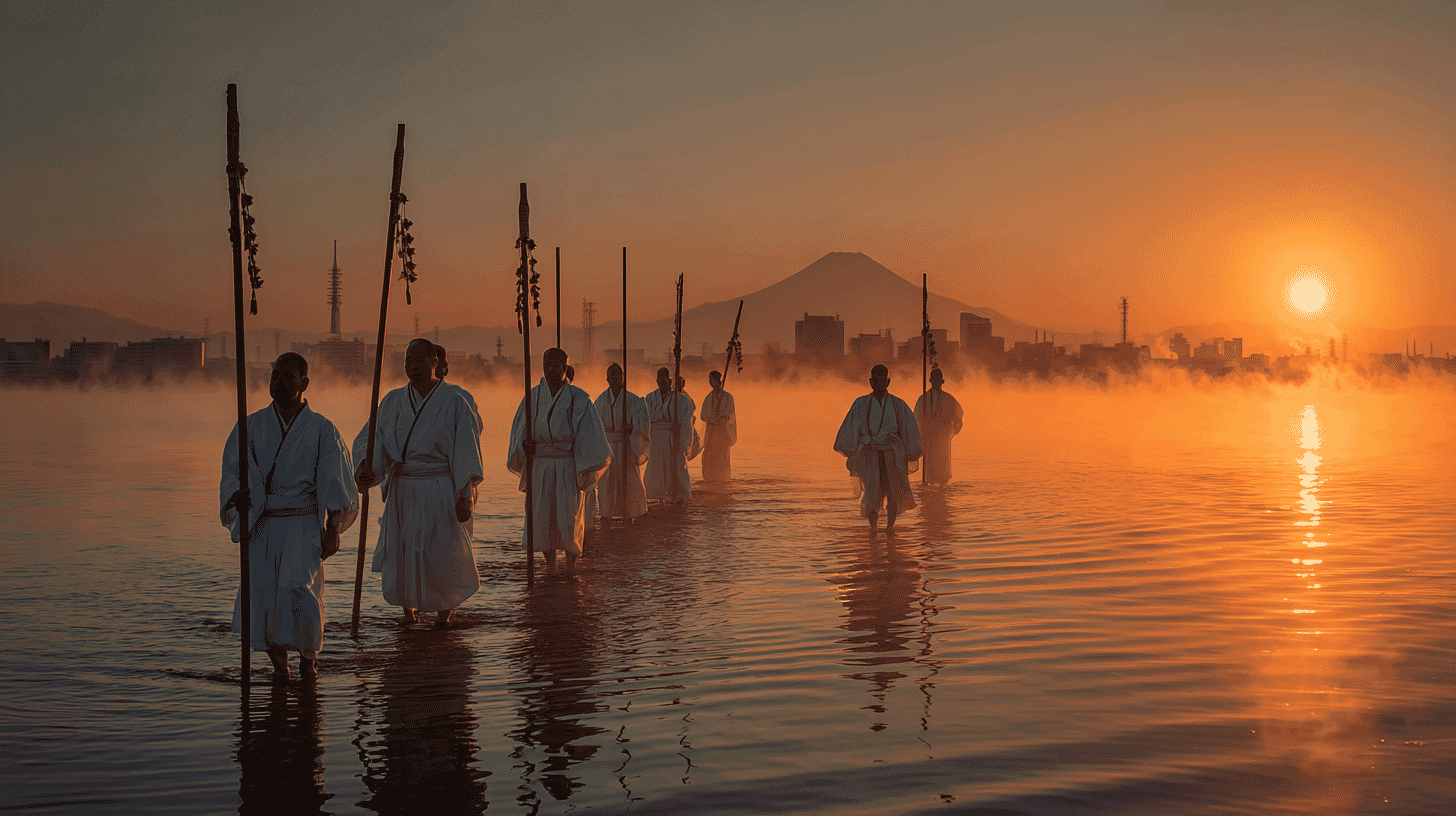
Bonten Stand in Nakajima, Kisarazu is a folk observance held before dawn around 7 January each year at Nakajima in Kisarazu City, Chiba Prefecture, selected on 25 February 1992 as an Intangible Folk Cultural Property requiring documentation. Young men of the Kaneda and Nakajima districts wade into the freezing sea and plant bonten, bamboo poles hung with paper streamers, in the water.
Those who enter the sea are the ones who have joined the ranks of the young men for the first time that year. The Agency for Cultural Affairs treats the observance as a form of coming-of-age rite. While the poles are being planted, practitioners of the Dewa Sanzan faith chant the Heart Sutra on the shore and pray for good harvests and good fishing. Two things happen at once at Bonten Stand in Nakajima, Kisarazu: men in the water, prayer on the beach.
Selected, Not Designated
The status here works differently from that of a designated property. Under the documentation-selection system, the Commissioner for Cultural Affairs selects intangible cultural properties, other than Important Intangible Cultural Properties, that particularly warrant it, and may then create, preserve and publish records of them. Kisarazu City states plainly that properties in this category are kept distinct from those designated at national, prefectural and municipal level.
So this observance is not a designated property but a selected one. Its formal category is an Intangible Folk Cultural Property for which documentation and other measures should be taken, sometimes shortened to selected intangible folk cultural property. The date of selection was 25 February 1992. The protective body is the Nakajima district; municipal records name the Nakajima District Cultural Property Preservation Society among others.
The grounds for selection lie in what the observance preserves. Chiba retains a strong Dewa Sanzan tradition, and this is one of the places where that tradition survives in concrete form, with the framework of a rite of passage into adulthood still intact.
Beginning with a Genroku Misfortune
Kisarazu City gives the origin as follows: during the Genroku years of the Edo period, a misfortune fell upon the village and was resolved through the intercession of Dewa Sanzan practitioners, and the observance began from that.
Dewa Sanzan is the collective name for Mount Haguro, Mount Gassan and Mount Yudono in Yamagata Prefecture. A faith centred on mountains far from the Boso coast took root here as a new year observance by the sea. The bonten is what carries that faith out into the water.
The sutra chanted by the practitioners is the Heart Sutra, and the prayers are for abundant crops and a good catch. Fields and fishery prayed for in the same breath: the livelihoods of this stretch of coast are written into the ritual.
Visiting
The observance is open to the public. Kisarazu City records it as public, held at the time of the festival, and there is no admission charge.
It takes place before dawn around 7 January on the shore at Nakajima in Kisarazu. The national database gives the date as 7 January each year but notes that the information dates from the time of selection and advises checking with the relevant municipal board of education before setting out. Starting times and the order of proceedings can also vary from year to year.
This is a pre-dawn event on a beach in the depths of winter, and the participants go into the water. Watching is done from the shore; keep back far enough not to interfere with the ritual or with the participants' movements. The surrounding area is also where people live.
Q&A
- When does Bonten Stand in Nakajima, Kisarazu take place?
- Before dawn around 7 January each year. The national database gives that date but notes it dates from the time of selection, so check with the city before travelling.
- Is this an Important Intangible Folk Cultural Property?
- No. It was selected as an Intangible Folk Cultural Property requiring documentation, not designated. Kisarazu City states that this category is kept distinct from properties designated at national, prefectural and municipal level.
- Who goes into the sea?
- Those who have joined the ranks of the young men for the first time that year take the central role. The Agency for Cultural Affairs treats the observance as a form of coming-of-age rite.
- What is being prayed for?
- While the poles are planted, Dewa Sanzan practitioners on the shore chant the Heart Sutra and pray for abundant crops and a good catch.
- How far back does it go?
- Kisarazu City relates that it began after a misfortune befell the village during the Genroku years of the Edo period and was resolved through the intercession of Dewa Sanzan practitioners.
Basic Information
| Name | Bonten Stand in Nakajima, Kisarazu |
|---|---|
| Location | Nakajima, Kisarazu City, Chiba Prefecture |
| Designation | Intangible Folk Cultural Property requiring documentation (nationally selected) |
| Year Designated | Selected 1992/02/25 (Heisei 4) |
| Quantity | 1 folk observance |
| Dimensions | Not applicable to an intangible property |
| Owner | Protective body: the Nakajima district |
| Public Access | Public at the time of the festival; held before dawn |
References
- Agency for Cultural Affairs, National Cultural Properties Database
- https://kunishitei.bunka.go.jp/bsys/maindetails/312/285
- Cultural Heritage Online: Bonten Stand in Nakajima, Kisarazu
- https://online.bunka.go.jp/heritages/detail/208470
- Kisarazu City: Bonten-tate at Nakajima (PDF)
- https://www.city.kisarazu.lg.jp/material/files/group/53/2-1nakijimabontedate.pdf
- Kisarazu City: Designated and Registered Cultural Properties
- https://www.city.kisarazu.lg.jp/kanko_bunka_sports/rekishi_bunkazai/shitei_torokubunkazai/index.html
Last verified: 2026.09.23