
One Box, National Treasure since 1957
Butterfly Mother-of-Pearl and Maki-E Hand Box (蝶螺鈿蒔絵手箱, Cho Raden Makie Tebako) is a Kamakura-period craft object at 2-20-12 Shirokanedai, Minato Ward, Tokyo, made an Important Cultural Property on 19 January 1931 and designated a National Treasure on 19 February 1957. The quantity is one box and the owner the Ebara Hatakeyama Memorial Foundation.
It measures 26.4 centimetres deep, 35.1 centimetres wide and 21.2 centimetres high.
19 January 1931 is the day on which the Himeji Castle corridor turrets and the tachi inscribed Masatsune also became Important Cultural Properties.
A Roman Letter Left in the Record
The field for form and condition carries a plain error.
Where the text should read butterflies, it gives a Roman letter followed by the syllables for that word in kana.
The context settles it. The title of the property names butterflies, and the preceding sentence describes the markings on their wings.
A Roman letter appears to have been left behind during input. Damage in these records has appeared before: at the Ataka and Kurohashi shell mounds a character was replaced by a substitute mark, and at the Futagoyama site one character stood in place of another.
Those errors stayed within the writing system. This one mixes in a letter from another. As a kind of damage it is new here.
This article reads the word as butterflies.
The Prefecture Field Does Not Match the Address
The location does not agree across the record either.
The heritage database gives the prefecture as Chiba and the address as 2-20-12 Shirokanedai, Minato Ward, Tokyo. Prefecture and address do not match.
The database holds both Chiba and Tokyo. The owner is a foundation whose museum stands in Minato Ward, Tokyo.
With the Inaba Tenmoku, the national database gave Marunouchi and the heritage database Setagaya, evidently because the museum had moved. With the Hirabaru finds, the record gave one municipality and other accounts another.
Here only the prefecture field disagrees with the address. Some change in where the owner or the holding facility stood may explain it, but the record does not say. This article follows the address.
Three Techniques Answering to Three Colours
The assessment is worded distinctively.
The box employs three techniques, gold burnished lacquer, mother-of-pearl inlay and flat silver inlay, to render butterflies.
It continues: the gold of the lacquer, the white of the shell and the silver of the inlay together strengthen the effect of colour.
Three techniques, three colours, in the same order. The techniques are named first, and then what colour each yields.
The Ninsei tea jar listed red, green, purple, silver and gold: five colours simply counted. Here technique and colour are set out in pairs.
The assessment closes: with its large form and fine technique, the box shows the character of the Kamakura period clearly and stands as a representative work of its time.
Seeing It
The box is at Shirokanedai, Minato Ward, Tokyo, owned by the Ebara Hatakeyama Memorial Foundation. It is a museum holding, not kept on permanent display.
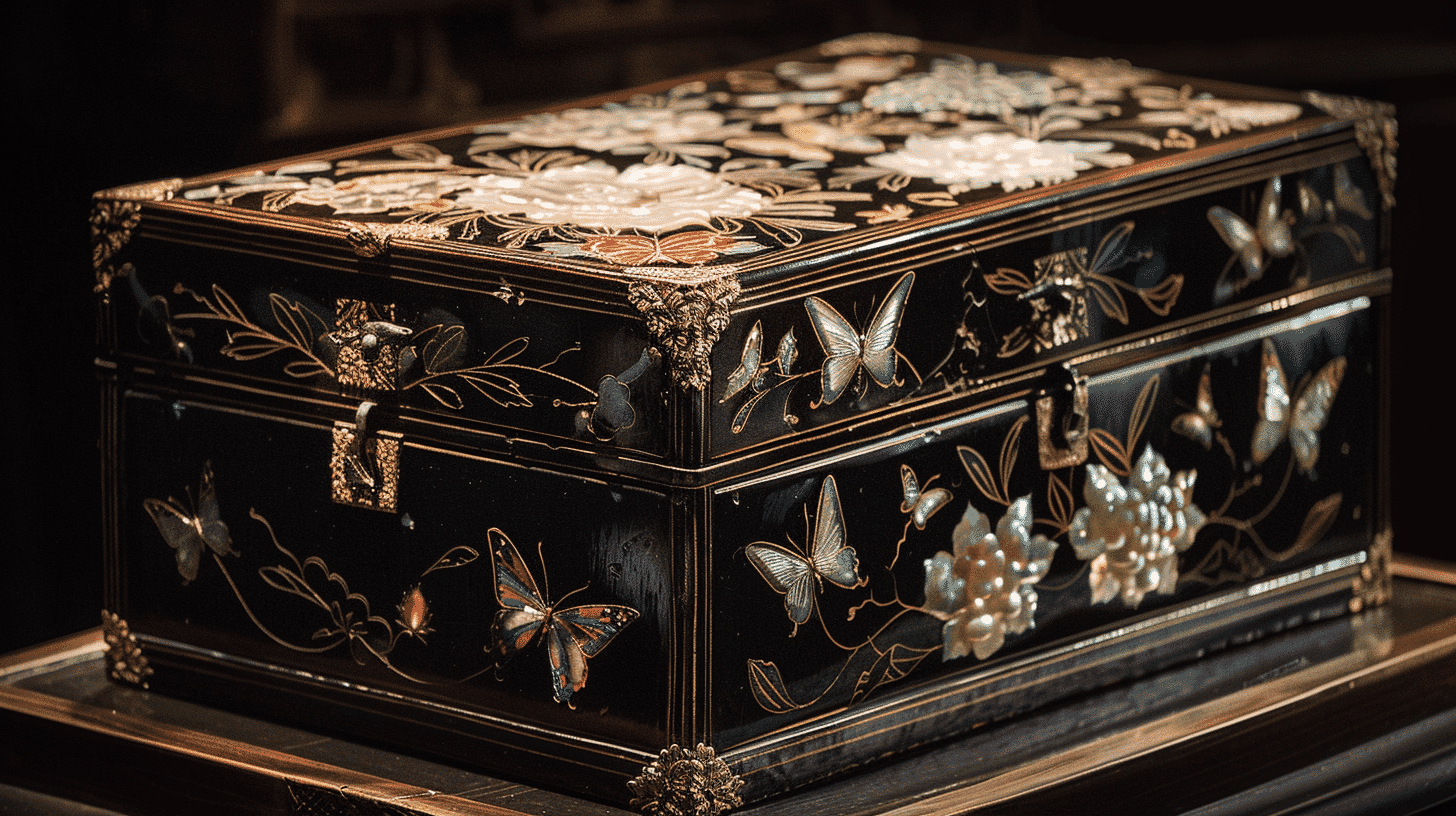
The form is described closely: a box whose lid and body meet flush, with a tin rim run around the mouth, a gently domed lid and a swelling body, gilt bronze cord fittings on the long sides, and a tray set within.
So is the ornament: peony scrollwork and butterflies across the front, with the wings themselves bearing comma patterns, small flowers, small circles and spirals. Within a single wing there is further pattern.
It extends to what cannot be seen. Butterflies dance in burnished lacquer on a pear-skin ground inside the lid and around the tray, and figured silk with peonies on a blue ground lines the body and the tray. Butterflies fly on surfaces reached only by opening the box.
The museum records an inscription on the inner box in the hand of the tea master Matsudaira Fumai. The container as well as the contents carries a record. Exhibition plans can change, so check the museum's information before travelling.
Q&A
- When was the box designated?
- It became an Important Cultural Property on 19 January 1931 and a National Treasure on 19 February 1957. The quantity is one box and the owner the Ebara Hatakeyama Memorial Foundation.
- Is there an error in the record?
- Yes. In the field for form and condition, a Roman letter stands where the word for butterflies should be, evidently left behind during input. This article reads the word as butterflies.
- Where is it kept?
- At 2-20-12 Shirokanedai, Minato Ward, Tokyo. The heritage database gives the prefecture as Chiba, which does not match the address; the record offers no explanation, and this article follows the address.
- What techniques were used?
- The Agency names three: gold burnished lacquer, mother-of-pearl inlay and flat silver inlay, adding that the gold of the lacquer, the white of the shell and the silver of the inlay strengthen the effect of colour.
- Is the inside decorated too?
- Yes. Butterflies are drawn in burnished lacquer on a pear-skin ground inside the lid and around the tray, and figured silk with peonies lines the body and tray, so butterflies fly on surfaces reached only by opening it.
Basic Information
| Name | Butterfly Mother-of-Pearl and Maki-E Hand Box (蝶螺鈿蒔絵手箱, Cho Raden Makie Tebako) |
|---|---|
| Location | 2-20-12 Shirokanedai, Minato Ward, Tokyo; the heritage database gives the prefecture as Chiba, which does not match the address |
| Designation | National Treasure (craft) |
| Year Designated | 1931 (19 January), Important Cultural Property; 1957 (19 February), National Treasure |
| Quantity | 1 box |
| Dimensions | 26.4 centimetres deep, 35.1 centimetres wide, 21.2 centimetres high. Lid and body meet flush with a tin rim around the mouth, and a tray sits within. 3 techniques are used: gold burnished lacquer, mother-of-pearl inlay and flat silver inlay. The period is Kamakura |
| Owner | Ebara Hatakeyama Memorial Foundation |
| Public Access | A museum holding, not on permanent display |
References
- Cultural Heritage Online: the butterfly hand box
- https://bunka.nii.ac.jp/db/heritages/detail/125694
- Ebara Hatakeyama Museum of Art: the butterfly hand box
- https://www.hatakeyama-museum.org/collection/lacquer/000050.html
- Ebara Hatakeyama Museum of Art official site
- https://www.hatakeyama-museum.org/
- Agency for Cultural Affairs, National Cultural Properties Database
- https://kunishitei.bunka.go.jp/
Last verified: 2026.09.05