
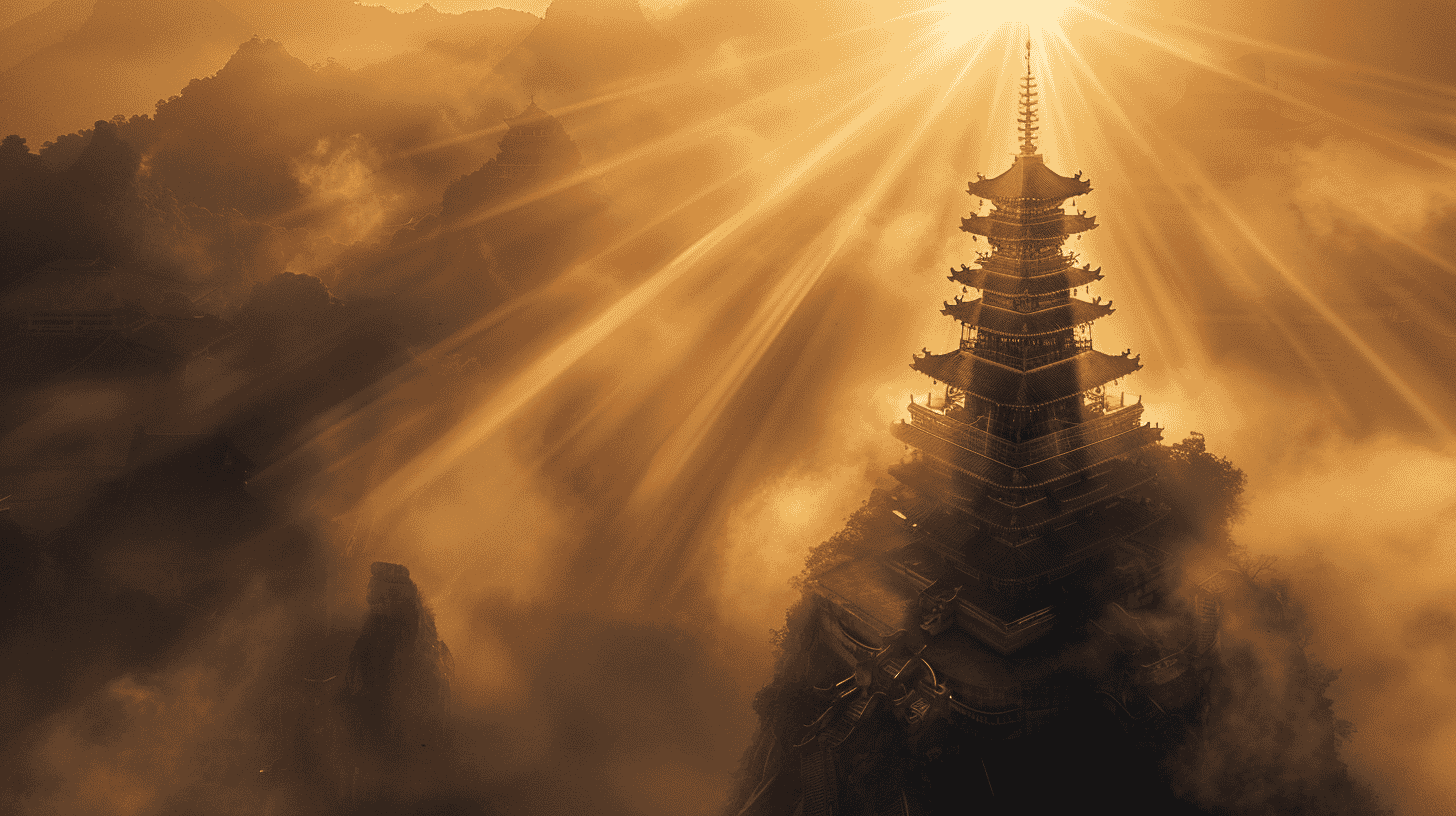
Buried treasures await eternity on a sacred mountain
In 1934, preparations for a rain prayer ceremony on Mount Narahara in Ehime Prefecture led to an extraordinary discovery. Workers clearing the summit area near the mountain shrine accidentally uncovered a cache of exquisite Buddhist artifacts buried 800 years earlier. These 42 precious objects, now designated as National Treasures of Japan, represent one of the finest examples of Heian period Buddhist material culture ever found. The discovery offers a remarkable window into medieval Japanese religious practices when aristocrats buried sacred texts and treasures on mountaintops, believing they would preserve Buddhism for billions of years until the future Buddha's arrival.
The Iyo Province Naraharayama Sutra Mound Excavated Items showcase the sophisticated artistry and deep religious devotion of 12th-century Japan. At the heart of the collection stands a magnificent 71.5-centimeter tall bronze pagoda, its surface inscribed with sacred seed mantras representing cosmic Buddhist truths. This pagoda, along with an intricately crafted bronze sutra container, mirrors decorated with cherry blossoms and mythical birds, and rare Chinese celadon boxes from the Song dynasty, tells the story of a civilization preparing for what they believed would be the end of Buddhist law.
Time capsules for 5.67 billion years
The creation of these sutra mounds emerged from a profound religious anxiety that gripped medieval Japan. Buddhist scholars calculated that the year 1052 marked the beginning of mappō, the "Final Dharma" period when Buddha's teachings would gradually disappear from the world. According to Buddhist cosmology, the bodhisattva Maitreya would descend to Earth after 5.67 billion years to revive Buddhism – a timeframe calculated with remarkable precision based on the belief that one day in Maitreya's heavenly realm equals 400 years on Earth.
This eschatological worldview transformed religious practice across Japan. No longer content with simply copying sutras in temples, aristocrats and religious communities began burying these sacred texts in bronze containers on mountain peaks believed to be future descent points for Maitreya. The Naraharayama sutra mound, created in the late 12th century, represents the pinnacle of this tradition. The bronze pagoda's seed mandala inscriptions invoke the Great Sun Buddha, while the accompanying Lotus Sutra texts – the most commonly buried scripture – were meant to preserve Buddhism's essential teachings through the dark age ahead.
The burial location itself held deep significance. Mount Narahara, rising 1,042 meters above the ancient Iyo Province, was considered a sacred peak where the boundary between earthly and heavenly realms grew thin. The careful arrangement of artifacts on stone foundations, covered with additional stones for protection, demonstrates the meticulous ritual protocols followed during burial ceremonies.
An aristocratic assembly of sacred and precious objects
The complete inventory of 42 items reveals both the religious devotion and worldly sophistication of Heian period elites. The bronze sutra container, standing 30.2 centimeters tall with its distinctive jewel-shaped knob, contained a grass-flower-butterfly-bird mirror facing inward – possibly for the buried sutras to reflect upon themselves through eternity. Five bronze mirrors in total were buried, including examples decorated with cherry blossoms and chrysanthemums paired with sparrows, demonstrating the Japanese aesthetic of combining natural motifs with religious symbolism.
Two court fans (檜扇) provide rare glimpses into secular Heian culture within this religious context. The complete fan, measuring 30.3 centimeters with 21 wooden slats and white bronze fittings, features polychrome paintings of flowering trees and human figures rendered in the distinctive Heian court style called hikime-kagibana, characterized by simple line-drawn eyes and hook-shaped noses. These fans, typically accessories of court nobles, suggest the burial was sponsored by someone of extremely high social standing.
The inclusion of Chinese Song dynasty celadon boxes demonstrates Japan's participation in international trade networks and the value placed on foreign luxury goods. These delicate blue-green glazed ceramics, imported from China's renowned kilns, would have been extraordinarily expensive and prestigious possessions. Their burial represents a significant material sacrifice made for spiritual merit.
Preserving faith through technical mastery
The exceptional preservation state of these 800-year-old artifacts testifies to the sophisticated metalworking and preservation techniques employed by Heian period craftsmen. The bronze pagoda's complex construction includes a cast bronze body, separate roof sections, a 40.3-centimeter tall finial with iron core reinforcement, and a wooden inverted flower decoration at the base. This modular design allowed for precise assembly while maintaining structural integrity through centuries of burial.
The varying materials and techniques – cast bronze with gilt details, carved wooden fan slats with mineral pigments, imported ceramics, and hand-copied sutras on specially prepared paper – represent the full range of elite craft production in 12th-century Japan. The metalwork particularly showcases advanced lost-wax casting techniques that produced fine decorative details still visible today. Multiple pottery jars and earthenware vessels likely contained offerings or additional ritual materials, though their contents have long since decomposed.
Bronze and iron bells found among the artifacts may have been rung during the burial ceremony to purify the space and summon protective deities. A gilt bronze hairpin and small knives suggest personal possessions were included, perhaps belonging to the sponsor or representing tools for copying sutras in the afterlife.
Visiting these eternal treasures today
Today, these National Treasures reside in the Tamakawa Modern Art Museum in Imabari City, where they are permanently displayed in climate-controlled conditions that ensure their preservation for future generations. The museum, located about an hour from Matsuyama, Ehime's capital, offers visitors the rare opportunity to see the complete assemblage of artifacts exactly as they were buried eight centuries ago.
The museum opens from 9:00 AM to 5:00 PM daily except Mondays, with admission at ¥520 for adults. Foreign visitors should note that exhibit labels are primarily in Japanese, so bringing a translation app or arranging for a guide enhances the experience significantly. The museum building lacks elevator access to upper floors, which may affect visitors with mobility concerns.
Getting to the museum from Matsuyama involves taking the JR Yosan Line's "Ishizuchi" Limited Express to Imabari Station (40 minutes), then local transportation to the Tamakawa area. The museum provides free parking for those driving via National Route 317. From major cities, visitors can fly to Matsuyama Airport from Tokyo (80 minutes) or take the Shinkansen to Okayama and transfer to the Shiokaze Limited Express to Imabari.
Sacred peaks and pilgrimage paths nearby
The original excavation site on Mount Narahara's summit remains accessible to determined hikers, though the ascent requires good physical condition and proper mountain gear. A 14th-century stone pagoda erected in 1371 still stands at the summit, marking the sacred space where these treasures lay hidden for centuries. The mountain offers panoramic views across the Seto Inland Sea on clear days, helping visitors understand why ancient Japanese considered such peaks as bridges to the heavenly realms.
Ehime Prefecture hosts numerous significant Buddhist sites that complement a visit to these sutra mound artifacts. Ishiteji Temple, the 51st temple on the famous 88-temple Shikoku Pilgrimage, features a National Treasure gate from 1318 and lies just 30 minutes from central Matsuyama. The pilgrimage route, associated with the Buddhist monk Kūkai (Kōbō Daishi), passes through Ehime as the "Bodai" (enlightenment) section, encompassing temples 40 through 65.
For those interested in samurai culture alongside Buddhist heritage, Oyamazumi Shrine on Omishima Island houses Japan's premier collection of National Treasure armor and weapons. Accessible via the scenic Shimanami Kaido bridge route, the shrine's treasure hall contains 80% of all designated National Treasure armor in Japan, offering fascinating parallels to the religious treasures of Naraharayama in terms of medieval craftsmanship and preservation.
Understanding the archaeological importance
The Naraharayama excavation ranks among Japan's most significant archaeological discoveries for understanding medieval Buddhist practice. These artifacts provide material evidence for the theological concepts that shaped an entire civilization's worldview, demonstrating how abstract religious ideas translated into concrete actions and objects. The sutra mound phenomenon, documented at over 2,200 sites across Japan, represents one of the world's most extensive religious archaeological legacies.
The combination of religious texts, ritual objects, luxury goods, and personal items creates a complete portrait of elite Heian period life at the intersection of Buddhism, aristocratic culture, and international trade. For archaeologists, the sealed context of the burial provides precise dating and association of objects that might otherwise be scattered across different collections. The preservation quality allows detailed study of manufacturing techniques, decorative styles, and material compositions that inform our understanding of medieval Japanese technology and aesthetics.
Modern scientific analysis continues to reveal new information about these artifacts. X-ray examination of the bronze pagoda's internal structure, chemical analysis of the ceramic glazes, and microscopic study of the painting pigments all contribute to expanding knowledge about 12th-century craft production and trade networks.
Cultural significance for modern Japan
The designation of these items as National Treasures in 1956 reflects their importance to Japanese cultural identity and historical consciousness. They embody the synthesis of Buddhist philosophy, Japanese aesthetic sensibility, and technological achievement that characterizes the Heian period's cultural flowering. The fact that medieval Japanese conceived of their religious acts as spanning billions of years reveals a temporal perspective that challenges modern notions of heritage and permanence.
For contemporary Japanese, these artifacts connect to ongoing Buddhist practices and beliefs, particularly in regions like Shikoku where pilgrimage traditions remain vibrant. The objects serve as tangible links to ancestors who shared similar spiritual concerns about preserving wisdom for future generations, even if expressed through different media today.
International visitors encountering these treasures gain insight into a uniquely Japanese response to universal human concerns about mortality, meaning, and legacy. The sutra mound tradition represents an indigenous development within Japanese Buddhism that has no direct parallel in Chinese or Korean practice, demonstrating how imported religions adapt to local contexts and concerns.
Planning your cultural journey
A comprehensive visit to the Naraharayama treasures works best as part of a broader exploration of Ehime's Buddhist heritage. Consider staying in Matsuyama to experience Dogo Onsen, one of Japan's oldest hot spring resorts, mentioned in the 8th-century Nihon Shoki chronicles. The city offers convenient access to both the Tamakawa Modern Art Museum and other cultural sites.
A suggested three-day itinerary might include: Day one exploring Matsuyama Castle and the Ehime Museum of Art; day two visiting the Tamakawa Modern Art Museum in the morning and Imabari's unique Towel Museum in the afternoon; and day three taking a cycling excursion on the Shimanami Kaido or visiting Oyamazumi Shrine's treasure hall. Spring (March-May) and autumn (September-November) provide the most comfortable weather for combining museum visits with outdoor exploration.
The Naraharayama Sutra Mound Excavated Items offer modern visitors an extraordinary encounter with medieval Japan's spiritual and material culture. These artifacts, buried with hope for Buddhism's distant future revival, have already survived 800 years – a tiny fraction of their intended 5.67-billion-year journey, yet long enough to become irreplaceable windows into a vanished world. They remind us that cultural heritage exists not just as objects in museums but as ongoing dialogues between past and present, between human aspirations and the vast scales of cosmic time that religions contemplate. For international tourists, these treasures provide an unforgettable introduction to the depth, sophistication, and spiritual intensity of Japanese Buddhist culture at its classical peak.
- 📍 Plan Your Visit to Ehime
- Find tours, activities & transport passes near Artifacts Excavated from the Naraharayama Sutra Mound in Iyo
- [ Dogo Onsen & Matsuyama Castle Relaxation Tour ]
Q&A
- Why were these artifacts buried on a mountaintop?
- In 12th-century Japan, people believed the world had entered the age of mappō (Final Dharma) starting in 1052, when Buddha's teachings would decline. Aristocrats buried sutras and treasures on sacred mountaintops to preserve Buddhism until Maitreya Buddha would descend after 5.67 billion years. Mountain peaks were considered sacred places closer to the heavenly realms.
- How do I get to the Tamakawa Modern Art Museum?
- From Matsuyama, take the JR Yosan Line's "Ishizuchi" Limited Express to Imabari Station (40 minutes), then use local transportation to the Tamakawa area. The museum is located along National Route 317 with free parking available. From Tokyo, fly to Matsuyama Airport (80 minutes) or take the Shinkansen to Okayama and transfer to Imabari.
- What is the most important artifact among the excavated items?
- The 71.5-centimeter tall bronze pagoda is the most significant piece. Its surface features engraved seed mandalas representing the Great Sun Buddha, and its complex structure—including cast bronze body, separate roof sections, and iron-reinforced finial—demonstrates the advanced metalworking techniques of the period.
- What related sites should I visit nearby?
- Visit Ishiteji Temple (51st temple of the Shikoku Pilgrimage with a National Treasure gate), Oyamazumi Shrine (housing National Treasure armor collections), and explore the Shimanami Kaido cycling route. The original excavation site on Mount Narahara's summit is also accessible for hikers with proper equipment.
References
- National Treasure - Archaeology | Iyo Province Naraharayama Sutra Mound Excavated Items [Tamakawa Modern Art Museum/Ehime]
- https://wanderkokuho.com/201-00854/
- Iyo Province Naraharayama Sutra Mound Excavated Items - Ehime Prefectural Board of Education
- http://ehime-c.esnet.ed.jp/bunkazai/kennobunkazai/shiteibunkazai/kouko/pdf-files/kuni/1-7-01naraharayamakyozuka.pdf
- Tamakawa Modern Art Museum - Visitor Information
- https://www.city.imabari.ehime.jp/museum/tamagawa/info/
- Sutra mound - Wikipedia
- https://en.wikipedia.org/wiki/Sutra_mound
- Kyozuka - Japanese Wiki Corpus
- https://www.japanesewiki.com/Buddhism/Kyozuka.html
Basic Information
| Name | Iyo Province Naraharayama Sutra Mound Excavated Items |
|---|---|
| Type | Archaeological Materials |
| Number of Items | 42 pieces |
| Period | Late Heian Period (12th century) |
| Discovery Year | 1934 (Showa 9) |
| Discovery Location | Mount Narahara summit, Tamagawa-cho, Ochi District, Ehime Prefecture (now Imabari City) |
| Collection | Tamakawa Modern Art Museum |
| Designation | National Treasure (designated 1956) |
| Major Artifacts | Bronze pagoda (height 71.5cm), bronze sutra container, 5 bronze mirrors, 2 court fans, Song dynasty celadon boxes, etc. |
Last verified: 2025.09.11