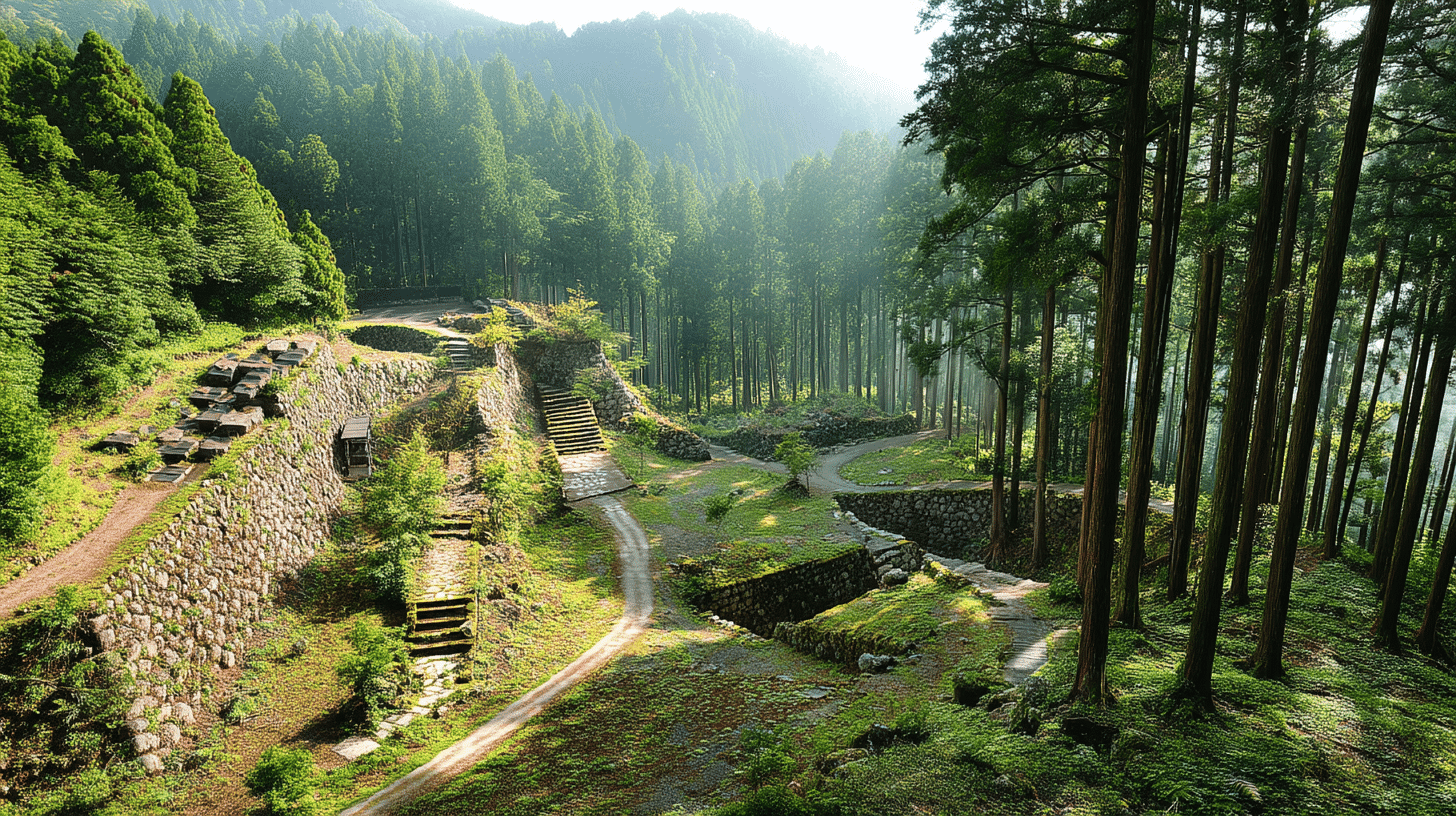
Tomyoji Temple Former Precincts: A Hidden Medieval Buddhist Sanctuary in Rural Shikoku
Nestled deep in the mountainous terrain of Kihoku Town, Ehime Prefecture, lies one of Japan's most remarkable and least-visited cultural heritage sites. The Tomyoji Temple Former Precincts (等妙寺旧境内) offers visitors a rare glimpse into the spiritual world of medieval Japan, where Buddhist monks sought enlightenment in remote mountain sanctuaries. Designated as a National Historic Site in 2008, this atmospheric archaeological site has recently been transformed into the Narayama Tomyoji Historic Park, opening its centuries-old secrets to modern travelers seeking authentic cultural experiences away from the crowds.
What is Tomyoji Temple Former Precincts?
The Tomyoji Temple Former Precincts represent the archaeological remains of a significant Tendai Ritsu Buddhist temple that flourished for 260 years during Japan's medieval period. Founded in 1320 (Genko 2) by the monk Rigyo, this mountain temple served as one of only four regional ordination platforms (四カ戒場) established throughout Japan by Kyoto's prestigious Hosshoji Temple to spread Buddhist teachings to distant provinces.
The temple complex stretches approximately 400 meters from north to south and 250 meters from east to west, situated at an elevation of about 300 meters on the northern slopes of Mount Kakko (郭公岳, 1,010m) within the Onigajo mountain range. Unlike many historical sites in Japan that have been reconstructed or heavily modified, Tomyoji's ruins remain remarkably intact, preserved by their remote location and the local reverence for this sacred ground that prevented development over the centuries.
Why Was It Designated a National Historic Site?
The Agency for Cultural Affairs designated Tomyoji Temple Former Precincts as a National Historic Site on March 28, 2008, recognizing its exceptional value for several compelling reasons.
First, the site provides concrete evidence of the Tendai Ritsu Buddhist movement's spread from the capital to regional Japan. During the Kamakura period, Buddhist reformers sought to revive strict monastic discipline that had deteriorated at major temples. Tomyoji represents a tangible manifestation of this religious reform movement in a remote corner of Shikoku.
Second, the preservation state is extraordinary. Because the site was managed as protected forest by the Uwajima Domain during the Edo period, then as national forest in the Meiji era, and finally as town-owned forest, no development disturbed the medieval remains. Visitors today walk among ruins that have remained essentially unchanged since the temple's destruction by fire in 1588.
Third, the sophisticated stone walls found throughout the site demonstrate advanced civil engineering techniques from the 14th-16th centuries. The main residence (本坊) features stone walls reaching 6 meters in height and 25 meters in length, representing the largest and most technically accomplished stonework from medieval Japanese temple construction.
Archaeological excavations have yielded rich finds including Chinese trade ceramics, domestic pottery, hajiki earthenware, and metal artifacts dating from the 14th through 16th centuries, confirming the temple's extensive connections with broader trade networks and its prosperity during its peak years.
The Fascinating History of Tomyoji Temple
The story of Tomyoji Temple begins with the monk Rigyo, originally from Awaji Island, who trained at Mount Hiei, the headquarters of Tendai Buddhism. He became a disciple in the lineage of Eizhin (also known as Enkan), who enjoyed the deep faith of Emperor Go-Daigo and transformed Hosshoji Temple in Kyoto's Higashiyama into a center for Buddhist precept revival.
According to the "Tomyoji Engi" (temple chronicle), Rigyo wandered through the mountains of Narayama seeking an ideal location for his training center. Local legend tells of his encounter with the demon king Oni-o Danzaburo, who hurled a boulder and told Rigyo to build his temple where it landed. This mythical narrative connects Tomyoji to Kihoku Town's identity as Japan's only municipality with "oni" (demon) in its name.
With patronage from the influential Saionji family who governed the Uwa region, the temple expanded rapidly. By 1330, twelve subsidiary temples had been constructed, establishing Tomyoji as a formidable center for esoteric Buddhist training. The temple served as the sole institution in southern Japan authorized to confer the prestigious kaishi (戒師) qualification upon monks who completed rigorous training.
For 260 years and through 25 successive abbots, Tomyoji flourished. However, tragedy struck following Toyotomi Hideyoshi's conquest of Shikoku. In 1587, the warlord Toda Katsutaka confiscated all temple lands and treasures. The following year, fire consumed the entire complex. The monks relocated approximately one kilometer down the mountain, rebuilding a modest successor temple that continues to this day under the patronage descendants of the Date clan, lords of Uwajima Domain.
Highlights and Must-See Attractions
The newly opened Narayama Tomyoji Historic Park offers several remarkable attractions that reward visitors willing to venture off the beaten path.
The Shimizu-dani Old Approach (清水谷旧参道) serves as the main entrance trail, winding through ancient forest along a clear stream. This atmospheric path allows visitors to experience the journey medieval monks would have made when ascending to the temple, surrounded by towering cedar and cypress trees that create a cathedral-like canopy.
The Observation Platforms (展望場) offer panoramic views of the entire temple precinct. From these vantage points, visitors can appreciate the ambitious scale of the medieval complex and understand how the monks utilized the mountain topography to create their spiritual community.
The Nyoi-kenin Ruins (如意顕院跡) mark the administrative and spiritual heart of medieval Tomyoji. Archaeological investigations have revealed the foundations of the main hall and residence buildings. Most significantly, this is where the special "Jujukai Kanjo" (重授戒灌頂) ceremony was performed, a sacred ritual conferring advanced Buddhist ordination.
The Main Residence Stone Walls (本坊の石積み) represent the site's most impressive physical remains. Standing 6 meters tall and stretching 25 meters long, these medieval stone walls showcase construction techniques that rivaled those of contemporary castle builders. The precision and scale of this stonework speaks to the resources and expertise available to this remote mountain temple.
The Horse-Washing Pool (馬洗いの淵) connects to temple legend. According to the Tomyoji Engi, this is where Rigyo encountered the Soga Brothers washing a black horse, an encounter that led him to the temple site. The pool remains today, evoking the mythological origins of this sacred place.
The Narayama Tomyoji Historical Exchange Center
Opened in September 2024, the Narayama Tomyoji Historical Exchange Center (奈良山等妙寺歴史交流館) serves as the gateway to understanding this complex site. This modern facility offers informative video presentations, detailed panel exhibits, and interactive displays that bring the temple's history to life.
A highlight is the organic LED display showcasing the temple's principal image, the Wooden Seated Bodhisattva (木造菩薩遊戯坐像), attributed to the Kei school of Buddhist sculptors that produced the famous Unkei and Kaikei. This Ehime Prefecture Designated Cultural Property appears publicly only once every 60 years, making the digital recreation an invaluable opportunity to appreciate this masterpiece. Remarkably, this Buddha statue sits with one knee raised on a rock seat, a pose found in no other Japanese Buddhist sculpture.
The center also features 360-degree VR experiences that recreate the ordination ceremonies once held at the temple, allowing visitors to virtually step back seven centuries into medieval Buddhist practice.
Surrounding Area and Local Attractions
Kihoku Town offers additional experiences that complement a visit to Tomyoji. The town proudly embraces its unique distinction as Japan's only municipality with "oni" (demon) in its name, creating distinctive attractions around this theme.
Michi-no-Eki Hiromi Mori no Sankaku Boshi features "Oni-o-maru," a striking 5-meter demon statue designed by renowned sculptor Takaya Takeyuki. The roadside station offers local specialties including the area's famous pheasant meat dishes, yuzu citrus products, and artisanal soy sauce.
Michi-no-Eki Hiyoshi Yumesanchi presents "Yukihime," a gentle female demon cradling the infant Oni-o-maru. This station is famous for its freshly baked bread and original baumkuchen made with local fruits.
The Narukawa Valley (成川渓谷) provides stunning natural scenery with walking trails, while Yasumori Cave (安森鍾乳洞) offers geological interest with its prehistoric animal fossil discoveries. During summer months, the cave area hosts traditional somen noodle flowing experiences.
Best Times to Visit
Each season offers distinct attractions at Tomyoji. Spring brings fresh green foliage and wildflowers along the forest paths. Summer provides cool mountain air and the sound of cicadas among ancient trees. Autumn transforms the precinct with spectacular red and gold maple colors, particularly beautiful around the temple pond and mountain gate. Winter offers a contemplative atmosphere with occasional snow dusting the stone walls.
The Historic Exchange Center hosts special events throughout the year, including morning meditation experiences, traditional Buddhist chanting performances, and historical costume parades. Check the official website for current programming.
Practical Information for Visitors
The Narayama Tomyoji Historic Park welcomes visitors year-round. The trail to the ruins involves moderate hiking on forest paths, so comfortable walking shoes are essential. The full exploration route takes approximately 60-90 minutes depending on pace and interest level.
Visitors are advised to bring water and snacks as no food services are available within the historic park. Restroom facilities are available at the Historical Exchange Center. The mountain environment means temperatures can be significantly cooler than nearby towns, so bringing an extra layer is recommended.
- 📍 Plan Your Visit to Ehime
- Find tours, activities & transport passes near Former Grounds of Tomyoji Temple
- [ Dogo Onsen & Matsuyama Castle Relaxation Tour ]
Q&A
- Is there an English guide or audio tour available?
- The Historical Exchange Center features video presentations and panel displays with some English explanations. While dedicated English audio guides are not currently available, the visual exhibits and site signage provide sufficient context for international visitors to appreciate the historical significance. Staff are welcoming and may be able to offer basic assistance.
- How difficult is the hiking trail to the ruins?
- The trail is moderate in difficulty, suitable for most visitors with reasonable fitness. The path includes some elevation gain and uneven terrain through forest. Proper walking shoes are recommended. The main highlights can be reached within about 25-30 minutes from the Historical Exchange Center. Rest areas with benches are positioned along the route.
- Can I visit the current Tomyoji Temple as well?
- Yes, the current Tomyoji Temple, rebuilt approximately 1 kilometer down the mountain after the 1588 fire, continues as an active place of worship. The temple houses the original principal image (viewable only every 60 years) and several designated cultural properties. Visitors can see the temple gate, bell tower, and main hall, though the temple interior is generally not open to casual tourists.
- Is this site wheelchair accessible?
- The Narayama Tomyoji Historical Exchange Center is wheelchair accessible, including designated parking spaces. However, the archaeological site itself involves forest trails with steps and uneven terrain that are not accessible for wheelchairs or mobility devices. Visitors with mobility limitations can still learn about the site through the excellent exhibits at the Exchange Center.
- What is the connection between this temple and the demon legends of Kihoku Town?
- According to the Tomyoji Engi (temple chronicle), the monk Rigyo encountered the demon king Oni-o Danzaburo while searching for a temple site in these mountains. The demon threw a boulder and instructed Rigyo to build his temple where it landed. This legend explains the temple's location and connects to broader regional folklore about mountain-dwelling spirits. Kihoku Town, whose name means "north of Onigajo (Demon Castle) Mountain," embraces this heritage through its demon-themed attractions and events.
Basic Information
| Official Name | Tomyoji Temple Former Precincts (等妙寺旧境内) |
|---|---|
| Cultural Property Designation | National Historic Site (designated March 28, 2008) |
| Period | Kamakura to Azuchi-Momoyama (1320-1588) |
| Religious Affiliation | Tendai Ritsu Buddhism |
| Founder | Monk Rigyo (理玉和尚), 1320 |
| Site Area | Approximately 400m (N-S) × 250m (E-W) |
| Elevation | Approximately 300m |
| Park Address | 1035 Nakanokawa, Kihoku-cho, Kitauwa-gun, Ehime 798-1356, Japan |
| Exchange Center Address | 1093 Nakanokawa, Kihoku-cho, Kitauwa-gun, Ehime 798-1356, Japan |
| Exchange Center Hours | 9:00 - 17:00 |
| Closed | Tuesdays, December 29 - January 3 |
| Admission | Free |
| Phone | 0895-49-4685 |
| Access (by car) | Approximately 1.5 hours from Matsuyama City |
| Access (by train) | 5 minutes by car or 8 minutes by bicycle from JR Yodo Line Chikayasu Station |
| Parking | Available (free) |
References
- Cultural Heritage Online - Tomyoji Temple Former Precincts
- https://bunka.nii.ac.jp/heritages/detail/212210
- Narayama Tomyoji Historic Park Official Website - Kihoku Town
- https://www.town.kihoku.ehime.jp/site/toumyo-jitemple/
- Kihoku Town Cultural Properties - Tomyoji Temple Former Precincts
- https://www.town.kihoku.ehime.jp/site/kanko-e/toumyouji-iseki.html
- Kihoku Town Tourism Official Site - Narayama Tomyoji Historic Park
- https://kihoku-sightseeing.jp/park/
- PR Times - Narayama Tomyoji Historic Park Opening Announcement
- https://prtimes.jp/main/html/rd/p/000000002.000148581.html
- Shikoku Tourism Authority - Tomyoji Temple Former Precincts
- https://shikoku-tourism.com/spot/12257
- Iyo Kannet - Tomyoji Temple Former Precincts
- https://www.iyokannet.jp/spot/4353
Last verified: 2026.01.02
Nearby heritages
- Masaki Honten Draft Sake Warehouse
- 86 Matsumaru, Matsuno-cho, Kitauwa-gun, Ehime Prefecture
- Masaki Main Store Brewery
- 86 Matsumaru, Matsuno-cho, Kitauwa-gun, Ehime Prefecture
- Masaki Head Office, Boiler Room, and Chimney
- 86 Matsumaru, Matsuno-cho, Kitauwa-gun, Ehime Prefecture
- Masaki Main Store Storage
- 86 Matsumaru, Matsuno-cho, Kitauwa-gun, Ehime Prefecture
- Masaki Main Store and Main Building
- 86 Matsumaru, Matsuno-cho, Kitauwa-gun, Ehime Prefecture
- Kihoku Town Hall
- 800-1 Chikanaga, Onihoku-cho, Kitauwa-gun, Ehime Prefecture
- Kawagomori Castle Ruins
- Matsuno Town, Kitauwa District
- Meguro-Yamagata Related Materials
- Meguro Furusatokan 684-2 Meguro, Matsuno-cho, Kitauwa-gun, Ehime Prefecture
- Ibuki at Hachiman Shrine
- Ibukicho, Uwajima City
- Kiya Ryokan Main Building
- 2-86-12 Honmachi Oite, Uwajima City, Ehime Prefecture