
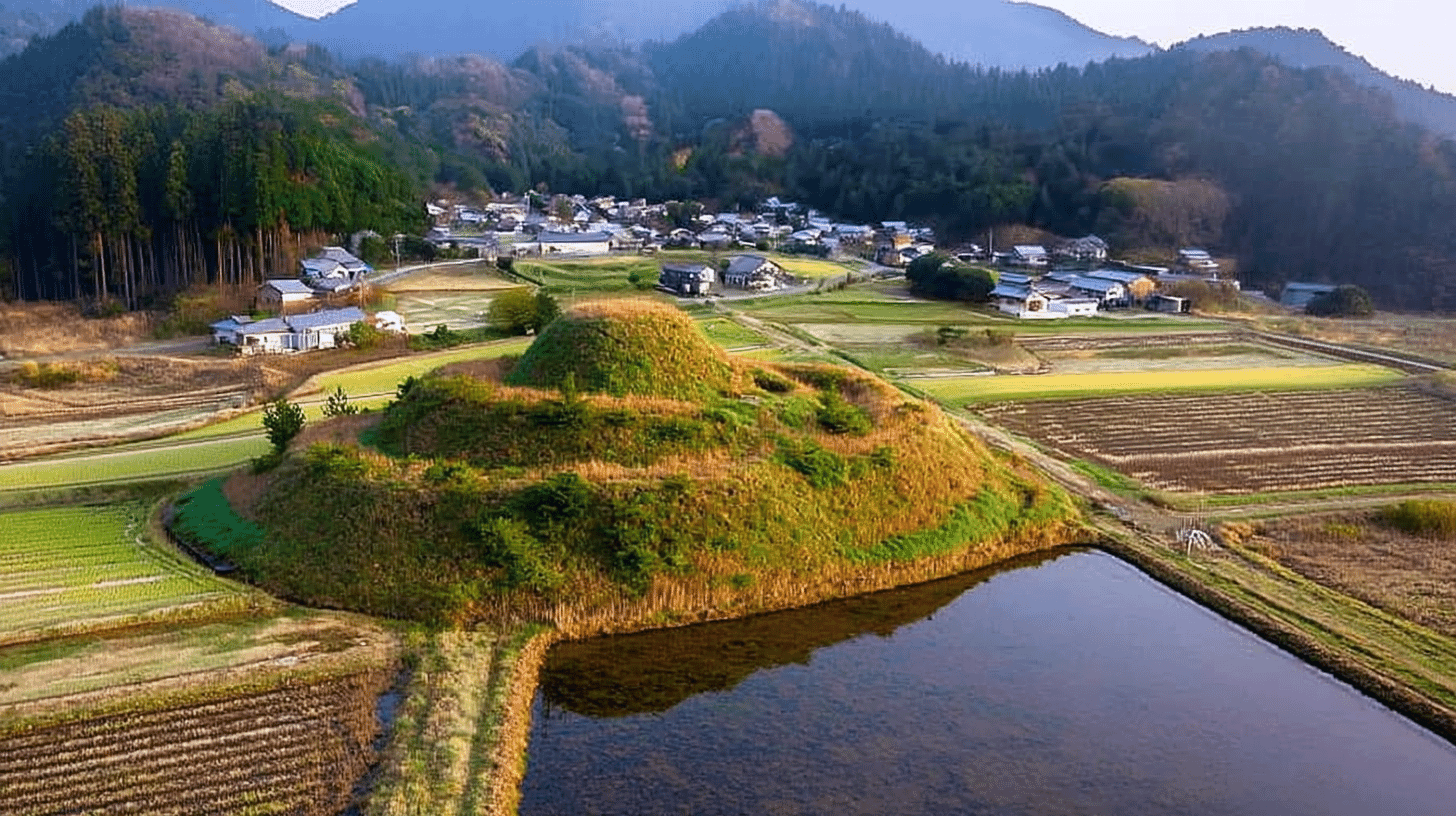
Jōnozuka Kofun: Wakasa's Majestic Keyhole Tomb and the Legacy of Ancient Kings
Nestled at the foot of Mount Zenbu in the heart of Fukui Prefecture's Wakasa region lies one of Japan's most impressive yet overlooked ancient burial mounds. The Jōnozuka Kofun, designated as a National Historic Site since 1935, stands as the largest keyhole-shaped tumulus in the entire Wakasa region, offering visitors a rare glimpse into Japan's mysterious Kofun period without the crowds that flock to more famous archaeological sites.
What is the Jōnozuka Kofun?
The Jōnozuka Kofun is a magnificent zenpo-koen-fun, or keyhole-shaped burial mound, constructed during the late 4th to early 5th century CE. When viewed from above, this architectural marvel reveals the distinctive keyhole silhouette that has become synonymous with Japan's ancient ruling elite. The tomb measures an impressive 100 meters in total length, with the circular rear section spanning 64 meters in diameter and rising approximately 6 meters above the surrounding landscape.
What makes this site particularly special is its remarkable state of preservation. Unlike many kofun that have been altered or damaged over the centuries, the Jōnozuka Kofun has retained much of its original three-tiered construction. The former moat that once encircled the mound can still be traced today in the pattern of surrounding rice paddies, creating an almost mystical reflection of the ancient landscape during the spring planting season.
Why It Became a National Historic Site
The Jōnozuka Kofun earned its National Historic Site designation on December 24, 1935, for several compelling reasons. As the largest keyhole-shaped burial mound in the Wakasa region, it represents the pinnacle of ancient civil engineering achievements in this strategically important area that connected the Sea of Japan to the Yamato heartland.
The tomb is believed to be the first of the great royal tombs constructed in Wakasa, predating other significant burial sites in the region. Archaeological excavations conducted in 1992 and ground-penetrating radar surveys in 2008 have revealed fukiishi (paving stones) covering the mound's surface, various types of haniwa (clay figures), and grave goods of Korean and Chinese origin, demonstrating the far-reaching trade networks and cultural connections of ancient Wakasa.
Together with the nearby Nishizuka Kofun and Nakatsuka Kofun, the Jōnozuka Kofun forms part of what local historians poetically call the "Valley of the Kings" of Wakasa, a cluster of royal tombs that once marked the resting places of the region's most powerful rulers.
The Mystery of the Kashiwade Clan
While the exact identity of the person interred within the Jōnozuka Kofun remains unknown, compelling evidence points to the Kashiwade clan (膳氏) as the likely occupants of this and neighboring tombs. The name of the nearby mountain, Zenbuyama (膳部山), contains the same characters as the Kashiwade clan name, suggesting a deep historical connection to this area.
According to ancient chronicles like the Kojiki and Nihon Shoki, the Kashiwade clan served as the Kuni no miyatsuko (provincial governors) of Wakasa Province, their lineage reportedly stretching back to the legendary Emperor Kōgen. This royal connection makes the Wakibukuro Kofun Cluster one of the most significant concentrations of elite burial mounds outside of the Yamato heartland, offering visitors an authentic encounter with Japan's ancient aristocracy.
Highlights and Things to See
Visiting the Jōnozuka Kofun offers a uniquely intimate experience with Japan's ancient past. Unlike the massive tomb complexes of Osaka that can only be appreciated from observation towers, the Jōnozuka Kofun allows visitors to walk around its perimeter and truly appreciate the scale and craftsmanship of ancient Japanese burial architecture.
The best time to visit is during late April to early May, when the surrounding rice paddies are flooded with water before planting. During this magical period, the water-filled fields mirror the original moat that once protected the sacred mound, creating a breathtaking visual connection to the 5th-century landscape. The tomb's distinctive three-tiered profile is clearly visible, and the well-preserved constriction between the circular and rectangular sections showcases the sophisticated engineering of the Kofun period builders.
Fragments of haniwa clay figures have been discovered scattered in the surrounding farmland, evidence of the elaborate decoration that once adorned the tomb's surface. While these artifacts are now preserved in the Wakasa Museum of History and Culture, walking the fields around the kofun still evokes a sense of walking through an open-air archaeological site.
Wakasa Museum of History and Culture
No visit to the Jōnozuka Kofun is complete without exploring the Wakasa Museum of History and Culture, located just a short distance away near Kaminaka Station. This modern facility houses an impressive collection of approximately 170 artifacts excavated from the region's kofun, including the prized gold pendant earrings that speak to the wealth and international connections of ancient Wakasa's rulers.
The museum offers free admission and provides excellent context for understanding the significance of the Wakibukuro Kofun Cluster within the broader narrative of Japan's ancient history. Exhibits explain how Wakasa's strategic position connecting the Sea of Japan to the imperial center at Yamato made it a crucial territory, worthy of the impressive burial monuments that dot the landscape.
Surrounding Attractions
Wakasa Town offers numerous attractions that complement a visit to the ancient tombs. The spectacular Mikata Five Lakes, designated as a Ramsar wetland site, feature five interconnected lakes that display subtly different colors due to varying levels of salinity. The Rainbow Line scenic drive offers panoramic views of both the lakes and the Sea of Japan from its mountain summit.
History enthusiasts will appreciate the Kumagawa-juku, a beautifully preserved Edo-period post town along the historic Saba Kaido (Mackerel Road) that once carried seafood from Wakasa to Kyoto. The town's traditional architecture and flowing water channels transport visitors back to a more recent layer of Japan's rich past.
Nature lovers should not miss Uriwari Falls at Tentokuji Temple, recognized as one of Japan's 100 Famous Waters. The crystal-clear spring water is so cold that it was said to crack melons placed in it, hence the name. The surrounding area also includes the Wakasa Mikata Jomon Museum, which explores the region's even more ancient Jomon period heritage.
- 📍 Plan Your Visit to Fukui
- Find tours, activities & transport passes near Kaminozuka Tomb
- [ Eiheiji Temple & Tojinbo Cliffs Day Trip ]
Q&A
- Is there an admission fee to visit the Jōnozuka Kofun?
- No, the Jōnozuka Kofun is located in open farmland and can be freely visited at any time. The nearby Wakasa Museum of History and Culture, which displays artifacts from the kofun, also offers free admission.
- How can I get to the Jōnozuka Kofun?
- The kofun is approximately 30 minutes on foot from Kaminaka Station on the JR Obama Line. By car, it is about 10 minutes from the Wakasa-Kaminaka IC on the Maizuru-Wakasa Expressway. Rental bicycles are available at Kaminaka Station for exploring the area.
- When is the best time to visit?
- Late April to early May is ideal, when the flooded rice paddies evoke the ancient moat. However, the site offers different charms throughout the year, with autumn colors and winter's stark beauty also providing memorable backdrops.
- Can I climb on the burial mound?
- The mound itself is on private farmland and is used for cultivation. Visitors should respect the site by viewing from the surrounding paths and roads. Please be mindful of agricultural activities and do not enter planted areas.
- Are there English information signs at the site?
- Signage at the kofun is primarily in Japanese. It is recommended to visit the Wakasa Museum of History and Culture first for background information, or download a translation app to help interpret the on-site explanations.
Basic Information
| Name | Jōnozuka Kofun (上ノ塚古墳) |
|---|---|
| Type | Keyhole-shaped burial mound (zenpo-koen-fun) |
| Designation | National Historic Site (designated December 24, 1935) |
| Construction Period | Late 4th century to early 5th century CE (Kofun period) |
| Dimensions | Total length: approx. 100m; Rear circular section diameter: 64m; Height: approx. 6m |
| Location | Wakibukuro, Wakasa Town, Mikatakaminaka District, Fukui Prefecture, Japan |
| Access | Approx. 30 min walk from JR Obama Line Kaminaka Station; 10 min by car from Wakasa-Kaminaka IC |
| Admission | Free (open-air site) |
| Related Museum | Wakasa Museum of History and Culture (free admission; closed Mondays) |
References
- Jōnozuka Kofun - Cultural Heritage Online (Agency for Cultural Affairs)
- https://bunka.nii.ac.jp/heritages/detail/138447
- Jōnozuka Kofun - Wikipedia
- https://en.wikipedia.org/wiki/J%C5%8Dnozuka_Kofun
- Kaminaka Kofun Cluster - Wakasa Town Official Website
- https://www.town.fukui-wakasa.lg.jp/soshiki/rekishibunkaka/gyomuannai/3/1/2/918.html
- Wakasa Town Museum of History and Culture
- https://www.town.fukui-wakasa.lg.jp/soshiki/wakasamikatajomonhakubutsukan/gyomuannai/949.html
- Japan Heritage - Miketsukuni Wakasa and Saba Kaido
- http://www1.city.obama.fukui.jp/japan_heritage/bunkazai/detail.php?id=2
- Wakasa Three Lakes and Five Lakes Tourism Association
- https://www.wakasa-mikatagoko.jp/
Last verified: 2026.01.14