
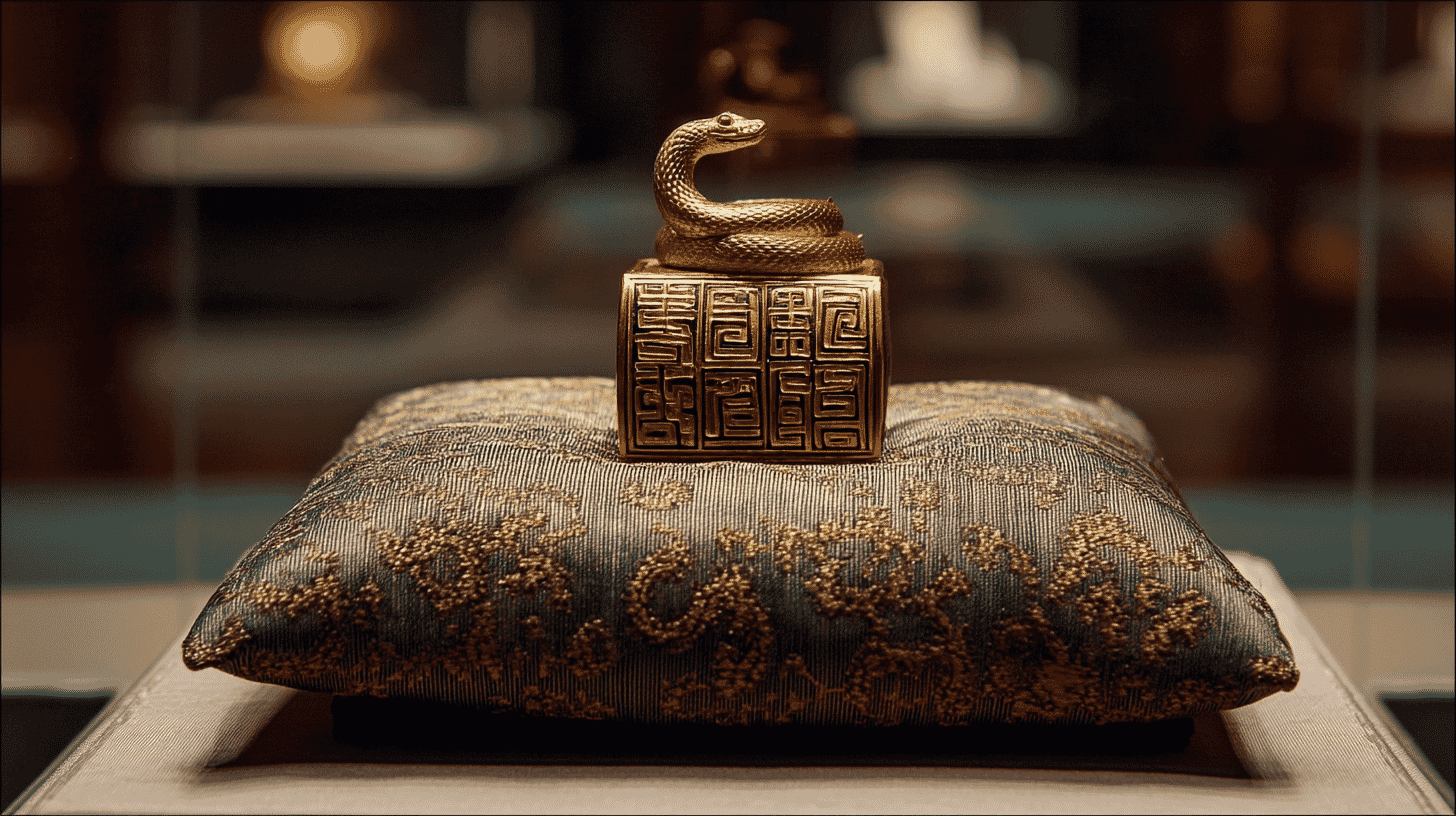
A Gold Seal 2.3 Centimetres Square, National Treasure since 1954
The Gold Seal (inscribed Kan no Wa no Na no Kokuo) (金印〈印文「漢委奴國王」〉) is a solid gold seal of the Yayoi period held by the Fukuoka City Museum, designated a National Treasure on 20 March 1954. It had been listed under the earlier National Treasure Preservation Law on 14 December 1931. It belongs to the city of Fukuoka.
Fukuoka City records that it was found in 1784 at Kananosaki on Shikanoshima island, beneath a stone that took two men to lift. The finder is given as a farmer named Jinbei. The circumstances are known from a statement Jinbei submitted to Tsuda Genjiro, the magistrate of the Naka district office.
The seal passed to the Kuroda family, lords of the Fukuoka domain, and was presented to the city of Fukuoka in 1978. The Fukuoka City Museum now holds it and shows it in the permanent galleries.
Reading the Inscription: Han, Wa-Na, King
Five characters are cut into the face in Han clerical script. How those five are divided is the interpretation of the seal itself.
The Fukuoka City Museum explains the rule. A seal granted to a subject ruler names first the Chinese dynasty, then the people, then the tribe. So the two characters read Wa-Na denote the Na tribe of the Wa people. The final two, king of the state, mark the highest of five ranks for subject rulers and acknowledge authority over a territory.
Under that rule the five characters read as king of the Na of the Wa, of Han. The structure of the inscription is itself a statement of Han diplomatic practice. The state of Na is thought to have covered the area from present Fukuoka City to Kasuga.
Other readings have been proposed. The Agency for Cultural Affairs records the inscription in characters without fixing a reading. This article follows the museum's interpretation.
Matching the Book of the Later Han
The first to examine the seal was Kamei Nanmei, head of the Kantokan, the western academy of the Kuroda domain.
Nanmei wrote a treatise on the seal and connected it with the account in the Book of the Later Han, which records that in the second year of Jianwu Zhongyuan, 57 CE, the eastern barbarian state of Wa-Na sent tribute and paid court, its envoy styling himself a grandee, that this was the southernmost limit of Wa, and that Emperor Guangwu bestowed a seal and ribbon. Nanmei argued that this was that very Han seal and pressed its importance. Through his efforts the seal was placed in the domain treasury and preserved.
Scholars have examined it from the Edo period to the present. Claims that it is a forgery have been raised and rejected, on comparison with ancient Chinese seals and on scientific measurement. Fukuoka City states that there is today no room to doubt that this is the seal bestowed by Emperor Guangwu on the king of Wa-Na.
Measurements and the Serpent Knob
Measurements taken in 1966 by Okazaki Takashi with the cooperation of the National Research Laboratory of Metrology give a total height of 2.236 centimetres, a knob height of 1.312 centimetres, a mean face length of 2.347 centimetres, a mass of 108.729 grams, a volume of 6.062 and a specific gravity of 17.94. It is a cast piece.
The face matches the one-Han-inch standard for official seals of the Han. Meeting that standard is itself the ground for holding the seal a Han official product. Gold, silver and copper have been measured in a ratio of 95.1 to 4.5 to 0.5.
The knob through which a cord passed takes the form of a coiled serpent, its scales rendered with a round punch known as nanako. A gold seal inscribed for the king of Dian, excavated at Shizhaishan in Yunnan, carries the same serpent knob, and Nishijima Sadao pointed out that the two are formally identical.
The Tang compilation Hanyuan speaks of the honour of a purple ribbon in the Zhongyuan era, from which it is understood that a purple cord was tied to the knob. Seals of the period were used on clay, pressed into sealing material to close letters and consignments.
Seeing It
The seal is shown in the permanent galleries of the Fukuoka City Museum. There are periods when a replica stands in its place, so anyone hoping to see the original should check the museum's notices.
The museum opens from 9:30 a.m. to 5:30 p.m., last entry 5:00 p.m., closed on Mondays or the next weekday when Monday is a holiday, and over the New Year. Admission to the permanent galleries is 200 yen for adults and 150 yen for high school and university students, free for junior high school students and younger.
The seal is small, 2.3 centimetres to a side. The display uses magnification and video to show the detail. The scales rendered with the round punch, and the marks left by the graver clearing the five characters, cannot be followed by eye alone.
From Nishijin Station on the Fukuoka City Subway Kuko Line it is about 15 minutes on foot, or by bus from Hakata Station to the Hakubutsukan-kitaguchi stop. At the find spot on Shikanoshima stands Kinin Park with a monument marking where the seal came to light; it lies at the opposite end of the city from the museum.
Q&A
- When was the gold seal designated a National Treasure?
- On 20 March 1954 under the Cultural Properties Protection Law, having been listed on 14 December 1931 under the earlier National Treasure Preservation Law. It was found on Shikanoshima in 1784, passed to the Kuroda family of the Fukuoka domain, and was presented to the city of Fukuoka in 1978.
- How is the inscription read?
- As Kan no Wa no Na no Kokuo, king of the Na of the Wa, of Han. A seal granted to a subject ruler names the dynasty, then the people, then the tribe, so the middle characters denote the Na tribe of the Wa people, and king of the state marks the highest of five ranks for subject rulers. Other readings have been proposed.
- How large and heavy is the seal?
- Measurements of 1966 give a total height of 2.236 centimetres, a knob height of 1.312, a mean face length of 2.347 and a mass of 108.729 grams. The face matches the one-Han-inch standard for Han official seals. Gold, silver and copper have been measured at 95.1 to 4.5 to 0.5.
- What grounds are there for holding it genuine?
- The face matches the Han standard for official seals, the serpent knob is formally identical to that of the seal of the king of Dian excavated in Yunnan, and scientific measurement supports it. Forgery claims have been rejected, and Fukuoka City states there is no room to doubt that Emperor Guangwu bestowed it.
- Where can the seal be seen?
- In the permanent galleries of the Fukuoka City Museum, though a replica stands in its place at times, so check the museum's notices. The museum opens 9:30 a.m. to 5:30 p.m., closed Mondays. Admission to the permanent galleries is 200 yen for adults.
Basic Information
| Name | Gold Seal (inscribed Kan no Wa no Na no Kokuo) (金印〈印文「漢委奴國王」〉) |
|---|---|
| Location | 3-1-1 Momochihama, Sawara Ward, Fukuoka City, Fukuoka Prefecture (Fukuoka City Museum) |
| Designation | National Treasure (archaeological materials) |
| Year Designated | 1931 (14 December), listed under the National Treasure Preservation Law; 1954 (20 March), National Treasure |
| Quantity | 1 seal |
| Dimensions | Total height 2.236 cm, knob height 1.312 cm, mean face length 2.347 cm, mass 108.729 g, specific gravity 17.94. Knob in the form of a coiled serpent with scales in round punchwork. Gold, silver and copper at 95.1 to 4.5 to 0.5. Yayoi period |
| Owner | City of Fukuoka |
| Public Access | Shown in the permanent galleries of the Fukuoka City Museum, with a replica in its place at times. Open 9:30 a.m. to 5:30 p.m., closed Mondays. Permanent galleries 200 yen for adults |
References
- Cultural Properties of Fukuoka City: the gold seal
- https://bunkazai.city.fukuoka.lg.jp/cultural_properties/detail/313
- Fukuoka Prefecture cultural properties database: the gold seal
- https://www.fukuoka-bunkazai.jp/frmDetail.aspx?db=1&id=42
- Fukuoka City Museum: the gold seal
- https://museum.city.fukuoka.jp/gold/
- Fukuoka City Museum official site
- https://museum.city.fukuoka.jp/
Last verified: 2026.09.03