Koriyama City Public Hall: A Neo-Renaissance Treasure Inspired by The Hague Peace Palace | Fukushima Cultural Heritage

Discover Koriyama City Public Hall, a stunning Neo-Renaissance building designed by Japan's National Diet Building architect. Built in 1924, this Registered Tangible Cultural Property features elegant stained glass and Renaissance ceilings, symbolizing the pioneering spirit of Fukushima Prefecture.

Koriyama City Public Hall: Where Taisho Romance Meets European Elegance

Standing proudly in the heart of Koriyama City, Fukushima Prefecture, the Koriyama City Public Hall (郡山市公会堂) is a magnificent example of Neo-Renaissance architecture that has graced this northern Japanese city for over a century. Completed in October 1924 to commemorate the establishment of Koriyama as a city, this elegant building draws inspiration from the world-famous Peace Palace in The Hague, Netherlands, embodying the ambitious spirit and international outlook of Japan's Taisho era.

As a Nationally Registered Tangible Cultural Property and a component of the Japan Heritage Story "A Path to the Future," this public hall tells the remarkable tale of how a once-barren plain transformed into one of Tohoku's most prosperous cities through sheer determination and pioneering spirit.

Historical Background: Birth of a City's Symbol

The construction of Koriyama Public Hall was intimately connected with the city's dramatic transformation. In September 1924, Koriyama officially achieved city status, marking the culmination of decades of development that began with the Asaka Canal project in the Meiji era. To celebrate this milestone, city leaders commissioned a grand public hall that would symbolize their community's progress and forward-thinking spirit.

Construction began in October 1922, but faced an unexpected setback when the Great Kanto Earthquake of September 1923 disrupted material supply chains. Work resumed in February 1924 and was completed that October, at a cost of 163,000 yen—a substantial investment that reflected the city's confidence in its future.

The building originally featured a clock embedded in its tower, though this was removed during World War II when citizens complained about its inaccuracy. The clock was restored during renovations around 1998, once again allowing the tower to fulfill its role as a landmark timekeeper for the city.

Architectural Significance: European Grandeur in Northern Japan

The Public Hall was designed under the supervision of Yahashi Kenkichi (1869-1927), one of the most distinguished architects in modern Japanese history. Yahashi served as a senior official in the Ministry of Finance's construction department and is best known for designing Japan's National Diet Building, the Old Prime Minister's Official Residence, and numerous other significant government structures. His involvement in the Koriyama project brought national-level architectural expertise to this regional city.

The actual design work was carried out by Ogiwara Sadao, who worked under Yahashi's guidance. Together, they created a building that drew inspiration from two notable structures: the Peace Palace in The Hague, Netherlands—a Neo-Renaissance masterpiece completed in 1913 that houses the International Court of Justice—and the Osaka Central Public Hall, another celebrated Taisho-era landmark.

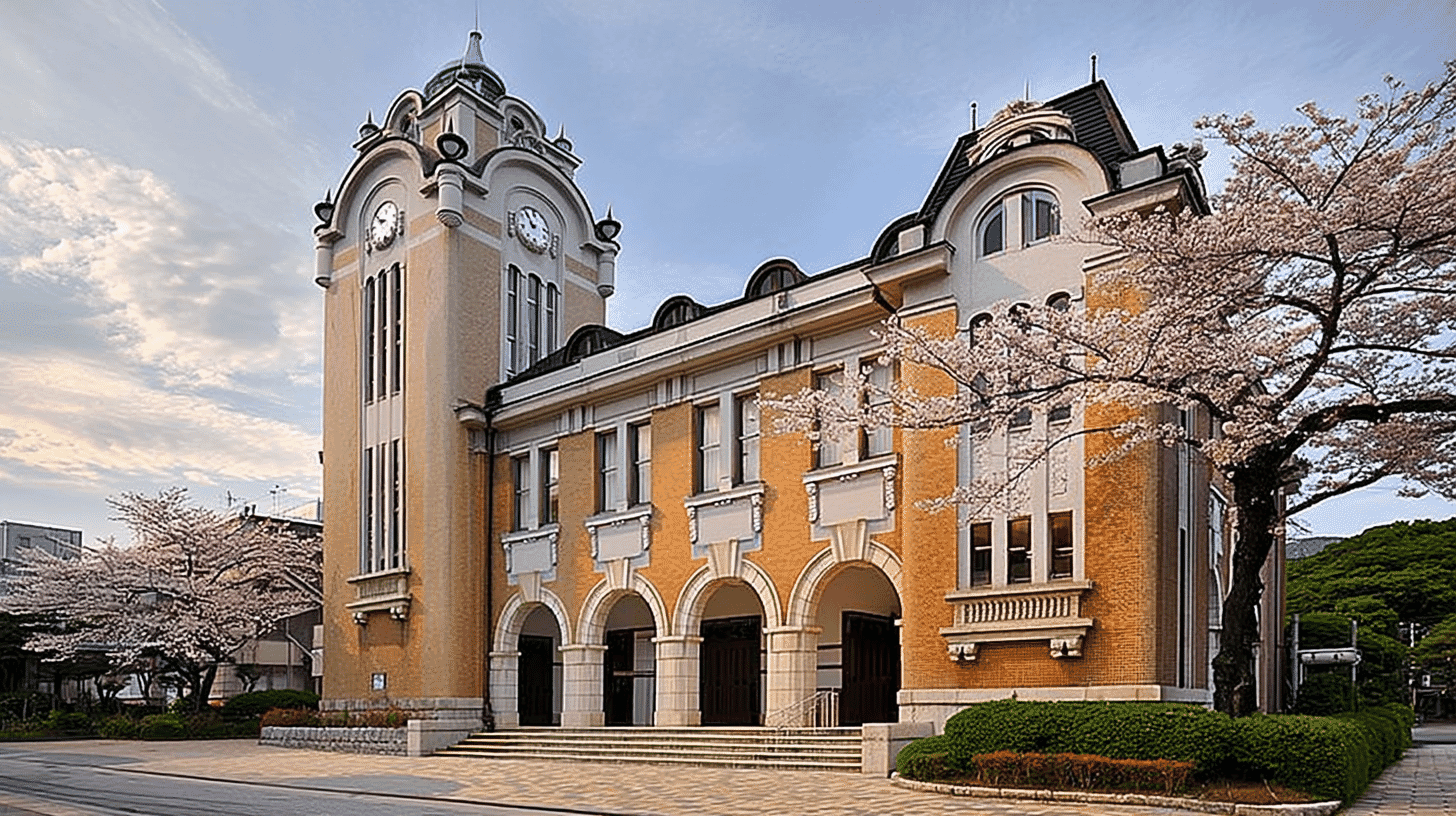
The Neo-Renaissance style is evident throughout the building's carefully considered details. The continuous semi-circular arched colonnade at the entrance creates a sense of classical grandeur, while the window sash supports and double-hung windows demonstrate meticulous attention to proportion and detail. The corner tower, with its tall vertical glass panels, adds striking verticality to the composition and serves as a visual landmark visible throughout the surrounding area.

Why It Became a Cultural Property

Koriyama City Public Hall was registered as a Nationally Registered Tangible Cultural Property on June 25, 2002, in recognition of its outstanding architectural and historical value. The registration acknowledges several key aspects of the building's significance.

First, the structure represents an authentic example of formal Western-style architecture from the Taisho period, executed with remarkable sophistication for a regional city. The quality of design and construction rivals that of major urban centers, demonstrating the high aspirations of Koriyama's early civic leaders.

Second, the building powerfully expresses the pioneering spirit that defined Koriyama's development. The grandeur of the Neo-Renaissance design reflects the confidence and ambition of a community that had recently transformed barren wasteland into productive farmland through the Asaka Canal project.

Third, the Public Hall remains one of the few surviving works associated with Yahashi Kenkichi. Many of his buildings, particularly prefectural government offices, have been demolished and replaced over the decades, making this hall a precious surviving example of his design philosophy.

Highlights and Attractions

The exterior of the Public Hall presents a harmonious composition of cream-colored plaster walls accented by granite stonework. A comprehensive renovation completed in 2005 restored many original features, including the granite exterior walls, Renaissance-style decorative ceilings, and beautiful stained glass windows that cast colorful light into the interior spaces.

The clock tower remains the building's most distinctive feature, rising above the surrounding landscape and serving as a beloved landmark. The tower's design emphasizes verticality through its tall glass panels, creating an elegant silhouette against the sky. During special events and seasons, the building is illuminated at night, creating a romantic atmosphere reminiscent of the Taisho era's fascination with modernity and Western culture.

Inside, the hall retains its original function as a venue for concerts, lectures, and community gatherings. The excellent acoustics and intimate atmosphere make it a cherished space for cultural events, allowing visitors to experience architecture as it was meant to be used rather than simply observed.

The building is also part of the Japan Heritage Story "A Path to the Future—Okubo Toshimichi's 'Last Dream' and the Pioneers' Footsteps," which tells the story of the Asaka Canal and the transformation of the Koriyama region. The Public Hall symbolizes the culmination of this pioneering endeavor, representing the prosperous city that emerged from decades of determined development.

Surrounding Area: Hayama Cultural District

Koriyama Public Hall is situated in the Hayama district, a cultural hub that offers visitors a wealth of experiences beyond the hall itself. Adjacent to the building is Hayama Park, one of Japan's 100 Selected Historical Parks with origins dating back to 1824 when the village of Koriyama was elevated to post-town status.

Within Hayama Park, visitors can discover the Hayama Waterfall (麓山の滝), itself a Registered Tangible Cultural Property. This waterfall was constructed in 1882 to commemorate the completion of the Asaka Canal, and its unveiling ceremony was attended by government dignitaries including Minister of the Right Iwakura Tomomi.

The 21st Century Memorial Park, located just across the street, offers a modern contrast with its contemporary design, water features, and café. The park's tearoom serves matcha in a relaxed setting, providing a peaceful respite from sightseeing.

Cherry blossom season transforms the area into one of Koriyama's premier hanami destinations. The Public Hall's elegant facade provides a stunning backdrop for the delicate pink blossoms, creating scenes that perfectly capture the spirit of Japan's appreciation for ephemeral beauty.

Access Information

Koriyama City Public Hall is conveniently located about 15 minutes on foot from JR Koriyama Station. From the station, visitors can walk west along Showa Street before turning onto Bunka Street, where the hall's distinctive clock tower soon comes into view.

Alternatively, buses depart from Platform 1 at Koriyama Station. Take the Cosmos Circulation Bus (池の台回り route) and alight at the Koriyama Library stop, from which the Public Hall is immediately visible.

For visitors traveling by car, the hall is located near the intersection of Showa Street and Bunka Street, just past the Koriyama Central Library. Parking is available at the shared cultural facilities parking lot in the Hayama district.

Koriyama Station is approximately 80 minutes from Tokyo Station by Tohoku Shinkansen, making this architectural gem easily accessible as a day trip from the capital or as part of a broader exploration of Fukushima Prefecture.

📍 Plan Your Visit to Fukushima
Find tours, activities & transport passes near Koriyama City Public Hall
[ Aizu-Wakamatsu Castle & Ouchi-juku Village Tours ]

Q&A

QCan visitors enter the Public Hall?
AThe building is primarily used as a rental facility for events, meetings, and concerts. When events are not in session, the doors may be locked. However, if the building is open for an event, visitors can often enter the lobby area to appreciate the interior architecture. The exterior can be freely viewed at any time.
QWhat is the best season to visit?
ASpring (late March to mid-April) offers spectacular cherry blossoms around the building, while autumn provides beautiful foliage in adjacent Hayama Park. The building is also illuminated during special events and seasons, making evening visits particularly atmospheric.
QIs there an admission fee?
AViewing the exterior is free. The hall can be rented for events starting from 2,600 yen, depending on the room and time slot. There is no regular admission fee for interior viewing as the building operates as a functional public facility.
QWhat other cultural properties can be visited nearby?
AThe Hayama Waterfall in adjacent Hayama Park is also a Registered Tangible Cultural Property. The nearby Kaiseikan (開成館), associated with the Asaka Canal development, and Kaiseizan Daijingu Shrine are also part of the Japan Heritage story and well worth visiting.
QWhat connection does this building have with the Peace Palace in The Hague?
AThe Koriyama Public Hall was designed with the Peace Palace in The Hague as one of its inspirations. Both buildings share the Neo-Renaissance architectural style, featuring similar elements such as prominent towers and classical detailing. The choice to reference this internationally significant building reflected Koriyama's aspirations to connect with the broader world during the cosmopolitan Taisho era.

Basic Information

Name Koriyama City Public Hall (郡山市公会堂 / 郡山市郡山公会堂)
Designation Nationally Registered Tangible Cultural Property (registered June 25, 2002)
Architectural Style Neo-Renaissance
Design Supervisor Yahashi Kenkichi (矢橋賢吉)
Designer Ogiwara Sadao (荻原貞雄)
Construction Shimizu-gumi (清水組, now Shimizu Corporation)
Completion October 1924 (Taisho 13)
Structure Reinforced concrete, 2 stories with tower, copper roof
Building Area Approximately 1,102 m²
Address 1-8-4 Hayama, Koriyama City, Fukushima Prefecture 963-8876
Hours 9:00 AM – 9:00 PM
Closed Third Sunday of each month; December 29 – January 3
Access Approximately 15 minutes on foot from JR Koriyama Station

References

郡山市公会堂 - 文化遺産オンライン (Cultural Heritage Online)
https://bunka.nii.ac.jp/heritages/detail/140011
郡山市公会堂 - 郡山市公式ホームページ (Koriyama City Official Website)
https://www.city.koriyama.lg.jp/site/japanheritage/32678.html
郡山市郡山公会堂 - Wikipedia
https://ja.wikipedia.org/wiki/郡山市郡山公会堂
矢橋賢吉 - Wikipedia
https://ja.wikipedia.org/wiki/矢橋賢吉
郡山市郡山公会堂の利用案内 - 郡山市公式ホームページ
https://www.city.koriyama.lg.jp/soshiki/152/6367.html
未来を拓いた「一本の水路」- 日本遺産ポータルサイト (Japan Heritage Portal)
https://japan-heritage.bunka.go.jp/ja/stories/story022/
Peace Palace - Wikipedia
https://en.wikipedia.org/wiki/Peace_Palace
麓山公園 - 郡山市公式ホームページ
https://www.city.koriyama.lg.jp/soshiki/132/3245.html

Last verified: 2025.12.04

Nearby heritages