
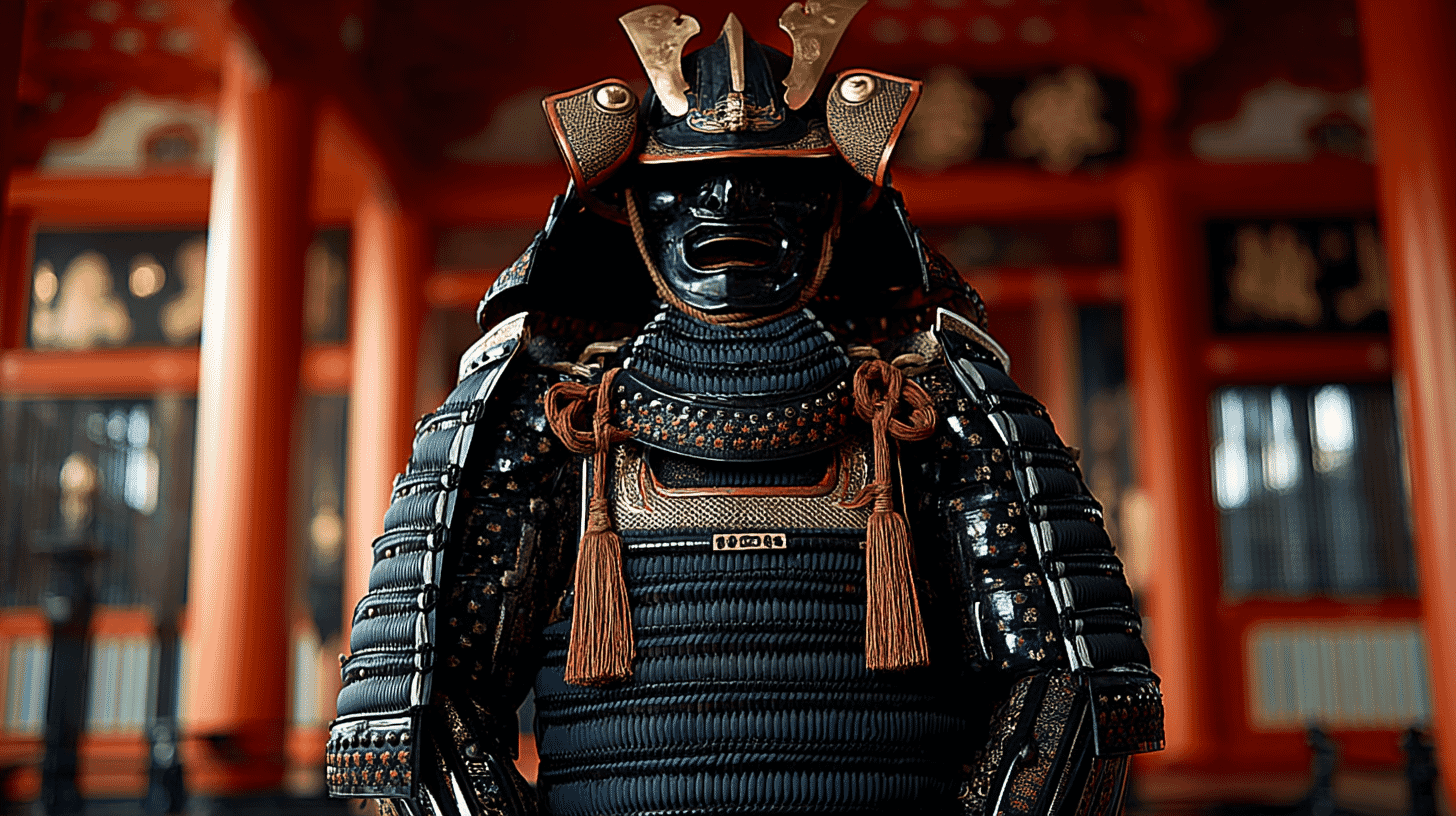
One Suit, National Treasure since 1952
Domaru Armour Laced in Black Leather, with Helmet and Large Sleeves (黒韋威胴丸〈兜、大袖付〉, Kurokawa Odoshi Domaru) is a Nanbokucho-period craft object owned by Itsukushima Shrine in Hiroshima Prefecture, made an Important Cultural Property on 1 August 1899 and designated a National Treasure on 29 March 1952. The quantity is one suit.
1 August 1899 is the day of the Tsurugaoka inkstone box. 29 March 1952 is the day of the Tenjukoku embroidery, the Kongobuji Fudo hall and the Shofukuji Jizo hall.
A domaru is a form of medieval armour that fits close to the body and is simple to put on. The title records that a helmet and large sleeves come with it.
A National Treasure of the Same Name Stands in Nara
This title belongs to more than one National Treasure.
The other is owned by Kasuga Taisha in Nara Prefecture. The name is the same, and so is the presence of a helmet and large sleeves.
The dates differ widely. The Kasuga suit became an Important Cultural Property on 25 April 1927 and a National Treasure on 17 August 2016.
This one was listed in 1899 and designated in 1952: sixty-four years apart in the year of designation.
With the Taisanji main halls, two National Treasures of one name stood in Hyogo and Ehime. Those are buildings, told apart by depth and roofing.
These two are craft objects. To tell them apart, one reads the owner and the dates.
The Earlier Article Cited the Nara Record
Rewriting this article turned up a serious confusion.
The earlier text was written about the Itsukushima suit while citing the record of the Kasuga suit as its source.
It also carried a heading comparing the property with the holdings of Kasuga Taisha. A different property of the same name was being treated as a point of comparison.
With the rhinoceros-horn knife, the earlier article had been written throughout as though the property were a Shosoin treasure. That was a confusion with an object of different owner and different place.
Here the names match exactly, which makes the confusion easier to fall into. Only the owner distinguishes them.
This article therefore records only what the Agency's data confirm of the Itsukushima suit. Details of construction are left out, since they could be confused with those of the Kasuga suit.
What Kind of Armour a Domaru Is
Types of armour divide by how they were used.
Medieval armour falls into three kinds: the great armour, the domaru and the haramaki.
The great armour was worn by mounted commanders, large and heavy along with its helmet and sleeves, built for strength in fighting with the bow from horseback.
The domaru and the haramaki, by contrast, sought mobility and lightness on foot, fitting close to the body and simple to put on.
The division is between riding and walking. The red-laced and white-laced suits at Kushihiki Hachimangu are both great armour.
This is a domaru, of the walking kind. That it comes with a helmet and large sleeves gives it elements of the great armour as well.
Seeing It
The suit belongs to Itsukushima Shrine. The address field in the Agency's database is blank, the fifteenth such case.
Itsukushima Shrine also owns a set of gilt bronze esoteric ritual implements, likewise a craft object.
It is a shrine holding, not kept on permanent display.
The measure word is the one used for suits of armour, the same as for the red-laced and white-laced suits.
Exhibition plans can change, so check the shrine's information before travelling.
Q&A
- When was this suit designated?
- It became an Important Cultural Property on 1 August 1899 and a National Treasure on 29 March 1952. The quantity is one suit and the owner Itsukushima Shrine.
- Is there another National Treasure of the same name?
- Yes. Kasuga Taisha in Nara owns a suit of the same name, listed in 1927 and designated in 2016. The dates of designation lie sixty-four years apart.
- What is a domaru?
- One of three kinds of medieval armour, alongside the great armour and the haramaki. It seeks mobility on foot, fitting close to the body and simple to put on.
- How does it differ from the great armour?
- The great armour was worn by mounted commanders and built for strength in fighting with the bow from horseback. The division is between riding and walking.
- Where can it be seen?
- The address field in the Agency's database is blank and the owner is given as Itsukushima Shrine. It is a shrine holding, not kept on permanent display.
Basic Information
| Name | Domaru Armour Laced in Black Leather, with Helmet and Large Sleeves (黒韋威胴丸〈兜、大袖付〉); a National Treasure of the same name is owned by Kasuga Taisha |
|---|---|
| Location | The address field in the Agency's database is blank; the owner is given as Itsukushima Shrine |
| Designation | National Treasure (craft) |
| Year Designated | 1899 (1 August), Important Cultural Property; 1952 (29 March), National Treasure |
| Quantity | 1 suit |
| Dimensions | Details of construction are left out here, since they could be confused with those of the National Treasure of the same name at Kasuga Taisha. A domaru is one of three kinds of medieval armour alongside the great armour and the haramaki, fitting close to the body and simple to put on. The period is Nanbokucho |
| Owner | Itsukushima Shrine |
| Public Access | A shrine holding, not on permanent display |
References
- Itsukushima Shrine official site
- https://www.itsukushimajinja.jp/
- Cultural Heritage Online: the suit of the same name at Kasuga Taisha
- https://bunka.nii.ac.jp/heritages/detail/367017
- Agency for Cultural Affairs, National Cultural Properties Database
- https://kunishitei.bunka.go.jp/
- Hiroshima Prefecture: cultural properties
- https://www.pref.hiroshima.lg.jp/
Last verified: 2026.09.06