
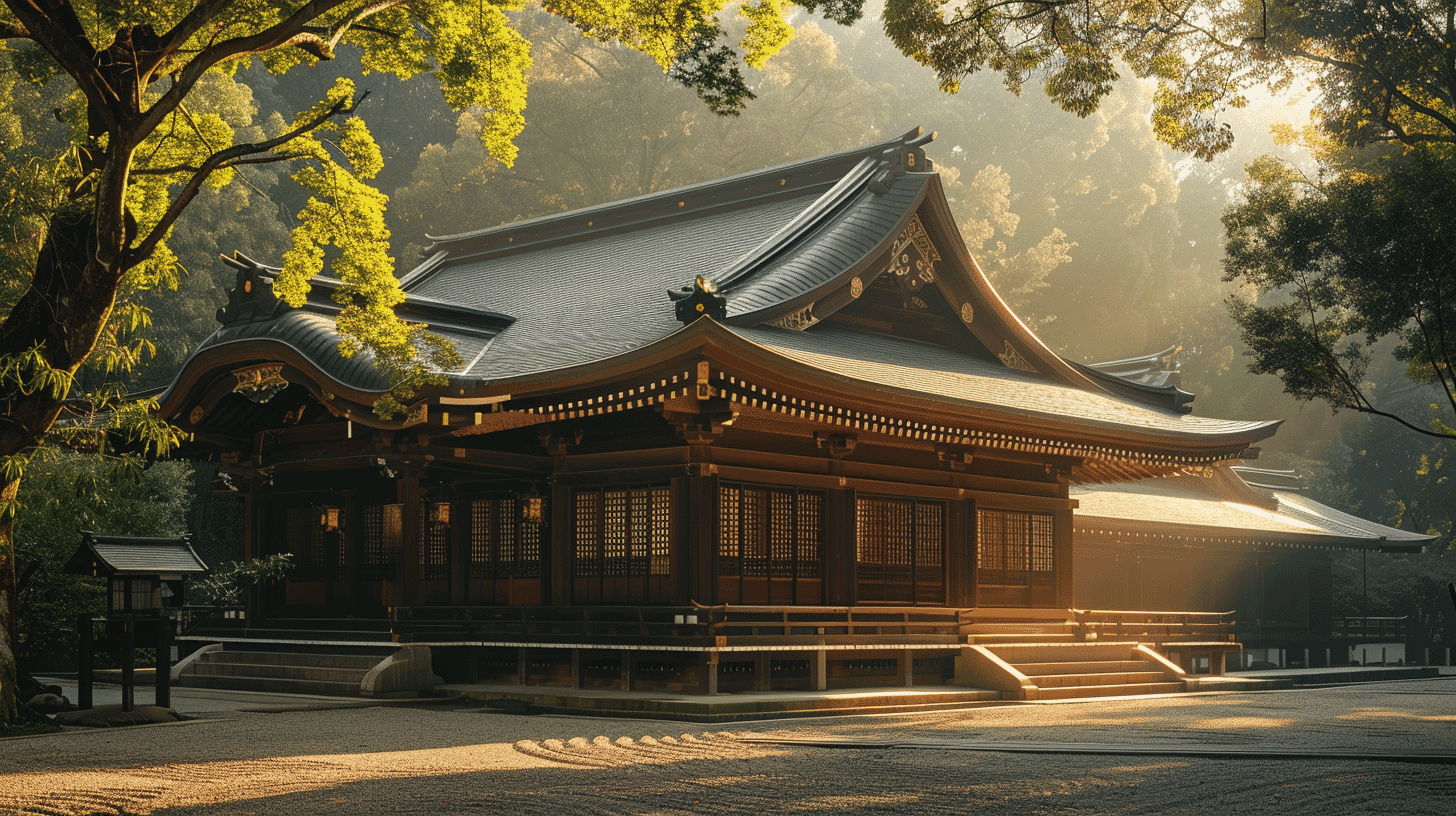
One Hall, National Treasure since 1958
Fudoin Temple Main Hall (不動院金堂, Fudoin Kondo) is a late Muromachi structure at 3-chome Ushitashinmachi, Higashi Ward, Hiroshima City, Hiroshima Prefecture, made an Important Cultural Property on 7 April 1900 and designated a National Treasure on 8 February 1958. The quantity is one building and the owner the temple.
The listing of 7 April 1900 is the second earliest met here, after the Kanshinji golden hall of 28 December 1897, and about a year before the Shinra Zenshindo.
The hall is three bays by four bays, single-storeyed with a skirt roof, hip-and-gable, shingled. The date field gives 1540.
The Building Was Moved from Yamaguchi to Hiroshima
This hall was not built where it stands.
The Agency records that in the Tensho era, Ankokuji Ekei moved it here from Yamaguchi.
A building standing in Yamaguchi was carried to Hiroshima and put up again: a move across provinces.
At the Sofukuji first gate, timbers were cut in China and shipped over in portions. At the Toshodaiji sutra repository, a building that never moved passed from other hands into a temple. At the Kangakuin guest hall, one room was reproduced in New York.
Here a finished building travelled as it was.
Its earlier identity is recorded too: it was the Buddha hall of a Zen temple founded by the warlord Ouchi Yoshitaka.
The School Changed, and So Did the Name
The move changed what the building is.
Before, it was the Buddha hall of a Zen temple. Now it is the main hall of a Shingon temple.
The school shifted from Zen to Shingon, and the word for the building from Buddha hall to golden hall.
At Onjoji, the golden hall was filed under temples, the Shinra Zenshindo under shrines and the Kangakuin guest hall under residences: differences of category within one temple.
Here one building has changed the school it belongs to over time.
The construction stayed as it was. The Agency notes that the details of the structure are typical of the Zen style. A Zen-style building stands at a Shingon temple.
The Date Comes from Writing on a Ceiling Painting
The ground for the date is stated.
An inscription on the ceiling painting shows that the hall was built in 1540.
Characters were written into a painting on the ceiling, and the year comes from them.
At the Himeji Castle turrets, the date of the great keep was known from an ink inscription: writing put directly on the timbers.
Here it is writing that accompanies a painting. What decorates the building carries the clue to its date.
With the Vajrabhadrani Sutra, a colophon's cyclical date fixed the year 686; with the Konjaku Monogatarishu, no colophon existed and the date came from format. What settles a date differs from property to property.
Visiting
The hall stands at 3-chome Ushitashinmachi, Higashi Ward, Hiroshima City, owned by the temple. It stands in the precinct and its exterior can be seen on a visit.
The assessment speaks of scale and interior. It is the largest of medieval Zen Buddha halls, a superlative stated within a named field.
It continues: the interior, made up of a space for the principal image and a space for worship, calls to mind the lost Buddha halls of the medieval Zen headquarters temples.
Something no longer standing is what it calls to mind. The hall is valued for conveying the form of buildings that do not survive.
The same precinct holds a gate and a bell tower. The bell tower is an Important Cultural Property of 19 July 1952, dated 1433, about a century older than the hall. Access to the interior follows the temple's own arrangements. Check before travelling.
Q&A
- When was the hall designated?
- It became an Important Cultural Property on 7 April 1900 and a National Treasure on 8 February 1958. The 1900 listing is the second earliest met here, after the Kanshinji golden hall.
- Was it always in this place?
- No. The Agency records that in the Tensho era Ankokuji Ekei moved it here from Yamaguchi, so a building standing in another province was carried to Hiroshima and put up again.
- What was it before?
- The Agency records that it was the Buddha hall of a Zen temple founded by the warlord Ouchi Yoshitaka. It is now the main hall of a Shingon temple, so both school and name have changed.
- When was it built?
- The Agency records that an inscription on the ceiling painting shows it was built in 1540, so characters written into a painting give the year.
- What is valued in it?
- The Agency calls it the largest of medieval Zen Buddha halls and writes that its interior calls to mind the lost Buddha halls of the medieval headquarters temples, so it is valued for conveying what does not survive.
Basic Information
| Name | Fudoin Temple Main Hall (不動院金堂, Fudoin Kondo); the gate and bell tower in the same precinct are Important Cultural Properties |
|---|---|
| Location | 3-chome Ushitashinmachi, Higashi Ward, Hiroshima City, Hiroshima Prefecture |
| Designation | National Treasure (structure, religious architecture) |
| Year Designated | 1900 (7 April), Important Cultural Property; 1958 (8 February), National Treasure |
| Quantity | 1 building |
| Dimensions | 3 bays by 4 bays, single-storeyed with a skirt roof, hip-and-gable, shingled. The date field gives 1540, known from an inscription on the ceiling painting. It was formerly the Buddha hall of a Zen temple in Yamaguchi and was moved here in the Tensho era. The period is the late Muromachi |
| Owner | Fudoin |
| Public Access | Standing in the precinct; the exterior can be seen on a visit, while the interior follows the temple's own arrangements |
References
- Cultural Heritage Online: the Fudoin main hall
- https://bunka.nii.ac.jp/heritages/detail/148301
- Cultural Heritage Online: the Fudoin bell tower
- https://bunka.nii.ac.jp/heritages/detail/176342
- Cultural Heritage Online: the Fudoin gate
- https://bunka.nii.ac.jp/heritages/detail/190943
- Hiroshima City, Higashi Ward: Fudoin
- https://www.city.hiroshima.lg.jp/site/higashiku/18986.html
Last verified: 2026.09.05