
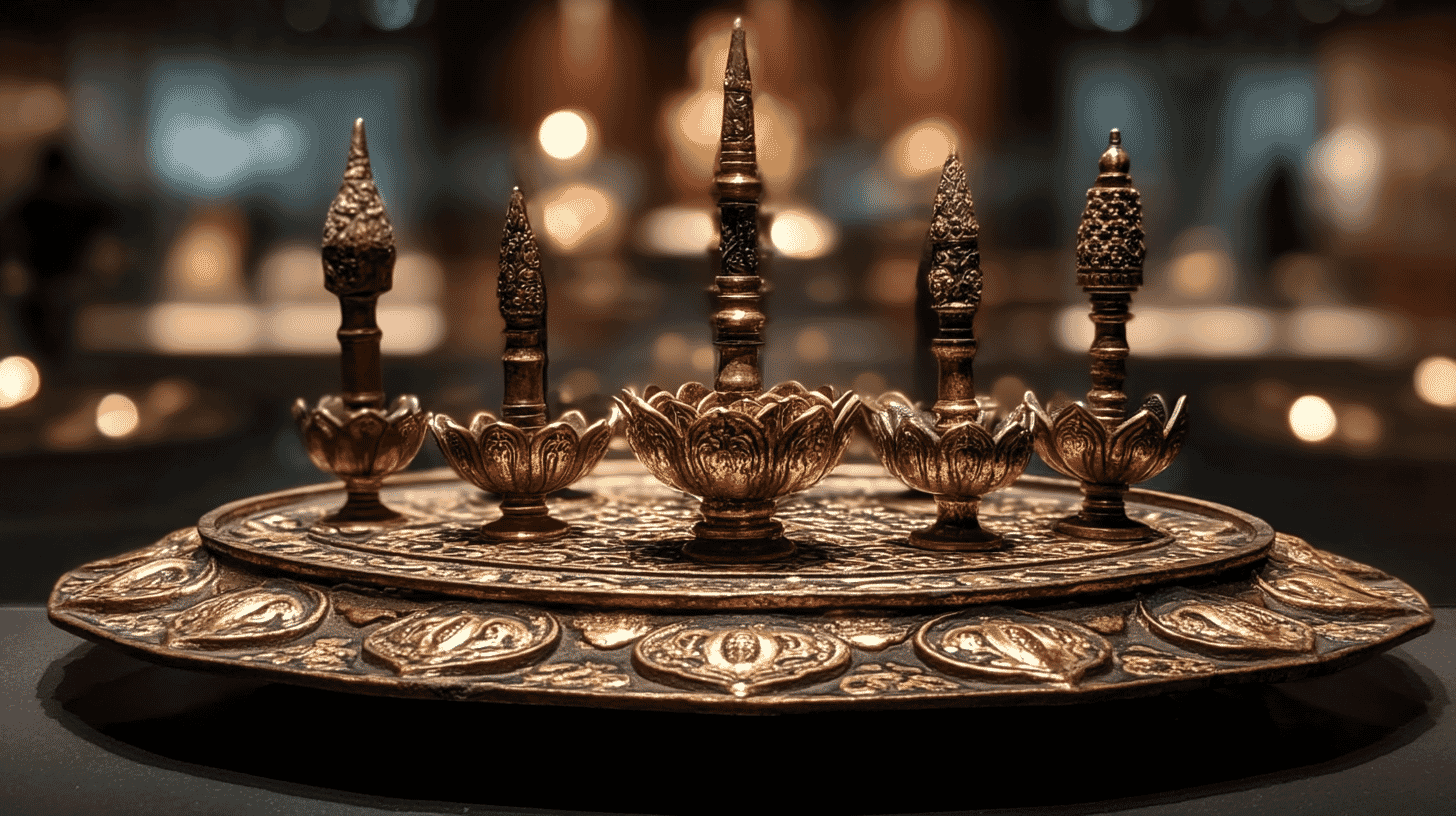
One Set, National Treasure since 1955
Gilt Bronze Esoteric Buddhist Ritual Implements (金銅密教法具, Kondo Mikkyo Hogu) is a Kamakura-period craft object owned by Itsukushima Shrine in Hiroshima Prefecture, made an Important Cultural Property on 1 August 1899 and designated a National Treasure on 22 June 1955. The quantity is one set and the designation number 00180.
1 August 1899 is the day of the shrine's black-laced domaru and of the Tsurugaoka inkstone box. 22 June 1955 is the day of the Daizenji main hall.
The set comprises five pieces: a ritual tray, a five-pronged bell, and single-, three- and five-pronged vajras. The address field in the Agency's database is blank, the sixteenth such case.
Three Vajras Within Nine Millimetres of Each Other
Dimensions are given for each of the five pieces.
The single-pronged vajra measures 18.5 centimetres overall, the three-pronged 18.8 centimetres, and the five-pronged 19.4 centimetres.
The shortest and the longest lie 0.9 centimetres apart.
The prongs are the branching points at each end: one, three and five. The more prongs, the slightly longer the piece.
The bell stands 20.9 centimetres high with a mouth 8.9 centimetres across. The tray carries seven figures, from 28.6 centimetres across down to 0.3 centimetres for the thickness of its body and 3.5 centimetres for the feet.
The rim at 0.8 and the body at 0.3 centimetres are set down as such. Thinness is recorded as a number.
Later Pieces Described Only by Their Differences
Partway through the field for form, the manner of description changes.
Through the single-pronged vajra, the account runs in order: cast bronze and gilded, the section of the points, the demon faces on the grip.
Of the three-pronged vajra it says that the arrangement of the four demon faces on the grip differs somewhat in detail from the single-pronged one, and that the rest is the same.
Of the five-pronged vajra, one line: apart from the detail of the demon faces, almost the same as the three-pronged.
With the flat-inlay sword at Kasuga Taisha, a whole commentary consisted of differences from another property. That was a comparison across records.
Here, within one record, each later piece is described more briefly than the last. Inside a single set, the later entries lean on the earlier.
Two Spellings for the Tray Within One Record
The same piece is named two ways.
The field for form calls it by one character for tray, and describes it as a four-lobed form of the usual type.
The commentary calls it by a different character, in listing the three vajras, the bell and the tray as a complete set.
The two characters differ. With the Tsurugaoka inkstone box, one record spelled the term for a silver rim two ways.
With the two Kasuga swords, the term for a hanging cord differed between two records.
Here the disagreement falls between fields of one record. This article follows the spelling in the field for form.
Seeing It
The set belongs to Itsukushima Shrine. The field for prefecture gives Hiroshima and the address field is blank.
The assessment turns twice on a concession. Taken to be an original set, the record says, its form is gentle and graceful yet sharp with it, fine in detail yet never given over to mere skill.
Gentle but sharp; delicate but not merely clever. Two opposed judgements stand one after the other.
It closes by calling the set a valuable survival, the summit of Japanese-manner esoteric implements made in the Kamakura period. That the manner is called Japanese marks how implements of continental origin had become native work.
Of the gilded bronze staff head, the record says an object from China influenced metalwork in Japan. This set stands further along that line, made here in a form of its own. It is a shrine holding, not kept on permanent display. Check before travelling.
Q&A
- When was the set designated?
- It became an Important Cultural Property on 1 August 1899 and a National Treasure on 22 June 1955. The quantity is one set and the owner Itsukushima Shrine.
- What does the set contain?
- Five pieces: a ritual tray, a five-pronged bell, and single-, three- and five-pronged vajras. The Agency takes them to be an original set.
- How do the three vajras differ?
- In the number of prongs at each end: one, three and five. They measure 18.5, 18.8 and 19.4 centimetres, all within 0.9 centimetres of each other.
- Are there inconsistencies in the record?
- Yes. The tray is written with one character in the field for form and a different one in the commentary. This article follows the spelling in the field for form.
- What is valued in it?
- The Agency calls the form gentle and graceful yet sharp, fine in detail yet never given over to mere skill, and the summit of Japanese-manner esoteric implements of the Kamakura period.
Basic Information
| Name | Gilt Bronze Esoteric Buddhist Ritual Implements (金銅密教法具, Kondo Mikkyo Hogu); the tray is written with different characters in two fields of the record |
|---|---|
| Location | The field for prefecture gives Hiroshima; the address field is blank and the owner is given as Itsukushima Shrine |
| Designation | National Treasure (craft), designation no. 00180 |
| Year Designated | 1899 (1 August), Important Cultural Property; 1955 (22 June), National Treasure |
| Quantity | 1 set, comprising 5 pieces |
| Dimensions | The tray has 7 figures recorded, measuring 28.6 centimetres across and 0.3 centimetres in the thickness of its body, with feet 3.5 centimetres high. The bell stands 20.9 centimetres high with a mouth 8.9 centimetres across. The vajras measure 18.5, 18.8 and 19.4 centimetres. All are cast bronze and gilded. The period is Kamakura |
| Owner | Itsukushima Shrine |
| Public Access | A shrine holding, not on permanent display |
References
- Agency for Cultural Affairs database: the gilt bronze ritual implements
- https://kunishitei.bunka.go.jp/heritage/detail/201/471
- Cultural Heritage Online: the same set
- https://bunka.nii.ac.jp/db/heritages/detail/189006
- Itsukushima Shrine official site
- https://www.itsukushimajinja.jp/
- Agency for Cultural Affairs, National Cultural Properties Database
- https://kunishitei.bunka.go.jp/
Last verified: 2026.09.06