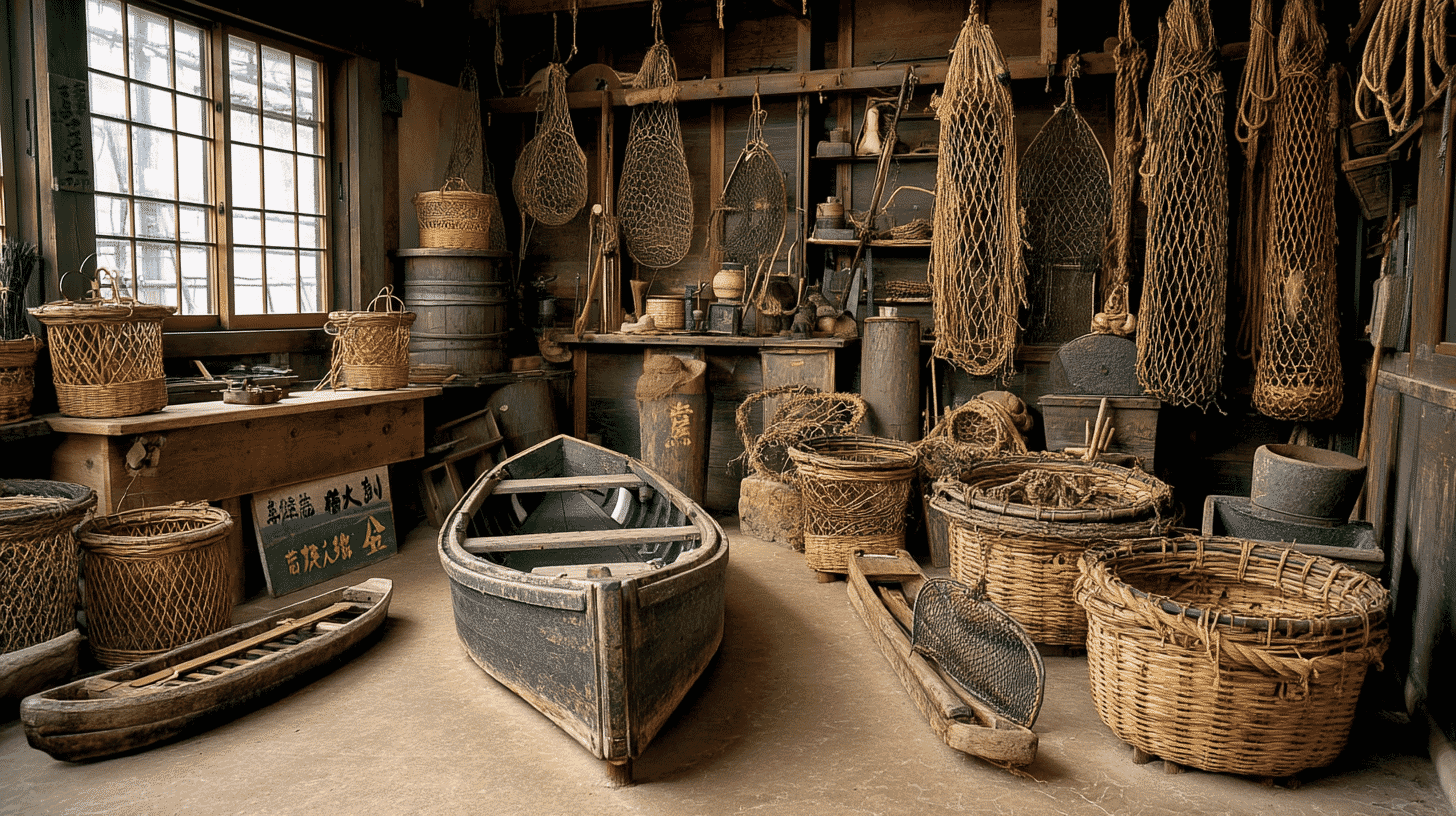
Rumoi Herring Fishing Tools: A Time Capsule of Hokkaido's Golden Age
In the coastal city of Rumoi, Hokkaido, lies an extraordinary treasure that tells the story of Japan's maritime heritage. The Rumoi Herring Fishing Tools from the former Saga Family Fishing Ground represent the only complete collection of herring fishing equipment preserved in Japan, designated as an Important Tangible Folk Cultural Property in 1995. This remarkable assemblage of 3,745 items offers international visitors a rare window into the fishing industry that built modern Hokkaido and shaped the lives of generations along Japan's northern coast.
The Saga Family Legacy: 113 Years of Herring Fishing History
The story begins in 1844 when Saga Heinojo, eighth generation of the Saga family, established a herring fishing ground in the Raiuke district of Rumoi. For 113 years until 1957, the Saga family operated this fishing ground, witnessing the rise and fall of Hokkaido's herring industry. Originally from Shimofuro village in present-day Aomori Prefecture, the Saga family brought their maritime expertise to Hokkaido during a period when herring fishing was transforming the region's economy.
What makes this collection truly exceptional is its completeness. In 1958, anticipating the herring fishing season, the Saga family prepared a full set of fishing tools and equipment. However, chronic poor catches led to the end of Hokkaido's herring fishing that year. The prepared equipment remained unused and perfectly preserved, creating an unprecedented historical record. Today, 14,585 items remain at the former Saga Family Fishing Ground, with 3,745 designated as nationally important cultural properties.
Why This Collection Earned National Recognition
The designation as an Important Tangible Folk Cultural Property reflects several unique characteristics that make these tools invaluable to understanding Japanese maritime history. First and foremost, this is the only herring fishing tool collection in Japan that has been preserved as a complete set. While individual tools exist in various museums, nowhere else can visitors see the entire ecosystem of equipment used in commercial herring fishing.
The collection demonstrates the scale and complexity of herring fishing operations that once dominated Hokkaido's economy. During the Meiji period, herring fishing reached its peak with an astonishing 979,984 tons caught in 1897 alone, representing nearly 60% of Japan's total fishery output. The Rumoi collection preserves the physical evidence of this industry that generated wealth comparable to modern oil rushes, funding the development of infrastructure, banking, and cultural institutions throughout Hokkaido.
Furthermore, these tools reveal the sophisticated division of labor and technical innovation that characterized herring fishing. From net-making to boat construction, from offshore harvesting to onshore processing, every aspect of the operation required specialized equipment and skills. The preservation of this complete toolkit allows researchers and visitors to understand the full scope of maritime industrial heritage.
Exploring the Collection: Five Categories of Maritime Heritage
The 3,745 designated items are organized into five main categories, each telling a different part of the herring fishing story.
Nets and Net-Related Equipment (1,059 items)
The heart of herring fishing lay in the massive nets that could capture entire schools of fish. The collection includes various types of nets, from the enormous frame nets (waku-ami) suspended from 16-meter boats to smaller gathering nets. Visitors can see the hemp ropes, wooden floats, stone weights, and the specialized tools used for net repair and maintenance. These nets required constant attention, and the collection preserves the complete toolkit of the net craftsmen who kept them fishing-ready.
Boats and Boat-Related Equipment (340 items)
Perhaps most impressive are the preserved boats themselves, including a 16-meter frame boat built in 1956 that never went to sea due to the collapse of herring fishing. These wooden vessels could hold 15-20 tons of herring in their suspended nets. The collection includes various boat types used at different stages of fishing: the large frame boats for setting nets, the smaller gathering boats (kumi-bune) for transferring caught fish, and the oars, anchors, and navigation equipment that made ocean fishing possible.
Offshore Harvesting and Processing Equipment (1,486 items)
This extensive category reveals the labor-intensive nature of herring processing. The iconic "mokkos" - wooden-frame backpack baskets - were carried primarily by women who transported 5-10 kilograms of fresh herring from boats to processing areas, with 50-60 fish per load. Processing tools include the distinctive "tamakiri hocho" (ball-cutting knives) used to break down dried herring fertilizer, with both single-person and two-person versions reaching 60 centimeters in length. The collection also preserves the massive iron cauldrons for boiling low-grade herring into fertilizer, oil extraction equipment, and the wooden presses used to separate fish oil from meal.
Repair and Maintenance Tools (307 items)
Commercial fishing demanded constant equipment maintenance. This category includes carpentry tools for boat repair, needles and thread for net mending, metalworking tools, and the specialized implements needed to keep fishing operations running through the intensive spring season. These tools demonstrate the self-sufficiency required of remote fishing communities.
Facility-Related Equipment (553 items)
Beyond fishing itself, the collection preserves items from the fishing ground's daily operations: cooking equipment for feeding hundreds of seasonal workers, storage containers, living quarters furnishings, and record-keeping materials. These mundane objects bring to life the community aspect of herring fishing, where 100 or more workers lived and worked together during the intensive spring fishing season.
The Rise and Fall of Hokkaido's Herring Empire
Understanding this tool collection requires knowing the broader story of Hokkaido herring fishing. The industry began in earnest during the Edo period when the Matsumae Domain controlled access to Hokkaido's rich fishing grounds. The place contracting system (basho ukeoi seido) allowed merchants to operate fishing grounds in exchange for tribute to domain samurai, laying the foundation for commercial fishing enterprises like the Saga family operation.
The Meiji Restoration opened Hokkaido to unrestricted development, and herring fishing exploded. Every spring from March through May, massive schools of spawning herring turned coastal waters milky white in a phenomenon called "kuki" (群来) - the coming of the multitudes. Seasonal workers called "yan-shu" traveled from throughout northern Japan to work the herring season, sleeping in large bunkhouses called "nishingoten" (herring palaces) and singing work songs like "Soran Bushi" as they hauled nets by hand.
The wealth generated by herring fishing built Hokkaido's infrastructure. Successful fishing families constructed elaborate mansions, merchants established banks and trading houses, and port cities like Otaru became known as the "Wall Street of the North." Herring products - from high-grade kazunoko (herring roe) to dried fish and fish meal fertilizer - were shipped throughout Japan via the Kitamae-bune trading routes.
However, by the 1950s, chronic overfishing and environmental changes caused herring populations to collapse. The last significant catch in Rumoi came in 1955 with just 317 koku, a fraction of historical levels. By 1957, the industry had effectively ended. The Saga family's 1958 preparations represent the final chapter of this epic story - equipment prepared for a fishing season that would never come.
Visiting the Former Saga Family Fishing Ground
The former Saga Family Fishing Ground and its remarkable tool collection are preserved as a National Historic Site in the Raiuke district of Rumoi City. The site includes six original structures: the main house, two warehouses (Tota-gura and Funa-gura for storing boats), the net warehouse, the processing corridor (Roka), and an Inari shrine. Archaeological remains of fish meal processing facilities, drying grounds, and boat landing areas provide additional context for understanding the fishing operation's scale.
Seasonal public viewings are typically held from late spring through autumn, though advance arrangements are recommended. International visitors should contact the Rumoi City Board of Education Lifelong Learning Division (TEL: 0164-42-0435) to arrange visits, as English language support may be limited but staff are welcoming to international guests interested in this unique heritage.
The site offers a rare opportunity to see authentic industrial heritage in its original location. Walking through the warehouses filled with carefully preserved equipment, visitors gain visceral understanding of the physical demands of pre-industrial fishing. The scale of the nets, the size of the processing knives, and the weight of the carrying baskets make vivid the labor that built Hokkaido.
Discovering Rumoi: Beyond the Fishing Heritage
Rumoi offers international visitors a quieter alternative to Hokkaido's crowded tourist destinations while providing authentic glimpses of northern Japan's maritime culture. The city's location on the Japan Sea coast provides stunning sunset views, with Ougon Misaki (Golden Cape) designated as one of Japan's Top 100 Sunset Viewing Spots. On clear days, visitors can see the silhouettes of Rishiri Island and the Teuri and Yagishiri islands floating on the horizon.
The Rumoi City Uminofurusato Kan (Sea Heritage Museum) provides broader context for understanding the region's fishing history through exhibits, replicas, and historical documentation. Open from late April through mid-October (9:00 AM to 6:00 PM), the museum complements a visit to the Saga Family Fishing Ground with more detailed explanations available in Japanese.
For culinary experiences, Rumoi remains Japan's leading producer of kazunoko (herring roe), processing over 50% of the nation's supply. Local restaurants serve fresh seafood throughout the year, with spring bringing fresh herring when available. The city's specialty "RuRu Rosso" pasta, made from locally-grown "Rurulosso" wheat cultivated only in Rumoi and neighboring Obira, offers a unique local food experience.
Nature enthusiasts can explore the Shokanbetsu-Teuri-Yagishiri Quasi-National Park north and south of Rumoi, featuring the sacred peaks of Shokanbetsu-dake and the Uryu-numa wetland, a Ramsar Convention registered site with over 100 ponds and spectacular seasonal wildflowers and autumn foliage.
Planning Your Visit: Access and Practical Information
Rumoi lies approximately 131 kilometers north of Sapporo, making it accessible as a day trip or overnight excursion from Hokkaido's capital.
By Car
Driving from Sapporo takes approximately 2 hours and 10 minutes via the Hokkaido Expressway to Fukagawa Junction, then the Fukagawa-Rumoi Expressway (toll-free) to Rumoi IC. Alternative scenic routes along coastal Highway 231 take about 3 hours but offer spectacular Japan Sea views.
By Public Transportation
Express buses operate from Sapporo Station to Rumoi Terminal, taking approximately 3 hours and 9 minutes. The "Kosoku Rumoi-go" (Express Rumoi) buses run via either Takikawa or Fukagawa routes. Alternatively, take JR Limited Express Lilac or Kamui from Sapporo to Fukagawa Station (about 1 hour), then transfer to local bus to Rumoi (approximately 1 hour and 12 minutes). Note that bus frequencies are limited, so checking schedules in advance is essential.
Best Seasons to Visit
Late spring through autumn (May to October) offers the most comfortable weather and coincides with the typical public viewing period for the Saga Family Fishing Ground. Spring (March to May) historically marks herring season and occasionally sees modern herring festivals. Summer provides warm weather for exploring coastal areas, while autumn brings spectacular foliage to nearby mountains. Winter visits are possible but require preparation for heavy snow and cold temperatures, with reduced attraction hours.
Q&A
- What makes the Rumoi herring fishing tools unique compared to other fishing heritage sites in Japan?
- This is Japan's only complete, preserved set of herring fishing equipment from a single operation. While other locations display individual tools or partial collections, Rumoi preserves the entire ecosystem of equipment used in commercial herring fishing, from nets and boats to processing tools and daily life items. The 3,745 designated items remained unused after being prepared for the 1958 season, providing an unaltered snapshot of fishing technology at the end of Hokkaido's herring era.
- Can international visitors tour the site without speaking Japanese?
- While English language support is limited, the visual impact of the preserved equipment and structures communicates powerfully across language barriers. International visitors should contact the Rumoi City Board of Education (TEL: 0164-42-0435) in advance to arrange visits and inquire about any available English materials or interpretation services. The physical scale and authenticity of the collection make it worthwhile even without detailed Japanese explanations, and staff are welcoming to foreign guests.
- How long was the Saga Family involved in herring fishing, and why did they stop?
- The Saga Family operated their fishing ground in Rumoi's Raiuke district for 113 years, from 1844 until 1957. They stopped due to the catastrophic collapse of Hokkaido's herring populations in the 1950s. After decades of peak catches exceeding 900,000 tons annually, chronic overfishing and environmental changes caused herring to virtually disappear from Hokkaido waters. The 1955 Rumoi catch of just 317 koku marked one of the final commercial herring seasons, and by 1958, the industry had ended throughout Hokkaido.
- What other attractions should I combine with a visit to the herring fishing tools?
- Rumoi offers several complementary attractions: the Rumoi City Uminofurusato Kan (Sea Heritage Museum) provides broader fishing history context; Senbodai observation point offers panoramic coastal views and spectacular sunsets over the Japan Sea; Golden Beach Rumoi provides northern Hokkaido's largest beach experience in summer; and the surrounding Shokanbetsu-Teuri-Yagishiri Quasi-National Park features hiking, wetland exploration, and island excursions. Food enthusiasts should try local kazunoko (herring roe) products and the unique RuRu Rosso pasta made from locally-grown wheat.
- Is herring fishing still practiced in Rumoi today?
- After disappearing for over 40 years, herring began returning to Hokkaido waters in the late 1990s following extensive conservation efforts including fry releases, spawning ground restoration, and fishing regulations. In 1999, the "kuki" (群来) phenomenon of spawning herring turning water milky white was observed in Rumoi for the first time in 45 years. Small-scale herring fishing has resumed in some Hokkaido locations, though nothing approaching historical levels. Today, Rumoi's fishing industry focuses on processing imported kazunoko (herring roe), accounting for over 50% of Japan's production, keeping the city's herring connection alive in a different form.
Basic Information
| Official Name | Rumoi Herring Fishing Tools (Former Saga Family Fishing Ground) |
|---|---|
| Japanese Name | 留萌のニシン漁撈(旧佐賀家漁場)用具 (Rumoi no Nishin Gyoro (Kyu Sagake Gyoba) Yogu) |
| Designation | Important Tangible Folk Cultural Property (国指定重要有形民俗文化財) |
| Designation Date | December 26, 1995 |
| Number of Items | 3,745 designated items (14,585 items total preserved) |
| Location | Raiuke district, Rumoi City, Hokkaido (Former Saga Family Fishing Ground site) |
| Operating Period | 1844-1957 (113 years of continuous operation) |
| Related Historic Site | Former Rumoi Saga Family Fishing Ground (National Historic Site, designated March 11, 1997) |
| Viewing Arrangements | Contact: Rumoi City Board of Education, Lifelong Learning Division TEL: 0164-42-0435 Seasonal public viewings typically held late spring through autumn; advance inquiry recommended |
| Access from Sapporo | By Car: Approximately 2 hours 10 minutes via Hokkaido Expressway and Fukagawa-Rumoi Expressway By Bus: Approximately 3 hours 9 minutes via Express Rumoi bus from Sapporo Station |
| Nearest Tourism Information | Rumoi Tourism Information Center TEL: 0164-43-6817 Address: Uminofurusato Kan, 2-3-1 Omachi, Rumoi City |
References
- 留萌のニシン漁撈(旧佐賀家漁場)用具 - Cultural Heritage Online
- https://bunka.nii.ac.jp/heritages/detail/160691
- 留萌のニシン漁撈用具について - Rumoi City Official Website
- https://www.e-rumoi.jp/syougaigakusyu/page29_00101.html
- 旧留萌佐賀家漁場 - Cultural Heritage Online
- https://bunka.nii.ac.jp/heritages/detail/200906
- 北海道を豊かにした魚・ニシン - Discover Japan
- https://discoverjapan-web.com/article/81575
- 群来はいずこへ―江戸時代から北海道の代名詞:ニシン - Hokkaido Development Bureau
- https://www.hkd.mlit.go.jp/ky/ki/kouhou/70th/history/00-06.html
- 留萌市への交通アクセス - Rumoi City
- https://www.e-rumoi.jp/shisei/rum_00005.html
- Access Information - Rumoi Tourism Association
- https://www.rumoi-rasisa.jp/web/access/
Nearby heritages
- Former Rumoi Saga Family Fishing Grounds
- Reukecho, Rumoi City
- Former Homma Family Residence
- 30 Bentencho 1-chome, Mashike-cho, Mashike-gun, Hokkaido
- Former Hanada Family Guardhouse (Odaira Town, Rumoi
- 35-2 Onika Hirotomi, Obira-cho, Rumoi-gun, Hokkaido
- Shonai Domain Hamamashike Jinya Ruins
- Hamamasu Village, Hamamasu District
- Otoe Stone Circle
- Otoecho, Fukagawa City
- Takasu Farrier Equipment and Related Materials
- 1-1-19 Minami 1-jo, Takasu-cho, Kamikawa-gun, Hokkaido
- Yamazaki Family Residence Main Building
- 2-3-2399 Akebono, Asahikawa City, Hokkaido, etc.
- Yagishiri's Natural Forest
- Haboro Town, Tomamae County
- Former Asahikawa Kaikosha
- 1-1-1, 4th Ward, Asahikawa City, Hokkaido
- Asaden Shunko Maintenance Factory (former Army 7th Division
- 231 Harumi 3-jo 7-chome, Asahikawa City, Hokkaido