
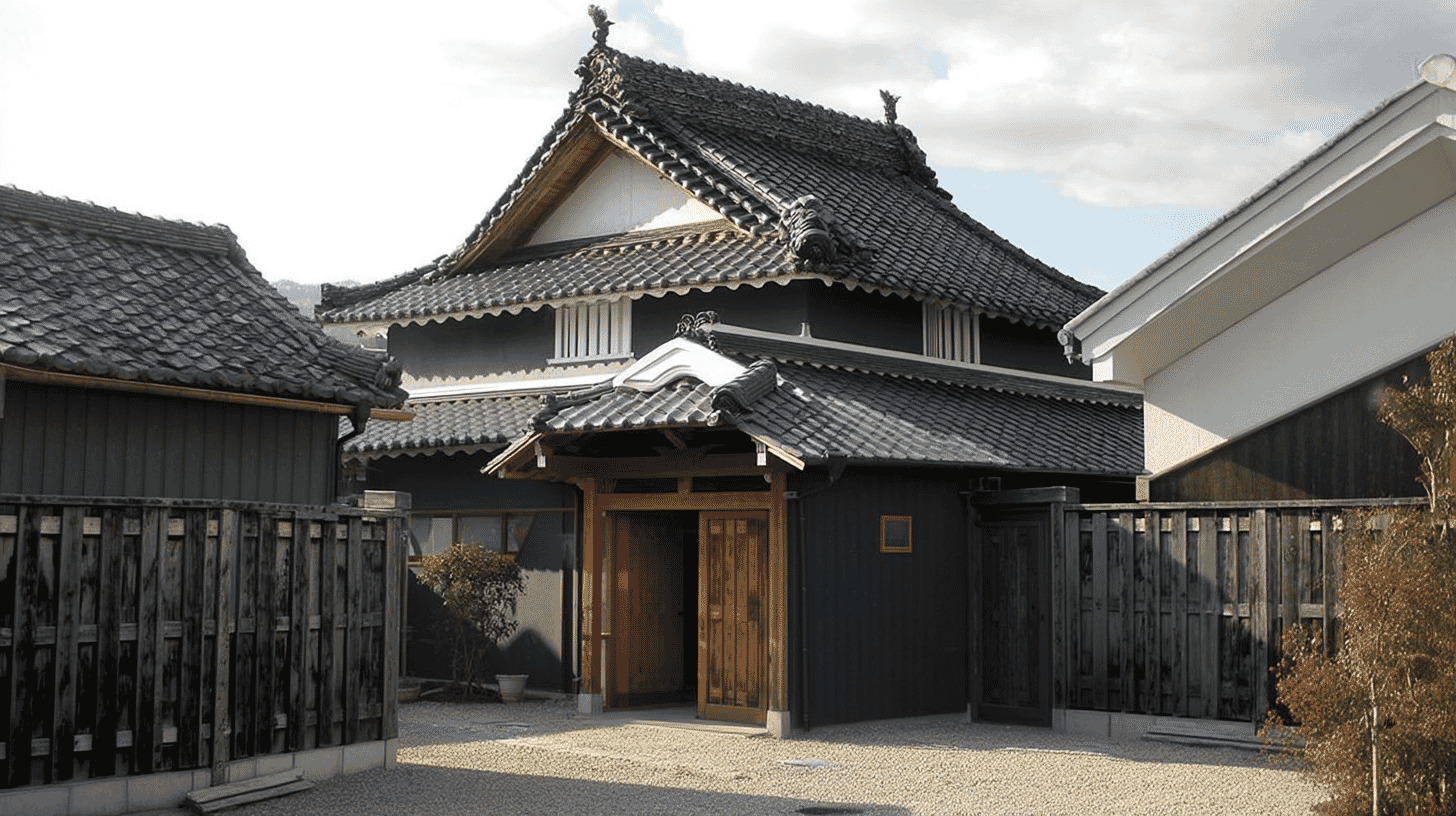
Iwasake Residence Storehouse: A Living Testament to Meiji-Era Agricultural Life
Standing quietly in the Toba district of Akashi City, Hyogo Prefecture, the Iwasake Residence offers visitors a rare glimpse into the daily life of prosperous Japanese farmers during the Meiji era. Built in 1904, this beautifully preserved complex—comprising a main house and adjacent storehouse—was designated as a Nationally Registered Tangible Cultural Property in 2007, recognizing its exceptional value as an example of traditional Japanese residential architecture.
What makes the Iwasake Residence particularly remarkable is its survival amid rapid urbanization. When the Nishi-Akashi Shinkansen Station opened in 1972, the surrounding area transformed dramatically from quiet farmland into a bustling suburban district. Yet through these changes, the Iwasake family has carefully maintained their ancestral home, preserving an authentic window into Japan's agricultural past that becomes more precious with each passing year.
Architectural Features: The Art of Black and White Stucco
The Iwasake Residence showcases the refined architectural traditions that characterized prosperous Meiji-era farmhouses. The complex demonstrates the Japanese aesthetic principle of contrast through its striking combination of black and white stucco finishes, a design choice that was both functional and visually appealing.
The main house is a two-story wooden structure measuring approximately 121 square meters in floor area. Its exterior walls are finished in kuro-shikkui, or black stucco, creating the elegant "nurizuya" style that was popular among wealthy farmers of the period. The roof follows the traditional irimoya-zukuri design—a graceful hip-and-gable form—covered with sanngawara clay tiles. Perhaps the most distinctive feature is the mukuri hafu, a gently curved gable with a subtle outward arc that adds an air of refined elegance to the building's facade.
The storehouse, or dozo, presents a beautiful contrast with its shiro-shikkui white stucco walls. This two-story structure sits adjacent to the main house, covering a compact 15 square meters. Built in the traditional kirizuma-zukuri gabled style with hongawara tiles, the storehouse features the characteristic thick earthen walls that protected valuable goods from fire and theft. The entry on the western face includes a traditional arrangement of sliding doors: a heavy earthen door for security, a wooden board door, and a decorative lattice door.
Why Was It Designated a Cultural Property?
The Iwasake Residence earned its registration as a Nationally Registered Tangible Cultural Property for several compelling reasons. First, it represents a quintessential example of Meiji-era farmhouse architecture, displaying the typical layout and construction methods that characterized prosperous agricultural households of the period. The building demonstrates how Japanese carpenters of the late 19th and early 20th centuries combined traditional techniques with subtle innovations.
Highlights and Points of Interest
Visitors to the Iwasake Residence will find much to appreciate in its thoughtful design and historical significance. The contrast between the black stucco main house and white stucco storehouse creates a visually striking composition that exemplifies Japanese aesthetic sensibilities. This color scheme was not merely decorative—black stucco was believed to offer superior fire resistance, while white stucco on storehouses symbolized purity and the protection of stored wealth.
The mukuri hafu curved gable on the main house deserves particular attention. Unlike the more common straight or concave gables, the mukuri style features a gentle convex curve that creates an impression of gentle elegance. This architectural detail was associated with higher-status buildings and demonstrates the family's prosperity during the Meiji period.
The traditional floor plan of the main house follows patterns established over centuries. The eastern portion contains the doma, an earthen-floored work area essential for agricultural families, while the western section houses the living quarters: an entrance room, an 8-mat parlor for receiving guests, an 8-mat family living room, and a smaller Buddhist altar room. This arrangement reflects the dual nature of farmhouse life, where work and domestic activities coexisted within a single structure.
The connection between the main house and storehouse through a nando (storage closet) that serves as a kura-mae (storehouse entryway) illustrates the practical considerations of traditional Japanese architecture. This intermediate space provided weather protection when accessing the storehouse while maintaining the security that made these structures so valuable.
Exploring the Surroundings
The Iwasake Residence is located in a convenient area that offers numerous opportunities to explore Akashi's rich cultural heritage and modern attractions. Nishi-Akashi Station, just minutes away, provides excellent access via both the Shinkansen and local JR lines, making the area an ideal base for exploring the region.
History enthusiasts should not miss Akashi Castle, located approximately 3.2 kilometers away. Built in 1619 under orders from Shogun Tokugawa Hidetada, the castle features two original watchtowers that are themselves designated Important Cultural Properties. The surrounding Akashi Park offers beautiful seasonal scenery and is particularly famous for its spring cherry blossoms.
The Akashi City Museum of Culture provides comprehensive exhibits on local history and would make an excellent complement to a visit to the Iwasake Residence, offering broader context for the region's architectural and cultural development. Located adjacent to Akashi Castle, the museum presents Akashi's 40,000-year history through engaging displays.
For a unique scientific experience, the Akashi Municipal Planetarium stands directly on the 135th meridian east longitude—the line that defines Japan Standard Time. The museum's iconic 54-meter clock tower has become a symbol of Akashi and offers fascinating exhibits about time, space, and astronomy.
Food lovers will delight in the Uonotana Shopping Street near Akashi Station, a vibrant market known locally as the "Kitchen of Akashi." Here you can sample fresh seafood from the Akashi Strait, including the famous Akashi octopus, and try akashiyaki—the local version of takoyaki that many consider superior to its Osaka counterpart.
Q&A
- Can visitors enter the Iwasake Residence?
- The Iwasake Residence remains a private home owned by the Iwasake family. As such, interior access is generally not available to the public. However, the exterior architecture can be appreciated from public areas, and the building's distinctive black and white stucco walls make it a worthy destination for those interested in traditional Japanese architecture.
- How do I get to the Iwasake Residence from Nishi-Akashi Station?
- The residence is located in the Toba district of Akashi City. From Nishi-Akashi Station, the area is accessible by local bus or taxi. As this is a residential area, visitors are encouraged to be respectful of the neighborhood and the privacy of local residents.
- What is the difference between "Registered Cultural Property" and "Designated Cultural Property"?
- In Japan's cultural property protection system, "Designated Cultural Properties" receive the highest level of protection and include National Treasures and Important Cultural Properties. "Registered Cultural Properties" are buildings built at least 50 years ago that have historical or artistic significance but may still be used for their original purpose. The registration system was created in 1996 to protect modern architectural heritage while allowing continued private ownership and use.
- What makes Meiji-era farmhouse architecture special?
- Meiji-era farmhouses represent a transition period in Japanese architecture. While maintaining traditional construction methods and layouts inherited from the Edo period, they often incorporated subtle innovations and higher-quality materials that reflected Japan's modernization and economic development. The Iwasake Residence exemplifies this with its refined stucco work and elegant curved gable.
- Are there other registered cultural properties near Akashi?
- Yes, Akashi City has numerous designated and registered cultural properties. These include the Nakazaki Public Hall, the Akashi Municipal Planetarium building, historic temple gates at Gesshoji Temple, and the Sumiyoshi Shrine tower gate. The city's Cultural Property Division provides information about these sites for those interested in architectural heritage.
Basic Information
| Name | Iwasake Residence Storehouse (岩佐家住宅土蔵) |
|---|---|
| Cultural Property Status | Nationally Registered Tangible Cultural Property (Building) |
| Registration Date | July 31, 2007 |
| Year Built | 1904 (Meiji 37) |
| Location | Toba 538, Akashi City, Hyogo Prefecture, Japan |
| Owner | Iwasake Family (Private Residence) |
| Main House | Two-story wooden structure, 121㎡, black stucco walls, irimoya-zukuri hip-and-gable roof with sanngawara tiles |
| Storehouse | Two-story dozo construction, 15㎡, white stucco walls, kirizuma-zukuri gabled roof with hongawara tiles |
| Nearest Station | JR Nishi-Akashi Station (Sanyo Main Line / Sanyo Shinkansen) |
| Contact | Akashi City Cultural Properties Division: +81-78-918-5629 |
References
- 岩佐家住宅 主屋・土蔵 - 明石市
- https://www.city.akashi.lg.jp/bunka/b_shinkou_ka/iwasake.html
- 岩佐家住宅土蔵 - 文化遺産オンライン
- https://bunka.nii.ac.jp/heritages/detail/182466
- 岩佐家住宅主屋 - 文化遺産オンライン
- https://bunka.nii.ac.jp/heritages/detail/152855
- 岩佐家住宅 - Wikipedia
- https://ja.wikipedia.org/wiki/岩佐家住宅
- 西明石駅情報|周辺地図・観光情報 - JRおでかけネット
- https://guide.jr-odekake.net/station/0610609/
- 市内の指定・登録文化財 - 明石市
- https://www.city.akashi.lg.jp/bunka/b_shinkou_ka/kanko-bunka/bunkazai/shitei.html
Last verified: 2026.08.29