
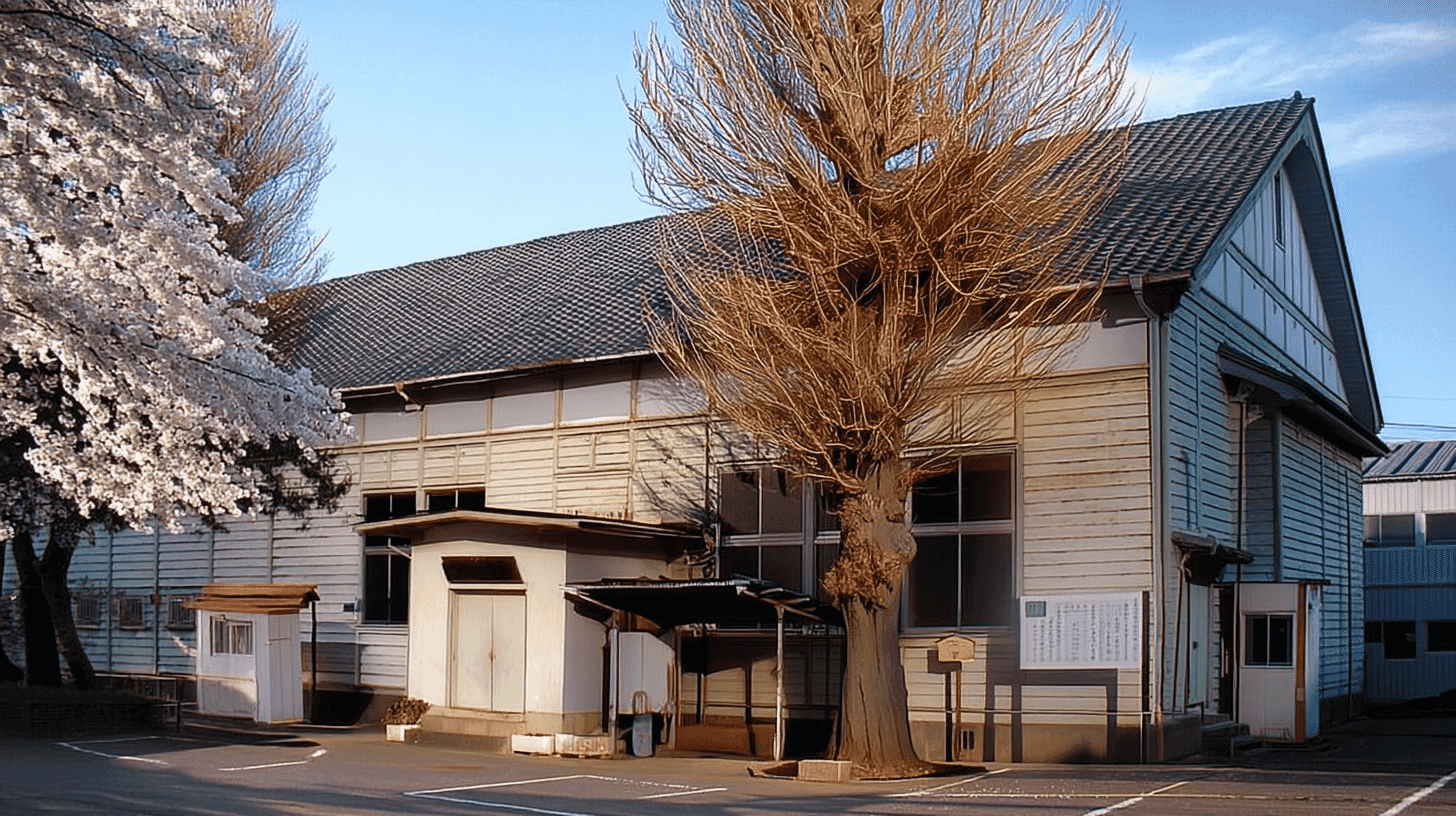
Built 1932, Registered in 2003
Budo Hall (former Mizukaido Elementary School Indoor Gymnasium and Auditorium) (武道館(旧水海道小学校雨天体操場兼講堂)) stands at 2680-1 Mitsukaido Sakae-cho, Joso City, Ibaraki Prefecture, entered on the national register of tangible cultural properties on 1 July 2003. The quantity is one building: timber, single storey, slate roof, with a footprint of 541 square metres. Its registration number is 08-0077.
The Agency for Cultural Affairs gives the date as early Showa, 1932.
Two uses appear in the name. The Agency writes: built as an indoor gymnasium and auditorium for the elementary school, now in use as a martial arts hall. The original use and the present one are set down side by side.
A Gymnasium That Was Also an Auditorium
An indoor gymnasium of this kind existed for exercise on wet days, when the schoolyard could not be used.
It also served as the auditorium. A space for ceremonies and assemblies and a space for physical exercise are combined in one building, because both call for the same thing: a large hall without columns.
A footprint of 541 square metres is large for a single-storey timber building. That scale answers to the double use.
It now serves as a martial arts hall. The use has not changed in kind so much as in name: gymnasium, auditorium and martial arts hall all require the same large interior.
The Walls Are Finished Differently by Part
The Agency describes the exterior precisely: timber, single storey, gabled, slate-roofed, with the gable boards and the upper parts of the side walls finished in the exposed-post manner and the rest in clapboard with the posts left showing.
The exposed-post manner is the Japanese method of plastering while leaving the frame in view. Clapboard, laid horizontally in overlapping boards, is a Western wall.
Gable boards and upper side walls in the exposed-post manner, everything else in clapboard: the division runs upper against lower.
Even the clapboard leaves the posts showing. Boards are laid while the frame stays visible, so Western boarding is combined with a Japanese way of thinking about structure. The Museido main building at Meiji Mura follows the same pattern, with Western clapboard below and plastered exposed-post work above.
The Ibaraki Prefectural Board of Education gives the same passage with one character different, describing the gable as a plain gable rather than a gable face. The same commentary appears in two slightly different forms.
The Owner Is Recorded as a City That No Longer Exists
The Agency gives the owner as Mizukaido City, and the prefectural record agrees.
Mizukaido City merged with Ishige Town in 2006 to form Joso City and no longer exists. Registration came on 1 July 2003, three years before. The location field reads Mitsukaido Sakae-cho, Joso City, while the owner field remains as it stood at registration.
The owner in the official record does not match the present administrative map. Takebe Station on the JR Tsuyama Line is the same case, its owner recorded as Takebe Town, absorbed into Okayama City in 2007.
Registration is a separate mechanism from designation: it works by notification and leaves the owner wide freedom to keep using the building. Keeping the structure while it serves as a martial arts hall follows from that framework.
Assessment and Visiting
The Agency's assessment reads: well preserved, its trim and dignified exterior a landmark in the local scene.
The assessment addresses the exterior and the townscape rather than the structure or the interior. What matters is how the building appears within the town.
It remains in use as a martial arts hall. It is not a facility for sightseeing, so use of the interior follows the way the hall is run; check Joso City's information.
The exterior can be seen from outside. The division between the exposed-post work on the gable and upper side walls and the clapboard below is easiest to read looking up from the street. The building stands at 2680-1 Mitsukaido Sakae-cho, Joso City, Ibaraki Prefecture.
Q&A
- When was the hall built and registered?
- The Agency for Cultural Affairs gives the date as early Showa, 1932. It was entered on the national register of tangible cultural properties on 1 July 2003, as one building of timber, single storey, slate-roofed, with a footprint of 541 square metres and registration number 08-0077.
- Why does the name carry two uses?
- The Agency records that it was built as an indoor gymnasium and auditorium for the elementary school and is now in use as a martial arts hall, so the original and present uses are set down side by side. All three uses call for the same thing: a large hall without columns.
- What marks the exterior?
- The Agency records the gable boards and upper parts of the side walls finished in the exposed-post manner and the rest in clapboard with the posts left showing. The division runs upper against lower, and even the boarded parts leave the frame in view.
- Why is the owner given as Mizukaido City?
- Mizukaido City merged with Ishige Town in 2006 to form Joso City and no longer exists. Registration came in 2003, three years before, and the owner field remains as it stood then. The location field reads Mitsukaido Sakae-cho, Joso City.
- Can it be visited?
- It remains in use as a martial arts hall and is not a facility for sightseeing, so use of the interior follows the way the hall is run; check Joso City's information. The exterior can be seen from outside.
Basic Information
| Name | Budo Hall (former Mizukaido Elementary School Indoor Gymnasium and Auditorium) (武道館(旧水海道小学校雨天体操場兼講堂)) |
|---|---|
| Location | 2680-1 Mitsukaido Sakae-cho, Joso City, Ibaraki Prefecture |
| Designation | Registered Tangible Cultural Property (structure); registration no. 08-0077 |
| Year Designated | 2003 (1 July), registered |
| Quantity | 1 building |
| Dimensions | Timber, single storey, slate roof, footprint 541 square metres. Gabled, with the gable boards and upper parts of the side walls in the exposed-post manner and the rest in clapboard with the posts left showing. Built 1932 |
| Owner | Mizukaido City, as recorded by the Agency; the city merged with Ishige Town in 2006 to form Joso City |
| Public Access | In use as a martial arts hall. Not a facility for sightseeing; use of the interior follows how the hall is run |
References
- Cultural Heritage Online: the Budo Hall, former Mizukaido Elementary School gymnasium and auditorium
- https://bunka.nii.ac.jp/heritages/detail/149965
- Ibaraki Prefectural Board of Education: the Budo Hall
- https://kyoiku.pref.ibaraki.jp/bunkazai/bunkazai-registered-6397/
- Joso City: registered tangible cultural property, the Budo Hall
- https://www.city.joso.lg.jp/kurashi_gyousei/kurashi/gakkou_kyouiku/isan/naregi_bunka_tangible/budokan.html
- Agency for Cultural Affairs: the registration system for tangible cultural properties
- https://www.bunka.go.jp/seisaku/bunkazai/shokai/yukei_kenzobutsu/
Last verified: 2026.09.04