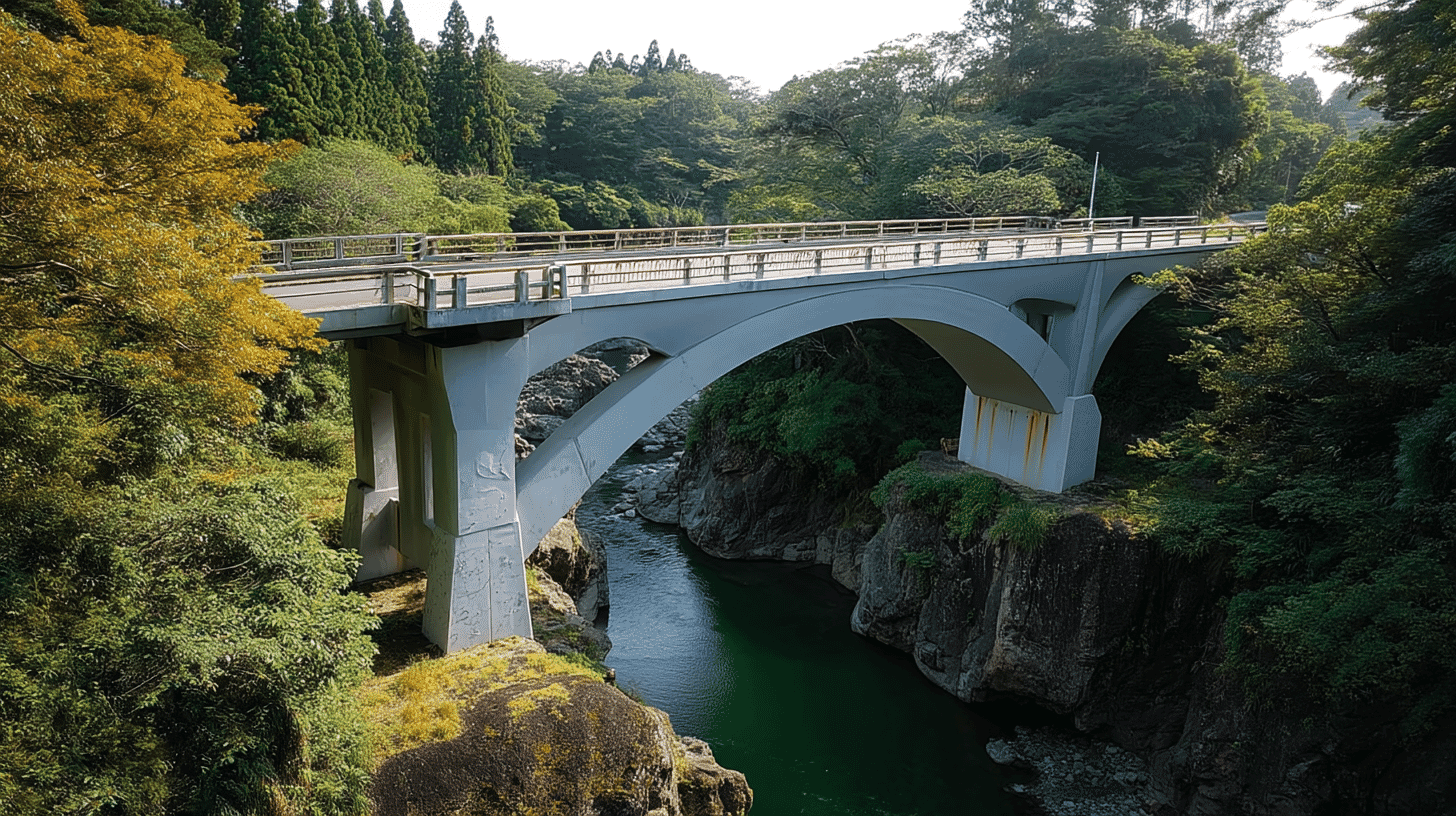
Chojataki Bridge: Japan's Rare Bamboo-Reinforced Heritage Bridge over Genbikei Gorge

Discover Chojataki Bridge, a rare bamboo-reinforced concrete arch bridge built in 1939, spanning the stunning Genbikei Gorge in Iwate Prefecture. This Registered Tangible Cultural Property showcases wartime Japanese engineering ingenuity and offers breathtaking views of a nationally designated Place of Scenic Beauty.

Chojataki Bridge: A Testament to Japanese Wartime Ingenuity

Rising gracefully above the emerald waters of Genbikei Gorge, Chojataki Bridge (長者滝橋) stands as one of Japan's most remarkable examples of wartime engineering innovation. Built in 1939 using bamboo-reinforced concrete—a rare construction technique born from necessity—this elegant double-arch structure has weathered earthquakes, floods, and over eight decades of use while remaining an active road bridge to this day.

Located in Ichinoseki City, Iwate Prefecture, this bridge offers visitors a unique opportunity to witness a living piece of modern industrial heritage while enjoying some of Japan's most spectacular natural scenery. The bridge was registered as a Tangible Cultural Property of Japan in 1999, recognizing its historical and technical significance.

The Legend Behind the Name

The name "Chojataki" (長者滝) translates to "Wealthy Man's Waterfall," and the bridge takes its name from a fascinating local legend dating back to the era of the Oshu Fujiwara clan. According to folklore, a wealthy merchant known as the "Osumi no Choja" (大すみの長者) amassed an enormous fortune trading gold from this region. Some versions of the tale say he drew gold from one waterfall and lacquer from another, building his wealth through commerce with the capital in Kyoto.

Another version of the legend tells that when bandits threatened the area, the wealthy man hid his treasures in the waterfall's depths to protect them from thieves. Whether the story speaks of gold, lacquer, or hidden treasure, the waterfall—and now the bridge that spans it—carries the name of this legendary figure, adding a layer of romantic mystique to this already enchanting location.

Bamboo-Reinforced Concrete: Engineering Born from Necessity

What makes Chojataki Bridge truly exceptional is its construction material: bamboo-reinforced concrete, known in Japanese as "chikukin concrete" (竹筋コンクリート). During the late 1930s, as Japan's involvement in the Second Sino-Japanese War deepened, steel became a strategic military resource prioritized for weapons production. This left civilian construction projects scrambling for alternatives.

Japanese engineers turned to an abundant natural resource—bamboo. While bamboo's tensile strength is roughly half that of steel (approximately 200 N/mm² compared to steel's 400 N/mm²), it proved more than adequate for many construction applications. Bamboo's light weight (specific gravity of 0.3-0.4 compared to steel's 7.9), ready availability, and the Japanese people's long familiarity with working the material made it an ideal substitute.

The technical aspects of bamboo-reinforced concrete were formalized in 1941 when civil engineer Kawamura Kyo published "Chikukin Concrete," establishing best practices including: selecting 4-5 year old bamboo for optimal strength, harvesting in autumn when moisture content is lowest, splitting bamboo lengthwise rather than using whole culms, and maintaining the nodes for better grip within the concrete.

Today, structures built with this technique are exceedingly rare. While the technology fell out of use after the war when steel became available again, a handful of bamboo-reinforced structures survive, with Chojataki Bridge being one of the finest examples still in active use.

Architectural Features and Design

Chojataki Bridge showcases the elegant functionality of early 20th-century Japanese civil engineering. The structure features a two-span filled spandrel arch design, with each central arch spanning 18 meters. The total bridge length is 61 meters with a roadway width of 3.9 meters, connecting the banks of the Iwai River.

The filled spandrel (充腹) design gives the bridge its characteristic solid, substantial appearance. Unlike open spandrel arches with multiple smaller arches above the main arch, the filled spandrel design creates a more massive visual presence that harmonizes beautifully with the rugged rock formations of the gorge.

Perhaps most impressive is how the bridge piers are anchored directly into the bedrock of the gorge itself. This integration with the natural rock formations creates a seamless visual connection between the man-made structure and the geological features of this nationally designated Place of Scenic Beauty and Natural Monument.

Why Chojataki Bridge Became a Cultural Property

The bridge was designated as a Registered Tangible Cultural Property on November 18, 1999, for several compelling reasons. First and foremost, it represents one of Japan's few surviving examples of bamboo-reinforced concrete construction, making it an invaluable artifact of wartime industrial history. The technique represents Japanese ingenuity in the face of material scarcity—a theme that resonates throughout the nation's modern history.

Beyond its technical significance, the bridge has proven remarkably durable. In 2008, the Ichinoseki area was struck by two major earthquakes in June and July. Chojataki Bridge withstood both tremors, demonstrating the effectiveness of its construction and earning renewed respect for the engineering wisdom of its builders.

The bridge also holds cultural value for its perfect integration with Genbikei Gorge, a scenic wonder that has drawn visitors for centuries. The structure enhances rather than detracts from the natural beauty, serving as a viewing platform for the dramatic landscape while being a photogenic subject itself.

Genbikei Gorge: The Magnificent Setting

Chojataki Bridge spans the upper reaches of Genbikei Gorge (厳美渓), a 2-kilometer stretch of the Iwai River that was designated as both a National Place of Scenic Beauty and a Natural Monument in 1927. The gorge was carved over millions of years through volcanic rock deposited by eruptions from nearby Mount Kurikoma approximately 9 million years ago.

The geological features of Genbikei are extraordinary. The river has sculpted the welded tuff (volcanic rock) into dramatic formations, creating towering cliffs, mysterious caves, and countless potholes (甌穴) carved by the swirling action of stones caught in whirlpools. Some of these natural potholes exceed one meter in diameter and continue to develop during floods.

The gorge has been celebrated by notable figures throughout history. The powerful feudal lord Date Masamune praised Genbikei alongside Matsushima as one of the two great scenic wonders of his domain. He had over a thousand cherry trees planted along its banks, and a few of these centuries-old trees still survive near Tenko Bridge.

Highlights and Best Viewing Points

From Chojataki Bridge itself, visitors enjoy spectacular views both upstream and downstream. Looking toward the waterfall that gives the bridge its name, one can appreciate the dramatic cascade and the rock formations that inspired centuries of legend. The bridge marks the beginning of the most scenic stretch of Genbikei.

On the downstream (Hinokuchi) side of the bridge, visitors can descend to the riverbank via a path, allowing them to view the bridge from below and appreciate its architectural form against the sky. This vantage point also provides access to the area near Chojataki waterfall itself.

The bridge is particularly atmospheric when morning mist rises from the gorge or when autumn colors transform the surrounding mountains. Horse-drawn carriages occasionally cross the bridge during the tourist season, creating scenes reminiscent of an earlier era.

Nearby Attractions

The broader Genbikei area offers numerous attractions for visitors. The most famous is the "Flying Dango" (空飛ぶだんご) at Kakkoya teahouse, where customers can receive fresh rice dumplings and tea via a rope-and-basket system stretched across the gorge—an experience that has delighted visitors since 1937.

The Ichinoseki City Museum, a 15-minute walk from the gorge, houses exhibitions on local history and the achievements of Iwate's scholars and thinkers. The nearby Sahara Glass Park features over 100,000 glass artworks from around the world and offers glass-blowing experiences.

For those with more time, Genbikei serves as an excellent base for exploring the UNESCO World Heritage temples of Hiraizumi, including the famous golden Konjikido at Chusonji Temple, located just 20 minutes away by car.

Seasonal Highlights

Each season brings distinct beauty to Chojataki Bridge and Genbikei Gorge. Spring sees the remaining Edohigan cherry trees blooming along the riverbanks, their pink blossoms contrasting with the grey-green waters below. Summer brings lush greenery and offers respite from the heat with the cool spray of waterfalls and rapids.

Autumn is perhaps the most spectacular season, when maple and other deciduous trees paint the gorge walls in brilliant reds, oranges, and golds. The contrast between the warm autumn colors and the emerald river water creates scenes that have inspired artists and photographers for generations.

Winter transforms the landscape into a serene white wonderland, with snow-capped rocks and frozen spray creating dramatic formations. While visitor numbers are lower in winter, those who venture here find a quieter, more contemplative atmosphere.

📍 Plan Your Visit to Iwate
Find tours, activities & transport passes near Chojataki Bridge
[ Visit Hiraizumi & Chusonji Temple World Heritage ]

Q&A

QWhy is bamboo used instead of steel in this bridge?
AChojataki Bridge was constructed in 1939 during the Second Sino-Japanese War when steel was reserved for military use. Japanese engineers developed bamboo-reinforced concrete as an alternative, utilizing bamboo's natural tensile strength and abundance. The technique proved remarkably effective, and this bridge remains in active use more than 85 years later.
QCan you actually see the bamboo inside the bridge?
ANo, the bamboo reinforcement is completely encased within the concrete and not visible from the outside. The bridge looks identical to any other concrete arch bridge. The use of bamboo was confirmed through historical records from the time of construction and a 1987 strength survey that detected bamboo fragments.
QIs the bridge safe to cross?
AYes, the bridge is a functioning road bridge that carries regular vehicle traffic. It successfully withstood two major earthquakes in 2008, demonstrating its structural integrity. Visitors can safely walk across and even stop to enjoy the views of Genbikei Gorge.
QHow do I get to Chojataki Bridge from Tokyo?
ATake the Tohoku Shinkansen from Tokyo Station to Ichinoseki Station (approximately 2 hours). From there, take the Iwate Kenkotsu bus bound for Genbikei (approximately 20 minutes). The Genbikei bus stop is closest to the main gorge area, and Chojataki Bridge is located upstream, about a 15-minute walk.
QWhat is the best time to visit?
AAutumn (late October to mid-November) offers the most spectacular scenery with brilliant fall foliage. Spring cherry blossom season and summer are also beautiful. Early morning visits provide the best lighting for photography and fewer crowds. The area is accessible year-round, though some facilities may have reduced hours in winter.

Basic Information

Name Chojataki Bridge (長者滝橋 / Chōjataki-bashi)
Cultural Property Status Registered Tangible Cultural Property (Building) - Registered November 18, 1999
Construction Year 1939 (Showa 14)
Structure Bamboo-reinforced concrete double-arch bridge with reinforced concrete approach spans
Dimensions Total length: 61m, Width: 3.9m, Central arch span: 18m each
Location Minami-taki-no-ue, Gembimachi, Ichinoseki City, Iwate Prefecture, Japan
Owner Ichinoseki City
Access 20 minutes by bus from JR Ichinoseki Station (Genbikei Line), 15-minute walk from Genbikei bus stop; 8 minutes by car from Ichinoseki IC (Tohoku Expressway)
Admission Free (public road bridge)

References

Cultural Heritage Online - Chojataki Bridge (Agency for Cultural Affairs)
https://bunka.nii.ac.jp/heritages/detail/192399
Ichinoseki City Official Tourism Website - Chojataki Bridge
https://www.city.ichinoseki.iwate.jp/index.cfm/18,13144,87,230,html
Ichinoseki Tourism Portal "Ichi-tabi" - Genbikei
https://www.ichitabi.jp/spot/data.php?p=8
Wikipedia - Bamboo-Reinforced Concrete (竹筋コンクリート)
https://ja.wikipedia.org/wiki/竹筋コンクリート
Wikipedia - Genbikei (厳美渓)
https://ja.wikipedia.org/wiki/厳美渓
Genbikei Community Center - Genbikei Natural Monument Guide
https://genbicc.jp/【天然記念物】厳美渓とは/2/

Last verified: 2026.01.02

Nearby heritages