
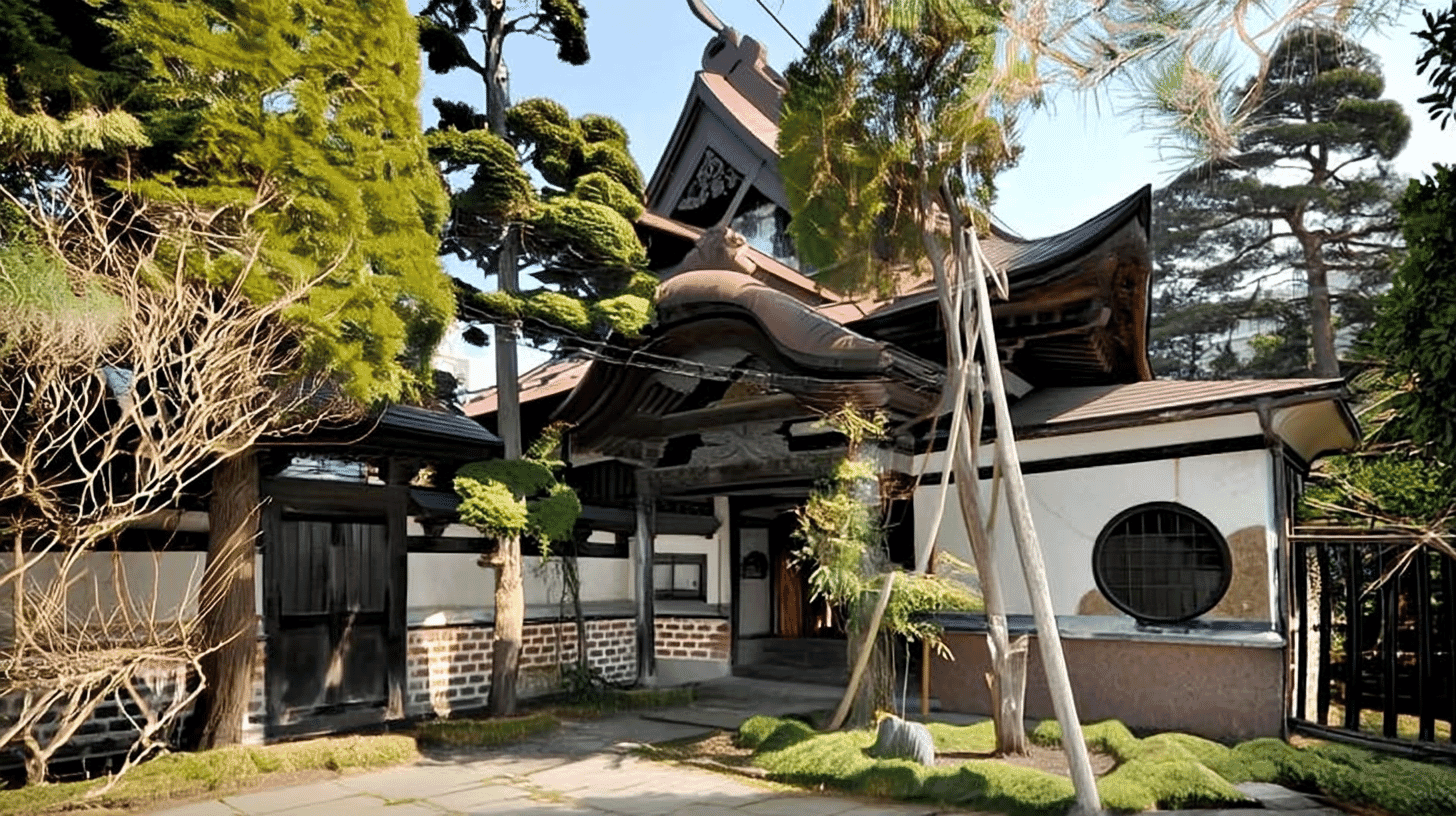
Seven Buildings Around a Main House of 1888, Designated in 2011
Former Takahashi Family Residence (旧高橋家住宅, Kyu Takahashi-ke Jutaku) stands at 6 Ohatakoji, Mizusawa Ward, Oshu City, Iwate Prefecture, designated an Important Cultural Property on 20 June 2011. The category is modern residential architecture and the designation number 02569. The owner is Oshu City, recorded by the Agency for Cultural Affairs under the owner type of municipality.
The designation covers seven buildings: the main house, the storehouse parlour, the earthen storehouse, the east and west board storehouses, the strongroom and the front gate. The main house dates from 1888: timber, with a footprint of 199.80 square metres, hip-and-gable roof, entered from the gable end, an undulating gable over the entrance on the east, a lean-to on the south, and a sheet-iron roof.
The Agency describes it as a residence standing in the former castle town of Mizusawa. That it sits within a castle town underlies how it is placed.
The Criterion for Designation Is Recorded
The Agency's record names the criterion under which the designation was made.
The first criterion cited is number five: outstanding in the characteristics of a school or a region. Important Cultural Properties are designated under several criteria, and which one applies is set down in the record.
This property was assessed on regional character. The measure is not its standing as the culmination of a national style but its character within the Tohoku region.
The commentary agrees. It is a large residence of free and inventive modern design, valuable as one of the lavish modern Japanese-style houses of the Meiji period in the Tohoku region. As one of marks a place within a type rather than a claim to be unique.
The Decorative Methods Are Listed
The Agency sets out the specific methods used inside and out.
The main house, built in 1888, presents an imposing exterior with a formal entrance under an undulating gable. Its rooms are finished with painted panels and with sand-plaster walls containing crushed shell, the alcove fittings and ceilings are elaborately worked, and choice timbers are used throughout.
Sand plaster is a wall finish mixed with sand, here with shell worked into it. The surface changes as the light falls on it. Painted panels are pictures on sliding doors and walls.
Choice timber means wood valued for itself. It is used to be seen rather than to carry load, so using it liberally shows the means of the household.
A formal entrance of this kind has a lowered projecting floor and carries standing; here it is roofed with an undulating gable. Exterior, walls, ceilings and timber: the decoration runs through every part of the building.
Documents and a Drawing Are Appended
Besides the seven buildings, four items are designated as appendages.
Two lengths of earthen wall, one set of gateposts with fencing, two volumes of building records, and one house-divination plan.
The first two are structures; the last two are on paper. The building records document the construction, and the divination plan sets out the layout of the house in terms of fortune.
A building and the papers made when it was built sit within one designation. They were added as evidence for the history of the house. At Chusonji the gong stand was principal and the gong appended; here it is documents that are appended.
The commentary closes: the front gate, the storehouse parlour and the rest are well preserved and retain the layout of a wealthy Meiji household, which gives the property high value. What is assessed is the arrangement of the whole compound rather than any single building.
Visiting
Oshu City owns the property and presents it among its samurai residences. It is open to visitors.
Opening hours and admission may change, so check the city's information before travelling. Not all seven buildings are necessarily open to their interiors.
The appended building records and divination plan are paper documents and are not necessarily displayed with the buildings. Check in advance if they are what the visit is for.
The property is at 6 Ohatakoji, Mizusawa Ward, Oshu City, Iwate Prefecture.
- 📍 Plan Your Visit to Iwate
- Find tours, activities & transport passes near Former Takahashi Family Residence
- [ Visit Hiraizumi & Chusonji Temple World Heritage ]
Q&A
- When was the property designated?
- On 20 June 2011, as an Important Cultural Property. The category is modern residential architecture, the designation number 02569, and the owner Oshu City, recorded under the owner type of municipality. The main house dates from 1888.
- How many buildings are included?
- Seven: the main house, the storehouse parlour, the earthen storehouse, the east and west board storehouses, the strongroom and the front gate. Two lengths of earthen wall, one set of gateposts with fencing, two volumes of building records and one house-divination plan are designated as appendages.
- Under what criterion was it designated?
- The Agency cites criterion five, outstanding in the characteristics of a school or a region. The measure is not its standing as the culmination of a national style but its character within the Tohoku region.
- What marks the decoration of the main house?
- The Agency records an imposing exterior with a formal entrance under an undulating gable, rooms finished with painted panels and sand-plaster walls containing crushed shell, elaborately worked alcove fittings and ceilings, and liberal use of choice timbers.
- Why are documents and a drawing designated?
- Two volumes of building records and a house-divination plan are included as appendages. The records document the construction and the plan sets out the layout in terms of fortune, so both were added as evidence for the history of the house.
Basic Information
| Name | Former Takahashi Family Residence (旧高橋家住宅, Kyu Takahashi-ke Jutaku) |
|---|---|
| Location | 6 Ohatakoji, Mizusawa Ward, Oshu City, Iwate Prefecture |
| Designation | Important Cultural Property (modern residential architecture), designation no. 02569; designated under the criterion of outstanding regional character |
| Year Designated | 2011 (20 June), Important Cultural Property |
| Quantity | 7 buildings: main house, storehouse parlour, earthen storehouse, east and west board storehouses, strongroom, front gate. Appended: 2 lengths of earthen wall, 1 set of gateposts with fencing, 2 volumes of building records, 1 house-divination plan |
| Dimensions | The main house is timber, footprint 199.80 square metres, hip-and-gable roof, entered from the gable end, undulating gable over the east entrance, lean-to on the south, sheet-iron roof. Rooms finished with painted panels and shell-flecked sand plaster, with choice timbers used throughout. Built 1888 |
| Owner | Oshu City (recorded by the Agency under the owner type of municipality) |
| Public Access | Presented by Oshu City among its samurai residences. Hours and admission may change |
References
- Agency for Cultural Affairs, National Cultural Properties Database: Former Takahashi Family Residence, main house
- https://kunishitei.bunka.go.jp/bsys/maindetails/102/00004499
- Cultural Heritage Online: Former Takahashi Family Residence, main house
- https://bunka.nii.ac.jp/heritages/detail/161424
- Oshu City: Former Takahashi Family Residence
- https://www.city.oshu.iwate.jp/samurai/bukejutaku/1723.html
- Oshu City: samurai residences
- https://www.city.oshu.iwate.jp/samurai/index.html
Last verified: 2026.09.04
Cultural Treasures in the Same Area
All are within walking distance in the same area, so we recommend visiting them together.
- Former Takahashi Family Residence Main house 0.00 km
- Former Takahashi Family Residence Storehouse room 0.01 km
- Former Takahashi Family Residence Front gate 0.02 km
- Former Takahashi Family Residence storehouse 0.02 km
- Former Takahashi Family Residence Treasury 0.02 km
- Former Takahashi Family Residence Nishiitakura 0.03 km
- Former Takahashi Family Residence Higashi Itakura 0.03 km