
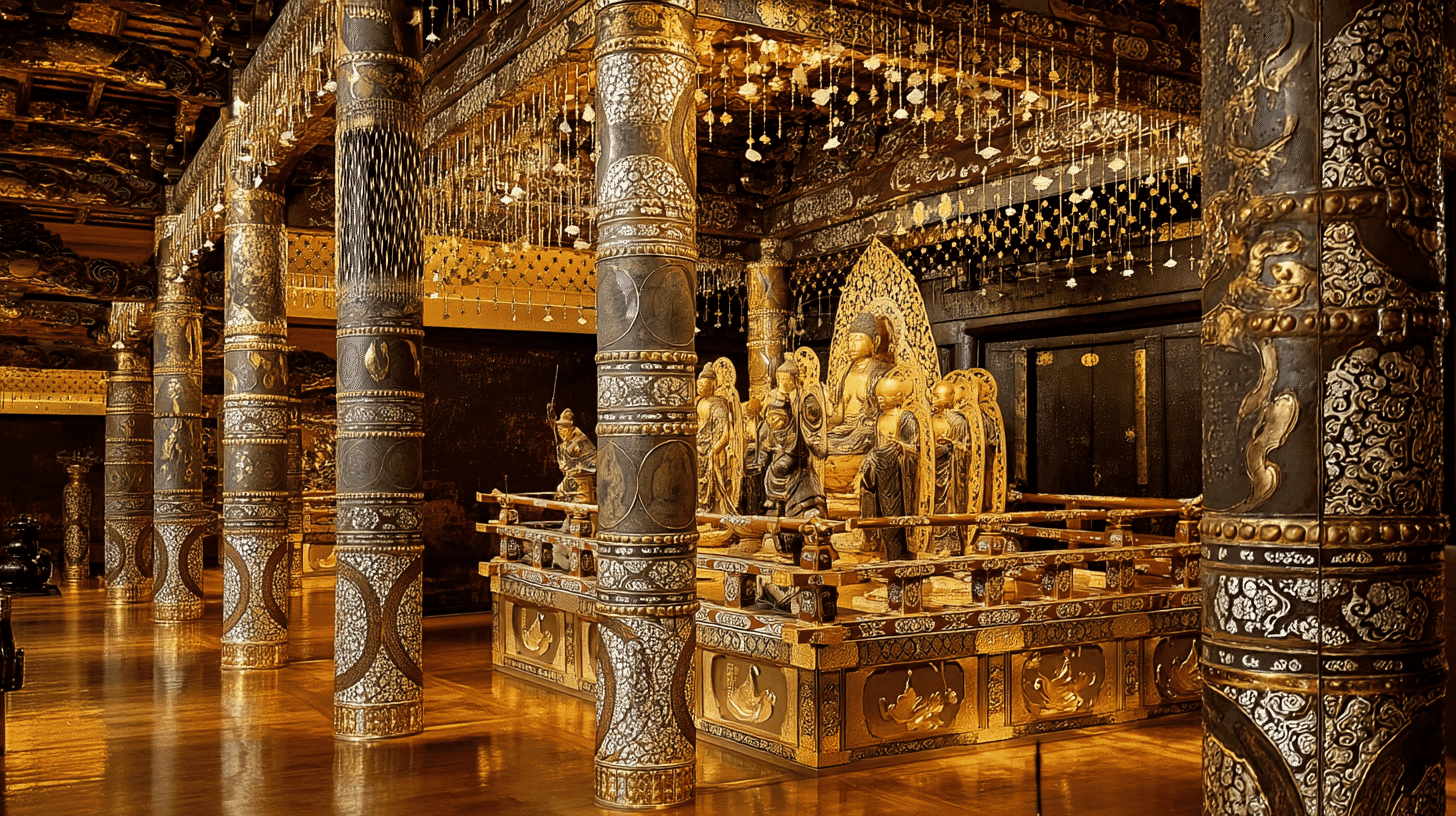
The Objects Standing Inside the Golden Hall, National Treasure since 1958
Interior of the Golden Hall of Chusonji Temple (中尊寺金色堂堂内具, Chusonji Konjikido Donaigu) is a group of Heian-period ritual objects in the Golden Hall of Chusonji at Hiraizumi, Nishiiwai County, Iwate Prefecture, designated a National Treasure in 1958, on 8 February. It had become an Important Cultural Property on 9 June 1951. The category is applied arts and the designation number 00219. It belongs to Konjikiin, with the Chusonji religious corporation as managing body.
What is designated is the equipment standing inside the hall, not the building. The Golden Hall itself is designated separately as a structure. The word furnishings in the name marks that distinction.
The Agency for Cultural Affairs leaves the quantity field blank and carries no commentary, so no words of assessment are recorded. The contents are set out in the itemised list.
Fourteen Objects in the List
The Agency's itemised list runs: one wooden dais, three tables in mother-of-pearl and sprinkled lacquer, one gong stand, three gilt bronze banner heads and six gilt bronze pendant ornaments with the design of the kalavinka bird. Fourteen objects in all.
The dais is where the officiating priest sits, the tables hold offerings, and the stand carries a gong. All three are equipment for conducting a service.
The banner heads are the metal fittings at the top of hanging banners, and the pendant ornaments hang within the hall. These are for adorning the hall rather than for use.
Three tables, three banner heads, six pendant ornaments: the same object recurs in numbers. They have come down as sets rather than singly, which marks the character of this designation.
The Peacock Gong Is Designated as an Appendage
Alongside the itemised list, the Agency's record carries a field for appended items: one peacock-design gong.
An appended designation covers something treated as belonging with the principal object. The gong stands apart from the fourteen items in the list, designated as an appendage to them.
A gong of this kind hangs on a stand beside the officiant and is struck during a service. The list holds the stand and the appended entry holds the gong: the stand is principal, what hangs on it is appended.
Another National Treasure carries the same name. The one held by Usa Jingu in Oita Prefecture is designated in its own right, while this one is an appendage. The same name can carry a different class of designation, so check location and class when consulting sources.
Owner and Managing Body Differ
The Agency records the owner as Konjikiin and the managing body as the Chusonji religious corporation.
The body that owns and the body that manages are recorded separately. Konjikiin is the sub-temple that has looked after the Golden Hall, and Chusonji is the temple above it.
The Golden Hall stands within a protective outer hall, and the furnishings are inside it. The building is doubled, so the furnishings cannot be seen from outside.
Chusonji is a component of the World Heritage property Hiraizumi: Temples, Gardens and Archaeological Sites Representing the Buddhist Pure Land. World Heritage inscription and national designation are separate systems and should not be run together.
Visiting
The Golden Hall stands within the protective outer hall and an admission charge applies. The furnishings are inside, so they are seen in the course of that visit.
Opening hours and charges can change with the season, so check the temple's information before travelling. Not all fourteen objects are necessarily in view at any one time.
The interior of the Golden Hall is viewed through glass. Close inspection is not possible, so the kalavinka design on the pendant ornaments and the mother-of-pearl on the tables must be taken in from a distance.
From Hiraizumi Station on the JR Tohoku Main Line it is about 25 minutes on foot, or a short bus ride.
- 📍 Plan Your Visit to Iwate
- Find tours, activities & transport passes near Interior of the Golden Hall of Chusonji Temple
- [ Visit Hiraizumi & Chusonji Temple World Heritage ]
Q&A
- When were the furnishings designated?
- They became an Important Cultural Property on 9 June 1951 and a National Treasure in 1958, on 8 February. The category is applied arts and the designation number 00219. They belong to Konjikiin, with the Chusonji religious corporation as managing body.
- What do they comprise?
- The Agency's list gives one wooden dais, three tables in mother-of-pearl and sprinkled lacquer, one gong stand, three gilt bronze banner heads and six gilt bronze pendant ornaments with the kalavinka design: fourteen objects. The dais, tables and stand are equipment for a service; the banner heads and pendants adorn the hall.
- Is the peacock gong included?
- It is recorded not in the list but as an appended item, one piece. An appended designation covers something treated as belonging with the principal object, so it stands apart from the fourteen. The list holds the gong stand and the appended entry holds the gong itself.
- Does this include the Golden Hall itself?
- No. What is designated is the equipment standing inside the hall, not the building; the Golden Hall is designated separately as a structure. The word furnishings in the name marks the distinction.
- Can the furnishings be seen?
- The Golden Hall stands within a protective outer hall and an admission charge applies; the furnishings are seen in the course of that visit. The interior is viewed through glass, so close inspection is not possible, and not all fourteen objects are necessarily in view at once.
Basic Information
| Name | Interior of the Golden Hall of Chusonji Temple (中尊寺金色堂堂内具, Chusonji Konjikido Donaigu) |
|---|---|
| Location | Koromonoseki, Hiraizumi, Nishiiwai County, Iwate Prefecture (Golden Hall of Chusonji) |
| Designation | National Treasure (applied arts), designation no. 00219; 1 peacock-design gong is designated as an appendage; the Golden Hall itself is designated separately as a structure |
| Year Designated | 1951 (9 June), Important Cultural Property; 1958 (8 February), National Treasure |
| Quantity | The Agency's quantity field is blank; the itemised list gives 1 wooden dais, 3 tables, 1 gong stand, 3 banner heads and 6 pendant ornaments, 14 objects together |
| Dimensions | The Agency's dimensions and materials fields are both blank. The dais, tables and gong stand are equipment for conducting a service; the banner heads and pendant ornaments adorn the hall. Heian period |
| Owner | Konjikiin (managing body: the Chusonji religious corporation) |
| Public Access | The Golden Hall stands within a protective outer hall and an admission charge applies. The interior is viewed through glass |
References
- Agency for Cultural Affairs, National Cultural Properties Database: the furnishings of the Golden Hall of Chusonji
- https://kunishitei.bunka.go.jp/bsys/maindetails/201/515
- Cultural Heritage Online: the furnishings of the Golden Hall of Chusonji
- https://bunka.nii.ac.jp/heritages/detail/197560
- Chusonji: the Golden Hall
- https://www.chusonji.or.jp/know/konjikido.html
- Chusonji: visitor information
- https://www.chusonji.or.jp/worship/
Last verified: 2026.09.04