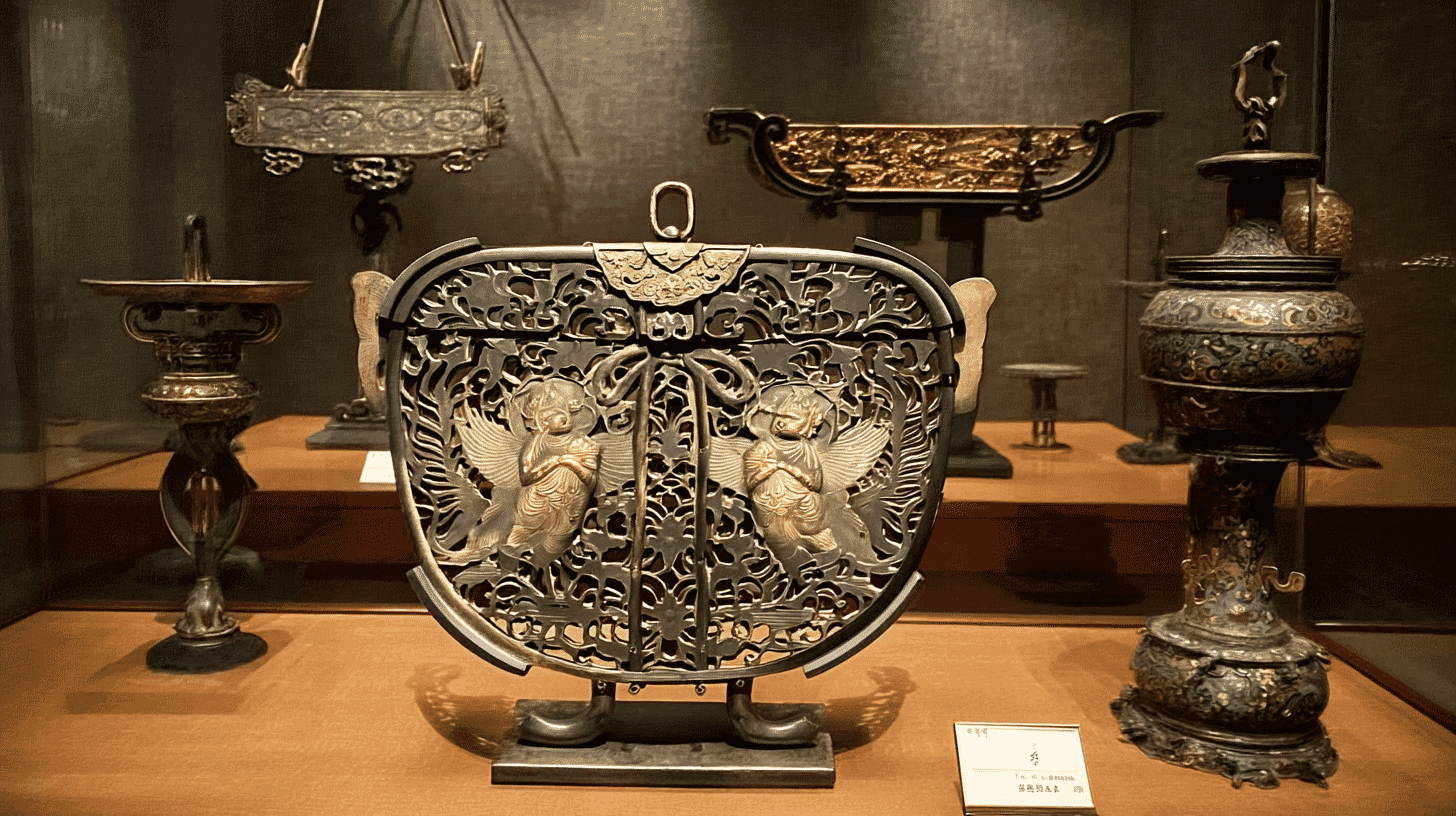
Interior Furnishings of the Sutra Repository at Chūsonji: A National Treasure of Heian Buddhist Craftsmanship
Nestled within the sacred grounds of Chūsonji Temple in Hiraizumi, Iwate Prefecture, lies a collection of liturgical furnishings that encapsulates the pinnacle of late Heian-period Buddhist craftsmanship. The Interior Furnishings of the Sutra Repository at Chūsonji (中尊寺経蔵堂内具, Chūsonji Kyōzō Dōnaigu) were designated a National Treasure of Japan in 1958. Comprising a ceremonial platform, an inlaid table, a gong stand, and a lamp stand, this ensemble of ritual objects represents one of the finest surviving collections of Buddhist liturgical furnishings from medieval Japan. Each piece showcases breathtaking techniques in mother-of-pearl inlay (raden), lacquerwork, and gilt-bronze metalwork that once adorned the interior of the temple's Sutra Repository, the building where the sacred Buddhist scriptures were housed.
The Legacy of the Ōshū Fujiwara Clan and Chūsonji
To appreciate these National Treasure furnishings, one must first understand the remarkable history of Hiraizumi and the Ōshū Fujiwara clan. In the early twelfth century, Fujiwara no Kiyohira — the first lord of the Ōshū Fujiwara — established his seat of power in Hiraizumi, in what is now Iwate Prefecture in northern Japan. Having endured devastating wars that claimed the lives of his own family, Kiyohira devoted himself to building a Buddhist utopia: a realm of peace where the spirits of all who had perished, friend and foe alike, would be guided to the Pure Land of Amida Buddha.
Beginning in 1105, Kiyohira undertook the grand reconstruction of Chūsonji, originally founded by the eminent Tendai monk Ennin (Jikaku Daishi) in 850. At its zenith, the temple complex boasted over 40 halls and pagodas, along with more than 300 monks' residences. The most celebrated of these structures is the Konjikidō (Golden Hall), completed in 1124, which gleams with gold leaf, mother-of-pearl, and ivory — a breathtaking physical manifestation of the Buddhist Pure Land.
Among the many halls constructed by the Fujiwara was the Kyōzō (Sutra Repository), which housed the precious sutras transcribed by three generations of the clan in gold and silver ink on indigo paper. Although a fire in 1337 destroyed most of the temple complex, both the Golden Hall and the Sutra Repository survived, preserving their treasures for future generations.
What Are the Kyōzō Interior Furnishings?
The Interior Furnishings of the Sutra Repository consist of four Buddhist liturgical objects, collectively designated as a single National Treasure. They were originally used inside the Kyōzō for religious ceremonies and rituals conducted by the monks of Chūsonji. Together, they form a rare surviving ensemble of Heian-period Buddhist furnishings that speaks to the extraordinary artistic ambitions of the Ōshū Fujiwara.
Wooden Ceremonial Platform (Raiban)
The raiban is a low, box-shaped ceremonial seat upon which the presiding priest would sit during Buddhist prayers and rituals. Standing 15.4 cm tall with a 65.4 cm square base, it is crafted from wood finished in lustrous black lacquer. The upper and lower frames are decorated in ike-kake-ji (a gold-dust sprinkling technique), while the corners and center panels feature exquisitely chased gilt-bronze fittings with nanako-ji (fish-roe texture) grounds and hōsōge (sacred floral) patterns. Between the metal fittings, mother-of-pearl inlay adds iridescent highlights. Each of the four sides contains two kōzama (cusped arches) framing embossed peacock-design gilt fittings, some still retaining tiny green and white glass jewels (ruri-dama).
Mother-of-Pearl Inlaid Table (Raden Heijin An)
This elegant offering table, standing 77.6 cm tall with a tabletop measuring 34.1 cm by 66.3 cm, served as a surface for placing Buddhist ritual implements and offerings. The lacquered wooden table features an indented rectangular top and openwork kōzama arches on its sides. Its most striking feature is the sagi-ashi (heron legs) — graceful pentagonal supports resembling the slender legs of a heron, with leaf-shaped fin decorations at the joints. The entire surface of the legs and side panels is decorated with heijin (scattered metal dust) lacquer overlaid with mother-of-pearl inlay depicting karakusa (arabesque) and hōsōge patterns. One leg retains its mother-of-pearl decoration remarkably well, offering a vivid glimpse of the table's original splendor.
Gong Stand (Keika) with Peacock-Design Gong
The keika is a wooden frame used to suspend a kei (gong) — a metal percussion instrument struck during Buddhist ceremonies to mark ritual transitions. At 57.9 cm tall and 55.1 cm wide, the stand features two upright columns supporting a mountain-shaped crossbeam with elegant warabi-te (bracken-fern scroll) finials. The stand was originally adorned with heijin lacquer and mother-of-pearl, though much of this decoration has been lost over the centuries, leaving only the carved outlines as evidence of its former beauty. The gilt-bronze fittings at the finials and column bases display the same refined nanako-ji and hōsōge arabesque patterns found throughout the ensemble. Attached to the stand as a supplementary designation is a cast bronze gong with a striking peacock motif (Kujaku-mon Kei), measuring 13.4 cm across the shoulders and 15.4 cm at the hem, with a lotus-flower striking point at its center.
Mother-of-Pearl Inlaid Lamp Stand (Raden Heijin Tōdai)
The tallest piece in the ensemble at 80.9 cm with a base diameter of 24.8 cm, this lamp stand once illuminated the interior of the Sutra Repository during evening ceremonies. Its entire surface is covered in heijin lacquer with scattered mother-of-pearl butterflies and hōsōge flowers — a decorative scheme that would have shimmered magnificently in candlelight. At the junction of the stem and receptacle, gilt-bronze fittings with nanako-ji ground, hōsōge arabesque patterns, and inome (heart-shaped) openwork are applied, while the base features matching four-lobed metal fittings. This lamp stand is currently held at the Tokyo National Museum.
Why Were They Designated a National Treasure?
The Interior Furnishings of the Sutra Repository were designated a National Treasure on February 8, 1958, in recognition of several exceptional qualities. The official designation statement notes that, aside from the attached gong, all pieces are believed to date from the founding period of the Sutra Repository — placing them in the late Heian to early Kamakura period (roughly the twelfth century).
Despite the inevitable deterioration of some mother-of-pearl and lacquer over nearly nine centuries, the furnishings retain their elegant forms and masterful metalwork. The intricately engraved gilt-bronze fittings, with their delicate nanako texturing and flowing hōsōge arabesque patterns, are recognized as outstanding examples of Heian-period artistry. The ensemble is valued not only for the individual quality of each piece, but also for the rarity of having a complete set of liturgical furnishings from a single Buddhist hall surviving together — a circumstance that provides invaluable insight into how the interior of a Heian-period temple would have been appointed.
Furthermore, these furnishings complement the other National Treasures from Chūsonji, including the Golden Hall Interior Furnishings and the mother-of-pearl octagonal pedestal (Raden Hakkaku Shumidan), forming a cohesive picture of the remarkable artistic culture fostered by the Ōshū Fujiwara clan in northern Japan.
Highlights and What to Look For
When visiting the Sankōzō treasure hall at Chūsonji, keep an eye out for these remarkable details among the Kyōzō furnishings:
- The surviving mother-of-pearl inlay on the sagi-ashi (heron leg) of the offering table — notice how the iridescent shell fragments create flowing arabesque patterns against the dark lacquer ground.
- The peacock-design embossed metal fittings on the raiban (ceremonial platform), featuring tiny glass jewels that hint at the original colorful brilliance of the piece.
- The gilt-bronze fittings throughout the ensemble, especially the nanako (fish-roe) ground texture achieved by punching tiny individual dots into the metal surface — a painstaking technique demonstrating extraordinary patience and skill.
- The cast bronze peacock gong, where two peacocks face each other holding flowers in their beaks, flanking a central lotus striking point — a masterpiece of Kamakura-period metalcasting.
Compare these furnishings with the similar but separate National Treasure set from the Golden Hall (Konjikidō) also displayed in the Sankōzō. The Kyōzō furnishings feature taller, more elegant "heron leg" supports on their offering table, while the Golden Hall versions are more compact. Together, these two ensembles reveal how the Fujiwara craftsmen adapted shared design principles to suit the distinct functions and scales of different temple halls.
Where to See the Furnishings
Several pieces from the Kyōzō Interior Furnishings are displayed at the Sankōzō (讃衡蔵), Chūsonji's treasure hall, which opened in the year 2000 to preserve the temple's more than 3,000 National Treasures and Important Cultural Properties. The mother-of-pearl inlaid offering table (raden heijin an) is among the items regularly on view here, alongside other extraordinary National Treasures such as the Fujiwara-era Buddhist sutras written in gold and silver ink.
The mother-of-pearl inlaid lamp stand (raden heijin tōdai), meanwhile, is deposited at the Tokyo National Museum, where it occasionally appears in special exhibitions. If you are planning a visit to Chūsonji, it is worth also visiting the Kyōzō building itself — the Sutra Repository stands near the Golden Hall and, though its interior has been largely cleared of its original contents, the structure retains Heian-period timbers and evokes the solemn atmosphere in which these furnishings once served their liturgical purpose.
Surrounding Attractions
Chūsonji is the crown jewel of Hiraizumi, a town that was registered as a UNESCO World Heritage Site in 2011 under the title "Hiraizumi — Temples, Gardens and Archaeological Sites Representing the Buddhist Pure Land." There is much to explore in the area beyond the Kyōzō furnishings:
- Konjikidō (Golden Hall) — Japan's National Treasure Building No. 1, this small hall is entirely covered in gold leaf and decorated with mother-of-pearl, lacquer, and ivory. It houses the mummified remains of four generations of the Fujiwara lords.
- Mōtsūji Temple — Another World Heritage component, featuring one of Japan's finest surviving Heian-period Pure Land gardens, with a tranquil pond reflecting the surrounding landscape.
- Takadachi Gikeido — A hilltop memorial overlooking the Kitakami River, dedicated to the tragic warrior Minamoto no Yoshitsune, who met his end in Hiraizumi. The haiku poet Matsuo Bashō composed one of his most famous verses here in 1689.
- Kanjizaiōin Ruins — The remains of a Pure Land garden built by the wife of the second Fujiwara lord, offering peaceful walks and historical contemplation.
- Genbikei Gorge — A scenic gorge about 20 minutes by car from Hiraizumi, famous for its unusual rock formations, emerald-green waters, and a legendary "flying dango" (sweet dumpling) service delivered by basket across the gorge.
- 📍 Plan Your Visit to Iwate
- Find tours, activities & transport passes near Interior of the Sutra Hall of Chusonji Temple
- [ Visit Hiraizumi & Chusonji Temple World Heritage ]
Q&A
- Can I see all four pieces of the Kyōzō Interior Furnishings at Chūsonji?
- Not all four pieces are displayed at Chūsonji at all times. The mother-of-pearl inlaid offering table (raden heijin an) and other items are regularly exhibited at the Sankōzō treasure hall on the temple grounds. However, the mother-of-pearl inlaid lamp stand (raden heijin tōdai) is deposited at the Tokyo National Museum. Check with both institutions before your visit if you wish to see the complete set.
- Is photography allowed inside the Sankōzō treasure hall?
- Photography is generally prohibited inside the Sankōzō and the Golden Hall (Konjikidō) to protect the sensitive cultural properties. Please enjoy the experience with your own eyes and consider purchasing postcards or catalogues from the museum shop as souvenirs.
- How much time should I allow for a visit to Chūsonji?
- Plan for approximately 1.5 to 2 hours to explore the temple grounds, including the walk up the Tsukimizaka approach path, the Sankōzō treasure hall, the Golden Hall, the Sutra Repository, and the Former Shelter Hall. If you wish to visit all the subsidiary halls and the Hakusan Shrine's Noh stage as well, allow up to 2.5 hours.
- What is the best season to visit Chūsonji?
- Each season offers its own charm. Spring (late April to early May) brings cherry blossoms and the Fujiwara Festival. Summer (July–August) features the rare Chūsonji lotus flowers germinated from 800-year-old seeds. Autumn (late October to early November) is spectacular for vibrant foliage along the approach path. Winter offers a serene, snow-dusted landscape with fewer crowds. The indoor Sankōzō exhibits can be enjoyed in any weather.
- What is "heijin" and "raden" — the techniques used on these furnishings?
- Heijin (平塵) is a lacquer decoration technique in which coarse metal filings (usually gold or silver) are sprinkled over a lacquered surface to create a glittering ground. Raden (螺鈿) refers to mother-of-pearl inlay, where thin pieces of iridescent shell — typically abalone or turban shell — are cut into decorative shapes and embedded into the lacquer surface. Together, these techniques created surfaces that shimmered with metallic and opalescent light, embodying the Buddhist vision of a luminous Pure Land.
Basic Information
| Designated Name | 中尊寺経蔵堂内具 (Interior Furnishings of the Sutra Repository at Chūsonji) |
|---|---|
| Designation | National Treasure (Craft / Decorative Arts) |
| Designation Date | February 8, 1958 |
| Period | Late Heian to Kamakura period (12th century) |
| Components | Wooden Raiban (Ceremonial Platform) ×1, Raden Heijin An (Mother-of-Pearl Inlaid Table) ×1, Keika (Gong Stand) ×1, Raden Heijin Tōdai (Mother-of-Pearl Inlaid Lamp Stand) ×1; with attached Kujaku-mon Kei (Peacock-Design Gong) ×1 |
| Owner | Daichōjuin (大長寿院), a sub-temple of Chūsonji |
| Location (Display) | Sankōzō Treasure Hall, Chūsonji Temple, Hiraizumi, Iwate Prefecture (some items at Tokyo National Museum) |
| Address | 202 Koromonoseki, Hiraizumi, Nishiiwai-gun, Iwate 029-4102, Japan |
| Opening Hours | 8:30–17:00 (Mar 1–Nov 3) / 8:30–16:30 (Nov 4–Feb 28/29); ticket sales end 10 min before closing |
| Admission | Adults ¥1,000 / High School ¥700 / Junior High ¥500 / Elementary ¥300 (includes Konjikidō, Sankōzō, Kyōzō, and Former Shelter Hall) |
| Access | JR Hiraizumi Station → bus approx. 5 min or walk approx. 20–30 min; also accessible from JR Ichinoseki Station (Tōhoku Shinkansen) via bus approx. 22 min |
| World Heritage | Part of "Hiraizumi — Temples, Gardens and Archaeological Sites Representing the Buddhist Pure Land" (registered 2011) |
| Official Website | https://www.chusonji.or.jp/language_en/ |
References
- Cultural Heritage Online — 中尊寺経蔵堂内具
- https://bunka.nii.ac.jp/db/heritages/detail/203829
- Iwate Cultural Information Encyclopedia — 中尊寺経蔵堂内具
- http://www.bunka.pref.iwate.jp/archive/hist5
- WANDER 国宝 — 中尊寺経蔵堂内具
- https://wanderkokuho.com/201-00514/
- Chūsonji Temple Official Website (English)
- https://www.chusonji.or.jp/language_en/
- Chūsonji Temple — History
- https://www.chusonji.or.jp/know/history.html
- Wikipedia — 中尊寺
- https://ja.wikipedia.org/wiki/%E4%B8%AD%E5%B0%8A%E5%AF%BA
- Japan National Tourism Organization — Chusonji Temple
- https://www.japan.travel/en/spot/1803/
Last verified: 2026.02.08