
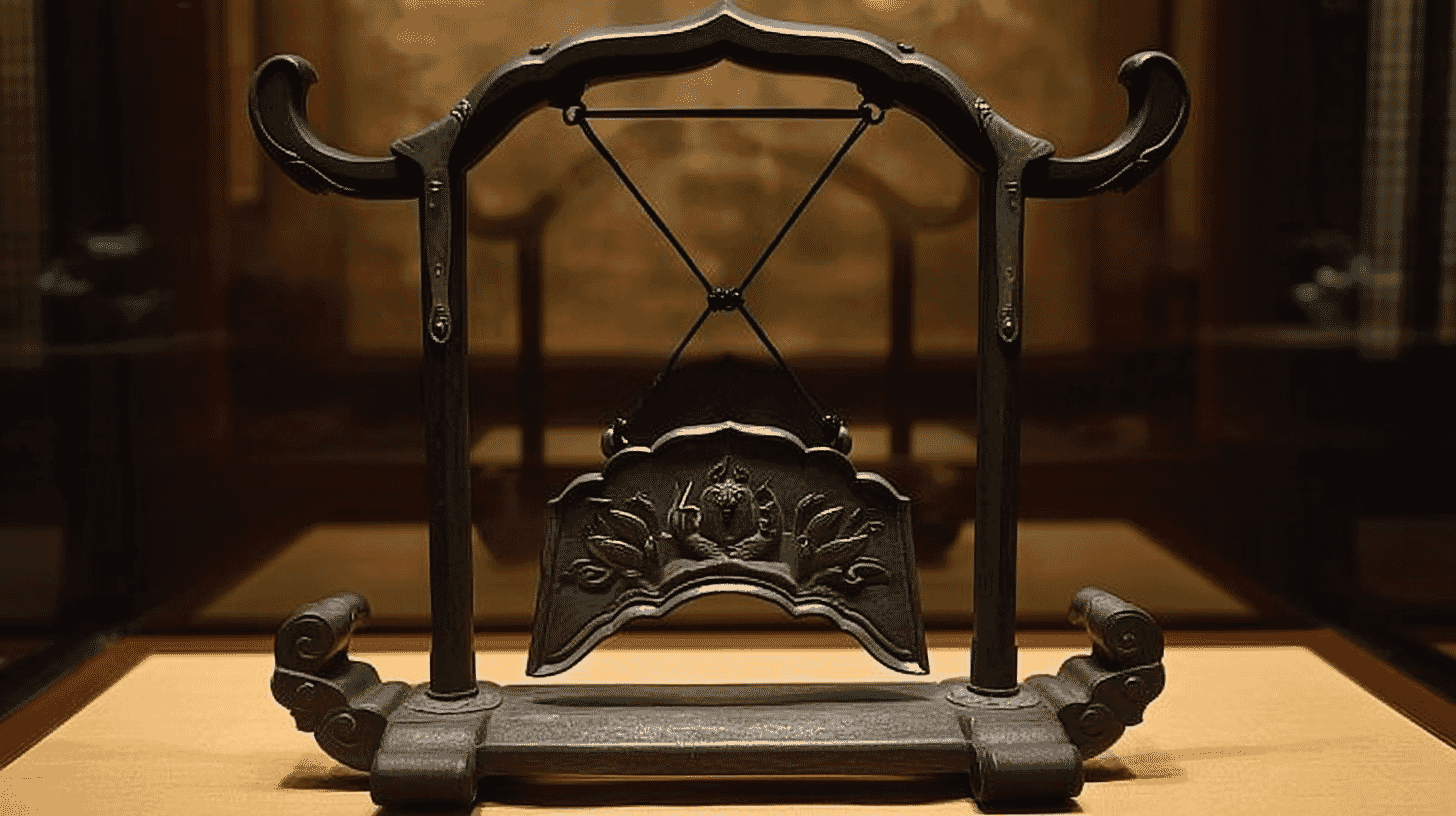
Inscribed with the Year 1250, National Treasure since 1953
Kei Gong with Peacock Design (Chusonji) (孔雀文磬, Kujakumon Kei) is a Kamakura-period gong at Chusonji in Hiraizumi, Nishiiwai County, Iwate Prefecture, designated a National Treasure in 1953, on 31 March. It had become an Important Cultural Property on 6 April 1929. The quantity is one piece, the category applied arts, and the designation number 00089. It belongs to Jizoin, with the Chusonji religious corporation as managing body.
A kei is a Buddhist implement hung on a frame and struck during a service. The Agency for Cultural Affairs gives the year as 1250 and notes an inscription recording its presentation in the first month of that year. The date is fixed by the inscription.
It measures 32.4 centimetres across the shoulders, 32.6 centimetres across the skirt, 13.0 centimetres high, with a striking boss 9.5 centimetres across and a rim 1.2 centimetres thick, weighing 2,100 grams. Shoulders and skirt are almost the same width.
The Peacocks Differ from Face to Face
The Agency's description of material and form notes what separates the two faces.
Cast bronze, gilded. A two-faced gong of the usual kind, the upper and lower edges each formed of three arcs, large in scale with shoulders and skirt almost equal and the peak low. A large, graceful striking boss sits at the centre, with peacocks cast in relief to either side and finished with line engraving. The two faces carry almost the same design, but on the front the peacocks are made as flower-bearing birds.
A flower-bearing bird holds a flower or spray in its beak. The peacocks on the reverse hold nothing; those on the front hold flowers. The faces are almost the same, and that single point is where they part.
The suspension ring is flat and large. It is the fitting by which the gong hangs from its stand.
The Inscription Names Where It Was Given
Incised inscriptions run beside the striking boss on both faces.
The front records the presentation to the Senjudo hall of Motsuji in 1250; the reverse records the same with the month and day added. The two faces carry the same statement, with the reverse alone giving the date in full.
Motsuji is a temple at Hiraizumi and the Senjudo is one of its halls. This gong was given to that hall and is now at Chusonji.
Hall of deposit, year and day all sit in the inscription. The gong at Usa Jingu likewise carries its hall of deposit and its year, 1209. A gong of this kind readily becomes the object on which a gift is recorded.
Old Form with Kamakura Marks
The Agency writes: the form is grand and imposing, and the modelling of the striking boss and the peacocks is finely done. The piece is on the whole of an older manner, but in parts, with the side edges nearly vertical and the outer two arcs of the upper and lower edges drawn in, it carries marks of the Kamakura period.
On the whole of an older manner, but is where the assessment turns. The general impression is close to an earlier form, while the details show Kamakura indicators.
Two such indicators are named: the side edges standing nearly vertical, and the outer two arcs at each edge drawn in. Reading the proportion of the arcs as a marker of period is the same framework applied to the gong at Usa Jingu, where the flanking arcs are drawn in against the central one.
More than one National Treasure carries this name. The one at Usa Jingu in Oita Prefecture is a separate entry, and the furnishings of the Golden Hall at Chusonji include a peacock gong as an appended item. The same name can mean a different unit of designation in a different place, so check when consulting sources.
Seeing It
Jizoin owns the gong, with the Chusonji religious corporation as managing body. The temple's holdings are shown in the Sankozo treasure hall at Chusonji.
Opening hours and charges can change with the season, so check the temple's information before travelling. It is not necessarily on permanent display.
The difference between the two faces is what repays looking at, but a gong is usually shown one face at a time. It is worth checking which face is on view.
From Hiraizumi Station on the JR Tohoku Main Line it is about 25 minutes on foot, or a short bus ride.
- 📍 Plan Your Visit to Iwate
- Find tours, activities & transport passes near Kei Gong with Peacock Design (Chusonji)
- [ Visit Hiraizumi & Chusonji Temple World Heritage ]
Q&A
- When was this gong designated?
- On 31 March 1953, having become an Important Cultural Property on 6 April 1929. It is listed as one piece in the applied arts category under designation number 00089. It belongs to Jizoin, with the Chusonji religious corporation as managing body.
- When was it made?
- The Agency gives the year as 1250, with an inscription recording its presentation in the first month of that year, so the date is fixed by the inscription. It measures 32.4 centimetres across the shoulders, 32.6 across the skirt and 13.0 high, weighing 2,100 grams.
- Do the two faces differ?
- Yes. The Agency records that the two faces carry almost the same design, but that on the front the peacocks are made as flower-bearing birds. Those on the reverse hold nothing in their beaks; those on the front hold flowers.
- What does the inscription say?
- Incised beside the striking boss on both faces, it records the presentation of the gong to the Senjudo hall of Motsuji in 1250, with the month and day added on the reverse. The gong was given to that hall at Motsuji and is now at Chusonji.
- Why was it designated?
- The Agency finds the form grand and imposing and the modelling finely done, and notes that while the piece is on the whole of an older manner, details such as the nearly vertical side edges and the drawn-in outer arcs carry marks of the Kamakura period.
Basic Information
| Name | Kei Gong with Peacock Design (Chusonji) (孔雀文磬, Kujakumon Kei) |
|---|---|
| Location | Koromonoseki, Hiraizumi, Nishiiwai County, Iwate Prefecture (Chusonji) |
| Designation | National Treasure (applied arts), designation no. 00089; a separate entry from the gong of the same name at Usa Jingu |
| Year Designated | 1929 (6 April), Important Cultural Property; 1953 (31 March), National Treasure |
| Quantity | 1 piece |
| Dimensions | 32.4 cm across the shoulders, 32.6 cm across the skirt, 13.0 cm high, striking boss 9.5 cm across, rim 1.2 cm thick, weight 2,100 g. Gilded cast bronze, two-faced, the upper and lower edges each of 3 arcs. On the front the peacocks are made as flower-bearing birds. Made 1250 |
| Owner | Jizoin (managing body: the Chusonji religious corporation) |
| Public Access | Shown in the Sankozo treasure hall at Chusonji. Hours and charges can change with the season |
References
- Agency for Cultural Affairs, National Cultural Properties Database: the peacock gong at Chusonji
- https://kunishitei.bunka.go.jp/bsys/maindetails/201/377
- Cultural Heritage Online: bronze gong with peacock design
- https://bunka.nii.ac.jp/heritages/detail/540321
- Chusonji: visitor information
- https://www.chusonji.or.jp/worship/
- Hiraizumi Town: the World Heritage of Hiraizumi
- https://hiraizumi.or.jp/heritage/
Last verified: 2026.09.04