
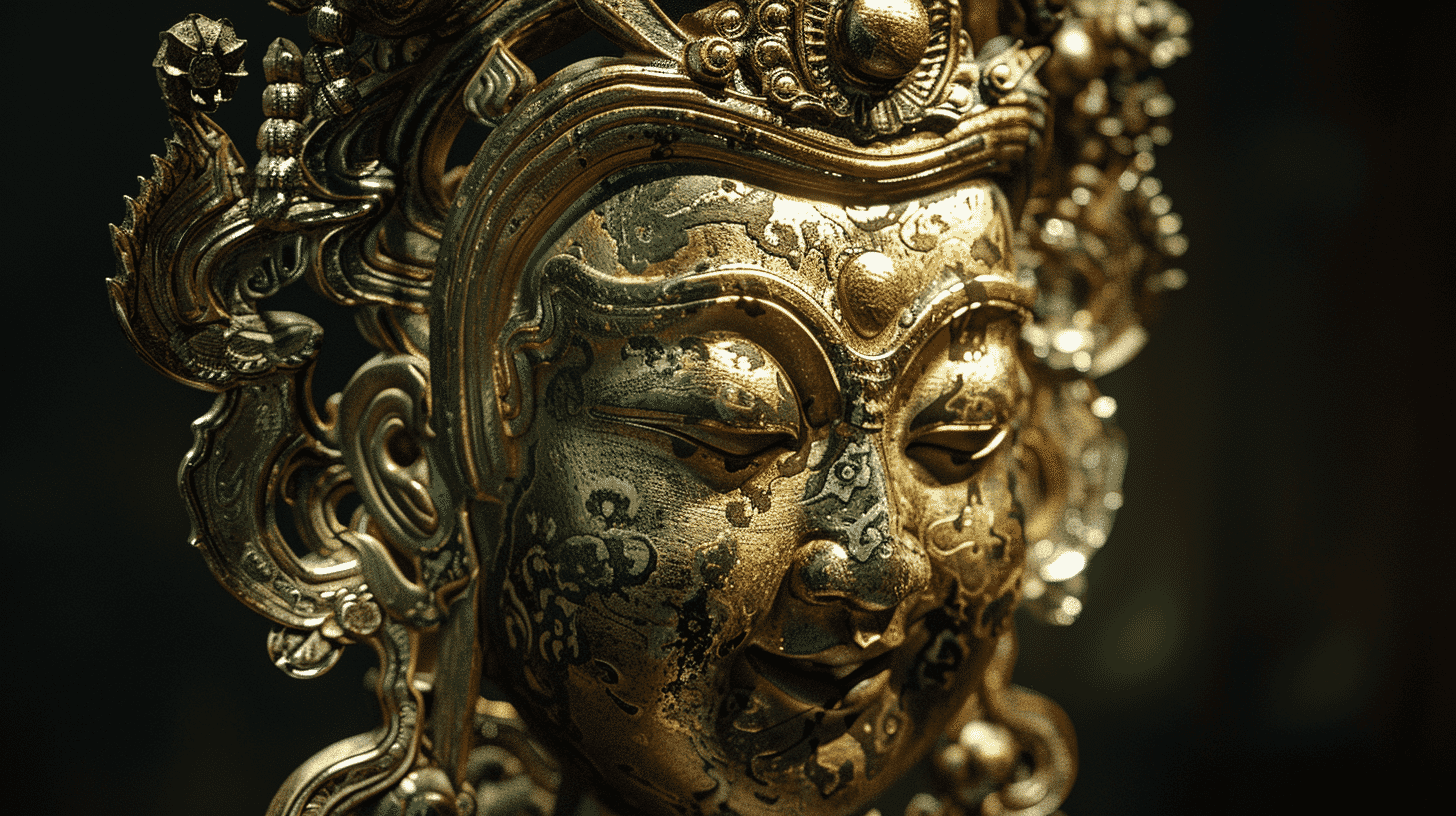
One Staff Head, National Treasure since 1981
Gilded Bronze Staff Head (金銅錫杖頭, Kondo Shakujo-to) is a Tang-period craft object owned by Zentsuji in Kagawa Prefecture, made an Important Cultural Property on 27 March 1901 and designated a National Treasure on 9 June 1981. The quantity is one staff head and the designation number 00253.
Eighty years separate the two listings, second only to the hundred and nine of the Five Wisdom Buddhas.
It measures 27.0 centimetres high overall with a ring 13.8 centimetres across. The address field in the Agency's database is blank, the fourteenth such case.
An Object That Came Over and Changed the Craft Here
The country field names somewhere other than Japan.
The country is China and the period the Tang, the second such case after the biography of Huineng.
The Agency records that it is Tang Chinese work, that it came to Japan long ago, and that it is significant for having influenced Japanese metalwork as well as the making of staffs.
The object is valued not only in itself but for having altered the craft in the country it reached.
At the Sofukuji first gate, timbers were carved at Ningbo and shipped over. At Kirishima Jingu, a form of pillar was said to be distributed across East Asia.
Here one object crossed over and the technique followed. The thing moved, and then the making moved with it.
Reading Marks Left in the Text with Their Brackets
The commentary carries a gloss with its punctuation still around it.
Where the text names the practice of begging at a gate, the reading of that term follows in lenticular brackets.
What should sit as small characters above the line stands instead in the body of the text with its brackets.
At the Ataka and Kurohashi shell mounds a doubled square-bracket notation survived; in the museum record for the chrysanthemum waist sword a reading stood between at-signs.
Here the brackets are lenticular. As an exposure of the recording apparatus this is the sixth form met.
The reading itself is written in an older orthography, without the small kana that modern spelling would use.
Named for the Head, with a Note about the Shaft
A note concerns a part the name does not cover.
The title names the head of the staff.
At the end of the field for form, however, comes the note that the shaft is a later replacement. The shaft is not in the name, and its replacement is recorded.
With the plover chest, the copper rim was a later replacement. On the chrysanthemum waist sword, only one hilt ornament was.
Those are parts of the object itself. Here the note falls outside what the name covers.
The use is explained too: a staff carried by monks and ascetics, shaken to drive off venomous creatures when travelling through hills and fields in India, and sounded at a gate when begging. What the object was for is set down.
Seeing It
The staff head belongs to Zentsuji. The field for prefecture gives Kagawa and the address field is blank.
Zentsuji also owns the Lotus Sutra scroll written one character to one Buddha. That record left nearly every field empty; this one has a long field for form.
The work is described closely: within the ring, on both faces, an Amida triad stands against pierced boat-shaped haloes, with the four heavenly kings cast outside them.
And the figures are skilfully cast through, joined at the back from one face to the other.
Of provenance, the record says the temple's tradition holds that Kobo Daishi brought it back. It is given as tradition, not as fact. The staff head is a temple holding, not kept on permanent display. Check before travelling.
Q&A
- When was the staff head designated?
- It became an Important Cultural Property on 27 March 1901 and a National Treasure on 9 June 1981, eighty years apart. The quantity is one staff head and the owner Zentsuji.
- Where was it made?
- The Agency gives the country as China and the period as the Tang, adding that it came to Japan long ago and influenced Japanese metalwork as well as the making of staffs.
- What is a staff of this kind for?
- The Agency records that monks and ascetics carried it, shaking it to drive off venomous creatures when travelling through hills and fields in India, and sounding it at a gate when begging.
- Is any part a later replacement?
- Yes. The field for form ends with a note that the shaft is a later replacement, although the title names only the head of the staff.
- How did it come down?
- The Agency records that the temple's tradition holds Kobo Daishi brought it back. It is given as tradition rather than as established fact.
Basic Information
| Name | Gilded Bronze Staff Head (金銅錫杖頭, Kondo Shakujo-to); the country field reads China and the period field the Tang |
|---|---|
| Location | The field for prefecture gives Kagawa; the address field is blank and the owner is given as Zentsuji |
| Designation | National Treasure (craft), designation no. 00253 |
| Year Designated | 1901 (27 March), Important Cultural Property; 1981 (9 June), National Treasure |
| Quantity | 1 staff head |
| Dimensions | 27.0 centimetres high overall, the ring 13.8 centimetres across. Cast bronze, finished by paring and then gilded. The ring is gourd-shaped in three raised lines, with a flaming jewel at its crown. Within the ring, an Amida triad and the four heavenly kings are cast on both faces, the figures joined through at the back. 6 loose rings. The shaft is a later replacement. The period is the Tang |
| Owner | Zentsuji |
| Public Access | A temple holding, not on permanent display |
References
- Agency for Cultural Affairs database: the gilded bronze staff head
- https://kunishitei.bunka.go.jp/heritage/detail/201/10335
- Zentsuji City: cultural properties
- https://www.city.zentsuji.kagawa.jp/soshiki/50/digi-m-culture-detail-065-index.html
- Zentsuji: the treasure hall
- https://zentsuji.com/yuisho/homotsukan/
- Agency for Cultural Affairs, National Cultural Properties Database
- https://kunishitei.bunka.go.jp/
Last verified: 2026.09.06