
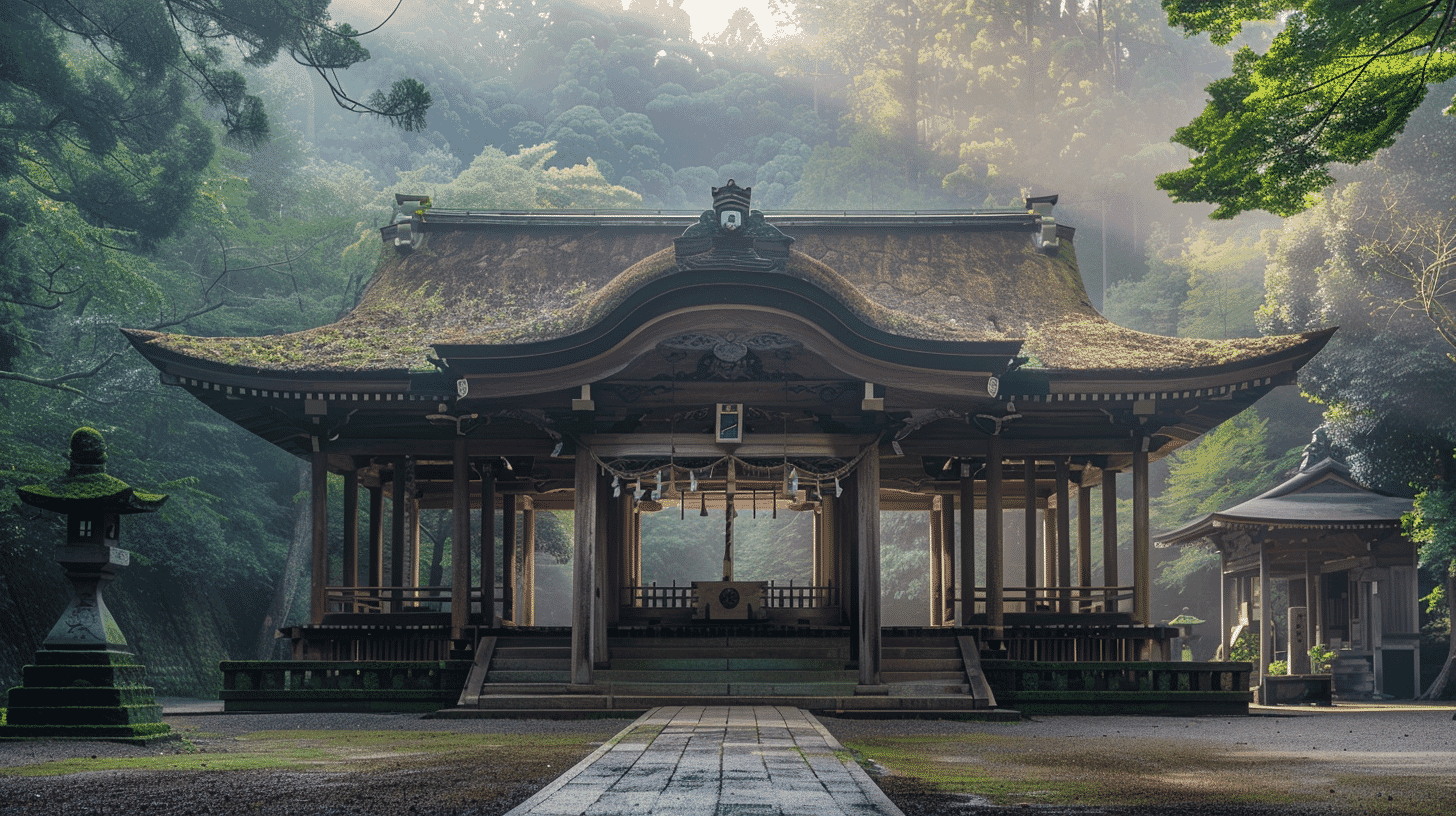
Visiting the Origins of Japanese Architecture
At the foot of Mt. Goshikidai overlooking the Seto Inland Sea in Sakaide City, Kagawa Prefecture, stands a building of extraordinary importance in Japanese architectural history. Kandani Shrine's main hall – the oldest existing shrine building in Japan with a verified construction date of 1219.
This modest main hall conceals cultural value far beyond what its humble appearance might suggest. Designated as a National Treasure, this architecture preserves the pure Japanese style of the early Kamakura period, embodying the essence of Japanese construction techniques and over 800 years of religious history.
Timeless Architectural Beauty – The Pinnacle of Nagare-zukuri Style
The architectural style of Kandani Shrine's main hall is called "sangen-sha nagare-zukuri" (three-bay flowing style), the most widespread form of shrine architecture in Japan. However, the nagare-zukuri seen here is not merely a conventional application of a common style.
The cypress bark roof flowing seamlessly from the ridge to the front worship area creates elegant curves that seem to gently embrace worshippers. This graceful roof curve represents the essence of nagare-zukuri and is a unique architectural expression born from Japanese aesthetics.
Particularly noteworthy is the "yariganna" (spear plane) finishing technique applied to the circular pillars. This sophisticated woodworking technique specific to the Kamakura period can still be observed in its precise finish even after 800 years. The traditional joinery without nails, the boat-shaped brackets and forked rafters – all demonstrate wisdom applicable to modern seismic resistance technology, as flexible structures adapted to Japan's earthquake-prone environment.
Significance of National Treasure Designation – Crystallization of Three Values
On February 2, 1955, Kandani Shrine's main hall was designated a National Treasure. This designation was not simply because it is an old building. It was recognized as a rare structure meeting all three requirements for National Treasure designation: "superior craftsmanship," "high academic value," and "historical importance."
Among the 43 National Treasure shrine buildings nationwide, this is the oldest with a clearly documented construction date. This fact provides an absolute reference point for Japanese architectural history research and serves as an important key for dating other buildings.
1200 Years of Religious History
Kandani Shrine is said to have been founded in 812 by Ato no Otari, uncle of Kukai (Kobo Daishi). With Homusubi no Mikoto, the deity of fire and hearth, as the main deity, it has attracted deep devotion from the region as a god governing "fire," essential to people's daily lives.
During the Heian period, it received the court rank of Junior Fifth Rank Lower Grade, and was listed as one of the 24 shrines of Sanuki Province in the Engishiki Jinmyocho. By the time of reconstruction in 1219, it had reached the highest rank of Senior First Grade. This prestigious status tells of Kandani Shrine's importance in Sanuki Province at that time.
From medieval to early modern times, it was influenced by shinbutsu-shugo (syncretism of Shinto and Buddhism), with an affiliated temple called Seiryuji. The nine bugaku masks and pair of wooden komainu dogs that remain today convey the rich religious culture of that era.
Embraced by Goshikidai's Nature
Kandani Shrine is located at the northern foot of Goshikidai, a plateau that is part of the Setonaikai National Park. This plateau, consisting of five peaks – Beni-no-mine, Ki-no-mine, Aomine, Kuromine, and Shiromine-san – is also known as a globally rare source of sanukite (Sanuki stone).
About 150 meters behind the main grounds stands a massive rock formation called the "Eigo-ishi" (Shadow-Facing Stone), believed to be the original object of worship at Kandani Shrine. It is a sacred place preserving the form of nature worship continuing from ancient times.
In early summer, fireflies dance around the shrine grounds, and a "Firefly Festival" is held. This new form of festival, connecting a shrine with 1200 years of history to modern environmental conservation activities, has taken root in the community.
The 2022 Trial and Path to Restoration
On September 27, 2022, lightning severely damaged the cypress bark roof of the National Treasure main hall. However, the Agency for Cultural Affairs stated that "the value as a National Treasure has not been compromised," and restoration work using traditional methods is currently underway.
This restoration utilizes crowdfunding from local residents, demonstrating a new form of citizen participation in cultural property preservation. Confronting the challenge of preserving traditional techniques with modern methods – this too is part of Kandani Shrine's nature as a living cultural heritage.
Message to Visitors
Kandani Shrine's main hall is not merely a tourist destination. It is a living place of faith that has received the prayers of local people for over 800 years. When we place ourselves in this tranquil space, we can touch the core of Japanese culture.
Whether appreciating architectural beauty, feeling the weight of history, or calming your spirit in nature – Kandani Shrine offers different values and emotions to each visitor.
- 📍 Plan Your Visit to Kagawa
- Find tours, activities & transport passes near Kamiya Shrine Main Hall
- [ Naoshima Art Island & Kotohiragu Shrine Visit ]
Q&A
- Why is Kandani Shrine's main hall designated as a National Treasure?
- It is Japan's oldest shrine building with a clear construction date of 1219, perfectly preserves pure Japanese-style architecture from the early Kamakura period, and demonstrates sophisticated construction techniques of the time such as yariganna finishing, meeting all criteria for craftsmanship, academic, and historical value.
- Can I still visit for worship?
- Yes, visits to the shrine grounds are possible even during restoration work following the 2022 lightning damage. However, the main hall is covered for protection and appears different from its normal state.
- How do I access the shrine?
- About 14 minutes by car from JR Sakaide Station, or 36 minutes on foot from JR Kamogawa Station. By public transport, take the Kotosan Bus Oetsu Line from Sakaide Station to "Takaya-minami" stop, then walk 20 minutes, but service is limited so advance confirmation is needed. Parking for 5-6 cars is available.
- Are there attractions besides the main hall?
- Yes, including the Eigo-ishi rock (original object of worship) about 150m behind the main hall, Important Cultural Property wooden guardian statues, nine bugaku masks, and firefly viewing in early summer is also popular.
- What tourist spots are nearby?
- Shiromine-ji Temple, the 81st temple of the Shikoku 88-temple pilgrimage, is within walking distance. Also nearby are the Goshikidai Visitor Center, and in Sakaide City, the Seto Ohashi Memorial Park and Higashiyama Kaii Setouchi Art Museum.
Basic Information
| Name | Kandani Shrine Main Hall |
|---|---|
| Location | 621 Kandani-cho, Sakaide City, Kagawa Prefecture |
| Construction Year | 1219 (Kenpo 7) |
| Founded | 812 (Konin 3) |
| Founder | Ato no Otari |
| Architectural Style | Three-bay nagare-zukuri with cypress bark roof |
| Dimensions | Three bays wide, two bays deep |
| Cultural Property Status | National Treasure (designated February 2, 1955) |
| Main Deities | Homusubi no Mikoto, Okitsuhiko no Mikoto, Okitsuhime no Mikoto |
| Associated Deities | Four Kasuga Deities |
References
- National Treasure Kandani Shrine Main Hall - Sakaide City Homepage
- https://www.city.sakaide.lg.jp/soshiki/bunkashinkou/kandanijinjya.html
- Kandani Shrine Main Hall Cultural Heritage Online
- https://bunka.nii.ac.jp/heritages/detail/124094
- Kandani Shrine | KAGAWA CULTURE COMPASS
- https://www.kagawa-culture-compass.net/en/spot/030.html
- Kandani Shrine - Wikipedia
- https://ja.wikipedia.org/wiki/神谷神社
- Kandani Shrine Restoration Project - READYFOR
- https://readyfor.jp/projects/kandani
Last verified: 2025.09.10