
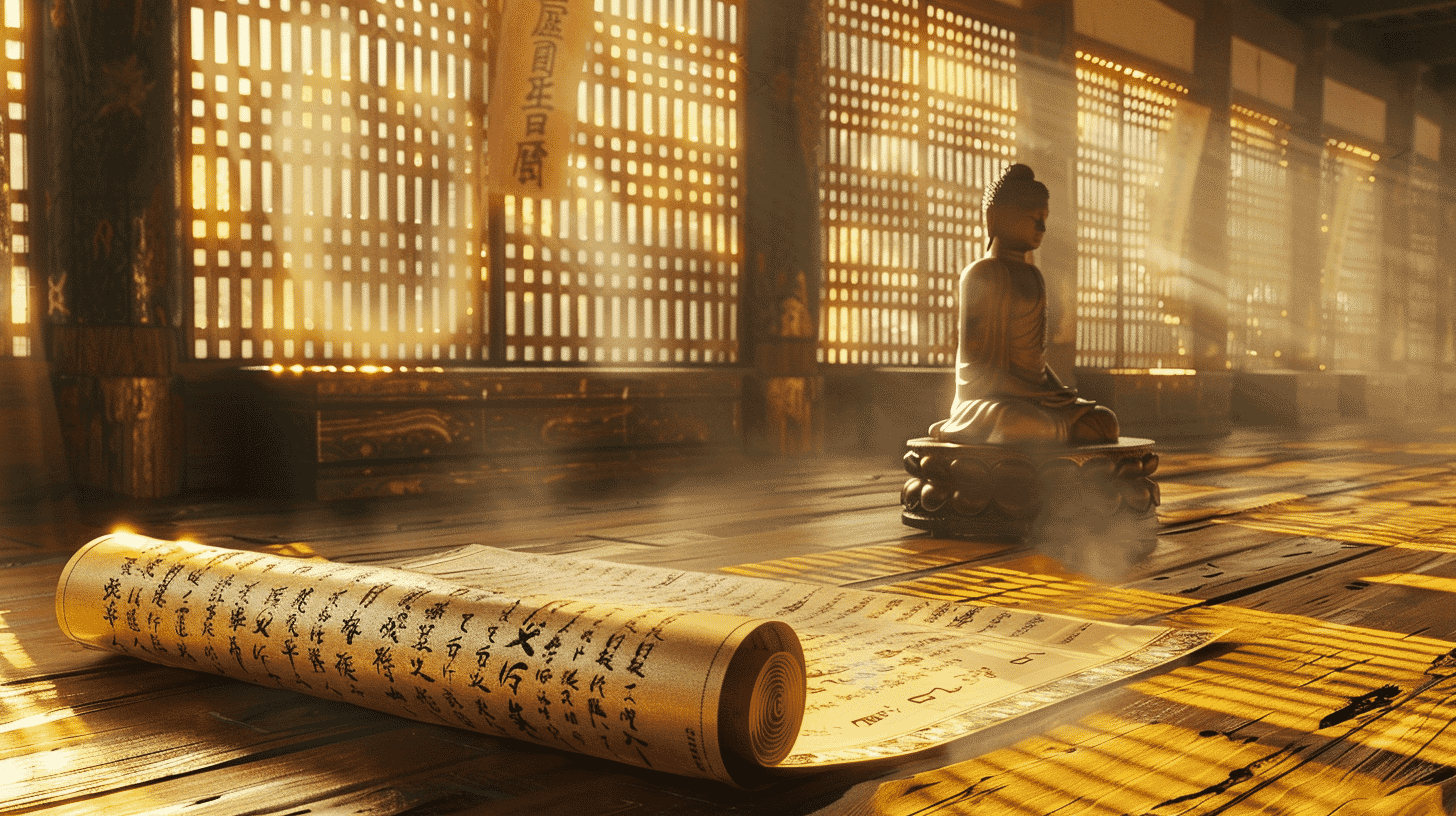
One Scroll, National Treasure since 1953
One Character, One Buddha: the Lotus Sutra, Preface (一字一仏法華経序品, Ichiji Ichibutsu Hokekyo Johon) is a Heian-period work of calligraphy and text owned by Zentsuji in Kagawa Prefecture, designated a National Treasure on 14 November 1953. The quantity is one scroll and the designation number 00187.
The field for designation as an Important Cultural Property is blank in the Agency's database: it went to National Treasure without that earlier step, the twenty-fifth such case covered here.
14 November 1953 is the day of the engraved mirror, the red-laced and white-laced armours and the Toshodaiji sutra repository.
Nearly Every Field Is Empty
Little is written in this record.
The fields for period, western year, writer, dimensions, form, supplementary notes, inscriptions and colophons, and provenance are all empty.
The commentary reads: a work of the Heian period. That makes the twenty-third one-sentence commentary here.
The address field is blank as well, the eighth such case. The field for prefecture gives Kagawa, and no street address follows.
With the Engishiki at Amanosan Kongoji, the date field stood empty while the notes field carried a dated colophon. There a clue survived in another field.
Here the notes field is empty too. What is filled in comes to the title, its reading, the quantity, the category, the period, the designation number and the owner.
The Title Itself States How It Was Made
Where the record says little, the title says much.
One character, one Buddha: those words open the name.
They describe a practice of writing one character of the sutra and then painting one Buddha, so that text and image alternate down the scroll.
The rest of the title names the text: the opening chapter of the Lotus Sutra. What was written is stated as well.
The Mikazuki Munechika took its by-name from a pattern in steel, the chrysanthemum waist sword from carving on a hilt, the Sofukuji first gate from characters on a plaque, the white-laced armour from a colour.
Here the method of making is the name. Even with the fields empty, the title tells what was done.
Three Running Counts Advance at Once
This property answers to several of the patterns counted here.
It is the twenty-fifth to reach National Treasure without an earlier listing as an Important Cultural Property.
It is the twenty-third whose commentary consists of the single sentence naming the period.
It is the eighth whose address field stands empty.
The three coincide because the sparseness gathers in one place. The ceremonial sword on a pear-skin ground also had empty fields for dimensions, maker, form and date, with a one-sentence commentary.
That sword, however, carried an address. Cases where all three fall together are not many.
Seeing It
The scroll belongs to Zentsuji. The prefecture is given as Kagawa and no address follows.
It is a temple holding, not kept on permanent display; work on paper is vulnerable to light and shown only briefly.
The category is calligraphy and texts, the same field as the Engishiki at Amanosan Kongoji.
The designation number is 00187, later than the 00147 of that Engishiki.
Access follows the temple's own arrangements. Check the temple's information before travelling.
Q&A
- When was it designated?
- On 14 November 1953. The quantity is one scroll, the designation number 00187 and the owner Zentsuji. The field for an earlier listing as an Important Cultural Property is blank.
- What does one character, one Buddha mean?
- Writing one character of the sutra and then painting one Buddha, so that text and image alternate. The title itself states how the scroll was made.
- What are its dimensions?
- None are recorded. The fields for dimensions, form, period, writer, supplementary notes, colophons and provenance are all empty.
- Where is it kept?
- The field for prefecture gives Kagawa, but the address field is blank and no street address follows. The owner is Zentsuji.
- What does the commentary say?
- Only that it is a work of the Heian period. What is filled in comes to the title, its reading, the quantity, the category, the period, the designation number and the owner.
Basic Information
| Name | One Character, One Buddha: the Lotus Sutra, Preface (一字一仏法華経序品, Ichiji Ichibutsu Hokekyo Johon) |
|---|---|
| Location | The field for prefecture gives Kagawa; the address field is blank and the owner is given as Zentsuji |
| Designation | National Treasure (calligraphy and texts), designation no. 00187; designated without an earlier listing as an Important Cultural Property |
| Year Designated | 1953 (14 November), National Treasure |
| Quantity | 1 scroll |
| Dimensions | The fields for dimensions, form, period, writer, supplementary notes, colophons and provenance are all empty. What is filled in comes to the title, its reading, the quantity, the category, the period, the designation number and the owner. The period is Heian |
| Owner | Zentsuji |
| Public Access | A temple holding, not on permanent display; work on paper is vulnerable to light and shown only briefly |
References
- Agency for Cultural Affairs database: the scroll at Zentsuji
- https://kunishitei.bunka.go.jp/heritage/detail/201/705
- Zentsuji: the treasure hall
- https://zentsuji.com/yuisho/homotsukan/
- Zentsuji City: cultural properties
- https://www.city.zentsuji.kagawa.jp/soshiki/50/digi-m-culture-detail-066-index.html
- Zentsuji official site
- https://zentsuji.com/
Last verified: 2026.09.06