
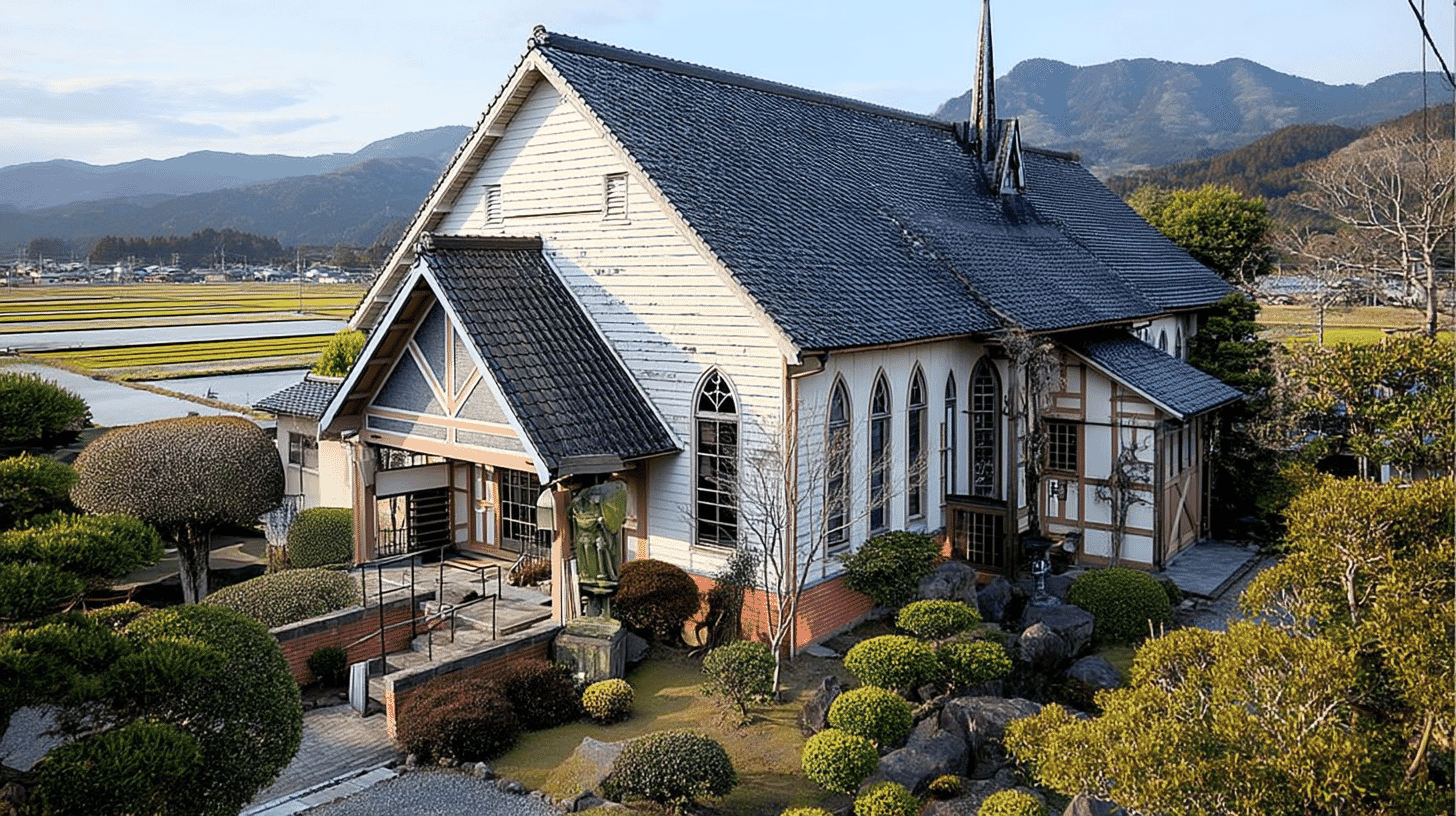
A Temple Hall Built in a Western Manner
Myodoji Temple Main Hall is a Buddhist temple main hall of 1926 at 1955 Kaigen, Yunomae Town, Kuma District, Kumamoto Prefecture, listed on 2 September 1998 as a Registered Tangible Cultural Property. It is a single-storey timber building with a tiled roof, covering 292 square metres.
The Agency for Cultural Affairs describes it as a temple main hall of unusual design. It is a temple hall, yet the shape of the roof, the wall cladding, the outlines of the windows and doorway, the division inside and the roof framing are all Western. Myodoji Temple Main Hall barely relies on the forms of Japanese temple architecture at all.
Why It Was Listed
Registration applies to structures generally more than fifty years old that contribute to the historic landscape of the country. It works through notification rather than permits and differs from the designation system; this hall is registered, not designated.
The point is that the Western treatment runs through every part rather than touching one detail. Plenty of temples took on a Western element here and there; this one is consistent from the exterior to the structure within. According to the national record, the design is said to have been the independent work of the eldest son of the head priest, who had studied at Ryukoku University in Kyoto. Not a professional architect, then, but someone who assembled a temple hall from the architecture he had seen where he studied.
Mansard Roof and Pointed Arches
The national record lists six Western elements: a mansard roof, weatherboarded walls, a half-timbered front entrance, a run of arches at the boundary between the inner and outer sanctuary, pointed-arch windows and a trussed roof frame.
A mansard roof breaks its pitch partway, steep below and shallow above, to gain room in the loft. Half-timbering exposes the timber frame on the outside of the wall and fills between it with plaster. The pointed arch is the window shape inherited from Gothic building.
Inside, the feature to look for is the boundary between the outer sanctuary, where worshippers sit, and the inner sanctuary, where the principal image is enshrined. Here it is marked by a series of arches. The most important division in a temple hall has been drawn in a Western form. The roof above is carried on trusses, a Western structure of triangulated members. At Myodoji Temple Main Hall what can be seen and what cannot are both Western.
Visiting
This is the main hall of a working temple and not a visitor site. There are no opening hours or admission fee, and no official source describes any arrangement for viewing. To see the interior, contact Myodoji in advance.
The Amida Hall and the nine-storey and seven-storey stone pagodas that also carry the Myodoji name, all nationally designated, stand in the Setoguchi district of Yunomae, about 2.8 kilometres from the main hall at Kaigen. They are in a different place.
The address is 1955 Kaigen, Yunomae Town, Kuma District. This is a place of worship for its congregation, so avoid disturbing services and observances.
Q&A
- When was Myodoji Temple Main Hall built?
- In 1926. It was listed as a Registered Tangible Cultural Property on 2 September 1998.
- What makes it Western?
- A mansard roof, weatherboarded walls, a half-timbered front entrance, a run of arches between the inner and outer sanctuary, pointed-arch windows and a trussed roof frame.
- Who designed it?
- It is said to have been designed independently by the head priest's eldest son, who had studied at Ryukoku University in Kyoto.
- Is it on the same site as the Myodoji Amida Hall?
- No. The Amida Hall and the two stone pagodas stand in the Setoguchi district of Yunomae, about 2.8 kilometres from the main hall at Kaigen.
- Can I visit?
- It is the main hall of a working temple and not a visitor site. No official source describes viewing arrangements, so contact Myodoji in advance.
Basic Information
| Name | Myodoji Temple Main Hall |
|---|---|
| Location | 1955 Kaigen, Yunomae Town, Kuma District, Kumamoto Prefecture |
| Designation | Registered Tangible Cultural Property (structure) |
| Year Designated | Registered 1998/09/02 (Heisei 10) |
| Quantity | 1 building |
| Dimensions | Floor area 292 square metres |
| Owner | Myodoji (religious corporation) |
| Public Access | Working temple hall; contact in advance to visit |
References
- Agency for Cultural Affairs, National Cultural Properties Database
- https://kunishitei.bunka.go.jp/bsys/maindetails/101/00000809
- Cultural Heritage Online: Myodoji Temple Main Hall
- https://online.bunka.go.jp/heritages/detail/191809
Last verified: 2026.09.24