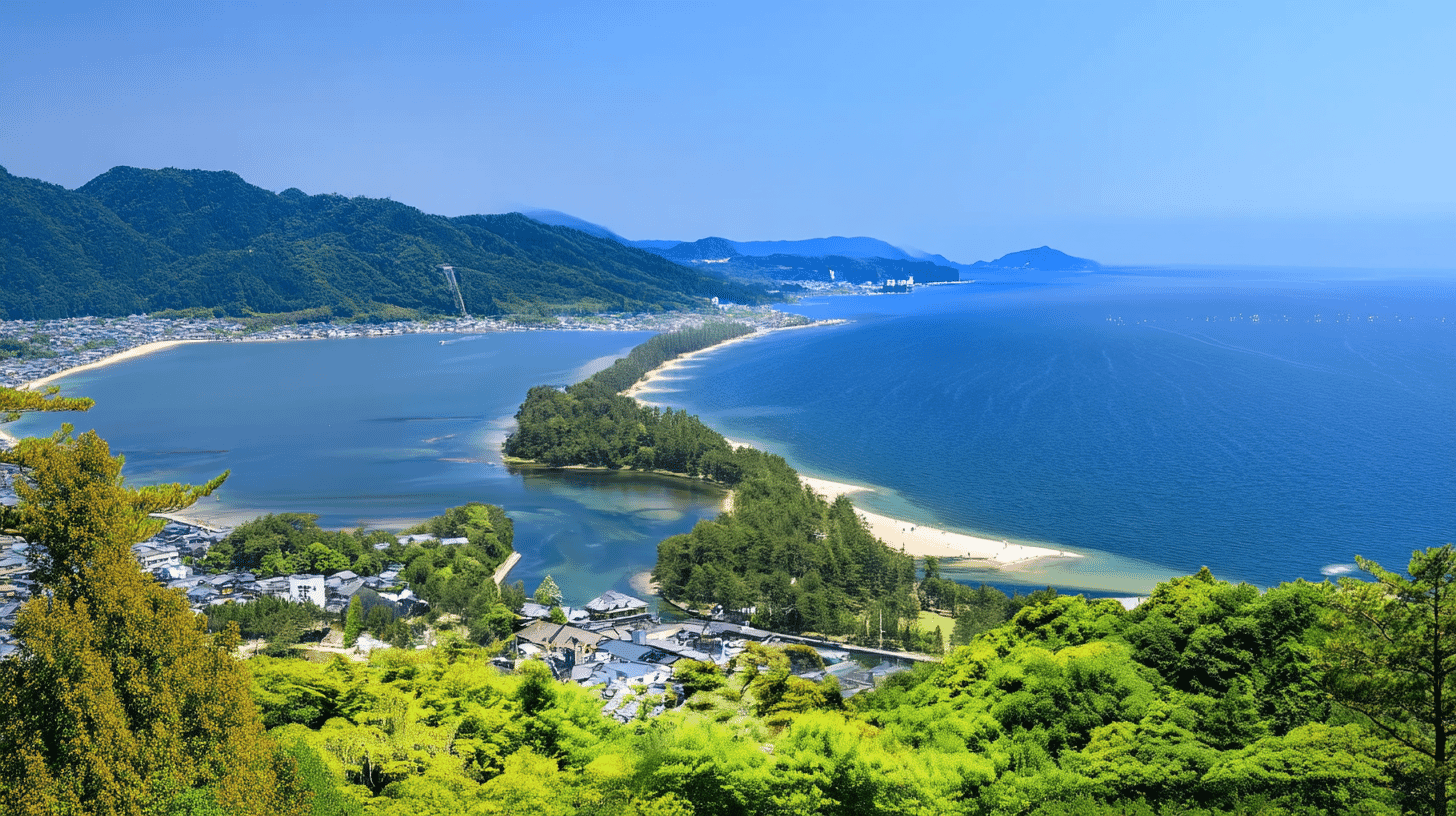
Amanohashidate: Japan's Divine Bridge to Heaven | One of Japan's Three Scenic Views

Discover Amanohashidate, a 3.6km pine-covered sandbar in Kyoto Prefecture and one of Japan's Three Scenic Views. Experience the legendary "matanozoki" viewing technique, explore ancient temples and shrines, and learn why this Special Place of Scenic Beauty has inspired artists and poets for over 1,000 years.

Amanohashidate: The Divine Bridge Where Earth Meets Heaven

Rising from the turquoise waters of Miyazu Bay in northern Kyoto Prefecture, Amanohashidate stands as one of Japan's most enchanting natural wonders. This extraordinary 3.6-kilometer sandbar, blanketed with approximately 6,700 Japanese black pine trees, has captivated the hearts of poets, artists, and travelers for over a millennium. As one of Japan's celebrated Three Scenic Views (Nihon Sankei)—alongside Matsushima in Miyagi and Miyajima in Hiroshima—Amanohashidate offers visitors an otherworldly landscape that seems to defy the boundaries between sea and sky.

The name "Amanohashidate" translates poetically as "Bridge to Heaven," a fitting title for a place that has inspired countless legends about divine beings traversing between the celestial and earthly realms. Whether you witness it from the mountaintop observatories or walk along its sandy paths beneath the whispering pines, this Special Place of Scenic Beauty reveals why it has been designated as one of only 36 such treasured landscapes in all of Japan.

The Mythology and Formation of a Natural Wonder

According to the ancient Tango no Kuni Fudoki (Records of Tango Province), compiled during the Nara period, Amanohashidate originated from divine intervention. The legend tells that the deity Izanagi-no-Mikoto erected a ladder to travel between heaven and earth. One day, while the god was sleeping, the ladder toppled and fell into the sea, creating the remarkable sandbar we see today. This mythological origin explains why the Japanese have long viewed Amanohashidate as a sacred bridge connecting the mortal world to the divine.

From a geological perspective, the formation of Amanohashidate is equally remarkable. The sandbar developed over thousands of years as sediment carried by rivers from the northern mountains was deposited by ocean currents flowing into Miyazu Bay. Scientists believe the northern section (Otenkyō) was formed by approximately 2,000 years ago, during the middle of the Yayoi period. This process created a unique geographical feature: the only inland bay sandbar of its kind in Japan, separating the inner Aso Sea from the outer Miyazu Bay.

Why Amanohashidate Became a Special Place of Scenic Beauty

Amanohashidate received its initial designation as a Scenic Site in March 1922 under the Historic Sites, Places of Scenic Beauty, and Natural Monuments Preservation Law—among the very first locations in Japan to receive such recognition alongside Miho no Matsubara in Shizuoka. In November 1952, it was elevated to the prestigious status of Special Place of Scenic Beauty, placing it among the nation's most treasured landscapes.

The designation recognizes several exceptional qualities that set Amanohashidate apart. The phenomenon known as "hakusha seishō" (white sand, green pines) represents the quintessential Japanese coastal aesthetic, and Amanohashidate stands as its most exemplary representation. The sandbar's southern section (Kotenkyō) preserves rare sand dune vegetation, including sea oats and beach roses, maintaining a diverse and beautiful natural ecosystem.

Furthermore, the designation encompasses not merely the natural sandbar itself, but also the cultural landscape that has grown inseparably intertwined with it: the precincts of Chionji Temple with its Important Cultural Property pagoda, the ancient Amanohashidate Shrine, and the historic Kasamatsu observation point that has served as a viewing spot since the Meiji era. This holistic approach recognizes that Amanohashidate's value lies in the harmonious fusion of natural beauty and human cultural achievement.

The Five Grand Views: Discovering Amanohashidate from Every Angle

What makes Amanohashidate truly exceptional is how dramatically its appearance transforms depending on your viewing position. The Five Grand Views (Gotaikan) offer distinct perspectives that reveal different aspects of this natural masterpiece.

Hiryū-kan (Flying Dragon View) - Southern Perspective

From Amanohashidate View Land atop Mount Monju, the sandbar appears like a dragon descending from the heavens. This is perhaps the most photographed angle, offering a sweeping panorama where the pine-covered peninsula seems to soar through the sky. The observation deck sits 130 meters above sea level and can be reached by chairlift or monorail from near Amanohashidate Station.

Shōryū-kan (Rising Dragon View) - Northern Perspective

Kasamatsu Park, the birthplace of the famous "matanozoki" viewing tradition, presents the sandbar as a dragon ascending toward heaven. Located on Mount Nariai at 130 meters elevation, this viewpoint is accessible by cable car or chairlift. The modern Sky Deck offers glass-floored sections for an even more dramatic experience.

Ichimonji-kan (Single Character View) - Western Perspective

From Ōuchi Pass, Amanohashidate stretches across the horizon like the kanji character "一" (ichi, meaning "one"). This lesser-known viewpoint attracts literary enthusiasts, as poetry monuments by celebrated writers Kawahigashi Hekigotō and Yosano Akiko and Tekkan stand here.

Sesshū-kan (Sesshū View) - Eastern Perspective

Named after the legendary ink wash painter Sesshū, who created the National Treasure painting "View of Amanohashidate" in the early 16th century, this viewpoint from Sesshū Observatory near Inari Shrine offers the angle that inspired one of Japan's greatest artistic masterpieces.

Tenpyō-kan (Tenpyō Era View) - Frontal Perspective

The newest addition to the Five Grand Views, this perspective from the ruins of Tango Kokubunji Temple offers a frontal view that ancient travelers would have experienced over 1,200 years ago. The historic temple ruins themselves, designated as a National Historic Site, add historical depth to the viewing experience.

Matanozoki: The Upside-Down Viewing Tradition

No visit to Amanohashidate is complete without experiencing "matanozoki"—the uniquely Japanese practice of viewing the landscape upside down by bending forward and looking between your legs. This playful tradition, which originated at Kasamatsu Park, transforms your perception in a magical way: with the sky and sea inverted, the pine-covered sandbar appears to float among the clouds like a bridge to heaven, fulfilling the promise of its name.

The practice gained international scientific recognition in 2016 when researchers studying the perceptual effects of matanozoki won the Ig Nobel Prize for Perception. Their study confirmed what visitors have intuitively known for centuries: viewing the world upside down genuinely alters our perception of depth and distance, making the landscape appear more dreamlike and ethereal.

Both Kasamatsu Park and Amanohashidate View Land provide dedicated platforms for matanozoki, complete with railings for safety. At View Land, you'll find seven different matanozoki platforms throughout the park, ensuring everyone can capture that perfect inverted photograph.

Walking the Divine Bridge: Exploring the Sandbar

While the aerial views are spectacular, walking along Amanohashidate offers an equally rewarding experience. The 3.6-kilometer path takes approximately 50 minutes on foot, though many visitors choose to rent bicycles (available near both ends) to cover the distance more quickly while still enjoying the scenery.

Along the way, you'll encounter several notable stops. Near the southern entrance stands the rotating Kaisenkyō Bridge, a charming engineering marvel built in 1923 that swings open to allow boats to pass. The bridge offers a wonderful photo opportunity and a glimpse into the area's maritime heritage.

Midway along the sandbar, Amanohashidate Shrine (Hashidate Myōjin) provides a peaceful spot for reflection. Adjacent to it flows Isoshimizu, a mysterious freshwater spring that has been selected as one of Japan's 100 Outstanding Waters. Despite being surrounded entirely by seawater, this well produces pure fresh water—a phenomenon that has puzzled visitors for centuries and adds to the location's mystical atmosphere.

The pine trees themselves are treasures, with some specimens over 300 years old. Each tree seems to have developed its own character, shaped by centuries of sea winds into graceful, twisted forms that would be the envy of any bonsai master.

Cultural Treasures Surrounding Amanohashidate

Chionji Temple (Wisdom Temple)

Located at the southern entrance to Amanohashidate, Chionji Temple is one of Japan's Three Major Monju Temples, dedicated to Monju Bosatsu, the bodhisattva of wisdom. The temple's origins trace back to 904 CE when it received patronage from Emperor Daigo. Its multi-storied pagoda (tahōtō), constructed in 1501, stands as a designated Important Cultural Property, while the main hall enshrines a sacred Monju statue that has drawn wisdom-seeking pilgrims for over a millennium.

The temple's connection to wisdom has created a charming local tradition: students visit before examinations to pray for academic success, and the temple's famous "wisdom mochi" rice cakes, sold at the four historic teahouses in the gate town, are said to bestow intelligence upon those who eat them.

Kono Shrine (Moto-Ise)

On the northern shore stands Kono Shrine, the most prestigious Shinto shrine of the former Tango Province. Known as "Moto-Ise" (Original Ise), tradition holds that the deities enshrined at Ise Grand Shrine originally resided here before being transferred to their present location. The Kaibe clan, who have served as hereditary priests for generations, preserve the Kaibe Clan Genealogy—designated as a National Treasure and considered one of Japan's oldest family records, dating to the early Heian period.

Nariaiji Temple

Perched high on Mount Nariai above Kasamatsu Park, Nariaiji Temple serves as the 28th station of the Saigoku Kannon Pilgrimage, one of Japan's oldest and most important pilgrimage routes. Founded in 704 CE, this atmospheric temple offers not only spiritual significance but also commanding views of Amanohashidate from its original medieval observation point, located about 70 meters above the current temple grounds.

Tango Kokubunji Temple Ruins

The remains of the provincial temple established during the Nara period under Emperor Shōmu's nationwide temple-building decree occupy a scenic hilltop position. Visitors can still see the foundation stones of the main hall, five-story pagoda, and middle gate from the temple's 1334 reconstruction. This National Historic Site provides not only historical interest but also the Tenpyō-kan viewing perspective of Amanohashidate.

Sesshū's National Treasure: Art Inspired by Amanohashidate

Perhaps no artwork captures Amanohashidate's magnificence more powerfully than Sesshū Tōyō's masterpiece "View of Amanohashidate" (Amanohashidate-zu), now housed in the Kyoto National Museum and designated as a National Treasure. Created when the master ink painter was in his eighties, sometime between 1501 and 1506, this monumental work (89.4 cm × 168.5 cm) represents the culmination of his artistic career.

The painting reveals Sesshū's genius for composition: while based on careful on-site sketches, he dramatically reorganized the landscape to create a bird's-eye panorama that could never be seen from any single vantage point. The work depicts not only the sandbar itself but the entire surrounding cultural landscape—Chionji Temple, Kono Shrine, Nariaiji Temple, and the bustling Fuchu district—providing an invaluable historical record of the region during the late Muromachi period.

Intriguingly, the painting appears to be a preliminary sketch rather than a finished work, with irregular paper joins and corrections visible throughout. Whether a completed version ever existed remains one of Japanese art history's enduring mysteries.

Seasonal Highlights and Best Times to Visit

Amanohashidate reveals different faces throughout the year, each season offering unique rewards.

Spring (March-May) brings cherry blossoms to Kasamatsu Park's cable car route, where approximately 100 trees create a tunnel of pink. The warming weather makes walking or cycling the sandbar particularly pleasant.

Summer (June-August) offers the most dramatic blue skies contrasting with the green pines. The beaches on either side of the sandbar become popular for swimming, and the area hosts various festivals. Extended evening hours at the observation points allow for spectacular sunset views.

Autumn (September-November) transforms the surrounding mountains into a tapestry of red and gold, creating stunning contrasts with the evergreen pines of the sandbar. Clear autumn air provides exceptional visibility for photography.

Winter (December-February) brings the possibility of snow-covered pines—a scene of ethereal beauty that Sesshū himself depicted in his masterwork. While colder and less crowded, winter visitors often enjoy the most dramatic, moody atmosphere.

For the clearest views, early morning visits are recommended, when mist often hovers over the water and crowds are minimal. Lucky visitors may witness the rare phenomenon of a "sea of clouds" (unkai) below the mountain observation points.

Conservation: Preserving the Bridge to Heaven

The beautiful landscape visitors enjoy today exists thanks to centuries of conservation efforts. Historical records from the Edo period document debates about whether to cut through the sandbar to aid local fishermen—proposals that were ultimately rejected to preserve this "peerless scenic wonder."

Modern conservation faces different challenges. Beginning in the 1950s, dam construction upstream reduced the natural sand supply, causing erosion of the sandbar. Since 1986, Kyoto Prefecture has implemented a "sand bypass" system, transporting sand accumulated at nearby beaches to Amanohashidate's base, where natural wave action distributes it along the entire length.

The pine forest itself requires ongoing care. Soil enrichment from accumulated organic matter has paradoxically made conditions less favorable for pine trees, encouraging broadleaf forest succession. The citizen group "Amanohashidate wo Mamoru Kai" (Association to Protect Amanohashidate), founded in 1965, organizes annual cleanup events drawing over 1,500 volunteers to collect fallen pine needles and debris, maintaining the conditions that allow these iconic trees to thrive.

In 2014 and 2015, the cultural landscape of Miyazu-Amanohashidate received designation as an Important Cultural Landscape, recognizing the value of the human activities—from ancient pilgrimage routes to fishing traditions—that have shaped this environment over centuries.

Nearby Attractions

The Amanohashidate region offers numerous additional destinations for visitors with time to explore.

Ine no Funaya (Ine Boat Houses), approximately 30 minutes by bus from the Amanohashidate area, presents a strikingly unique fishing village where traditional boat houses stand directly on the water's edge. This Important Preservation District for Groups of Traditional Buildings has earned comparisons to Venice and offers boat tours through its picturesque waterways.

Miyazu itself, the historic castle town serving as the gateway to Amanohashidate, features the Kyū-Mibuchi Family Residence, an Important Cultural Property merchant house complex dating to the Edo period. The Catholic Miyazu Church, constructed in the Meiji era, stands as one of Japan's oldest extant church buildings.

For those seeking natural beauty beyond the sandbar, Kanabiki Falls (one of Japan's 100 Famous Waterfalls) offers a refreshing forest excursion, while the Tango Peninsula's dramatic coastline provides spectacular seaside drives.

Local Culinary Specialties

The waters surrounding Amanohashidate yield exceptional seafood. Miyazu's fishing port provides fresh catches including yellowtail, sea bream, and the region's famous kuroshio-gani (snow crab) during winter months. Many restaurants near the sandbar specialize in kaisen-don (seafood rice bowls) featuring the day's best selections.

The historic teahouses (yon-ken chaya) at Chionji Temple's gate have served "chie no mochi" (wisdom cakes) since the Kamakura period. These simple but delicious rice cakes, topped with sweet red bean paste, are said to confer wisdom upon those who eat them—a perfect treat before or after visiting the temple.

The area has also developed a wine industry, with Amanohashidate Winery offering tastings and tours. Local sake breweries continue traditions dating back centuries, producing distinctive regional varieties worth seeking out.

📍 Plan Your Visit to Kyoto
Find tours, activities & transport passes near Amanohashidate
[ Kinkakuji Fushimi Inari & Kimono Rental ]

Q&A

QHow long does it take to walk across Amanohashidate?
AWalking the full 3.6-kilometer length of the sandbar takes approximately 50 minutes at a leisurely pace. Alternatively, you can rent a bicycle near either end and cycle across in about 20 minutes, which is a popular option especially during warmer months.
QWhat is "matanozoki" and where can I experience it?
AMatanozoki is the traditional practice of viewing Amanohashidate upside down by bending forward and looking between your legs. This inverts the landscape, making the sandbar appear to float in the sky like a bridge to heaven. You can experience this at both Kasamatsu Park (the birthplace of the tradition) on the north side and Amanohashidate View Land on the south side, where dedicated platforms with safety railings are provided.
QWhich observation point offers the best view—Kasamatsu Park or View Land?
ABoth offer spectacular but different perspectives. Kasamatsu Park (north side) is the traditional matanozoki birthplace and shows the "Shōryū-kan" (Rising Dragon) view. Amanohashidate View Land (south side) offers the "Hiryū-kan" (Flying Dragon) view and includes a small amusement park with a Ferris wheel. Many visitors try to see both for the complete experience, as they can be connected by walking or cycling across the sandbar, or by sightseeing boat.
QWhat is the best season to visit Amanohashidate?
AEach season offers unique appeal. Spring (April-May) features cherry blossoms along the cable car route; summer provides brilliant blue skies and beach activities; autumn brings stunning foliage on the surrounding mountains; and winter offers the rare beauty of snow-covered pines with fewer crowds. Clear days in any season provide the best views, with early morning being ideal for avoiding crowds and catching mystical mist over the water.
QIs Amanohashidate accessible for visitors with mobility challenges?
AThe sandbar path is relatively flat and accessible. Both observation points are reachable by cable car or monorail rather than stairs. However, some temple areas and the highest viewpoints may have steps. The sightseeing boat provides a seated option for crossing between the north and south sides without walking the full length.

Basic Information

Official Name Amanohashidate (天橋立)
Designation Special Place of Scenic Beauty (designated November 22, 1952)
Other Recognitions One of Japan's Three Scenic Views (Nihon Sankei); Important Cultural Landscape (Miyazu-Amanohashidate)
Length Approximately 3.6 km
Width 20-170 meters
Pine Trees Approximately 6,700 Japanese black pines (Kuromatsu)
Location Miyazu City, Kyoto Prefecture, Japan
Access (Train) Kyoto Tango Railway Miyatoyo Line, Amanohashidate Station (approximately 2 hours from Kyoto Station via limited express)
Access (Car) Miyazu-Amanohashidate IC from Kyoto-Jukan Expressway, approximately 10 minutes
View Land Hours 9:00-17:00 (varies seasonally; extended hours in summer)
View Land Admission Adults ¥1,000, Children ¥500 (includes chairlift/monorail)
Kasamatsu Park Hours 8:00-17:30 (varies seasonally)
Kasamatsu Park Admission Cable car/chairlift: Adults ¥680 round trip, Children ¥340
Sandbar Access Free, open year-round
Contact Amanohashidate Tourism Association: +81-772-22-8030

References

The Value of Amanohashidate - Association to Make Amanohashidate a World Heritage Site
https://hashidate.org/about_amanohashidate/
National Cultural Properties Database - Agency for Cultural Affairs
https://kunishitei.bunka.go.jp/heritage/detail/401/1644
View of Amanohashidate - Kyoto National Museum Collection
https://www.kyohaku.go.jp/jp/collection/meihin/suibokuga/item01/
Amanohashidate Tourism Association Official Website
https://www.amanohashidate.jp/
The Five Grand Views of Amanohashidate - Miyazu City Official Website
https://www.city.miyazu.kyoto.jp/site/citypro/7761.html
Amanohashidate View Land Official Website
https://www.viewland.jp/
Kasamatsu Park - Tango Kairiku Kotsu
https://www.amano-hashidate.com/
Nihon Sankei - Tango Amanohashidate Official Website
https://nihonsankei.jp/hashidate.html
Umi no Kyoto Tourism Zone - Amanohashidate Model Course
https://www.uminokyoto.jp/course/detail.php?cid=89

Last verified: 2026.01.02

Nearby heritages