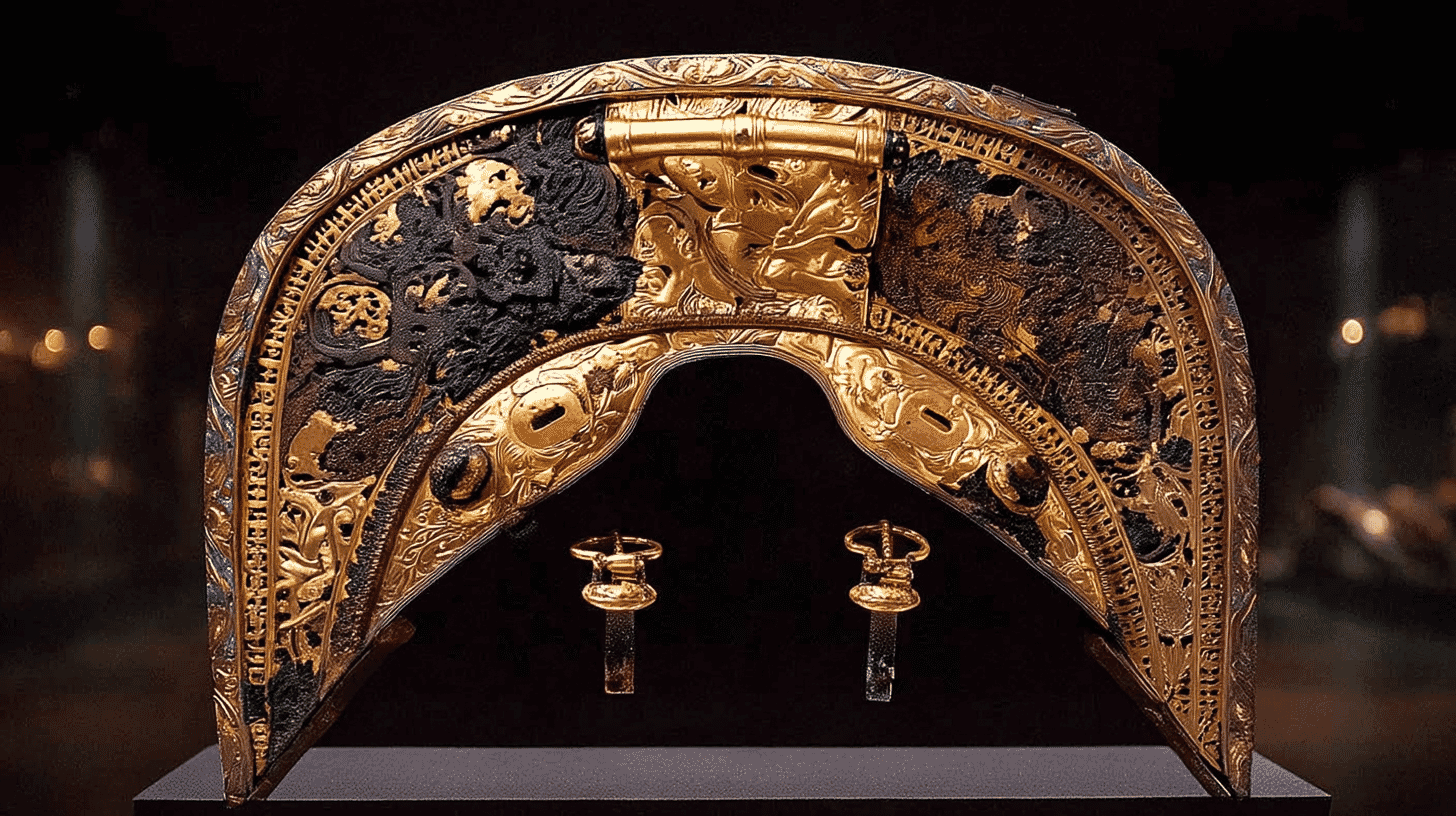
Fujinoki Kofun Artifacts: A Glimpse into Ancient Japan's Royal Splendor
Tucked away in the quiet town of Ikaruga in Nara Prefecture, just 350 meters west of the world-famous Horyuji Temple, lies a grassy mound that conceals one of Japan's greatest archaeological treasures. The Fujinoki Kofun, a circular burial mound dating to the late 6th century, yielded an astonishing collection of over 12,000 artifacts when it was first excavated in 1985. These artifacts, collectively designated as a National Treasure in 2004, offer a vivid window into the artistic mastery, international connections, and political power of Japan's ancient ruling elite during the Kofun period.
What makes the Fujinoki Kofun discovery so extraordinary is that the tomb was found virtually undisturbed — an exceedingly rare occurrence among ancient Japanese burial mounds. The gilt-bronze horse trappings, ornamental crowns, decorated shoes, ceremonial swords, and thousands of glass and metal ornaments that emerged from this tomb are among the finest examples of 6th-century craftsmanship ever discovered in East Asia.
The Discovery: An Undisturbed Royal Tomb
In 1985, a team from the Nara Prefectural Kashihara Archaeological Institute and the Ikaruga Town Board of Education began systematic excavation of the Fujinoki Kofun. What they uncovered exceeded all expectations. The tomb's horizontal stone burial chamber, measuring nearly 14 meters in total length, contained a house-shaped stone sarcophagus coated entirely in bright vermillion lacquer. Between the sarcophagus and the rear wall of the chamber, an extraordinary assemblage of burial goods lay folded and stacked, largely in their original arrangement.
Unlike so many other ancient tombs across Japan that had been plundered by grave robbers over the centuries, the Fujinoki Kofun remained essentially intact. While there was some evidence that intruders had entered the chamber at some point — a chipped corner on the sarcophagus and some pottery moved to one side — the overwhelming majority of the grave goods had been left untouched. This remarkable preservation allowed archaeologists to study not only the artifacts themselves but also how they were originally placed within the tomb, providing invaluable insights into 6th-century funerary customs.
When the sarcophagus was finally opened during the third excavation campaign in 1988, researchers discovered the remains of two individuals buried head-to-east, wrapped in multiple layers of fine textile cloth. The bodies were accompanied by an incredible array of personal ornaments, weapons, and ritual objects, all still positioned as they had been at the time of burial over 1,400 years earlier.
Why These Artifacts Were Designated a National Treasure
The Fujinoki Kofun artifacts were first designated as an Important Cultural Property in 1988, with additional items from within the sarcophagus added in 1991. In 2004, the entire collection was elevated to National Treasure status — Japan's highest cultural designation — in recognition of its exceptional historical, artistic, and academic value.
Several factors contributed to this prestigious designation. First, the undisturbed condition of the tomb provided an extraordinarily complete picture of elite burial practices during a pivotal period in Japanese history. The artifacts represent one of the most lavish assemblages of grave goods ever recovered from the Late Kofun period (500–600 CE), rivaling or exceeding anything found in contemporary tombs across East Asia.
Second, the quality of craftsmanship displayed in the gilt-bronze saddle fittings, crown, and shoes is unparalleled. The saddle fittings in particular are recognized as having no equal anywhere in ancient East Asia for the intricacy and sophistication of their openwork decoration. Third, the artifacts reveal extensive cultural connections between ancient Japan and the broader East Asian world, including ties to the Korean kingdoms of Silla and Baekje, as well as influences from the Xianbei nomadic peoples of northern China. These objects embody a remarkable intersection of multiple cultural traditions, demonstrating how Japan's ancient elite integrated diverse artistic and technical influences into a uniquely Japanese funerary culture.
Highlights of the Collection
Gilt-Bronze Saddle Fittings (Kondō-sei Kura Kanagu)
The crown jewel of the Fujinoki collection is undoubtedly the set of gilt-bronze saddle fittings. Measuring 57 centimeters wide and 43 centimeters high, these ornamental fittings originally adorned a wooden saddle and consist of a front bow (maewa) and rear bow (shizuwa), each decorated with stunningly intricate openwork and relief carving.
The front bow features phoenixes, dragons, and palmette motifs in raised relief along its outer rim. Its central panels (umi kanagu) are framed by a hexagonal honeycomb pattern, within which exquisitely carved dragons, phoenixes, lions, and other creatures are arranged in perfect bilateral symmetry, surrounded by small animals and floral scrolls.
The rear bow shares a similar construction but displays different imagery, including demon faces (kimen), elephants, rabbits, and a figure of a demon deity (kishin) wielding a sword and axe. Glass beads are set into the handle fittings at the top, demonstrating an extraordinary level of decorative ambition. Scholars have noted that comparable saddle fittings from the Xianbei kingdoms of northern China (known as the Three Yan states) provide the closest parallels, though none match the Fujinoki examples in terms of complexity and artistic refinement.
Gilt-Bronze Crown (Kondō-sei Kan)
The gilt-bronze crown found within the sarcophagus features a broad headband approximately 52 centimeters in circumference, rising to form two peaks. Atop these peaks, two elaborate standing ornaments reach a total height of about 35 centimeters. The standing ornaments are composed of intertwining wave-like patterns, tipped with bird-shaped and diamond-shaped designs rendered in delicate openwork. The entire crown was originally adorned with small dangling pendants (hoyō) in the shapes of flower petals and birds, designed to shimmer and make gentle sounds with the wearer's movements.
Gilt-Bronze Shoes (Kondō-sei Kutsu)
Two pairs of ornamental gilt-bronze shoes were recovered, the larger pair measuring 38.4 centimeters in length. The surface of each shoe is covered with hexagonal tortoiseshell patterns created by incised lines and punched dots, while the entire exterior was originally covered with leaf-shaped dangling pendants. Traces of woven fabric remain on the interior, and the openings were trimmed with brocade. These shoes were clearly ceremonial rather than practical — dazzling symbols of the wearer's exalted status.
Swords and Weaponry
The sarcophagus contained five long swords (tachi) and one shorter sword (ken), all featuring gilt-bronze fittings of remarkable quality. The two largest swords, each measuring an impressive 136 centimeters, were placed alongside the two bodies and decorated with gold, silver, and glass inlay, with their scabbards studded with glass beads. Fish-shaped gilt-bronze ornaments (gyohai) accompanied three of the swords — this discovery was particularly significant because it definitively established, for the first time, that these fish ornaments were sword accessories rather than belt decorations as previously theorized.
Bronze Mirrors and Ornaments
Four bronze mirrors were found in the sarcophagus, placed beneath the heads of the two buried individuals. Two of these are believed to be Chinese imports from the 5th century, connected to diplomatic exchanges between the Southern Dynasties of China and Japan's Yamato rulers. The remaining two mirrors are domestic copies inspired by the Chinese originals. In addition, the tomb yielded thousands of glass beads, silver-gilt hollow beads, ear ornaments, and large glass ankle beads, creating a dazzling picture of how Japan's ancient elite were adorned for the afterlife.
The Mystery of the Buried Individuals
One of the most intriguing aspects of the Fujinoki Kofun is the unresolved question of who was buried within its sarcophagus. Scientific analysis of the skeletal remains confirmed that one of the two individuals was a young male between 17 and 25 years of age, while the second individual is also believed to have been male, though the evidence is less conclusive due to poor bone preservation.
The simultaneous burial of two men in a single sarcophagus within such a richly furnished tomb has long puzzled researchers. Ancient documents refer to the site as "Misasaki" (a term meaning imperial tomb), suggesting that the occupants were of royal or near-royal rank. Leading theories propose that the tomb's occupants may have been Prince Anahobe and Prince Yakabe, two members of the imperial family who were assassinated by the powerful Soga no Umako in 587 CE. Other candidates include Emperor Sushun, members of the Kashiwade clan, or local powerful families such as the Ki or Heguri clans. The rushed construction evident in certain features of the tomb — including the unusual use of a single sarcophagus for two individuals — lends support to the assassination theory, suggesting that the burial may have been conducted under emergency circumstances.
International Connections: Where East Asia Meets
The Fujinoki artifacts provide compelling evidence of the extensive international networks that connected 6th-century Japan with the broader East Asian world. The saddle fittings display design elements traceable to the Xianbei nomadic cultures of northern China, particularly the kingdoms of Former Yan, Later Yan, and Northern Yan. Similar openwork gilt-bronze saddle fittings have been found at Silla kingdom sites in Gyeongju, Korea, such as the famous Cheonmachong tomb.
The Chinese-made bronze mirrors point to diplomatic ties with the Southern Dynasties, while the sword fittings blend Japanese (wa-style) traditions with Korean-peninsula influences, including one round-pommel sword believed to be of Korean manufacture. The glass beads and silver ornaments further attest to the vast trading networks that brought materials and techniques from across the continent to the Yamato heartland. Rather than merely reflecting foreign influence, however, these artifacts demonstrate how Japan's 6th-century elite actively synthesized diverse cultural traditions into a distinctive funerary aesthetic uniquely adapted to the political and spiritual needs of the Nara Basin.
Where to See the Artifacts
Kashihara Archaeological Institute Museum (Original Artifacts)
The original National Treasure artifacts are permanently displayed at the Nara Prefectural Kashihara Archaeological Institute Museum in the city of Kashihara. This museum, founded in 1938, houses approximately 3,700 archaeological objects spanning from the Paleolithic era to the medieval period, with the Fujinoki collection as one of its star attractions. Here you can admire the actual gilt-bronze saddle fittings, crown, shoes, mirrors, swords, and other burial goods up close. A particularly noteworthy detail for international visitors: foreign tourists may be admitted free of charge under the Nara Prefecture fee exemption policy. Be sure to inquire at the reception desk.
Ikaruga Cultural Properties Center (Replicas)
For those visiting the Fujinoki Kofun itself, the nearby Ikaruga Cultural Properties Center (Ikaruga Bunkazai Center) offers an excellent complementary experience. Opened in 2010, this free facility displays approximately 60 meticulously crafted replicas of the key artifacts, including the saddle fittings, crown, and shoes, presented in specially designed low-height display cases that allow visitors to examine the intricate details at close range. The center also features a full-scale reproduction of the vermillion sarcophagus with a projected video showing the original excavation footage inside. A documentary film about the excavation is screened in the center's video hall.
The Fujinoki Kofun Site
The burial mound itself is accessible year-round at no charge. The site has been landscaped as a small park with explanatory signboards in the surrounding area. During special public openings held in spring and autumn, visitors can enter the stone chamber and view the vermillion-lacquered sarcophagus through a glass partition — an experience that brings the ancient world powerfully to life. Dates for these special openings are announced on the Ikaruga Town website, so it is worth checking in advance if you plan your visit around these events.
Surrounding Attractions
A visit to the Fujinoki Kofun pairs beautifully with exploration of the surrounding Ikaruga area, one of the most historically rich districts in all of Japan. The UNESCO World Heritage Site of Horyuji Temple is just a short walk away, home to the world's oldest surviving wooden structures and a wealth of National Treasure artworks including the famous Kudara Kannon statue. Nearby Chuguji Temple preserves a National Treasure statue of Miroku Bosatsu (Maitreya) widely regarded as one of the most beautiful sculptures in East Asian art. Other nearby temples such as Hokki-ji and Horin-ji offer quieter, more intimate settings to appreciate ancient Japanese Buddhist architecture.
The entire area can be explored comfortably on foot or by bicycle, making it ideal for a full day of cultural immersion in one of Japan's most historically significant landscapes.
- 📍 Plan Your Visit to Kyoto
- Find tours, activities & transport passes near Artifacts Excavated from Fujinoki Tomb in Nara Prefecture
- [ Kinkakuji Fushimi Inari & Kimono Rental ]
Q&A
- Can I see the actual National Treasure artifacts, or only replicas?
- You can see the actual National Treasure artifacts at the Kashihara Archaeological Institute Museum in Kashihara City, where they are part of the permanent collection. In addition, high-quality replicas of approximately 60 key items are on display at the Ikaruga Cultural Properties Center near the actual tomb site. Visiting both locations gives you the most complete experience.
- Is there any English signage or support for non-Japanese-speaking visitors?
- The Kashihara Archaeological Institute Museum has some English labeling and pamphlets. The Ikaruga Cultural Properties Center has basic English information. At the Fujinoki Kofun site itself, explanatory signboards include some English text. While full English-language guided tours are not regularly available, the visual impact of the artifacts transcends language barriers. It may also be helpful to download a translation app for detailed exhibit descriptions.
- When can I enter the stone chamber of the Fujinoki Kofun?
- The stone chamber is opened to the public during special events held in spring and autumn each year. Exact dates are announced on the Ikaruga Town official website. Outside of these special openings, the burial mound exterior and surrounding park area can be visited freely year-round.
- Is the Fujinoki Kofun suitable for visitors with limited mobility?
- The tomb mound itself is on generally flat ground and can be viewed from the surrounding walkways. However, entering the stone chamber during special openings requires navigating a narrow corridor. The Ikaruga Cultural Properties Center and the Kashihara Archaeological Institute Museum are both accessible facilities with barrier-free features. It is advisable to contact each facility in advance for specific accessibility information.
- How should I plan my visit to see both the kofun site and the museum?
- The Fujinoki Kofun and the Ikaruga Cultural Properties Center are located in Ikaruga Town, while the Kashihara Archaeological Institute Museum is in Kashihara City, approximately 30 minutes away by train. A recommended itinerary is to visit the Horyuji Temple area (including the kofun and the Ikaruga Cultural Properties Center) in the morning, then take the train to Kashihara in the afternoon to see the original artifacts at the museum. Both areas offer plenty to fill a full day of cultural exploration.
Basic Information
| Official Name | Nara-ken Fujinoki Kofun Shutsudohin (Artifacts Excavated from Fujinoki Kofun, Nara Prefecture) |
|---|---|
| Designation | National Treasure (designated June 8, 2004); previously Important Cultural Property (designated June 6, 1988) |
| Period | Late Kofun period (second half of the 6th century) |
| Number of Items | Approximately 12,000 items (designated collectively) |
| Owner | Government of Japan (Agency for Cultural Affairs) |
| Museum (Original Artifacts) | Nara Prefectural Kashihara Archaeological Institute Museum 50-2 Unebi-cho, Kashihara City, Nara 634-0065 TEL: 0744-24-1185 |
| Museum Hours | 9:00 AM – 5:00 PM (last entry 4:30 PM) Closed Mondays (open if Monday is a holiday; closed the following day instead), year-end/New Year holidays |
| Museum Admission | Adults: 400 yen / University & high school students: 300 yen / Elementary & middle school students: 200 yen *Foreign tourists may be eligible for free admission under Nara Prefecture's fee exemption policy |
| Museum Access | 5-minute walk from Kintetsu Unebigoryomae Station; 15-minute walk from Kintetsu Kashiharajingu-mae Station |
| Replica Display | Ikaruga Cultural Properties Center 1-11-14 Horyuji-nishi, Ikaruga-cho, Ikoma-gun, Nara 636-0172 TEL: 0745-70-1200 |
| Replica Center Hours | 9:00 AM – 5:00 PM (last entry 4:30 PM) Closed Wednesdays (open if Wednesday is a holiday or during special exhibitions), year-end/New Year holidays Admission: Free (some special exhibitions may charge a fee) |
| Kofun Site | Horyuji-nishi 2, Ikaruga-cho, Ikoma-gun, Nara Open year-round, free admission Stone chamber special openings: Spring and Autumn (check Ikaruga Town website for dates) |
| Kofun Site Access | Approximately 10-minute walk from the Horyuji Sando bus stop (bus from JR Horyuji Station); about 5-minute walk from Ikaruga Town Hall bus stop |
References
- 藤ノ木古墳出土金銅製鞍金具 | 奈良県歴史文化資源データベース
- https://www.pref.nara.jp/miryoku/ikasu-nara/bunkashigen/main10401.html
- 藤ノ木古墳出土品 | AONIYOSHI
- https://eich516.com/note07/note07_0201/syutsudohin
- 藤ノ木古墳 – Wikipedia (Japanese)
- https://ja.wikipedia.org/wiki/%E8%97%A4%E3%83%8E%E6%9C%A8%E5%8F%A4%E5%A2%B3
- Fujinoki Tomb – Wikipedia (English)
- https://en.wikipedia.org/wiki/Fujinoki_Tomb
- 国宝-考古|奈良県藤ノ木古墳 出土品 | WANDER 国宝
- https://wanderkokuho.com/201-10613/
- 奈良県立橿原考古学研究所附属博物館 – 大和の遺跡 / 藤ノ木古墳
- https://www.kashikoken.jp/museum/yamatonoiseki/kofun/2018_fujinoki.html
- 奈良県藤ノ木古墳出土品 | 文化遺産オンライン
- https://bunka.nii.ac.jp/heritages/detail/202733
- 藤ノ木古墳 | 奈良県観光公式サイト あをによし なら旅ネット
- http://yamatoji.nara-kankou.or.jp/03history/06kofun/02west_area/fujinokikofun/
- 文化財センターについて | 斑鳩町文化財センター
- https://horyuji-ikaruga-nara.or.jp/b-center/about/
- 奈良県立橿原考古学研究所附属博物館 利用案内
- https://www.kashikoken.jp/museum/info/info.html
Last verified: 2026.02.17
Nearby heritages
- Water-Pouring Pottery
- Nara Prefectural Kashihara Archaeological Institute Museum 50-2 Unebi-cho, Kashihara City, Nara Prefecture
- Artifacts Excavated from Mesuriyama Tomb in Nara Prefecture
- 50-2 Unebicho, Kashihara City
- Artifacts Excavated from the Kashihara Ruins in Nara
- 50-2 Unebicho, Kashihara City
- Artifacts Excavated from the Omine Summit Site in Nara
- 50-2 Unebicho, Kashihara City
- Artifacts Excavated from Yamato Goboyama Tomb No. 3
- 50-2 Unebicho, Kashihara City
- Artifacts Excavated from the Yamato and Tango Ancient Ruins
- Nara Prefectural Kashihara Archaeological Institute Museum 50-2 Unebi-cho, Kashihara City, Nara Prefecture
- Artifacts Excavated from the Kengyokozuka Tomb in Takaichi
- Nara Prefectural Kashihara Archaeological Institute Museum 50-2 Unebi-cho, Kashihara City, Nara Prefecture
- Artifacts Excavated from Kurozuka Tomb in Nara Prefecture
- 50-2 Unebicho, Kashihara City
- Artifacts Excavated from Shimanoyama Tumulus in Nara
- 50-2 Unebicho, Kashihara City
- Taian Manso's Epitaph / Inscribed on July 6, 2012 /
- 50-2 Unebicho, Kashihara City