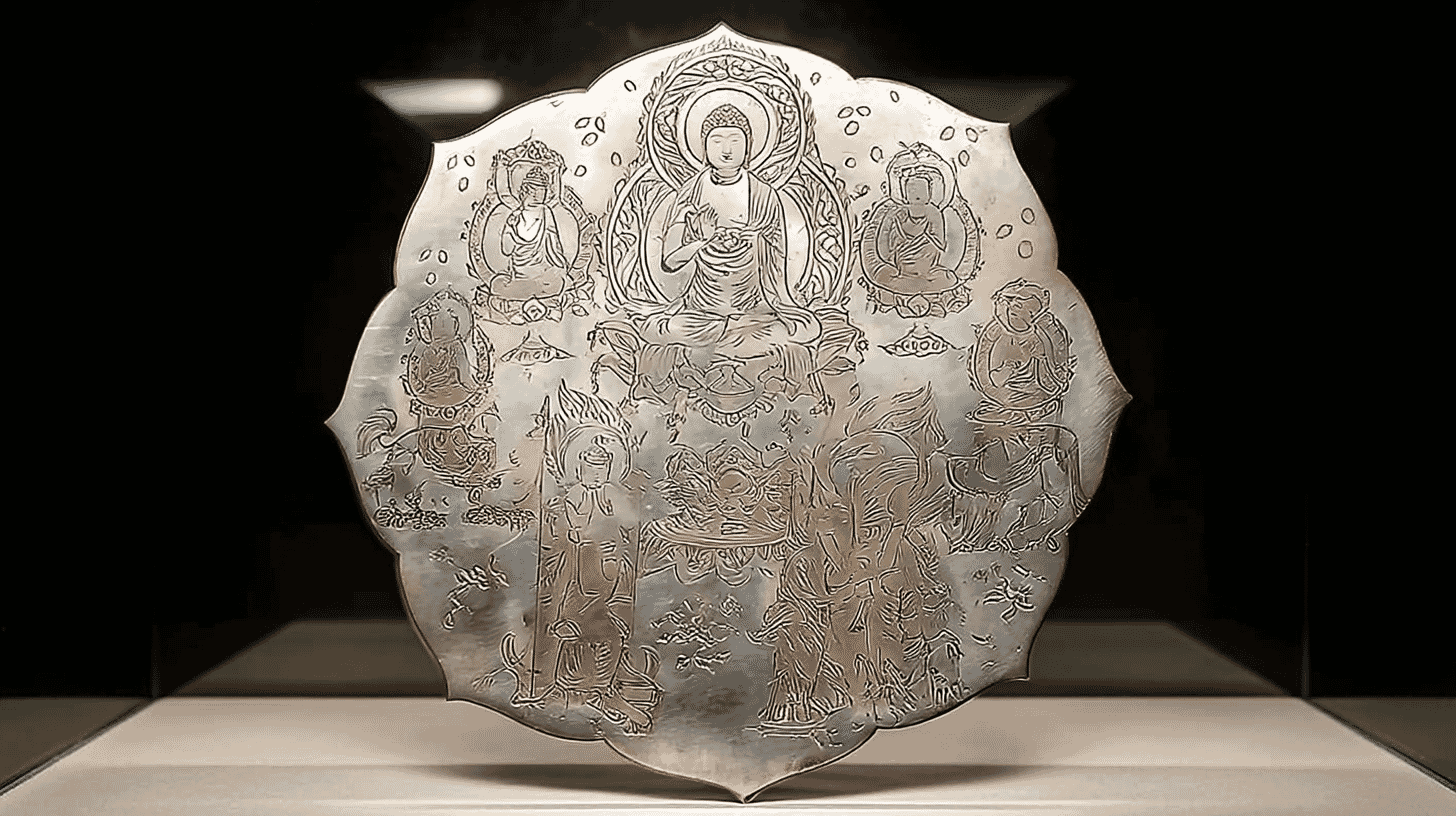
Line-Engraved Mirror with Shaka Triad: A National Treasure of Japanese Buddhist Metalwork

Discover the Line-Engraved Mirror with Shaka Triad (Senkoku Shaka Sanzon-tō Kyōzō), a Heian-period National Treasure featuring nine Buddhist deities in exquisite line engraving. Housed at the Sen-oku Hakukokan Museum in Kyoto.

Line-Engraved Mirror with Shaka Triad and Other Deities: A Masterpiece of Heian-Period Buddhist Metalwork

Hidden within the tranquil museum district of Kyoto's Shishigatani neighborhood, near the famed Philosopher's Path, lies one of Japan's most extraordinary examples of devotional metalwork — the Line-Engraved Mirror with Shaka Triad and Other Deities (線刻釈迦三尊等鏡像, Senkoku Shaka Sanzon-tō Kyōzō). Designated as a National Treasure, this small yet breathtakingly intricate bronze mirror, dating to the 12th century Heian period, embodies an entire Buddhist cosmos within a surface just 15 centimeters in diameter.

Owned by the Sen-oku Hakukokan Museum (泉屋博古館), this mirror image, or kyōzō, stands as one of the finest surviving examples of a uniquely Japanese art form that merged the spiritual traditions of Shinto and Buddhism. It offers modern visitors a rare window into the devotional artistry and profound religious sensibilities of medieval Japan.

What Is a Kyōzō? — The Sacred Art of Mirror Images

To fully appreciate the significance of this National Treasure, it helps to understand the artistic tradition it represents. A kyōzō (鏡像) is a bronze mirror upon which images of Buddhist or Shinto deities have been engraved or painted. These sacred objects emerged during the late Heian period (11th–12th centuries) as a tangible expression of shinbutsu shūgō — the syncretic blending of Shinto and Buddhist beliefs that characterized Japanese religion for centuries.

In Shinto tradition, mirrors were regarded as receptacles of divine spirit, or kami. Under the theological framework known as honji suijaku, Japanese kami were understood to be local manifestations of universal Buddhist deities. Kyōzō thus became powerful symbols of this unity: the mirror served as a vessel of Shinto sanctity, while the engraved Buddhist imagery represented the transcendent deities believed to reside within. These mirrors were often enshrined in temples and used as objects of worship known as mishōtai (御正体), or "true bodies" of the divine.

Description of the National Treasure

The Line-Engraved Mirror with Shaka Triad and Other Deities is an octalobed mirror (八稜鏡, hachiryōkyō) crafted from white bronze (白銅, hakudō) — a copper-nickel alloy that produces an elegant silver-white surface. The eight pointed lobes of its rim evoke the shape of lotus petals, lending the mirror an inherent sense of Buddhist symbolism before one even encounters the engraved imagery within.

The Front Face — A Buddhist Pantheon in Miniature

On the polished front surface, nine Buddhist deities are arranged in a carefully composed hierarchy, all rendered through the exquisite technique known as kebori (毛彫り), or hair-line engraving. This technique uses extremely fine incised lines to produce imagery of remarkable delicacy and detail.

At the top center sits Shakyamuni Buddha (釈迦如来), the historical Buddha, enthroned upon an elaborate lotus pedestal adorned with lotus-petal motifs (hōsōge), cascading jeweled necklaces (yōraku), and a double-circle halo incised with floral patterns and flame borders. He is shown in the teaching posture, presiding over the entire composition.

Flanking the Buddha on either side are two bodhisattvas seated upon lotus pedestals with double-circle halos backed by flames. Below and to the sides, Fugen Bosatsu (Samantabhadra, 普賢菩薩) appears in a posture of prayer atop a white elephant, while Monju Bosatsu (Manjushri, 文殊菩薩) rides a lion, holding a sword in the right hand and a lotus bearing a sutra box in the left. Together with Shakyamuni, they form the Shaka Triad — one of the most important groupings in Japanese Buddhist iconography.

In the lower portion of the mirror, rendered at a slightly larger scale, stand two powerful guardian figures. On the left, Fudō Myōō (Acala, 不動明王) glares with a wrathful expression, baring his fangs and gripping a sword and lasso, backed by an all-encompassing flame halo. He is attended by two young acolytes: Kongara Dōji (矜羯羅童子) and Seitaka Dōji (制多迦童子). On the right, Bishamonten (Vaisravana, 毘沙門天), clad in full armor, holds a pagoda in his left hand and a trident in his right, standing upon a rocky base with a wheel-and-flame halo behind him.

Scattered flowers and offerings adorn the space before the Shaka Triad, completing a scene of celestial reverence. Altogether, nine figures occupy this tiny stage — an astonishing feat of composition and engraving skill.

The Reverse Face — Decorative Splendor

The back of the mirror is equally impressive. Divided into inner and outer zones by ring-shaped lines, the inner area features a floral-pattern knob at the center, surrounded by alternating motifs of auspicious flowers (zuika) and mandarin ducks (oshidori) in a swirling arrangement. The outer zone is decorated with butterflies and small birds connected by graceful arabesque scrollwork. The casting quality is exceptionally fine, with crisp details throughout — further testament to the outstanding craftsmanship of the Heian artisan who created it.

Why Was It Designated a National Treasure?

The Line-Engraved Mirror with Shaka Triad was first designated an Important Cultural Property on November 14, 1953, and elevated to National Treasure status on March 20, 1954. The Agency for Cultural Affairs recognizes it for several exceptional qualities.

First, the skillful arrangement of nine deities of varying sizes within such a compact space demonstrates extraordinary compositional mastery. The hierarchical placement — with the Shaka Triad at the summit, flanking bodhisattvas in the middle, and guardian deities at the base — creates a miniature mandala of remarkable clarity and balance.

Second, the line engraving itself is described as both "exquisite and elegant" (精緻かつ流麗). The fineness of the kebori technique, with its subtle variations in depth and line weight, lends the figures a painterly, almost calligraphic quality that transcends the limitations of the metal medium. Scholars have compared the engraving style to the hakubyō (white-line drawing) traditions of late Heian and early Kamakura period painting.

Third, the reverse side of the mirror displays outstanding casting quality, with decorative motifs rendered with exceptional sharpness and detail. Taken together, the front and back of this mirror represent a rare masterwork among surviving kyōzō — the official designation describes it as "an exceptionally fine piece, seldom seen among mirror images."

Highlights and Points of Interest for Visitors

For international visitors, encountering this National Treasure offers a uniquely intimate art experience. Unlike monumental temple sculptures or grand painted screens, this mirror draws you into an almost meditative act of close observation.

When displayed at the Sen-oku Hakukokan Museum, the mirror is typically presented in an independent display case, allowing visitors to view both the engraved front and the decorative back. Visitors often note that the engraved figures are best appreciated from a slightly elevated angle — standing on tiptoe and looking down at a gentle incline can reveal details that are less visible from a straight-on perspective.

The white bronze material has a distinctive silvery sheen unlike the green patina many associate with ancient metalwork. Under the museum's carefully directed lighting, the hair-thin engraved lines seem to emerge and recede as you shift your viewing angle, creating an almost living, breathing quality in the sacred figures. It is a reminder that this object was not merely decorative but served as a genuine focus of spiritual devotion.

Photography has been permitted in some exhibitions featuring this mirror, offering a wonderful opportunity to capture this National Treasure up close. However, policies may vary between exhibitions, so visitors are advised to check the current rules upon arrival.

The Sen-oku Hakukokan Museum — Home of the Sumitomo Collection

The Line-Engraved Mirror with Shaka Triad resides in the Sen-oku Hakukokan Museum (泉屋博古館), one of Japan's most distinguished private art museums. Established in 1960, the museum was founded to preserve and exhibit the art collection of the Sumitomo family — one of the great industrial dynasties of modern Japan.

The museum's name derives from "Izumiya," the Sumitomo family's Edo-period trade name, and "Hakuko," from the Song dynasty bronze vessel catalogue Hakuko Zuroku (博古図録). The collection centers on ancient Chinese bronze vessels, widely regarded as one of the finest assemblages of such objects outside China. However, the holdings extend far beyond bronzes to encompass Chinese and Japanese paintings, Buddhist sculpture, calligraphy, tea ceremony utensils, and more — totaling approximately 3,500 works, including two National Treasures, 19 Important Cultural Properties, and 60 Important Art Objects.

The Kyoto museum completed a major renovation and reopened with improved lighting, barrier-free access, and refined display environments. The mirror is now displayed upright rather than flat, greatly enhancing visitor viewing. A Tokyo branch, Sen-oku Hakukokan Tokyo, operates in Roppongi and occasionally exhibits the mirror during special exhibitions.

Please note that the museum is open seasonally — typically spring (March through June) and autumn (September through December) — so visitors should confirm the schedule on the official website before planning their trip.

Surrounding Area — Kyoto's Cultural Gem, the Shishigatani District

The Sen-oku Hakukokan Museum is located in the Shishigatani (鹿ヶ谷) district at the foot of the Higashiyama mountains — one of Kyoto's most culturally rich and scenic neighborhoods. The area is home to a remarkable concentration of temples, shrines, and natural beauty, making a visit to the museum an ideal starting point or destination within a full day of exploration.

The museum sits along the southern end of the famed Philosopher's Path (哲学の道, Tetsugaku no Michi), a roughly 2-kilometer walking trail that follows a canal from the Lake Biwa Aqueduct. Named after the Kyoto University philosopher Nishida Kitarō, who walked it daily in contemplation, the path is particularly breathtaking during cherry blossom season in spring and amid brilliant autumn foliage.

Nearby cultural landmarks include Eikandō (Zenrin-ji), celebrated for its stunning autumn maple displays; the grand Nanzen-ji temple complex with its iconic aqueduct; Ginkaku-ji (the Silver Pavilion), a World Heritage Site at the northern end of the Philosopher's Path; Hōnen-in, a tranquil moss-covered temple; and Kumano Wakaoiji Shrine, nestled amid forest at the southern terminus of the Philosopher's Path.

The neighborhood rewards slow, leisurely exploration on foot. Charming cafés, traditional craft shops, and quiet residential streets offer a refreshing contrast to the busier tourist districts of central Kyoto.

Practical Tips for International Visitors

The Sen-oku Hakukokan Museum can be reached by taking Kyoto City Bus lines 5, 93, 203, or 204 to the "Higashitenno-cho" (東天王町) stop, then walking approximately 200 meters east. Alternatively, from the Tozai subway line, alight at Keage Station (蹴上駅) and walk north for about 20 minutes — a pleasant route that passes through the atmospheric Nanzen-ji temple grounds.

While the museum primarily provides information in Japanese, the art speaks a universal visual language. Basic English signage is available, and the museum's official website offers English-language pages with exhibition schedules and access information. Coin-operated lockers are available free of charge, and the museum offers a relaxed, uncrowded atmosphere ideal for contemplative viewing.

To make the most of your visit, consider combining the museum with a walk along the Philosopher's Path and visits to neighboring temples. Spring (late March through April for cherry blossoms) and autumn (mid-November through early December for maple colors) are especially beautiful times to visit this area.

📍 Plan Your Visit to Kyoto
Find tours, activities & transport passes near Carved Mirror Images of the Shaka Triad and Other Statues
[ Kinkakuji Fushimi Inari & Kimono Rental ]

Q&A

QIs the Line-Engraved Mirror with Shaka Triad always on display?
ANo, the mirror is not permanently on display. It is periodically exhibited at the Sen-oku Hakukokan Museum in Kyoto, primarily during the Bronze Gallery exhibitions and special exhibitions. The museum is open seasonally (spring and autumn), and the mirror may also travel to other museums for special shows. Always check the museum's official website or contact them directly before visiting to confirm whether it is currently on view.
QHow small is the mirror, and can I see the engraved details clearly?
AThe mirror measures approximately 15.1 cm (about 6 inches) in diameter — roughly the size of a dessert plate. Despite its compact size, the engraved figures are remarkably detailed. The museum displays it in a well-lit independent case, and viewing from a slightly elevated angle helps reveal the fine kebori (hair-line engraving) details. Taking your time with this piece is highly recommended.
QWhat is the significance of the nine Buddhist figures on the mirror?
AThe nine figures compose a miniature Buddhist pantheon. At the center is the Shaka (Shakyamuni) Triad — the historical Buddha flanked by Fugen (Samantabhadra) and Monju (Manjushri) bodhisattvas. Two additional bodhisattvas appear nearby. Below are the protective deities Fudō Myōō (Acala) with two attendant boys and Bishamonten (Vaisravana). Together, they represent a comprehensive devotional universe condensed onto a tiny surface.
QAre there other National Treasures at the Sen-oku Hakukokan Museum?
AYes. The museum holds a second National Treasure: "Pasturing Water Buffaloes in an Autumnal Countryside" (秋野牧牛図), a Southern Song dynasty painting attributed to Yan Ciping. In addition, the collection includes 19 Important Cultural Properties and 60 Important Art Objects, primarily focusing on ancient Chinese bronze vessels — one of the finest such collections in the world.
QCan I combine a visit to the museum with other sightseeing in the area?
AAbsolutely. The museum is ideally situated near the southern end of the Philosopher's Path, one of Kyoto's most scenic walking routes. Within a short walk, you can visit Eikandō temple, Nanzen-ji temple, Hōnen-in, and Ginkaku-ji (Silver Pavilion). The entire Shishigatani and Higashiyama district can easily fill a rewarding full day of cultural exploration.

Basic Information

Designated Name Line-Engraved Mirror with Shaka Triad and Other Deities (線刻釈迦三尊等鏡像, Senkoku Shaka Sanzon-tō Kyōzō)
Also Known As Line-Engraved Mirror with Various Buddhist Deities (線刻仏諸尊鏡像); Mirror with Auspicious Flowers and Mandarin Ducks, Octalobed (瑞花鴛鴦八稜鏡)
Category National Treasure — Craft (Metalwork)
Period Heian Period (12th century)
Material White bronze (hakudō, copper-nickel alloy), octalobed mirror (hachiryōkyō)
Dimensions Diameter: 15.1 cm; Rim thickness: 1.2 cm
Quantity 1 piece
National Treasure Designation March 20, 1954
Important Cultural Property Designation November 14, 1953
Owner Sen-oku Hakukokan Museum (Public Interest Incorporated Foundation)
Museum Location (Kyoto) 24 Shimomiyanomae-cho, Shishigatani, Sakyo-ku, Kyoto 606-8431, Japan
Museum Hours 10:00 AM – 5:00 PM (last entry 4:30 PM); Closed Mondays (open on national holidays, closed the following weekday)
Open Seasons Spring (approx. March – June) and Autumn (approx. September – December); Closed during exhibition changeover periods
Admission Adults: ¥1,000 (special exhibitions ¥1,200); Students with ID: ¥600 (special exhibitions ¥800)
Access Kyoto City Bus lines 5, 93, 203, 204 to "Higashitenno-cho" stop, 200m walk east; or 20-minute walk from Keage Station (Tozai Line)
Phone +81-75-771-6411
Official Website https://sen-oku.or.jp/kyoto/en/

References

Cultural Heritage Online — Line-Engraved Mirror with Shaka Triad and Other Deities (文化遺産データベース)
https://bunka.nii.ac.jp/db/heritages/detail/148528
National Treasure Japan — Line-Engraved Mirror with Shaka Triad (国宝を巡る)
https://www.national-treasure.jp/?p=74
WANDER National Treasures — Line-Engraved Mirror with Shaka Triad [Sen-oku Hakukokan/Kyoto]
https://wanderkokuho.com/201-00443/
Sen-oku Hakukokan Museum — Official Website (Kyoto English)
https://sen-oku.or.jp/kyoto/en/
Nara National Museum — Masterworks of the Sen-oku Hakukokan Museum (Exhibition Page)
https://www.narahaku.go.jp/english/exhibition/special/feature_exhibition/202407_senoku/
Kyoto National Museum — Divine Reflections: Medieval Japanese Votive Mirrors and Plaques
https://www.kyohaku.go.jp/old/eng/theme/floor1_5/past/1F-5_20220208.html
The Metropolitan Museum of Art — Votive Mirror with Eleven-Headed Kannon
https://www.metmuseum.org/art/collection/search/45522
Sen-oku Hakukokan Museum — Wikipedia (English)
https://en.wikipedia.org/wiki/Sen-oku_Hakuko_Kan
Butsuzō Tanbō — Sen-oku Hakukokan National Treasure Mirror Image
https://www.butsuzoutanbou.org/

Last verified: 2026.02.17

Nearby heritages