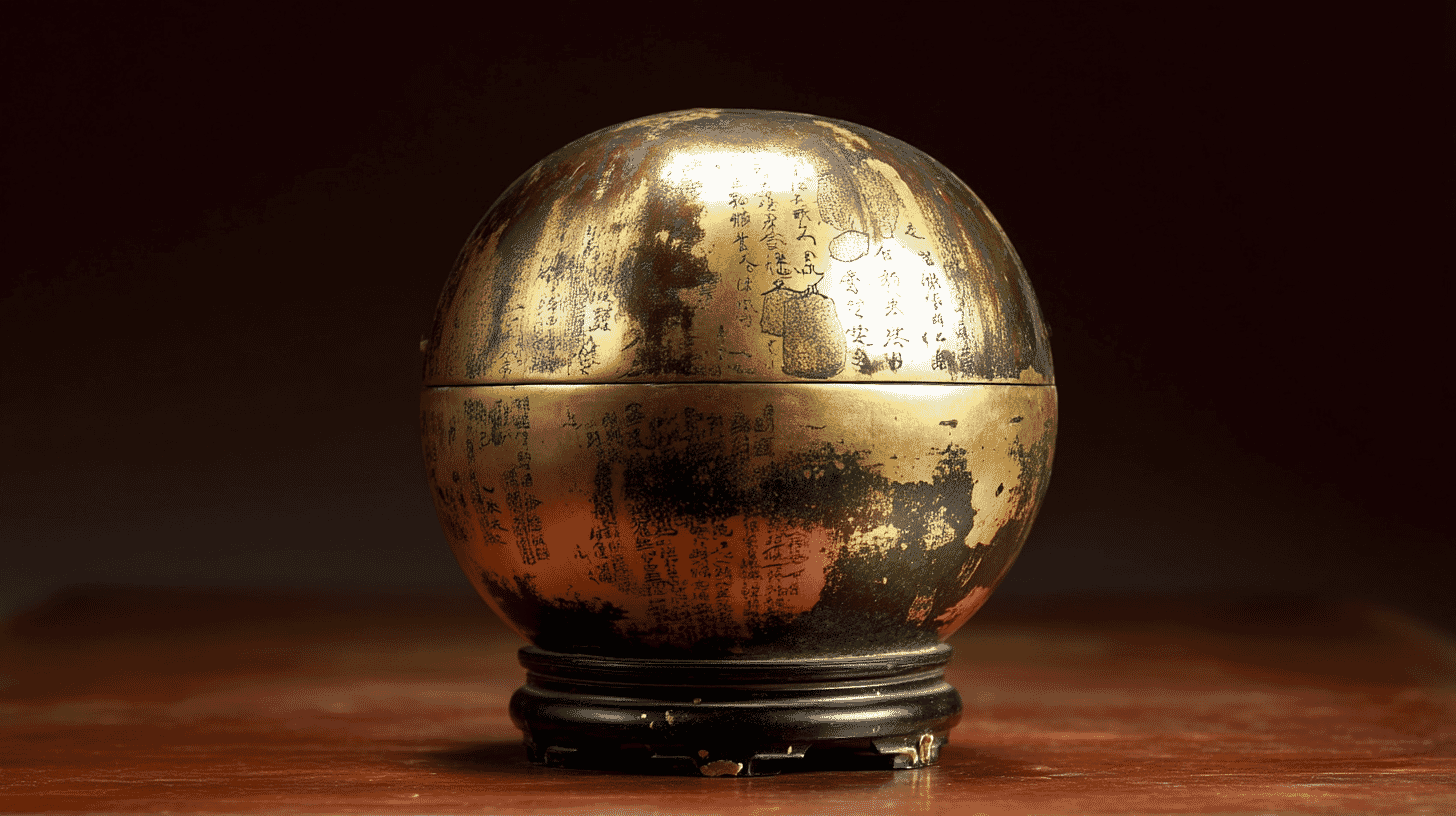
Gilt-Bronze Cinerary Container of Ina no Ōmura: A National Treasure from Japan's Asuka Period

Discover the Gilt-Bronze Cinerary Container of Ina no Ōmura, a Japanese National Treasure from 707 CE. This golden spherical ossuary with a 391-character epitaph reveals the life of an Asuka-period aristocrat and Japan's earliest cremation practices.

Gilt-Bronze Cinerary Container of Ina no Ōmura: A Golden Sphere that Speaks Across Thirteen Centuries

Deep within the collections of the Kyoto National Museum rests a radiant golden sphere, small enough to cradle in both hands, yet bearing the weight of over 1,300 years of Japanese history. The Gilt-Bronze Cinerary Container of Ina no Ōmura (金銅威奈大村骨蔵器) is one of Japan's most extraordinary National Treasures — not merely an exquisite object of metalwork, but a personal biography etched in bronze, a window into the dawn of cremation in Japan, and a poignant memorial to a court official who died far from home.

Designated as a National Treasure in 1955, this spherical ossuary dates to 707 CE and once held the cremated remains of Ina no Ōmura, a nobleman who served the imperial court during one of Japan's most transformative eras. For visitors seeking to encounter the ancient world of Asuka-period Japan in an intimate, deeply human way, this object offers something no grand temple or towering statue can — the personal story of an individual life, told in his own time.

What Is the Gilt-Bronze Cinerary Container?

The cinerary container is a cast bronze sphere measuring 24.2 centimeters in height and 24.4 centimeters in diameter — roughly the size of a large grapefruit. It separates horizontally into two halves: a hemispherical lid and a hemispherical body. The surface was finished on a lathe and gilded, giving it a lustrous golden appearance. A small foot ring is riveted to the base, allowing the vessel to sit upright. The bronze walls are remarkably thin, ranging from about one to three millimeters, becoming thinner toward the base.

What makes this container truly exceptional is the inscription engraved on the inner surface of the lid. A total of 391 characters of classical Chinese are arranged in 39 columns of 10 characters each, radiating outward from the center. This epitaph provides a detailed biography of the deceased, Ina no Ōmura, covering his lineage, character, official career, death, and burial — a remarkably complete personal record from the early eighth century.

The Life of Ina no Ōmura: A Courtier's Journey

According to the epitaph and historical records such as the Shoku Nihongi, Ina no Ōmura was born in 662 CE as the third son of Ina no Kagami-kō. His lineage traced back four generations to Emperor Senka, making him a member of the imperial extended family bearing the prestigious kabane (hereditary title) of Mahito — the highest rank in the system established by Emperor Tenmu.

Ōmura began his court career during the reign of Empress Jitō, receiving his initial rank under the older court ranking system. When the capital moved to Fujiwara Palace, he was appointed Minor Counsellor (Shōnagon) under Emperor Monmu. With the establishment of the landmark Taihō Code in 701, which reorganized the entire government along Chinese-style lines, Ōmura was granted Junior Fifth Rank, Lower Grade — officially entering the aristocracy. He also served concurrently as a Chamberlain (Jijū), advising the emperor on matters of state.

In 705, Ōmura was appointed Governor of Echigo Province, a remote northern territory bordering the lands of the Emishi peoples. This was no mere administrative posting; the region required careful diplomatic and military stewardship. Tragically, Ōmura fell ill and died at his post on April 24, 707 CE, at the age of approximately 42. His remains were cremated in Echigo and, on November 21 of that same year, were brought back over 600 kilometers of mountainous terrain to be interred in his ancestral homeland of Yamakimi no Sato in Katsuragi Lower County, Yamato Province — the area known today as Anamushi in Kashiba City, Nara Prefecture.

Why This Object Became a National Treasure

The Gilt-Bronze Cinerary Container of Ina no Ōmura holds exceptional value for several overlapping reasons.

First, as a historical document, the 391-character epitaph is among the most detailed biographical inscriptions from early Japan. Much of what it records about Ōmura's career does not appear in the Shoku Nihongi, making this container an irreplaceable primary source for understanding Asuka-period aristocratic life and the implementation of the Taihō Code — the legal framework that shaped Japanese governance for centuries.

Second, the container is a masterpiece of early Japanese metalwork. Its perfectly spherical form, precise lathe-finishing, and fine gilding demonstrate a level of craftsmanship that speaks to the sophistication of Asuka-period artisans. Only one other spherical ossuary of this type is known — an uninscribed example reportedly found in Saga Prefecture — making this a virtually unique artifact.

Third, the calligraphy of the inscription is itself considered artistically significant. The finely incised small regular script (kaisho) represents the calligraphic standards of its era. The Edo-period polymath Kimura Kenkadō, who personally examined the container in the 1770s, was so impressed that he created a rubbing of the entire text to use as a calligraphy model.

Fourth, the container is a tangible witness to the introduction of cremation in Japan. The earliest recorded cremation was that of the monk Dōshō in 700 CE. Ōmura's cremation in 707 CE, just seven years later, shows how rapidly this Buddhist practice spread among the aristocratic class. The object thus documents a profound cultural shift in Japanese attitudes toward death and the body.

Discovery and Provenance: From Farmland to National Treasure

The container lay hidden for over a thousand years beneath the earth of Mount Anamushi (also called Nijōzan area) in what was then Baba Village, Katsuragi Lower County. During the Meiwa era (1764–1772) of the Edo period, a farmer unearthed it while cultivating land. The container was found beneath an overturned ceramic jar, and inside it was a circular lacquer box containing the cremated remains.

The farmer, initially believing the gleaming vessel to be pure gold, kept it. Upon realizing it was bronze, he donated it to the local temple An'yūji, while the lacquer box with Ōmura's bones was sent to Ōtani Honbyō, the Pure Land Buddhist mausoleum in Kyoto, as the farmer was a Jōdo Shinshū follower. Sadly, the lacquer container and the bones have since been lost.

The local people could not read the inscription, but a traveling Buddhist monk named Gitan recognized its historical significance and published a scholarly study titled "Ina-kyō Dōban Boshimei-kō." His friend, the celebrated Osaka intellectual Kimura Kenkadō, borrowed the container for direct examination and wrote his own study. Word spread further through publications such as Akisato Ritō's "Yamato Meisho Zue" and Matsudaira Sadanobu's "Shūko Jisshu," bringing the container to national attention.

Eventually a monk named Taijun from Shitennōji Temple in Osaka attempted to reunite the bones with the container but was unsuccessful. The container itself came into Shitennōji's possession, where it remains today as part of the temple's collection, currently deposited at the Kyoto National Museum for safekeeping and exhibition.

Highlights and Points of Appreciation

When you stand before this object in a museum gallery, several features deserve special attention. The perfect spherical form, glowing with its gilt surface, immediately commands the eye. Unlike rectangular or jar-shaped containers common in other funerary traditions, this globe-like shape is strikingly unusual and almost modern in its elegance.

Look closely at the lid, and you may be able to discern the fine lines of the inscription radiating outward from the center — columns of characters so small and precise that they required exceptional skill to engrave. The text begins with Ōmura's name and imperial lineage, proceeds through his character and career, and concludes with quotations from the Confucian Analerta and other Chinese classics, praising his virtues in sophisticated literary Chinese. The final lines poignantly mourn his death far from home.

The thin walls of the container — as fine as one millimeter in places — testify to the metalworking expertise of early eighth-century Japanese craftsmen. The foot ring, attached with rivets, is a practical and elegant solution for stability. Together, these details reveal an object made not for mass production but as a unique, bespoke memorial for a man of rank and distinction.

Where to See the Container

The Gilt-Bronze Cinerary Container of Ina no Ōmura is owned by Shitennōji Temple in Osaka but is currently deposited at the Kyoto National Museum. Because it is a sensitive archaeological artifact, it is not on permanent display. Instead, it appears periodically in special exhibitions and the museum's rotating Masterpieces Gallery. Typically, it is exhibited once every few years.

The Kyoto National Museum (京都国立博物館) is itself a magnificent destination, located in the Higashiyama district near Sanjūsangendō and the Kyoto National Museum Garden. Its Heisei Chishinkan Wing houses rotating exhibitions of National Treasures and Important Cultural Properties across all categories of Japanese art and archaeology. Even when this particular container is not on view, the museum's archaeological galleries often feature related objects such as other epitaphs, cinerary urns, and Asuka-period artifacts that provide rich context.

Surrounding Area and Related Destinations

Visitors inspired by this object can deepen their experience by exploring related sites in the Kansai region.

In Osaka, Shitennōji Temple — the container's owner — is one of Japan's oldest temples, founded by Prince Shōtoku in 593 CE. The temple's Treasure House (Hōmotsukan) displays National Treasures and Important Cultural Properties on a rotating basis. The lively antique market held on the 21st and 22nd of every month draws hundreds of vendors and offers a unique cultural experience.

In Nara Prefecture, the city of Kashiba — where Ōmura was buried — sits at the foot of Mount Nijō, a twin-peaked mountain straddling the Osaka-Nara border. The Kashiba City Nijōzan Museum offers exhibits on local history and archaeology. Nearby, the Archaeological Institute of Kashihara houses an outstanding collection of artifacts from Nara Prefecture's rich archaeological heritage, spanning from the Jōmon period to the medieval era.

For those wishing to explore more of the Asuka period, the Asuka region itself is just a short train ride south of Kashihara, offering temple ruins, mysterious stone carvings, ancient palace sites, and the Takamatsuzuka Tomb with its famous wall paintings — all set in a beautiful rural landscape perfect for cycling.

📍 Plan Your Visit to Kyoto
Find tours, activities & transport passes near Gilt-Bronze Ina Omura Funerary Vessels
[ Kinkakuji Fushimi Inari & Kimono Rental ]

Q&A

QWhere can I see the Gilt-Bronze Cinerary Container of Ina no Ōmura?
AThe container is deposited at the Kyoto National Museum, where it appears in special exhibitions and the rotating Masterpieces Gallery every few years. Check the museum's exhibition schedule before your visit. It is not on permanent display.
QWhy is this container so significant among Japanese National Treasures?
AIt combines exceptional metalcraft with a 391-character biographical inscription that is one of the most detailed personal records from early eighth-century Japan. It is also one of only two known spherical ossuaries of this type, and it documents the very early adoption of cremation in Japan, making it invaluable for archaeology, history, and art history alike.
QWho was Ina no Ōmura?
AIna no Ōmura (662–707 CE) was an Asuka-period court official descended from Emperor Senka. He served as Minor Counsellor and Chamberlain before being appointed Governor of Echigo Province (present-day Niigata). He died at his post at age 42, and his ashes were returned to his homeland in present-day Kashiba City, Nara Prefecture.
QIs the inscription on the container readable to visitors?
AThe inscription is engraved on the inner surface of the lid in very fine characters. While it can be difficult to read with the naked eye through a display case, museums typically provide photographs, explanatory panels, and sometimes digital close-ups that allow visitors to appreciate the content. Full transcriptions and translations are available in scholarly publications.
QCan I visit the original burial site in Kashiba, Nara?
AThe Anamushi area in Kashiba City is where the container was excavated in the Edo period. While there is no formal monument or museum at the exact excavation site, the surrounding area offers scenic views of Mount Nijō and access to local cultural facilities. The Kashiba City Nijōzan Museum is a worthwhile stop for those interested in the region's archaeological heritage.

Basic Information

Designated Name Gilt-Bronze Cinerary Container of Ina no Ōmura (金銅威奈大村骨蔵器)
Reading Kondō Ina no Ōmura Kotsuzōki
Category National Treasure — Archaeological Materials
Date 707 CE (Asuka period)
Dimensions Height: 24.2 cm, Diameter: 24.4 cm
Material Cast bronze with gilding
Inscription 391 characters in classical Chinese, dated November 21, Keiun 4 (707 CE)
Provenance Excavated from Anamushi, Kashiba City, Nara Prefecture (formerly Kitakatsuragi County)
Owner Shitennōji Temple, Osaka
Current Location Kyoto National Museum (on deposit)
National Treasure Designation February 2, 1955
Designation Number 00018-00 (Registry ID: 201-851)

References

Gilt-bronze Cinerary Container of Ina-no-Omura — Masterpieces of the KNM — Kyoto National Museum
https://www.kyohaku.go.jp/eng/collection/meihin/kouko/item11/
金銅威奈大村骨蔵器 — 名品紹介 — 京都国立博物館
https://www.kyohaku.go.jp/jp/collection/meihin/kouko/item11/
国宝-考古|金銅威奈大村骨蔵器[四天王寺/大阪] — WANDER 国宝
https://wanderkokuho.com/201-00851/
威奈大村 — Wikipedia(日本語)
https://ja.wikipedia.org/wiki/%E5%A8%81%E5%A5%88%E5%A4%A7%E6%9D%91
A Three-Colored Cinerary Urn — Museum Dictionary — Kyoto National Museum
https://www.kyohaku.go.jp/eng/learn/home/dictio/kouko/sansai/
国指定文化財等データベース — 文化庁
https://kunishitei.bunka.go.jp/heritage/detail/201/851
List of National Treasures of Japan (archaeological materials) — Wikipedia
https://en.wikipedia.org/wiki/List_of_National_Treasures_of_Japan_(archaeological_materials)

Last verified: 2026.02.08

Nearby heritages