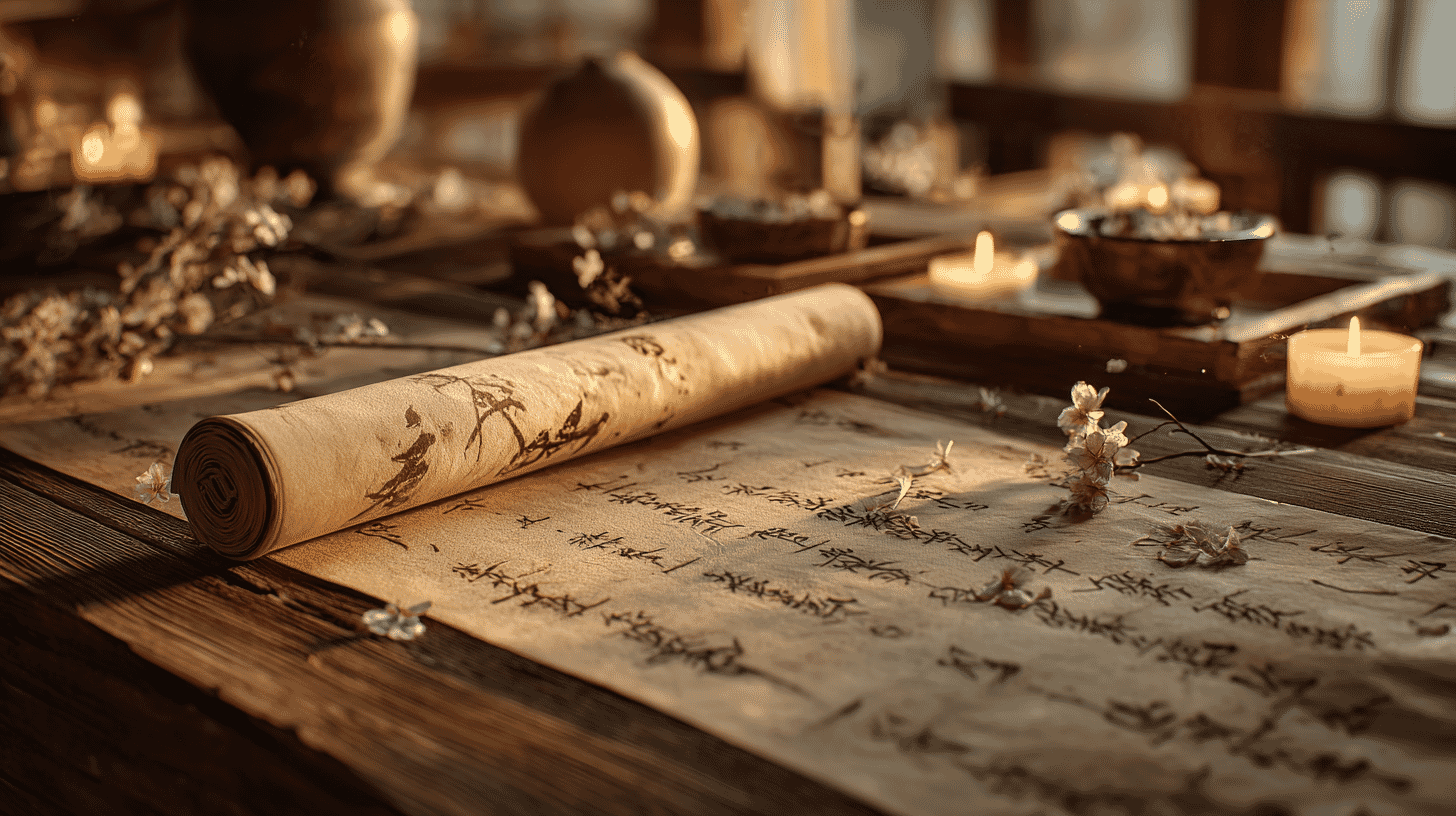
Konjaku Monogatarishū: Japan's Greatest Ancient Tale Collection and National Treasure
Imagine holding a manuscript that preserves over a thousand stories spanning the entire known world of medieval Japan — tales of the Buddha in India, wise monks in China, cunning foxes in Japanese forests, and noble warriors on battlefields. The Konjaku Monogatarishū (今昔物語集), or "Anthology of Tales Old and New," is exactly that: Japan's largest and most important collection of ancient tales, compiled during the late Heian period around the early 12th century. Its oldest surviving manuscript, known as the Suzuka Manuscript (鈴鹿本), is preserved at Kyoto University Library and was designated a National Treasure in 1996.
This extraordinary work has shaped Japanese literature for centuries and continues to captivate readers worldwide. If you know Akutagawa Ryūnosuke's famous short story "Rashōmon" or Akira Kurosawa's legendary film of the same name, you have already encountered the enduring legacy of the Konjaku Monogatarishū.
What Is the Konjaku Monogatarishū?
The Konjaku Monogatarishū is a monumental anthology of setsuwa (short narrative tales) compiled during the late Heian period, believed to have been created around the 1120s during the era of cloistered rule by Emperor Shirakawa and Emperor Toba. The collection originally comprised 31 volumes, though 3 volumes (8, 18, and 21) have been lost. Even in its incomplete state, the anthology contains more than 1,020 individual stories.
The work is divided into three geographical sections that together represented the entirety of the known world as understood by the Japanese of the time. Volumes 1 through 5 cover tales from Tenjiku (India), volumes 6 through 10 cover tales from Shintan (China), and volumes 11 through 31 cover tales from Honchō (Japan). Each section begins with Buddhist narratives — tales of karma, miraculous salvation, and the spread of the dharma — before transitioning into secular tales that depict the daily lives, struggles, humor, and drama of people from every social class.
Nearly every tale in the collection opens with the phrase "Ima wa mukashi" (今は昔), meaning "Now, long ago" — an elegant Japanese equivalent of "Once upon a time." Each story concludes with the formulaic ending "To namu katari tsutaetaru to ya" (トナム語リ伝ヘタルトヤ), meaning "And so the tale has been handed down." It is from the Sino-Japanese reading of "ima wa mukashi" — "konjaku" — that the collection takes its name.
The Suzuka Manuscript: The National Treasure
While the Konjaku Monogatarishū itself is a literary masterpiece, the specific object designated as a National Treasure is the Suzuka Manuscript (鈴鹿本), the oldest known copy of the collection, housed at Kyoto University Library. This manuscript consists of 9 volumes (volumes 2, 5, 7, 9, 10, 12, 17, 27, and 29) bound in large-format fukurotoji (pouch-binding) booklet form.
The manuscript is believed to have been transcribed during the mid-Kamakura period (13th century), judging from its large format, the quality of its kōzo (mulberry bark) paper, and the calligraphic style. Radiocarbon dating of the binding threads has confirmed dates ranging from 1000 to 1200 CE for the oldest materials, lending further support to the early dating.
Crucially, this is the only manuscript that bears the title "Konjaku Monogatarishū" — the name by which the work is known today is established solely through this copy. All other surviving manuscripts of the collection are descended from the Suzuka Manuscript, making it the ancestral copy (祖本) from which all subsequent versions derive.
Why Was It Designated a National Treasure?
The Suzuka Manuscript was designated a National Treasure on June 27, 1996, for several compelling reasons. First, it is the sole surviving ancestral manuscript from which all known copies of Japan's greatest tale collection descend. Over sixty copies of the Konjaku Monogatarishū exist today, but — with one or two exceptions of uncertain lineage — every single one can be traced back to the Suzuka Manuscript.
Second, the title "Konjaku Monogatarishū" itself can only be confirmed through this manuscript. Without it, scholars would not even know the proper name of the collection.
Third, the manuscript contains important historical annotations. In the Japan (Honchō) section of some volumes, a later reader named "Sōrokumaru" left reading notes, and one entry in volume 27 includes a reference to the reopening of Kasuga Grand Shrine, which corresponds precisely to a record in the Daijōin Nikki Mokuroku from the seventh month of the year 1446. This evidence, combined with a lending record from 1451, establishes the manuscript's provenance in Nara during the medieval period.
Fourth, as a physical artifact, the manuscript is a remarkable example of Kamakura-period calligraphy and bookmaking, written in the senmyōgaki style — a mixed script of Chinese characters with small katakana annotations that preserves the reading conventions of medieval Japan.
The World Within: Stories That Span Civilizations
One of the most remarkable aspects of the Konjaku Monogatarishū is its astonishing breadth. The tales range from the sublime to the earthy, from sacred to profane, presenting a panoramic view of human experience across three civilizations.
The Indian section recounts the life of the Buddha, the development of Buddhist doctrine, and miraculous tales of karmic retribution. The Chinese section introduces Confucian moral tales alongside Buddhist narratives adapted for a Chinese setting. The Japanese section — the largest and most celebrated — offers Buddhist parables, historical episodes, tales of warriors and craftsmen, ghost stories, tales of foxes and demons, love stories, and even bawdy humor.
The Japanese author Akutagawa Ryūnosuke, who drew extensively from the Konjaku for his own fiction, famously praised its prose for possessing a "beautiful rawness" and for "shining with a barbaric brilliance." Unlike the refined aesthetics of The Tale of Genji, which focused on the inner lives of the Heian aristocracy, the Konjaku turns its gaze outward and downward, capturing the voices of monks, merchants, soldiers, thieves, farmers, and even animals.
This panoramic quality makes the collection invaluable not just as literature, but as a source for studies in history, folklore, religious studies, geography, and the history of ideas.
Influence on Modern Literature and Film
The Konjaku Monogatarishū has had an outsized influence on modern Japanese culture. Akutagawa Ryūnosuke drew on its tales to write some of the most celebrated short stories in Japanese literature, including "Rashōmon," "In a Grove" (Yabu no Naka), "The Nose" (Hana), and "Yam Gruel" (Imogayu). The tale behind "Rashōmon" — about a thief who encounters a corpse-robbing old woman at the ruined Rajō Gate of Kyoto — comes directly from volume 29 of the Konjaku.
Akira Kurosawa's 1950 film "Rashomon," which combined elements from "Rashōmon" and "In a Grove," introduced the world to the concept of unreliable narration and multiple perspectives, revolutionizing cinema. The film's source material traces directly back to this National Treasure manuscript.
Other major literary figures, including Tanizaki Jun'ichirō and Hori Tatsuo, have also found inspiration in its pages. The collection is frequently compared to Chaucer's Canterbury Tales or Boccaccio's Decameron for its variety, social breadth, and narrative energy.
The Journey of the Manuscript: From Nara to Kyoto University
The history of the Suzuka Manuscript itself reads like one of its own tales. The manuscript appears to have been kept in Nara, possibly at a temple in the Southern Capital, during the medieval period. Records from 1446 and 1451 document its presence there.
By 1833, the manuscript was in the hands of an unnamed Nara resident, and by 1844, it had passed to Suzuka Tsuretane, a Shinto priest serving at Yoshida Shrine in Kyoto. The scholar Ban Nobutomo examined the manuscript during this period and recognized it as the ancestral copy of all surviving manuscripts.
The manuscript remained in the Suzuka family for generations. In 1920, Suzuka Sanshichi published a small booklet that brought wider scholarly attention to the manuscript. Eventually, in 1991, descendants of the Suzuka family — one of whom worked at Kyoto University Library — donated the manuscript to the university, where it underwent careful conservation and restoration before being designated a National Treasure in 1996.
Today, the manuscript is stored in a specially climate-controlled room at Kyoto University Library alongside other important cultural properties.
Viewing the Konjaku Monogatarishū Today
While the original National Treasure manuscript is preserved in secure, climate-controlled storage and is not available for casual viewing, Kyoto University has made the entire Suzuka Manuscript accessible through its digital archive. The Kyoto University Rare Materials Digital Archive provides high-resolution digital images of all nine surviving volumes, accompanied by transcriptions and scholarly commentary, completely free of charge.
Visitors to Kyoto who wish to explore the world of the Konjaku can also visit the Kyoto University Museum (京都大学総合博物館), which occasionally features exhibitions related to the university's rare holdings. The museum houses over 2.6 million academic specimens and historical materials and is open to the general public.
For those interested in experiencing the manuscript in a broader scholarly context, the Kyoto University Library campus itself is located in the historic Yoshida area of Sakyo Ward, surrounded by some of Kyoto's most beloved cultural landmarks.
Nearby Attractions and Suggested Itinerary
The Kyoto University campus sits in an area rich with cultural treasures, making it easy to combine a literary pilgrimage with broader sightseeing.
Yoshida Shrine (吉田神社)
Located directly adjacent to the university campus on the slopes of Yoshida Hill, this historic shrine was founded in 859 CE. It is particularly famous for its spectacular Setsubun Festival in early February, which features a dramatic demon-expelling ceremony. The shrine's Taigenkyū pavilion, which enshrines deities from across Japan, is designated an Important Cultural Property.
Ginkaku-ji (Silver Pavilion)
Just a 15-minute walk northeast from Kyoto University, this UNESCO World Heritage temple was built by Shogun Ashikaga Yoshimasa in 1482. Its refined sand garden and moss-covered grounds represent the height of Higashiyama culture — the very aesthetic world that existed alongside the era when the Konjaku was being rediscovered.
The Philosopher's Path (哲学の道)
This beloved 2-kilometer canal-side walking path connects Ginkaku-ji to Nanzen-ji. Named after Kyoto University philosopher Nishida Kitarō, who walked it daily in contemplation, it is one of Kyoto's most atmospheric strolling routes, especially stunning during cherry blossom season in spring and peak foliage in autumn.
Kyoto University Museum (京都大学総合博物館)
Located on the Yoshida Campus, this museum showcases the university's research heritage across natural history, technology, and cultural history. General admission is 400 yen, and English-language descriptions are available for parts of the exhibition.
Experiencing the Konjaku in English
For international visitors who wish to read the tales themselves before or after their visit, several excellent English translations are available. "Tales of Times Now Past," published by the University of Michigan Press, offers 62 selected tales with lively translations. "Japanese Tales from Times Past" by Naoshi Koriyama and Bruce Allen presents 90 stories from the Japanese section. Most recently, a complete English translation of all 1,059 surviving tales has been published in multiple volumes.
Reading even a handful of these stories before visiting Kyoto transforms the experience — the old streets, temple gates, and mountain paths come alive with the voices and footsteps of characters from a thousand years ago.
- 📍 Plan Your Visit to Kyoto
- Find tours, activities & transport passes near Konjaku Monogatarishu
- [ Kinkakuji Fushimi Inari & Kimono Rental ]
Q&A
- Can I see the original National Treasure manuscript at Kyoto University?
- The original Suzuka Manuscript is stored in a climate-controlled secure room and is not available for casual public viewing. However, Kyoto University has digitized the entire manuscript and made it freely available online through the Kyoto University Rare Materials Digital Archive (rmda.kulib.kyoto-u.ac.jp). High-resolution images of every page, along with transcriptions and commentary, can be viewed at no cost from anywhere in the world.
- What is the connection between the Konjaku Monogatarishū and the film "Rashomon"?
- Akira Kurosawa's 1950 film "Rashomon" draws on two short stories by Akutagawa Ryūnosuke — "Rashōmon" and "In a Grove" — both of which were inspired by tales from the Konjaku Monogatarishū. The story of the thief at the Rajō Gate comes from volume 29 of the collection, while "In a Grove" was inspired by a tale in volume 29 as well. The film introduced the "Rashomon effect" — the concept of contradictory eyewitness accounts — to world cinema.
- Who compiled the Konjaku Monogatarishū?
- The compiler's identity remains one of the great mysteries of Japanese literary history. The collection contains no preface, postscript, or authorial attribution. A traditional theory credited Minamoto no Takakuni, but this has been rejected by modern scholars. Current theories suggest the compiler may have been a Buddhist monk with connections to either the major temples of Nara or Kyoto, or someone close to the cloistered court of Emperor Shirakawa or Emperor Toba.
- Is there an English translation of the Konjaku Monogatarishū available?
- Yes, several English translations are available. Notable editions include "Tales of Times Now Past" (University of Michigan Press), which contains 62 selected tales, and "Japanese Tales from Times Past" by Naoshi Koriyama and Bruce Allen, which features 90 stories. A complete English translation of all 1,059 surviving tales has also been published in a multi-volume series by Jongho Park.
- How do I get to Kyoto University from Kyoto Station?
- The most efficient route is to take the Karasuma Subway Line from Kyoto Station to Imadegawa Station (about 9 minutes), then transfer to City Bus No. 203 toward Ginkaku-ji and get off at the "Kyodai Seimon Mae" (Kyoto University Main Gate) stop. The total journey takes approximately 30 minutes. Alternatively, you can take City Bus No. 206 directly from Kyoto Station to the Hyakumanben stop near the university.
Basic Information
| Name | Konjaku Monogatarishū (今昔物語集) — Suzuka Manuscript (鈴鹿本) |
|---|---|
| Designation | National Treasure (国宝), designated June 27, 1996 |
| Category | Written Works and Classics (書跡・典籍) |
| Period of Compilation | Late Heian period (c. 1120s) |
| Period of Manuscript Transcription | Mid-Kamakura period (13th century) |
| Format | 9 volumes, large-format fukurotoji (pouch-bound) booklets |
| Dimensions | Approx. 32.4 cm × 28.1 cm (current binding); 29.6 cm × 24.2 cm (original paper) |
| Material | Kōzo (mulberry bark) paper with ruled lines |
| Owner | Kyoto University (National University Corporation) |
| Location | Kyoto University Library, Yoshida-Honmachi, Sakyo-ku, Kyoto, Japan |
| Digital Archive | Kyoto University Rare Materials Digital Archive (https://rmda.kulib.kyoto-u.ac.jp) |
| Nearby Museum | Kyoto University Museum — General admission: 400 yen, Closed: Mon & Tue |
| Access | Kyoto City Bus "Hyakumanben" stop, or Keihan Railway "Demachiyanagi" Station (20 min walk) |
References
- 今昔物語集 — 文化遺産オンライン
- https://bunka.nii.ac.jp/heritages/detail/205950
- 国宝 今昔物語集 — 京都大学附属図書館 (PDF)
- https://www.s-coop.net/lifestage/backnumber/2010/pdf/1101_10-10.pdf
- National Treasure - Konjaku monogatari-shu (Suzuka Ed.) — Kyoto University Rare Materials Digital Archive
- https://rmda.kulib.kyoto-u.ac.jp/en/classification/pickup-nt
- 今昔物語集(鈴鹿本) — 京都大学貴重資料デジタルアーカイブ
- https://rmda.kulib.kyoto-u.ac.jp/item/rb00000125
- 京都大学所蔵資料でたどる文学史年表: 今昔物語集 — 京都大学貴重資料デジタルアーカイブ
- https://rmda.kulib.kyoto-u.ac.jp/item/rb00000125/explanation/konjaku
- 国宝-書跡典籍|今昔物語集(鈴鹿本)[京都大学] — WANDER 国宝
- https://wanderkokuho.com/201-08969/
- Konjaku Monogatarishū — Wikipedia (English)
- https://en.wikipedia.org/wiki/Konjaku_Monogatarish%C5%AB
- 今昔物語集 — Wikipedia (Japanese)
- https://ja.wikipedia.org/wiki/%E4%BB%8A%E6%98%94%E7%89%A9%E8%AA%9E%E9%9B%86
- 京都大学附属図書館 — 学外の方への利用案内
- https://www.kulib.kyoto-u.ac.jp/mainlib/service/ext
Last verified: 2026.02.08
Nearby heritages
- Architectural Education Materials (formerly Owned by the
- Yoshida Honmachi, Sakyo Ward, Kyoto City, Kyoto Prefecture
- Ogikoki Written in Ink on Paper (handwritten Version
- Yoshida Honmachi, Sakyo Ward, Kyoto City, Kyoto Prefecture
- Manyoshu Volume 16 (Amagasaki Edition)
- Yoshida Honmachi, Sakyo Ward, Kyoto City, Kyoto Prefecture
- Heihanki (19 Volumes of Handwritten Manuscripts/6 Volumes of
- Yoshida Honmachi, Sakyo Ward, Kyoto City, Kyoto Prefecture
- Moderation〈Zhu Xi Poems〉
- Yoshida Honmachi, Sakyo Ward, Kyoto City, Kyoto Prefecture
- Long Lecture Hall Property Catalog
- Yoshida Honmachi, Sakyo Ward, Kyoto City, Kyoto Prefecture
- Shuli Commentary (single Commentary)
- Yoshida Honmachi, Sakyo Ward, Kyoto City, Kyoto Prefecture
- Kindergarten Guidance (Volume 7, 22nd Middle School)
- Yoshida Honmachi, Sakyo Ward, Kyoto City, Kyoto Prefecture
- Kyoo-Gokokuji Temple Documents
- Yoshida Honmachi, Sakyo Ward, Kyoto City, Kyoto Prefecture
- Artifacts Excavated from the Tsubakii Otsukayama Tomb in
- Yoshida Honcho, Sakyo Ward, Kyoto City