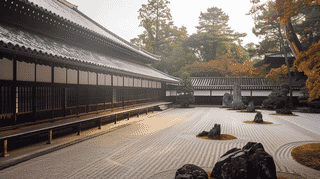
Nanzenji Temple Imperial Envoy Gate
The Nanzenji Temple Imperial Envoy Gate (南禅寺勅使門, Nanzen-ji Chokushimon) is a four-legged gate of the Momoyama period in the grounds of Nanzenji in Nanzenji Fukuchicho, Sakyo Ward, Kyoto City; the Agency for Cultural Affairs dates it to the Keicho era (1596 to 1614), and it was designated an Important Cultural Property on June 28, 1956.

The Agency records a single gate of the four-legged type with a gabled roof of cypress bark, designation number 01368, owned by Nanzenji Temple. One ridge tag, a board recording the building or repair of a structure, is included in the designation as an attached item.
A Gate Brought from the Imperial Palace
According to Nanzenji, the Imperial Envoy Gate is the Hi no Gomon, a gate of the imperial palace that Empress Meisho granted to the temple in 1641. The Agency's Keicho date can be read as the age of the gate as a palace building, before it was moved.
No primary source found for this article records when the gate was built at the palace or how it was moved to Nanzenji. The Agency's database does not say what the attached ridge tag records.
As its name says, the Nanzenji Temple Imperial Envoy Gate was opened only when the emperor or an imperial envoy came to Nanzenji. Today it is opened only for the installation of a new head priest (Nanzenji).
Why It Is an Important Cultural Property
The Agency's database gives no commentary for the Nanzenji Temple Imperial Envoy Gate, so there is no official statement of the reasons for its designation. What the record shows is a four-legged gate of the Momoyama period with a gabled roof of cypress bark, protected together with its ridge tag.
A four-legged gate has two main posts at its center, each braced front and back by a pair of auxiliary posts. The roof of the Imperial Envoy Gate is laid in layers of cypress bark rather than tiles, a different material altogether from the tiled roof of the Nanzenji Temple Sanmon Gate in the same grounds.
The Imperial Envoy Gate and the Middle Gate
The Middle Gate stands to the south of the Nanzenji Temple Imperial Envoy Gate. Nanzenji relates that it was donated in 1601 by Matsui Yasuyuki, who gave the gate of his residence at Fushimi Castle to serve as the temple's imperial envoy gate. When the palace gate arrived, it was moved to its present place, and until the end of the Edo period it was called the side gate.
In other words, another gate did the work of the imperial envoy gate before the present one came. That history explains why a gate from the palace and a gate from Fushimi now stand side by side, north and south, at the entrance to the grounds.
What to Look For
Walk in from the approach through the Middle Gate and the Nanzenji Temple Imperial Envoy Gate is immediately to the north. The space in front of it serves as the parking area for tour buses (Nanzenji), so you look at the closed gate from a little distance.
The roof is the thing to watch. Cypress bark roofing is built up from many thin layers of stripped bark, which gives the eaves a thick, soft edge. Come back to the Imperial Envoy Gate after the great tiled roofs of the Sanmon Gate to the east, and its small, gentle form, made for the palace, stands out clearly.
Visiting
The exterior of the Nanzenji Temple Imperial Envoy Gate can be seen on a walk through the grounds, with no admission fee. Its doors are normally closed, and the gate cannot be walked through (Nanzenji; checked November 29, 2026).
Nanzenji forbids monopods, tripods and model shoots in the grounds (Nanzenji). Opening hours and directions are covered on the Nanzenji Temple page.
Q&A
- How old is the Nanzenji Temple Imperial Envoy Gate?
- The Agency for Cultural Affairs dates it to the Keicho era (1596 to 1614) of the Momoyama period. Nanzenji says it received the gate from the imperial palace in 1641.
- Where did the Nanzenji Temple Imperial Envoy Gate originally stand?
- According to Nanzenji, it was the Hi no Gomon of the imperial palace, granted to the temple by Empress Meisho.
- When are the doors of the Nanzenji Temple Imperial Envoy Gate opened?
- In the past only for visits by the emperor or an imperial envoy; today only for the installation of a new head priest (Nanzenji). They are normally closed.
- Can I see the Nanzenji Temple Imperial Envoy Gate without paying admission?
- Yes. Nanzenji charges admission only for the Hojo garden, the Sanmon Gate and Nanzen-in; the Imperial Envoy Gate can be seen from the grounds (Nanzenji; checked November 29, 2026).
- When was the Nanzenji Temple Imperial Envoy Gate designated an Important Cultural Property?
- On June 28, 1956. One ridge tag is included in the designation as an attached item (Agency for Cultural Affairs).
Basic Information
| Name | Nanzenji Temple Imperial Envoy Gate (南禅寺勅使門) |
|---|---|
| Location | Nanzenji Fukuchicho, Sakyo Ward, Kyoto City, Kyoto Prefecture |
| Designation | Important Cultural Property (Structure) |
| Year Designated | Designated 1956/06/28 (Showa 31) |
| Quantity | 1 building (with 1 ridge tag) |
| Dimensions | Four-legged gate, gabled roof in cypress bark (no measurements recorded) |
| Owner | Nanzenji Temple |
| Public Access | Exterior visible from the grounds; doors opened only when a new head priest is installed |
References
- Nanzenji Temple Imperial Envoy Gate (Database of National Cultural Properties, Agency for Cultural Affairs)
- https://kunishitei.bunka.go.jp/heritage/detail/102/1640
- Nanzenji Temple Sanmon Gate (Database of National Cultural Properties, Agency for Cultural Affairs)
- https://kunishitei.bunka.go.jp/heritage/detail/102/1638
- Imperial Envoy Gate (Nanzenji, Japanese)
- https://www.nanzenji.or.jp/equipment/chokushimon
- Sanmon Gate (Nanzenji, Japanese)
- https://www.nanzenji.or.jp/equipment/sanmon
- Visiting hours and admission (Nanzenji, Japanese)
- https://www.nanzenji.or.jp/about_rinzaishu/visit
- Access (Nanzenji, Japanese)
- https://www.nanzenji.or.jp/profile
- Requests for visitors to the grounds (Nanzenji, Japanese)
- https://www.nanzenji.or.jp/information/notices/20191001
Last verified: 2026.11.28
Last verified: 2026.11.28