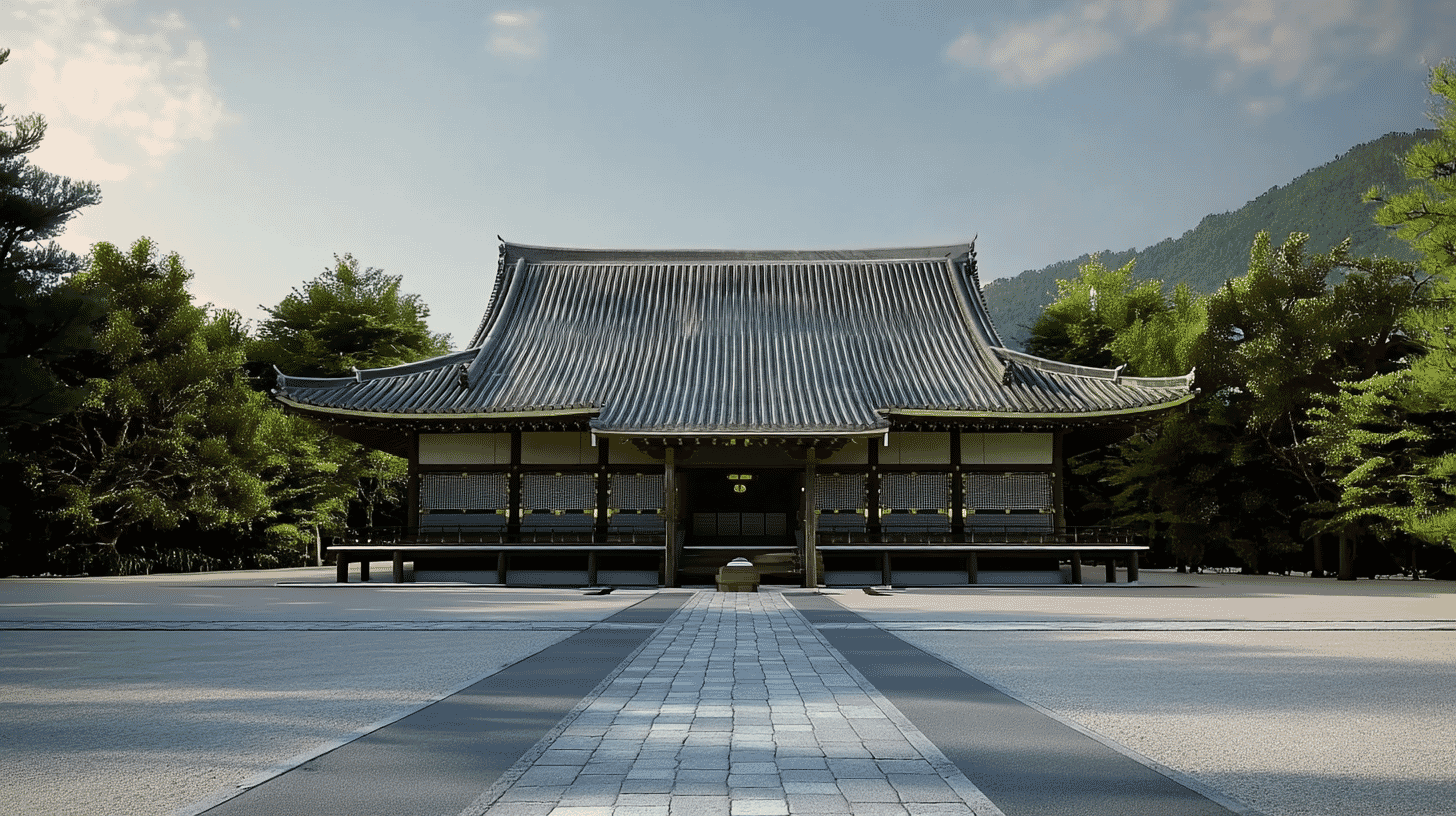
Ninna-ji Kondo (Golden Hall): Kyoto's National Treasure — The Oldest Surviving Imperial Throne Hall in Japan

Discover the Kondo (Golden Hall) at Ninna-ji Temple in Kyoto — a National Treasure and UNESCO World Heritage Site. Originally the Imperial Palace's Shishinden, it is the oldest surviving throne hall in Japan, housing stunning Buddhist art and centuries of imperial history.

Ninna-ji Kondo: A Palace Reborn as a Sacred Hall

Standing at the northern end of the expansive grounds of Ninna-ji Temple in Kyoto, the Kondo (Golden Hall) commands a quiet, regal presence. Unlike most temple main halls built from the ground up for religious purposes, the Kondo has an extraordinary origin: it was once the Shishinden — the ceremonial throne hall at the very heart of the Imperial Palace. Relocated to Ninna-ji in the early 17th century, it survives today as the oldest Shishinden structure in Japan, and the only National Treasure building within this UNESCO World Heritage temple complex.

For international visitors, the Kondo offers a rare chance to stand before a building that once hosted emperors and their most solemn ceremonies, now transformed into a serene Buddhist sanctuary adorned with vivid polychrome paintings and sacred statuary. It is a place where the secular grandeur of imperial Japan and the spiritual depth of Shingon Buddhism converge in a single, breathtaking structure.

The History of Ninna-ji Temple

Ninna-ji was founded in 888 CE by Emperor Uda, who completed the construction his father Emperor Koko had begun. The temple takes its name from the Ninna era during which it was completed. After abdicating the throne, Emperor Uda took Buddhist vows and resided within the temple grounds at a retreat known as the Omuro, leading to Ninna-ji's enduring nickname: the "Omuro Gosho" (Omuro Imperial Palace).

For centuries, members of the imperial family served as the head priests of Ninna-ji, a distinction that made it the foremost of Japan's monzeki temples — monasteries led by royalty. This deep connection to the court brought prestige, wealth, and cultural refinement to the temple. Ninna-ji became the head temple of the Omuro school of Shingon Buddhism and also the birthplace of the Omuro-ryu school of Japanese flower arrangement (ikebana), a tradition that continues to this day.

Tragedy struck in 1467, when the devastating Onin War reduced the temple's magnificent buildings to ashes. For roughly 150 years, Ninna-ji lay in ruins. Revival came in the early Edo period when the third Tokugawa shogun, Iemitsu, provided substantial support for reconstruction. As part of this effort, several buildings from the Kyoto Imperial Palace were donated to the temple — among them, the Shishinden, which became the Kondo we see today. In 1994, Ninna-ji was inscribed as a UNESCO World Heritage Site as part of the "Historic Monuments of Ancient Kyoto."

What Is the Kondo (Golden Hall)?

The Kondo serves as the main worship hall of Ninna-ji, housing the temple's principal deity: a triad of Amida Nyorai (Amitabha Buddha) flanked by two attendant bodhisattvas. It is a single-story timber structure with an elegant irimoya-zukuri (hip-and-gable) roof, measuring seven bays wide and five bays deep — an impressively spacious building that reflects its original role as the most important hall of the Imperial Palace.

The Shishinden was originally constructed in 1613 (Keicho 18) as part of the Kyoto Imperial Palace. In 1643 (Kan'ei 20), when the palace underwent a new round of construction under Shogun Iemitsu, the older Shishinden was gifted to Ninna-ji and carefully relocated to its present site. This relocation was supervised by Nakai Masakiyo, the chief carpenter of the Tokugawa shogunate, a master builder responsible for many of the era's most important architectural projects.

During the move, a number of modifications were made to adapt the former palace hall for use as a Buddhist temple. The original cypress bark roof (hiwadabuki) was replaced with heavier ceramic tiles (kawarabuki) to give the building a more temple-like appearance. Interior partitions were added to create an inner sanctum (naijin) and an outer worship area (gejin). Yet many elements of the original Shishinden were carefully preserved, giving the Kondo its unique blend of palatial elegance and sacred purpose.

Why Was It Designated a National Treasure?

The Kondo was first designated an Important Cultural Property in 1900, and elevated to National Treasure status on November 14, 1953. The official designation statement is concise but revealing: the Kondo is recognized as the relocated Shishinden constructed in 1613 (some records note 1611), and it is valued as the sole surviving example of an early modern Shishinden — a building type of supreme importance in Japanese imperial architecture.

The Shishinden was the ceremonial heart of the Imperial Palace, the stage for enthronement ceremonies, New Year audiences, and the most solemn rites of state. Within its walls stood the Takamikura — the Emperor's throne. No other surviving building in Japan preserves this particular chapter of imperial architectural history. The Kondo at Ninna-ji is thus an irreplaceable document of how the emperor's most sacred space was designed and decorated in the early 17th century.

Beyond its architectural significance, the Kondo is also valued for its remarkable interior art. The walls feature vivid polychrome paintings of Pure Land scenes and Kannon (Avalokiteshvara) imagery, while the ceiling is adorned with 88 panels of flower-and-bird paintings — all reflecting the decorative sensibility of imperial palace art adapted to a Buddhist context.

Highlights and What to See

Shinden-zukuri Architectural Elements

One of the most striking features of the Kondo is the survival of shitomido — hinged lattice shutters characteristic of shinden-zukuri (aristocratic palace) architecture. These elegant wooden screens, which can be swung up during the day to admit light and air, are a direct inheritance from the building's days as the Shishinden. They lend the Kondo a refined, open quality rarely seen in temple architecture.

The Interior Sanctuary

Inside the Kondo, where the Takamikura (imperial throne) once stood, visitors now find the Amida Triad — Amida Nyorai seated serenely between two attendant figures. Surrounding the main altar are statues of the Four Heavenly Kings (Shitenno) and Brahma (Bonten), guardians of the Buddhist cosmos. The walls blaze with richly colored paintings depicting the Pure Land paradise and various manifestations of Kannon. The interior is normally closed to the public but is opened during special viewings held periodically in spring and autumn.

The Kensho Shoji Paintings

When the Shishinden was relocated, it came with its original Kensho Shoji — painted panels depicting 32 legendary wise men and sages of ancient China, arranged around a central composition of pine trees with a guardian lion and a komainu (Korean lion-dog). This set, now preserved separately by Ninna-ji, is the oldest surviving example of Kensho Shoji art and has been designated an Important Cultural Property.

Morning Prayer at the Kondo

Guests staying at the Omuro Kaikan, a temple lodging facility within the Ninna-ji grounds, have the special privilege of participating in the daily morning prayer service held inside the Kondo. This is an extraordinary opportunity to experience the living spiritual practice of Shingon Buddhism in a National Treasure setting — something few visitors to Kyoto ever have the chance to do.

The Wider Ninna-ji Complex

While the Kondo is the crown jewel, Ninna-ji's sprawling grounds hold many other treasures worth exploring. The Nio-mon (Two Kings' Gate), standing at the entrance along the Kinukake-no-michi road, is one of Kyoto's Three Great Gates and an Important Cultural Property. Its imposing 18.7-meter height and powerful guardian statues create a dramatic entrance to the temple.

The Five-Story Pagoda, built in 1644 and also an Important Cultural Property, rises 36.18 meters and is a symbol of the temple. The Goten (Palace), a complex of palace-style buildings with exquisite gardens, evokes the atmosphere of the former Omuro Imperial Palace. The tranquil North Garden features a pond, miniature mountains, and views of the pagoda, while the austere South Garden of white sand recalls the aesthetic of the Kyoto Imperial Palace.

In spring, the temple is famous for its Omuro cherry blossoms — a unique variety of late-blooming, low-growing sakura trees that allow visitors to walk among the flowers at eye level. The Omuro cherries typically bloom in mid-April, after other Kyoto cherry blossoms have faded, making Ninna-ji the perfect place to extend the sakura season.

Nearby Attractions

Ninna-ji sits along the Kinukake-no-michi, a scenic road that connects three UNESCO World Heritage Sites. Ryoan-ji Temple, home to Japan's most celebrated rock garden, is about a 20-minute walk to the east. Kinkaku-ji (the Golden Pavilion), one of Kyoto's most iconic sights, lies a short distance beyond. Together with Ninna-ji, these three temples form an outstanding half-day walking route through some of Kyoto's finest cultural landscapes.

Myoshin-ji Temple, one of the largest Zen temple complexes in Japan, is also nearby. For those interested in the imperial heritage that Ninna-ji embodies, the Kyoto Imperial Palace itself — where the Kondo once stood as the Shishinden — is accessible by bus in about 30 minutes.

📍 Plan Your Visit to Kyoto
Find tours, activities & transport passes near Ninna-Ji Temple Golden Hall
[ Kinkakuji Fushimi Inari & Kimono Rental ]

Q&A

QCan I go inside the Kondo?
AThe interior of the Kondo is usually closed to the public. However, special viewings are held periodically, often during spring and autumn. Check the official Ninna-ji website for the latest schedule. Additionally, guests staying at the Omuro Kaikan temple lodging can join the daily morning prayer service held inside the Kondo.
QIs there an admission fee to see the Kondo from outside?
ANo. Outside of the cherry blossom festival period (usually mid-April), entering the temple grounds and viewing the Kondo from the outside is free of charge. The Goten (Palace) and gardens require a separate admission fee of 800 yen for adults.
QHow do I get to Ninna-ji from Kyoto Station?
AFrom Kyoto Station, take the JR Bus (Takao/Keihoku line) for approximately 30 minutes to the "Omuro Ninna-ji" bus stop, which is right in front of the temple gate. Alternatively, take City Bus No. 26 (about 40 minutes). You can also take the JR Sagano Line to Hanazono Station and walk about 15 minutes, or ride the Keifuku (Randen) tram to Omuro-Ninnaji Station, just a 3-minute walk away.
QWhat is the best season to visit?
AEvery season has its charm. Mid-April brings the famous Omuro cherry blossoms. Autumn (mid-November to early December) offers spectacular red and golden foliage. The approach path from the Chu-mon (Middle Gate) to the Kondo becomes a stunning tunnel of autumn color. Winter provides a peaceful, uncrowded atmosphere, and the temple occasionally holds special nighttime illumination events.
QIs Ninna-ji wheelchair accessible?
AThe main paths within the temple grounds are relatively flat, but some areas involve steps and gravel paths. Ninna-ji provides a barrier-free route map on its website and asks wheelchair users to contact the temple in advance so staff can offer assistance where possible.

Basic Information

Official Name Ninna-ji Kondo (仁和寺金堂)
Designation National Treasure (Architecture); UNESCO World Heritage Site component ("Historic Monuments of Ancient Kyoto," 1994)
Original Construction 1613 (Keicho 18) — as the Shishinden of the Kyoto Imperial Palace
Relocation to Ninna-ji 1643 (Kan'ei 20)
Architectural Style Irimoya-zukuri (hip-and-gable roof), 7 bays wide × 5 bays deep, single-story, with 1-bay front porch (kohai); Hon-kawarabuki (ceramic tile roof)
Important Cultural Property Designation April 7, 1900
National Treasure Designation November 14, 1953
Principal Deity Amida Nyorai Triad (Amitabha Buddha with two attendant bodhisattvas)
Temple Affiliation Omuro school of Shingon Buddhism (Head Temple: Ninna-ji)
Address 33 Omuro-Ouchi, Ukyo-ku, Kyoto 616-8092, Japan
Phone 075-461-1155
Hours March–November: 9:00–17:00 (last entry 16:30); December–February: 9:00–16:30 (last entry 16:00)
Admission Temple grounds: Free (except during cherry blossom festival, 800 yen); Goten (Palace/Gardens): 800 yen (adults); Reihokan Museum: 500 yen (seasonal). High school students and younger: free.
Access Keifuku (Randen) Omuro-Ninnaji Station: 3-min walk; JR Bus from Kyoto Station: ~30 min; City Bus No. 26 from Kyoto Station: ~40 min; JR Sagano Line to Hanazono Station: 15-min walk
Official Website https://ninnaji.jp/
Cultural Property Registry ID 102-01853

References

境内のご案内 | 世界遺産 真言宗御室派総本山 仁和寺
https://ninnaji.jp/precincts/
拝観・交通案内 | 世界遺産 真言宗御室派総本山 仁和寺
https://ninnaji.jp/visit/
国宝-建築|仁和寺 金堂[京都] | WANDER 国宝
https://wanderkokuho.com/102-01853/
仁和寺金堂 - 文化遺産オンライン
https://bunka.nii.ac.jp/db/heritages/detail/175092
国指定文化財等データベース - 仁和寺金堂
https://kunishitei.bunka.go.jp/heritage/detail/102/1853
仁和寺 - Wikipedia
https://ja.wikipedia.org/wiki/仁和寺
仁和寺・金堂 | たびMAG
https://tabi-mag.jp/ky0537/
Ninna-ji Temple of Kyoto | history, highlights and access - Kyoto Kinkaku
https://kyoto-kinkaku.com/en/ninna-ji/

Last verified: 2026.02.08

Nearby heritages
