
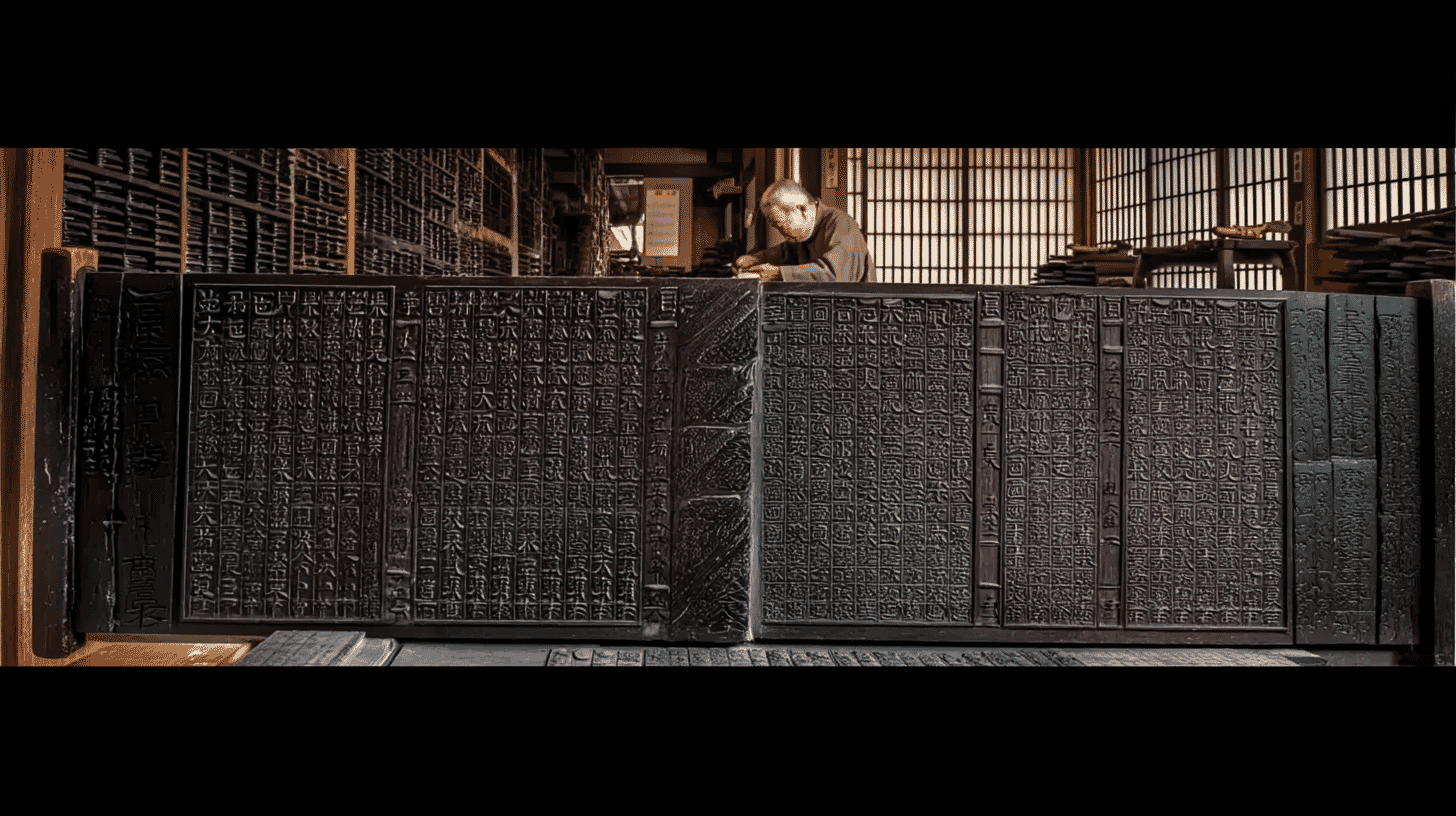
48,275 Blocks, an Important Cultural Property since 1957
Printing Blocks for the Tetsugen Edition of the Buddhist Canon (鉄眼版一切経版木, Tetsugenban Issaikyo Hangi) are Edo-period material owned by Hozoin in Kyoto Prefecture, designated an Important Cultural Property on 19 February 1957. The quantity is 48,275 blocks.
Quantities among the properties covered here have run to sixteen hanging scrolls, eighteen painted surfaces, twelve scrolls. This figure is of another order.
Accounts elsewhere give roughly sixty thousand blocks. The Agency's record gives 48,275, and this article follows the record.
Material, Not a Work
The Agency's commentary is a single sentence, but its wording differs from the others.
It reads: material of the Edo period. Every one-sentence commentary met so far has read a work of such and such a period. Paintings and craft objects alike were called works.
This is material. The category field lists three headings together: historical material, calligraphy and books, and old documents.
The blocks are not handled under painting, craft or structure. A printing block is less an object for viewing than a tool for producing something else, and the word material seems to answer to that character.
The Agency gives no reason, however. This is the fourteenth one-sentence commentary among the properties covered here.
The Blocks and Their Impressions Are Recorded Apart
Related entries make the position of this property clear.
One entry covers the Obaku Tetsugen edition of the Buddhist canon itself, the scriptures printed from these blocks.
Another covers a Tetsugen-edition Great Perfection of Wisdom sutra at Ganjoji together with the wooden chest that holds it. Printed scriptures and their chest are recorded as one property.
The blocks are the matrix; the scriptures are what the matrix produced. The two are recorded as separate properties.
Around the Jittoku painting the division lay between two systems, Important Cultural Property and registered art object. Here it lies not between systems but between matrix and product.
Counted One Block at a Time
How the quantity is written repays attention.
The figure 48,275 is counted to the single block. Not approximately fifty thousand, not just under fifty thousand.
Among the properties covered here, handscrolls have been counted in scrolls, hanging scrolls in scrolls of another kind, wall paintings in surfaces, folding screens in pairs, and bowls and swords each in their own measure word. Blocks are counted in sheets.
The word for sheets counts flat things. When a great many objects share one form, there is nothing for it but to count them one by one.
With the Gobu Shinkan scrolls, designation number 00073 divided two scrolls by sub-number. Here 48,275 blocks are gathered into a single property. Whether to divide or to gather differs from property to property.
Consulting Them
Hozoin, in Kyoto Prefecture, owns the blocks. They are a temple holding, not kept on permanent display.
Carved wood is vulnerable to humidity and to insects, and calls for careful storage.
Given a quantity of 48,275, it is hard to imagine all of them being viewable at once.
Conditions of access can change, so check with the temple before travelling.
Q&A
- When were the blocks designated?
- On 19 February 1957, as an Important Cultural Property. The quantity is 48,275 blocks, the period Edo, and the owner Hozoin in Kyoto Prefecture.
- How many blocks are there?
- The Agency records 48,275, counted to the single block. Accounts elsewhere give roughly sixty thousand, but this article follows the record.
- Why material rather than a work?
- The commentary reads material of the Edo period, and the category field lists historical material, calligraphy and books, and old documents together. The blocks are not handled under painting or craft, though no reason is given.
- Are the printed scriptures designated too?
- Related entries cover the Obaku Tetsugen edition of the canon, and a Tetsugen-edition sutra at Ganjoji with its wooden chest. The blocks are the matrix and the scriptures what it produced, and the two are recorded separately.
- Can they be seen?
- They are a temple holding and not on permanent display. Carved wood is vulnerable to humidity and insects, and with 48,275 blocks it is hard to imagine all being viewable at once.
Basic Information
| Name | Printing Blocks for the Tetsugen Edition of the Buddhist Canon (鉄眼版一切経版木, Tetsugenban Issaikyo Hangi) |
|---|---|
| Location | Kyoto Prefecture; the owner is Hozoin |
| Designation | Important Cultural Property (historical material; calligraphy and books; old documents); the printed scriptures form separate properties |
| Year Designated | 1957 (19 February), Important Cultural Property |
| Quantity | 48,275 blocks |
| Dimensions | The Agency's commentary reads only: material of the Edo period, with no dimensions recorded. The period is Edo |
| Owner | Hozoin |
| Public Access | A temple holding, not on permanent display; carved wood is vulnerable to humidity and insects |
References
- Cultural Heritage Online: printing blocks for the Tetsugen edition of the canon
- https://bunka.nii.ac.jp/heritages/detail/168995
- Hozoin official site
- https://www.hozoin.net/
- Agency for Cultural Affairs, National Cultural Properties Database
- https://kunishitei.bunka.go.jp/
- Agency for Cultural Affairs: introduction to fine arts and crafts
- https://www.bunka.go.jp/seisaku/bunkazai/shokai/bijutsu_kogei/
Last verified: 2026.09.05