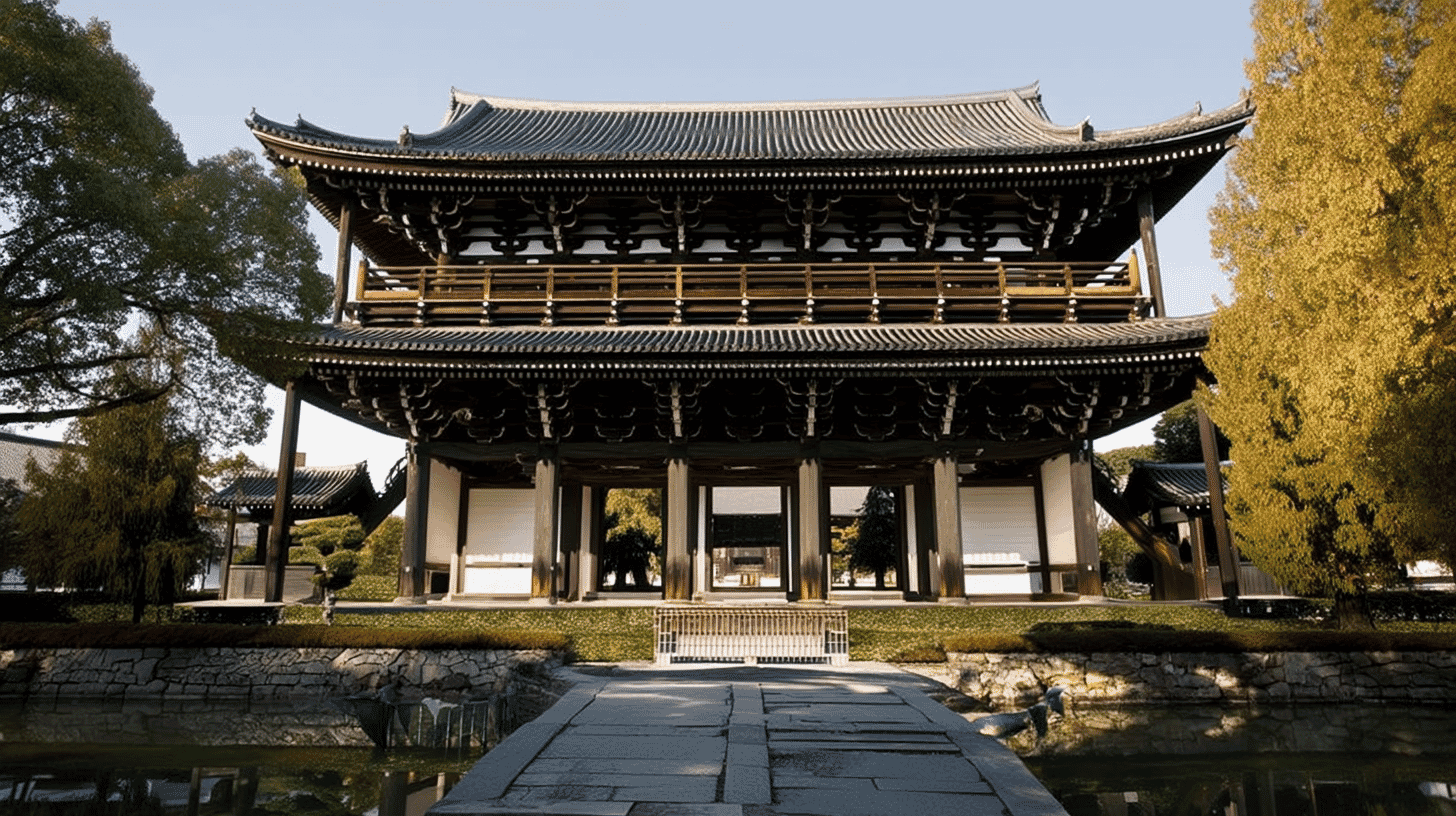
Tofukuji Sanmon Gate: Japan's Oldest and Grandest Zen Gate, Designated a National Treasure
Standing over 22 meters tall amid the ancient temple grounds of Higashiyama, the Sanmon Gate of Tofukuji Temple is far more than a mere entrance — it is a portal through six centuries of Japanese spiritual and architectural heritage. Designated a National Treasure in 1952, this colossal two-story wooden gate holds the distinction of being the oldest and largest surviving Zen Sanmon gate in all of Japan. For international visitors seeking an authentic encounter with medieval Japanese culture beyond the well-trodden tourist paths, the Tofukuji Sanmon offers a rare and deeply rewarding experience.
The History of Tofukuji Temple and Its Sanmon Gate
Tofukuji Temple was founded in 1236 by Kujo Michiie, one of the most powerful statesmen of the Kamakura period. Michiie envisioned a temple complex in Kyoto that could rival the magnificent Todaiji and Kofukuji temples of Nara — and so its very name was created by combining the characters "To" from Todaiji and "Fuku" from Kofukuji. The revered monk Enni Ben'en (Shoichi Kokushi) was appointed as the founding priest, and construction of the Shichido Garan (seven-hall monastery) continued for decades, with the original Sanmon Gate believed to have been completed around 1273.
Tragically, Tofukuji suffered devastating fires in 1319, 1334, and 1336, and the original Sanmon was lost in the flames. Reconstruction began soon after, and the present Sanmon Gate was completed in 1425 during the early Muromachi period. Ink inscriptions discovered during a modern restoration confirmed that construction of the roof tiles and the upper story took place between approximately 1405 and 1413, under the patronage of Ashikaga Yoshimochi, the fourth Shogun of the Muromachi shogunate.
In 1585, the gate suffered damage from an earthquake and was repaired under the orders of the warlord Toyotomi Hideyoshi. Further repairs were carried out in 1792. The most extensive modern restoration began in 1969 when the Agency for Cultural Affairs undertook a full-scale disassembly and repair — the first such comprehensive renovation in 600 years. This monumental project took 8 years and 9 months and cost approximately 500 million yen, finally reaching completion in March 1978.
Why Was the Tofukuji Sanmon Designated a National Treasure?
The Tofukuji Sanmon Gate was designated a National Treasure (Kokuho) on March 29, 1952, and it was in fact the very first Sanmon gate in Japan to receive this supreme cultural designation. Several extraordinary qualities justify this honor.
First, it is the oldest surviving Zen temple Sanmon in Japan. While many famous temple gates have been rebuilt in later centuries, the Tofukuji Sanmon has stood since 1425, preserving its original Muromachi-period form across six centuries.
Second, it is the largest Zen Sanmon gate in the country, standing over 22 meters to the ridge. Its five-bay, three-entrance, two-story double-gate format (known as gokan-sando-nikai-nijumon) represents the most prestigious and complete form of Zen temple gateway architecture.
Third, and perhaps most fascinating from an architectural perspective, is the gate's unique use of the Daibutsu-yo (Great Buddha style) construction method. This is remarkable because Tofukuji is a Zen temple, and Zen temples typically employed the Zenshu-yo (Zen style) of architecture. The Daibutsu-yo, originally developed for the reconstruction of Todaiji's Great Hall in the Kamakura period, features massive structural timbers, through-beams (nuki) that penetrate the pillars, and inserted bracket arms (sashi-hijiki). This gives the Sanmon its characteristically bold, powerful appearance with thicker timber proportions than a typical Zen structure — making it a true rarity in the history of Japanese architecture.
The gate also houses invaluable artworks on its upper floor, including polychrome ceiling paintings, a crowned Shakyamuni Buddha statue, and sixteen Arhat figures, all dating from the early Muromachi period.
Highlights and Things to See
The Monumental Exterior
Simply approaching the Sanmon Gate is an awe-inspiring experience. The structure rises 22 meters into the sky, with an Irimoya-zukuri (hip-and-gable) roof clad in traditional hon-kawara tiles. Flanking the main gate on both sides are Sanro (side corridors) with their own Kirizuma-zukuri (gable) roofs. The sheer scale and the robust proportions of the wooden pillars and beams immediately convey a sense of monumental power that distinguishes this gate from more delicate Zen architecture elsewhere.
The "Myo-un-kaku" Plaque
Mounted above the upper level of the gate is a magnificent plaque inscribed with the characters "Myo-un-kaku" (Pavilion of Wondrous Clouds). This calligraphy was written by Ashikaga Yoshimochi, the fourth Shogun of the Muromachi shogunate, who also played a key role in the gate's reconstruction. The bold brushwork of this plaque has been admired for centuries as a masterwork of medieval calligraphy.
The Ceiling Paintings and Interior Art
The second floor of the Sanmon is adorned with spectacular polychrome paintings covering the ceiling and pillars. These vibrant artworks were created by Chodensu (also known as Mincho), one of the most celebrated painter-monks of the Muromachi period, together with his disciple Kandensu. The ceiling paintings depict celestial beings including two heavenly maidens (tennyo) in flight and the mythical Karyobinga birds — creatures from Buddhist lore said to have sung beautiful melodies even before hatching from their eggs. The vivid colors of these paintings, preserved over six centuries, create an extraordinary atmosphere of the Pure Land paradise within the gate's upper chamber.
The Hokan Shaka Nyorai and Sixteen Arhats
Enshrined on the upper floor is the Hokan Shaka Nyorai-zo, a seated statue of Shakyamuni Buddha wearing a jeweled crown, flanked by the attendant figures of Gakkai Choja (the Elder Gakkai) and Zenzai Doji (the Youth Sudhana). Arranged on both sides of this sacred triad are sixteen Arhat (Rakan) statues — eight on each side, with odd-numbered Arhats on the left wing and even-numbered Arhats on the right when facing the main image. These figures are attributed to the early Muromachi period and form a solemn assembly of Buddhist saints that has watched over the temple for nearly 600 years.
The Symbol of "Garan-zura"
Tofukuji has long been known by the nickname "Garan-zura" — literally, "the temple known for its grand buildings." The Sanmon Gate is the ultimate embodiment of this reputation, representing the finest example of a Sanmon gate in all of Japan. Together with the massive Hondo (main hall), the Zendo (meditation hall, Japan's oldest and largest), and other historic structures, the Sanmon anchors an extraordinary collection of medieval Zen architecture found nowhere else.
Special Openings and Seasonal Highlights
The interior of the Sanmon Gate, including its upper-floor Buddha statues and ceiling paintings, is normally closed to the public. However, it is opened during special viewing periods that typically occur during the autumn foliage season (usually early November through early December) and occasionally during summer special openings organized by Kyoto tourism campaigns. Admission for the Sanmon special opening is typically around 1,000 yen. These limited viewing opportunities are highly recommended, as they allow visitors to ascend to the upper level and experience the breathtaking polychrome paintings and sacred statues up close.
The autumn foliage season at Tofukuji, generally from mid-November to early December, is one of Kyoto's most spectacular natural events. Over 2,000 maple trees fill the Sengyokukan ravine with brilliant reds, oranges, and golds, making the temple one of the most celebrated autumn leaf viewing spots in all of Japan.
Surrounding Attractions
Tofukuji Temple itself offers a wealth of attractions beyond the Sanmon Gate. The Honbo Gardens (Hojo Gardens), designed in 1939 by the acclaimed modern landscape architect Shigemori Mirei, are designated as a National Site of Scenic Beauty. Uniquely surrounding the abbot's quarters on all four sides, these four gardens combine traditional Zen rock garden aesthetics with bold modernist composition — including the famous checkerboard pattern of moss and paving stones in the north garden.
The Tsutenkyo (Bridge to Heaven) offers breathtaking views of the maple-filled Sengyokukan ravine and is Tofukuji's most iconic scenic spot. The temple complex also includes 24 sub-temples, several of which are occasionally open to visitors, including Funda-in (known as "Sesshuji" for its garden originally designed by the master painter Sesshu) and Ryogin-an, which houses a National Treasure dry garden.
Just a 15-minute walk south of Tofukuji lies the world-famous Fushimi Inari Taisha, with its thousands of vermillion torii gates cascading up the mountainside. To the east, the imperial temple of Sennyuji offers serene beauty with far fewer crowds. These three destinations can be combined into a memorable half-day walking tour of southern Higashiyama.
- 📍 Plan Your Visit to Kyoto
- Find tours, activities & transport passes near Tofukuji Temple Sanmon Gate
- [ Kinkakuji Fushimi Inari & Kimono Rental ]
Q&A
- Can I go inside the Sanmon Gate and see the upper floor?
- The upper floor of the Sanmon Gate is normally closed to the public. However, it is opened during special viewing periods, typically in autumn (early November to early December) and occasionally in summer. During these periods, you can climb to the upper level and view the polychrome ceiling paintings, the crowned Shakyamuni Buddha statue, and the sixteen Arhat figures. Check the official Tofukuji website for the latest schedule and admission fees.
- Is there English signage or guided information available at Tofukuji?
- Tofukuji provides some basic English-language signage and pamphlets. The official Sanmon Gate guide on the temple's website is also available in English. However, the detailed explanations during special openings are primarily in Japanese. Consider bringing a guidebook or using a translation app for the best experience, or hire a licensed English-speaking guide for a deeper understanding of the temple's history and art.
- What is the best time of year to visit Tofukuji?
- The most spectacular time is the autumn foliage season (mid-November to early December), when the 2,000+ maple trees create an unforgettable display of color. This is also when the Sanmon Gate interior is often open for special viewing. However, this is the busiest season. For a quieter experience, visit in early spring for fresh greenery, or in summer when special openings of the Sanmon may also be held. Early mornings and late afternoons are less crowded throughout the year.
- How do I get to Tofukuji Temple from Kyoto Station?
- Tofukuji is very easy to reach. Take the JR Nara Line from Kyoto Station one stop to Tofukuji Station (about 2 minutes, 150 yen). From the station, it is a 10-minute walk to the temple. You can also take the Keihan Railway to Tofukuji Station or Tobakaido Station, which are both within a 10-minute walk. During the autumn foliage season, parking at the temple is closed, so public transportation is strongly recommended.
- What makes the Tofukuji Sanmon architecturally unique compared to other Zen temple gates?
- While most Zen temple gates use the Zenshu-yo (Zen style) of architecture, the Tofukuji Sanmon was built using the Daibutsu-yo (Great Buddha style), a construction method originally developed for the massive Todaiji temple in Nara. This gives the gate unusually thick, robust timber proportions and powerful structural features like through-beams and inserted bracket arms, resulting in a bold, majestic appearance that is quite distinct from the more delicate aesthetics typical of Zen architecture.
Basic Information
| Name | Tofukuji Sanmon Gate (東福寺三門) |
|---|---|
| Cultural Designation | National Treasure (designated March 29, 1952; initially designated as Important Cultural Property on December 28, 1897) |
| Construction Period | Muromachi period, c. 1405–1425 |
| Architectural Style | Gokan-sando nikai-nijumon (five-bay, three-entrance, two-story double gate), Irimoya-zukuri (hip-and-gable roof), Hon-kawara-buki (ceramic tile roofing), Daibutsu-yo (Great Buddha style) construction |
| Height | Approximately 22 meters (to the ridge) |
| Temple | Tofukuji Temple (Head temple of the Rinzai Zen Tofukuji School) |
| Address | 15-chome Honmachi, Higashiyama-ku, Kyoto 605-0981, Japan |
| Phone | 075-561-0087 |
| Temple Grounds Admission | Free (paid areas: Tsutenkyo Bridge & Kaisando 600 yen / Hojo Gardens 500 yen / Combination 1,000 yen; fees increase during autumn season) |
| Sanmon Special Opening | Typically during autumn foliage season (Nov–Dec) and occasionally summer; approximately 1,000 yen (check official website for dates) |
| Visiting Hours | Apr–Oct: 9:00–16:00 / Nov–early Dec: 8:30–16:00 / Mid Dec–Mar: 9:00–15:30 (admission ends 30 min before closing) |
| Access | 10-minute walk from Tofukuji Station (JR Nara Line or Keihan Railway); 2 minutes by JR from Kyoto Station |
| Official Website | https://tofukuji.jp/ |
References
- 国宝 東福寺三門ガイド|臨済宗大本山 東福寺
- https://tofukuji.jp/guide/sanmon_gate/
- Tofuku-ji Temple "Sanmon" gate Guide (English)
- https://tofukuji.jp/guide/sanmon_gate/en/
- 文化遺産データベース — 東福寺三門
- https://bunka.nii.ac.jp/db/heritages/detail/174992
- 東福寺 — Wikipedia
- https://ja.wikipedia.org/wiki/東福寺
- Tōfuku-ji — Wikipedia (English)
- https://en.wikipedia.org/wiki/Tōfuku-ji
- 拝観案内 — 臨済宗大本山 東福寺
- https://tofukuji.jp/guide/
- 国宝三門 特別公開について — 臨済宗大本山 東福寺
- https://tofukuji.jp/news/国宝三門 特別公開について/
- Tofukuji Temple — Japan National Tourism Organization
- https://www.japan.travel/en/spot/1125/
- Tofukuji Temple — japan-guide.com
- https://www.japan-guide.com/e/e3930.html
Last verified: 2026.02.08
Nearby heritages
- Tofukuji Temple Rokuharamon Gate
- Honmachi 15-chome, Higashiyama Ward, Kyoto City, Kyoto Prefecture
- Tofukuji Temple Bathhouse
- Honmachi 15-chome, Higashiyama Ward, Kyoto City, Kyoto Prefecture
- Tofukuji Temple Toji
- Honmachi 15-chome, Higashiyama Ward, Kyoto City, Kyoto Prefecture
- Tofukuji Temple Main Hall
- 778 Honmachi 15-chome, Higashiyama-ku, Kyoto City, Kyoto Prefecture
- Tofukuji Temple's Thirteen-Story Pagoda
- Honmachi 15-chome, Higashiyama Ward, Kyoto City, Kyoto Prefecture
- Tofukuji Temple Zen Hall (Buddha Selection Hall)
- Honmachi 15-chome, Higashiyama Ward, Kyoto City, Kyoto Prefecture
- Tofukuji Temple Bell Tower
- Honmachi 15-chome, Higashiyama Ward, Kyoto City, Kyoto Prefecture
- Tofukuji Temple Tsusho Gate
- 778 Honmachi 15-chome, Higashiyama-ku, Kyoto City, Kyoto Prefecture
- Tofukuji Temple Hojo Tsukiji Wall
- 778 Honmachi 15-chome, Higashiyama-ku, Kyoto City, Kyoto Prefecture
- Ryuginan Front Gate
- Honmachi 15-chome, Higashiyama Ward, Kyoto City, Kyoto Prefecture