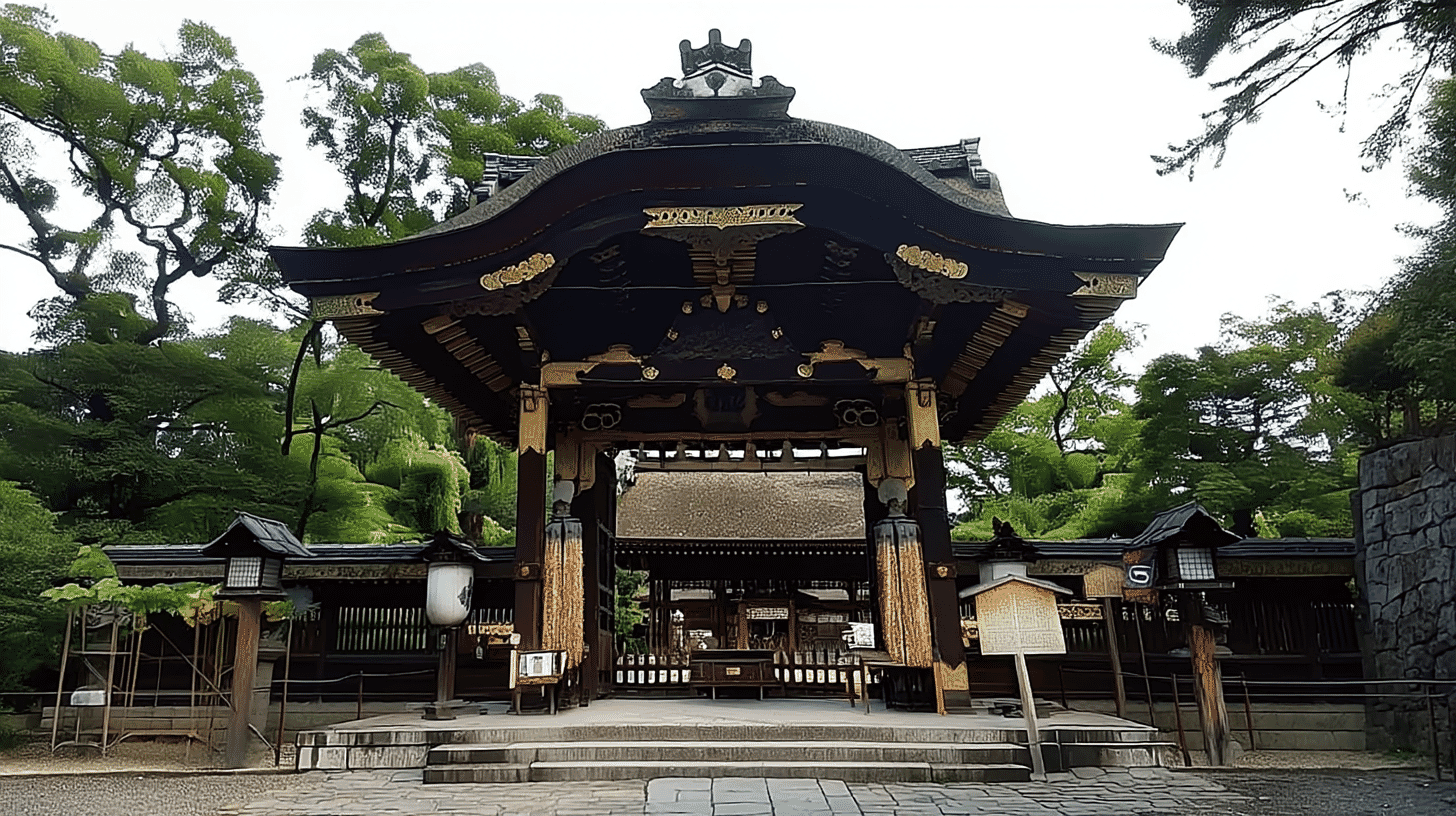
Toyokuni Shrine Karamon Gate: A National Treasure of Momoyama Splendor in Kyoto

Discover the Karamon Gate at Toyokuni Shrine in Kyoto, a National Treasure from the Momoyama period. Originally from Fushimi Castle, this gate features exquisite carvings attributed to the legendary Hidari Jingoro and stands as one of Kyoto's three celebrated National Treasure karamon gates.

Toyokuni Shrine Karamon Gate: A Masterpiece of Momoyama Architecture That Survived Centuries of Upheaval

Standing proudly at the entrance of Toyokuni Shrine in Kyoto's Higashiyama district, the Karamon Gate is a breathtaking relic of Japan's Momoyama period (1573–1614) — an era celebrated for its bold artistry and unrestrained grandeur. Designated as a National Treasure of Japan, this magnificent gate is believed to have originated at Fushimi Castle, the residence of Toyotomi Hideyoshi, the legendary warlord who unified Japan. Over the centuries, it traveled from castle to castle, temple to shrine, before finally returning to stand as the centerpiece of the very shrine that enshrines Hideyoshi's spirit. The Karamon Gate is not merely an architectural monument; it is a narrative in wood and gold, telling the story of ambition, rivalry, destruction, and rebirth that defines one of the most dramatic chapters in Japanese history.

What Is a Karamon Gate?

A "karamon" is a style of gate distinguished by a karahafu — a gracefully undulating gable that curves like a gentle wave above the entrance. This architectural element, despite the "kara" (Chinese) in its name, is actually a uniquely Japanese invention that reached its zenith during the Momoyama period. Karamon gates were symbols of supreme authority, typically reserved for the residences of the most powerful rulers or the most prestigious temples and shrines. Kyoto is home to three karamon gates designated as National Treasures: the Karamon at Toyokuni Shrine, the Karamon at Nishi Hongan-ji Temple, and the Karamon at Daitoku-ji Temple. Together, these three structures form the celebrated "Three National Treasure Karamon Gates of Kyoto," each a testament to the lavish artistic ambition of the Momoyama era.

The Dramatic Journey of the Gate: From Fushimi Castle to Toyokuni Shrine

The history of this gate reads like a chapter from a historical novel. According to tradition, the Karamon was originally constructed as part of Fushimi Castle, the grand fortress built by Toyotomi Hideyoshi in the Fushimi district of Kyoto during the 1590s. After Hideyoshi's death in 1598 and the fall of the Toyotomi clan, the Tokugawa shogunate ordered Fushimi Castle dismantled in 1623. The gate was relocated to Nijo Castle, where the monk Ishin Suden, a trusted advisor to the Tokugawa regime, received it in 1627 and moved it to Konchi-in, a sub-temple of Nanzen-ji Temple. There it remained for over two centuries, quietly enduring the passage of time.

When Emperor Meiji ordered the revival of Toyokuni Shrine in 1868 — honoring Hideyoshi's spirit as a patriotic symbol — the Karamon was selected for transfer from Konchi-in to the newly rebuilt shrine. After its journey spanning nearly 300 years and multiple relocations, the gate that once graced Hideyoshi's castle had at last come to rest at the shrine that enshrines his memory. It was as though the gate had finally returned home.

Why Was the Karamon Designated a National Treasure?

The Karamon Gate was first designated as an Important Cultural Property in 1897, and later elevated to National Treasure status on March 31, 1953. Its designation reflects several extraordinary qualities. The gate is a superb example of Momoyama-period architecture, embodying the era's signature aesthetic of bold, flamboyant grandeur. Its structural form — a four-pillar gate (shikkyaku-mon) with karahafu gables on both the front and rear faces and elegant irimoya (hip-and-gable) roofing on the sides, all covered with hinoki cypress bark — represents the highest level of gate architecture from this period. The carvings and decorative elements display the magnificent, uninhibited artistic spirit of the Momoyama era, with dynamic animal and plant motifs executed with extraordinary vitality and skill.

Highlights and Things to See

The Carvings Attributed to Hidari Jingoro

Among the most celebrated features of the Karamon Gate are the elaborate wood carvings that adorn its transoms, doors, and kaerumata (frog-leg struts). These masterful works are traditionally attributed to Hidari Jingoro, one of Japan's most legendary carvers, who is also credited with the famous "Sleeping Cat" at Nikko Tosho-gu. While some scholars debate whether Hidari Jingoro was a single historical figure or a collective name for multiple master craftsmen, the carvings on this gate are undeniably extraordinary. Visitors can admire depictions of cranes in flight, koi leaping through flowing water, and the goban-kiri (five-seven paulownia) crest of the Toyotomi family, all executed with a dynamic energy that seems to bring the wooden surfaces to life.

Traces of Gold and Lacquer

When the gate was first constructed, it was entirely coated in black lacquer, with polychrome pigments and gold leaf lavishing every surface — a true reflection of Hideyoshi's famous love of gold and extravagant display. Today, while most of the lacquer and gold have worn away to reveal the beautiful natural grain of the zelkova wood, careful observers can still spot faint traces of the original gold leaf in sheltered areas. These remnants offer a tantalizing glimpse of just how dazzling the gate must have looked when it was new.

The Front and Back of the Gate

The Karamon Gate features karahafu gables on both the front and rear — an arrangement that makes it especially impressive when viewed from either direction. The front doors display dramatic carvings of koi swimming upstream, while the back panels feature elegant compositions of flowing water and bamboo. Both sides reward close attention. To view the back of the gate, visitors need to enter the shrine grounds during opening hours (9:00–17:00), while the front face is visible at any time from the approach pathway.

The Imperial and Toyotomi Crests

Throughout the gate's decorations, visitors can spot two important family crests intertwined: the imperial chrysanthemum crest and the Toyotomi family's five-seven paulownia crest. The paulownia was originally an imperial symbol, granted by the Emperor to Hideyoshi as a mark of supreme honor. These crests appear in the metalwork fittings and carved details throughout the gate, serving as a powerful reminder of the extraordinary status that Hideyoshi achieved in his rise from humble origins to ruler of all Japan.

Stone Lanterns of the Loyalist Daimyo

Flanking the Karamon Gate, visitors will notice eight stone lanterns. These were donated by powerful daimyo lords who owed their fortunes to Hideyoshi's patronage. Originally placed at the Toyokuni Mausoleum on the summit of Amidagamine hill, they were relocated here when the shrine was rebuilt in the Meiji era. Each lantern bears inscriptions identifying the donor lord, offering a tangible connection to the web of loyalty and power that once surrounded Hideyoshi.

Toyokuni Shrine: The Shrine That Refused to Disappear

Toyokuni Shrine was established in 1599, just one year after Hideyoshi's death, when Emperor Go-Yozei granted him the divine title "Toyokuni Daimyojin" and a shrine was constructed on the slopes of Amidagamine hill. For a brief period, the shrine was among the most magnificent in all of Japan, drawing pilgrims from across the country. However, after the Toyotomi clan's final defeat at the Siege of Osaka in 1615, the victorious Tokugawa shogunate ordered the shrine destroyed. Although Hideyoshi's wife Kitanomandokoro (Nene) successfully pleaded for the buildings to be spared from demolition, the Tokugawa forbade any repairs, and the shrine slowly fell into ruin over the next 250 years.

In 1868, Emperor Meiji, recognizing Hideyoshi as a great patriot who had unified Japan without establishing his own shogunate, ordered the shrine's restoration. Rebuilt on the former grounds of Hokoji Temple — itself a creation of Hideyoshi — the restored Toyokuni Shrine features the magnificent Karamon Gate and serves today as a place where visitors pray for success in life, career advancement, and good fortune, following the inspiring example of Hideyoshi's legendary rise from peasant to ruler.

Surrounding Attractions

Toyokuni Shrine sits at the heart of one of Kyoto's richest cultural districts, and there are numerous significant sites within easy walking distance.

Immediately adjacent to the shrine is Hokoji Temple, home to the famous temple bell whose inscription inadvertently triggered the Siege of Osaka — a pivotal event in Japanese history. The bell, inscribed with characters that the Tokugawa interpreted as a curse, can still be seen today. Just a five-minute walk south brings you to the Kyoto National Museum, one of Japan's premier museums, housing an extensive collection of art and cultural artifacts spanning more than a millennium. Across the street from the museum stands Sanjusangendo, the awe-inspiring hall containing 1,001 gilded statues of the Thousand-Armed Kannon — a sight that defies description. A little further south, Chishaku-in Temple offers stunning Momoyama-period screen paintings (National Treasures) and a magnificent garden. For those wishing to trace Hideyoshi's legacy further, the Toyokuni Mausoleum (Toyokuni-byo) sits atop Amidagamine hill, accessible via approximately 500 stone steps — a rewarding climb for those seeking a contemplative connection with this legendary figure.

Visiting Tips for International Travelers

The shrine grounds are open to all visitors free of charge. To view both the front and the back of the Karamon Gate, visit during the gate's open hours from 9:00 to 17:00. If you arrive outside these hours, you can still appreciate the magnificent front face from the stone stairway. The Treasure Museum within the shrine requires an admission fee (300 yen for adults) and houses important artifacts related to Hideyoshi. A flea market called "Taiko-san no Omoshiro-ichi" is held on the 8th of every month, offering antiques and crafts, while a larger flea market takes place on the 18th — both are excellent opportunities to experience local culture. Gourd-shaped ema (votive plaques) are a unique souvenir, referencing Hideyoshi's famous gourd battle standard. The shrine has limited restroom facilities, so visitors may wish to use facilities at nearby Kyoto National Museum or Kyoto Station before visiting.

📍 Plan Your Visit to Kyoto
Find tours, activities & transport passes near Toyokuni Shrine Karamon Gate
[ Kinkakuji Fushimi Inari & Kimono Rental ]

Q&A

QIs there an admission fee to see the Karamon Gate?
ANo, viewing the Karamon Gate is completely free. The shrine grounds are open to all. However, the Treasure Museum within the shrine charges an admission fee of 300 yen for adults, 200 yen for high school and university students, and 100 yen for elementary and junior high school students.
QHow do I get to Toyokuni Shrine from Kyoto Station?
ATake Kyoto City Bus and get off at "Hakubutsukan Sanjusangendo-mae" bus stop, then walk about 5 minutes north. Alternatively, take the Keihan Railway to Shichijo Station and walk approximately 10 minutes east. The shrine is also within walking distance from Kyoto Station (about 18 minutes on foot).
QWhat are the Three National Treasure Karamon Gates of Kyoto?
AThe three National Treasure Karamon Gates in Kyoto are: the Karamon at Toyokuni Shrine (described in this article), the Karamon at Nishi Hongan-ji Temple, and the Karamon at Daitoku-ji Temple. All three are believed to have connections to buildings originally constructed under Toyotomi Hideyoshi's patronage during the Momoyama period, and all feature extraordinarily ornate carvings and decorative elements.
QCan I take photographs of the Karamon Gate?
AYes, photography of the Karamon Gate is permitted. The gate stands in the open shrine grounds and can be photographed freely from both the front approach and inside the grounds. However, please be respectful of worshippers and follow any on-site instructions.
QWhat is the best time to visit Toyokuni Shrine?
AThe shrine can be visited year-round. For the most rewarding experience, visit during gate opening hours (9:00–17:00) so you can see both sides of the Karamon Gate. The monthly flea markets on the 8th and 18th add an extra dimension to your visit. The shrine is also a lovely place during cherry blossom season in spring and during the annual festival on September 18th, the anniversary of Hideyoshi's death.

Basic Information

Name Toyokuni Shrine Karamon Gate (豊国神社唐門 / ほうこくじんじゃからもん)
Designation National Treasure of Japan (designated March 31, 1953; previously Important Cultural Property since December 28, 1897)
Category Architecture — Pre-modern / Shrine
Period Momoyama period (1573–1614)
Structure Four-pillar gate (shikkyaku-mon), karahafu gables front and rear, irimoya (hip-and-gable) sides, hinoki cypress bark roof (hiwadabuki)
Location Yamato-oji-dori Shomen Higashi-iru, Higashiyama-ku, Kyoto
Owner Toyokuni Shrine
Shrine Hours Gate accessible 9:00–17:00 (front face visible 24 hours); Treasure Museum 9:00–16:30
Admission Shrine grounds: Free; Treasure Museum: 300 yen (adults)
Access Kyoto City Bus "Hakubutsukan Sanjusangendo-mae" stop, 5-min walk; Keihan Railway "Shichijo" Station, 10-min walk
Parking Limited free parking (approximately 15 cars, 2 buses)

References

Cultural Heritage Online — Toyokuni Shrine Karamon (文化遺産データベース)
https://bunka.nii.ac.jp/db/heritages/detail/156285
WANDER Kokuho — Toyokuni Shrine Karamon (WANDER 国宝)
https://wanderkokuho.com/102-01746/
Toyokuni Shrine (Kyoto) — Wikipedia
https://en.wikipedia.org/wiki/Toyokuni_Shrine_(Kyoto)
豊国神社 (京都市) — Wikipedia
https://ja.wikipedia.org/wiki/豊国神社_(京都市)
Kyoto Travel Guide — Toyokuni Shrine (京都観光Navi)
https://ja.kyoto.travel/tourism/single01.php?category_id=7&tourism_id=433
Kyoto de Asobo ART — Toyokuni Shrine History
https://www.kyotodeasobo.com/art/static/houmotsukan/toyokuni-shrine/01-toyokuni-rekisi.html
Kyoto Tsuu Hyakka Jiten — Toyokuni Shrine (京都通百科事典)
https://www.kyototuu.jp/Jinjya/ToyokuniJinjya.html
Three Karamon Gates Reflect Hideyoshi's Authority — jhistories
https://jhistories.com/karamon/
National Designated Cultural Properties Database (国指定文化財等データベース)
https://kunishitei.bunka.go.jp/bsys/maindetails/102/1746

Last verified: 2026.02.08

Nearby heritages