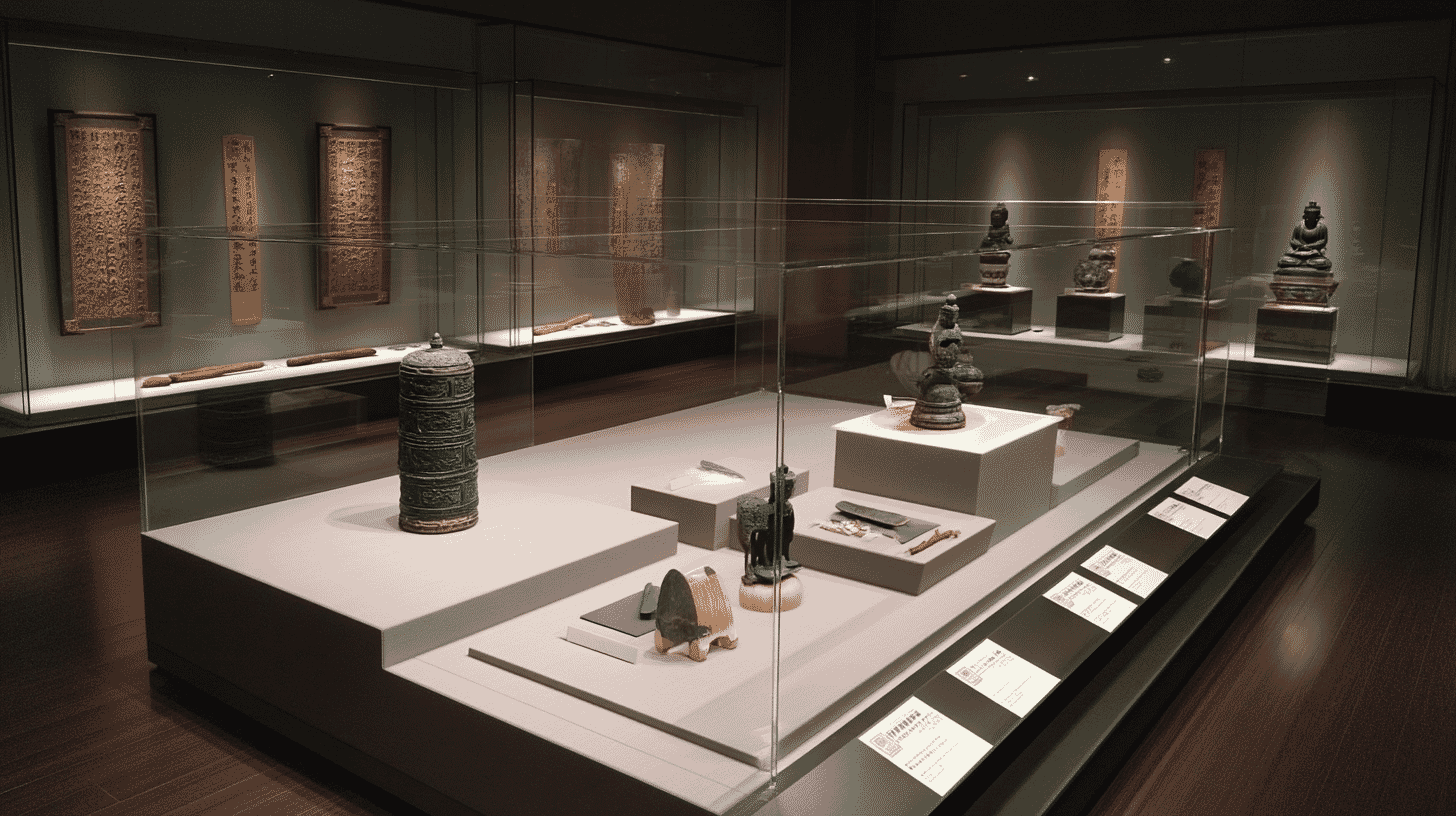
Excavated Treasures of Mount Asakuma's Sutra Mounds: Where Shinto Priests Secretly Prayed to the Buddha
High on the misty slopes of Mount Asakuma, overlooking the sacred precincts of Ise Grand Shrine, lies one of Japan's most remarkable archaeological discoveries. The Excavated Items from the Sutra Mounds at Kyōgamine, Mount Asakuma, Ise Province (伊勢国朝熊山経ケ峯経塚出土品) is a collection of Heian-period artifacts designated as a National Treasure of Japan. These exquisite objects — bronze mirrors engraved with images of Amida Buddha descending from paradise, sutra tubes inscribed with the names of Shinto priests, and hand-copied Buddhist scriptures — tell an extraordinary story of spiritual devotion that transcended the boundaries between Japan's two great religions.
What Are the Sutra Mound Excavated Items?
A sutra mound, or kyōzuka (経塚), is a burial site where Buddhist devotees interred sacred scriptures inside containers, placing them deep underground along with ritual offerings. The practice arose during the late Heian period (794–1185) from the belief that the world had entered Mappō, the prophesied "Age of the Decline of the Dharma," in which the Buddha's true teachings would gradually disappear from the world. By burying sutras in durable containers, the faithful hoped to preserve the sacred texts for future generations or for the coming of Maitreya, the Buddha of the Future.
The artifacts designated as this National Treasure come from three of the 43 sutra mounds discovered at Kyōgamine (Sutra Peak), a ridge northwest of the main hall of Kongōshōji Temple atop Mount Asakuma. The collection comprises items from the First, Second, and Third Sutra Mounds, dating between 1159 and 1173 during the late Heian period. Together, they form one of the most important and best-preserved sutra mound assemblages in all of Japan.
A Discovery Born from Disaster
The story of this National Treasure begins with catastrophe. In September 1959, the devastating Isewan Typhoon — the most powerful typhoon in Japan's recorded history at that time — struck the Kii Peninsula, causing enormous destruction across the Ise-Shima region. Mount Asakuma, the highest peak in the area at 555 meters, suffered severe landslides and uprooted trees.
During the subsequent cleanup and fallen-tree removal operations in 1959 and 1960, workers unexpectedly unearthed bronze sutra tubes, mirrors, and other artifacts from the disturbed soil. Though a ceramic sutra tube had already been found during the Meiji era in 1894, the typhoon-related discoveries prompted the first systematic archaeological excavation, which ultimately revealed a total of 43 sutra mounds — an extraordinarily large cluster representing decades of continuous devotional activity.
The excavated items from the three most significant mounds were collectively designated as an Important Cultural Property in 1912 (for the earlier Meiji-era find), and then elevated to National Treasure status on July 1, 1963. The sutra mound site itself was designated as a National Historic Site in 1966 under the name "Asakumayama Sutra Mound Group."
The Designated Artifacts: A Closer Look
The National Treasure designation encompasses artifacts from three sutra mounds, each containing objects of outstanding historical and artistic significance.
First Sutra Mound
The centerpiece from this mound is a ceramic sutra tube (陶経筒) bearing an inscription dated to the third year of Jōan (1173). The inscription names Arakida Tokimori, identified as a gon-negi (deputy priest) of the Ise Grand Shrine, as the person who commissioned the sutra burial. This is among the most compelling pieces of evidence linking Ise Grand Shrine officials directly to Buddhist devotional practices.
Second Sutra Mound
This mound yielded two bronze sutra tubes, two bronze mirrors (including fragments), and a celadon porcelain lidded box (青白磁盒子). The celadon box, likely imported from Song Dynasty China, reflects the cosmopolitan material culture of the period and the high social status of those involved in the sutra burial.
Third Sutra Mound
The Third Mound is the richest of the three and contains the collection's most celebrated masterpieces. It produced a bronze sutra tube dated to the first year of Heiji (1159), thirteen sutra scrolls including a Lotus Sutra volume with a colophon dated August 14, 1159 and a Heart Sutra, and four extraordinary bronze mirrors with line-engraved Buddhist imagery. The mirrors include two "Line-engraved Amida Triad Raigō Mirror Images" (線刻阿弥陀三尊来迎鏡像), one "Line-engraved Amida Triad Mirror Image" (線刻阿弥陀三尊鏡像), and one "Line-engraved Amida Nyorai Mirror Image" (線刻阿弥陀如来鏡像). Also found were a bronze ladle (銅提子) and a clay outer tube (土製外筒) that once protected the sutra container.
The Line-Engraved Mirrors: Masterpieces of Devotional Art
The four line-engraved mirrors from the Third Sutra Mound are widely considered the artistic highlight of the entire collection. Created by skilled metalworkers using a burin to incise fine lines into polished bronze surfaces, these mirrors depict scenes of Amida Buddha and attending bodhisattvas descending from the Western Paradise to welcome the souls of the faithful — a composition known as raigō (来迎), or "welcoming descent."
On the two Raigō mirror images, Amida Buddha is shown seated in meditation upon clouds, flanked by Kannon (Avalokitesvara) bearing a lotus pedestal and Seishi (Mahasthamaprapta) with hands pressed together in prayer. Rays of light emanate from the Buddha's forehead as the heavenly procession descends over mountain peaks toward the earthly realm. In one of these mirrors, a small building with a hip-and-gable roof appears in the lower corner — likely representing the deathbed chamber of the person being welcomed to paradise.
Art historians praise these mirrors not only as exceptional examples of metalwork but also as valuable pictorial documents. The engraved raigō compositions follow the conventions of contemporary Heian-period Buddhist painting, making them important cross-references for the study of Pure Land Buddhist art. The delicacy and confidence of the engraved lines demonstrate the highest level of craftsmanship available in 12th-century Japan.
Why This Is a National Treasure: The Significance
The designation as a National Treasure reflects the collection's exceptional importance across multiple dimensions. First, the artistic quality of the line-engraved mirrors is outstanding — they rank among the finest examples of Heian-period decorative metalwork in existence, valuable both as masterworks of craftsmanship and as irreplaceable pictorial records of Pure Land Buddhist iconography.
Second, and perhaps most remarkably, the inscriptions on the sutra tubes and colophons on the scrolls reveal that the people who created these sutra mounds were priests of the Ise Grand Shrine — the holiest site of Shinto, Japan's indigenous religion. The 1173 inscription explicitly names an Ise Shrine gon-negi, while analysis of the 1159 materials has identified the involvement of Watarai Masahiko, a senior priest of the Outer Shrine (Gekū), and a nun named Shinmyō, believed to have been his wife who took Buddhist vows. She is thought to have buried the sutras to pray for her husband's rebirth in paradise when he passed away on August 15, 1159 — just one day after the date on the sutra colophon.
This evidence is profoundly significant for understanding the religious history of Japan. It demonstrates that even at the very heart of Shinto practice, Buddhist faith — specifically, Pure Land devotion and Mappō eschatology — had deeply penetrated the lives of shrine officials. The collection thus provides irreplaceable primary evidence for the study of shinbutsu shūgō (神仏習合), the syncretic fusion of Shinto and Buddhism that characterized much of Japanese religious life before the forced separation of the two religions in the Meiji era.
Third, the collection is valuable as an archaeological assemblage. The combination of dated inscriptions, well-preserved sutra scrolls, fine metalwork, imported ceramics, and associated ritual objects provides a rich, contextually intact window into the devotional practices and material culture of 12th-century Japan.
Visiting: Kongōshōji Temple and the Sutra Mound Site
The excavated artifacts are preserved and displayed at the Treasure House (宝物館) within the grounds of Kongōshōji Temple, located near the summit of Mount Asakuma. The temple itself is a deeply rewarding destination — founded in the 6th century, it has served for over a millennium as the spiritual guardian of Ise Grand Shrine's northeastern "demon gate" (kimon). The famous folk song goes: "If you visit Ise, you must also climb Asakuma; without Asakuma, your pilgrimage is only half complete."
The sutra mound archaeological site at Kyōgamine lies on the ridge northwest of the temple's main hall. While the original artifacts have been removed for preservation, stone pagodas now mark each excavation point, creating an atmospheric trail through the forested hillside. The 28 standing stone markers were donated by supporters after the excavation, each with its own distinctive design.
The journey to Kongōshōji is itself part of the experience. The Ise-Shima Skyline toll road winds through the mountains, offering spectacular panoramic views of Ise Bay. Alternatively, adventurous visitors can hike the historic Asakuma-dake pilgrimage trail from the base of the mountain — the same path that Ise pilgrims have walked for centuries.
Surrounding Attractions
A visit to Mount Asakuma can be combined with explorations of several nearby attractions. The Ise Grand Shrine Inner Sanctuary (Naikū) and Outer Sanctuary (Gekū) are the primary pilgrimage destinations in the area, and the charming traditional shopping street of Oharai-machi and Okage Yokochō near the Inner Sanctuary offer local cuisine and souvenirs. The Asakuma Summit Observatory provides sweeping 360-degree views, and the photogenic "Sky Post" (天空のポスト) atop the mountain has become a popular spot. Nearby Toba, accessible via the Ise-Shima Skyline, is famed for its pearl industry and Toba Aquarium. The scenic Meoto Iwa (Wedded Rocks) at Futami are also within easy reach.
Tips for International Visitors
Mount Asakuma and Kongōshōji Temple offer a serene contrast to the crowds at Ise Grand Shrine. English signage is limited at the temple and treasure house, so preparing in advance will enrich your visit. Photography policies at the treasure house should be confirmed on-site. The mountain summit can be significantly cooler and windier than the town below, so bringing a light jacket is recommended even in warm months. If visiting by taxi, arrange for the driver to wait during your visit, as taxis are difficult to summon at the mountaintop.
- 📍 Plan Your Visit to Mie
- Find tours, activities & transport passes near Artifacts Excavated from the Sutra Mound at Kyogamine, Mount
- [ Ise Grand Shrine & Shima Bay Cruise Tours ]
Q&A
- What exactly are the "Excavated Items from the Sutra Mounds at Kyōgamine, Mount Asakuma"?
- They are a collection of Heian-period (1159–1173) artifacts excavated from three sutra mounds on Mount Asakuma in Ise City, Mie Prefecture. The collection includes ceramic and bronze sutra tubes, hand-copied Buddhist scripture scrolls, four bronze mirrors with exquisitely line-engraved images of Amida Buddha, a celadon porcelain box, a bronze ladle, and a clay outer tube. They were collectively designated as a National Treasure in 1963.
- Where can I see these National Treasure artifacts?
- The artifacts are preserved at the Treasure House (宝物館) within the grounds of Kongōshōji Temple, located near the summit of Mount Asakuma in Ise City. The temple is accessible via the Ise-Shima Skyline toll road. Please note that specific items may be on loan for special exhibitions at other museums, so it is advisable to confirm viewing availability in advance.
- Why are these artifacts so historically important?
- Beyond their outstanding artistic quality, these artifacts provide rare physical evidence that priests of the Ise Grand Shrine — the most sacred Shinto institution in Japan — practiced Buddhist devotion during the Heian period. Inscriptions on the sutra tubes and scrolls identify specific shrine priests by name, documenting the deep intertwining of Shinto and Buddhism (shinbutsu shūgō) at the very heart of Japanese religion.
- How do I get to Kongōshōji Temple on Mount Asakuma?
- By car, take the Ise-Shima Skyline toll road from either the Ise or Toba gate; the temple is about 20 minutes from the Ise-side entrance. By public transport, the Sangū Bus runs from Kintetsu Isuzugawa Station to Kongōshōji Temple on weekends and holidays only. Alternatively, you can hike the Asakuma-dake Trail from near Kintetsu Asama Station (about 90 minutes uphill). The temple is open daily from 9:00 to 15:45, and admission to the grounds is free.
- What is the best time of year to visit?
- The temple and sutra mound site can be enjoyed year-round. Spring brings cherry blossoms along the Skyline road, while autumn offers stunning foliage. From late June through August, hundreds of water lilies bloom in the temple's Renma Pond, creating a beautiful scene. Winter visits offer clear panoramic views from the mountaintop. The summit can be quite cool even in summer, so bring layers.
Basic Information
| Official Name | 伊勢国朝熊山経ケ峯経塚出土品 (Excavated Items from the Sutra Mounds at Kyōgamine, Mount Asakuma, Ise Province) |
|---|---|
| Designation | National Treasure (Archaeological Artifacts) |
| Important Cultural Property Designation | February 8, 1912 |
| National Treasure Designation | July 1, 1963 |
| Period | Heian period (1159–1173) |
| Excavation Site | Kyōgamine (Sutra Peak), Mount Asakuma, Ise City, Mie Prefecture |
| Associated Site Designation | National Historic Site "Asakumayama Sutra Mound Group" (designated 1966) |
| Storage / Exhibition | Treasure House, Kongōshōji Temple (金剛證寺), Ise City |
| Temple Address | 548 Asamachō-dake, Ise City, Mie Prefecture 516-0021, Japan |
| Temple Hours | 9:00–15:45 (open daily, no holidays) |
| Temple Admission | Free (treasure house may have a separate admission fee) |
| Contact | Kongōshōji Temple: 0596-22-1710 |
| Access | Via Ise-Shima Skyline (toll road), approx. 20 min from Ise-Nishi IC; Sangū Bus from Kintetsu Isuzugawa Station (weekends/holidays only) |
References
- Cultural Heritage Online — Excavated Items from Sutra Mounds at Kyōgamine, Mount Asakuma, Ise Province (文化遺産データベース)
- https://bunka.nii.ac.jp/db/heritages/detail/189396
- Agency for Cultural Affairs — National Designated Cultural Properties Database
- https://kunishitei.bunka.go.jp/heritage/detail/201/863
- Ise City Official Website — Archaeological Cultural Properties: Excavated Items from Sutra Mounds at Kyōgamine
- https://www.city.ise.mie.jp/cul_spo_edu/culture/bunkazai_shiseki/bunkazai/kouko/1009660.html
- Ise City Official Website — Asakumayama Sutra Mound Group (National Historic Site)
- https://www.city.ise.mie.jp/cul_spo_edu/culture/bunkazai_shiseki/bunkazai/kinenbutsu/1002154.html
- Ise City Tourism Association — Asakumayama Sutra Mound Group
- https://ise-kanko.jp/purpose/asamakyouzuka/
- Ise City Tourism Association — Asamagatake Kongōshōji Temple
- https://ise-kanko.jp/purpose/kongoshoji/
- Kanko Mie (Mie Prefecture Tourism) — Kongōshōji Temple
- https://www.kankomie.or.jp/spot/3035
- Wikipedia — Kongōshō-ji
- https://en.wikipedia.org/wiki/Kong%C5%8Dsh%C5%8D-ji
- Note.com — Sutra Mounds Revealing Buddhist Devotion of Ise Shrine Priests (仏都伊勢を行く)
- https://note.com/buttoise19/n/nd8b110e439a3
Last verified: 2026.02.08