
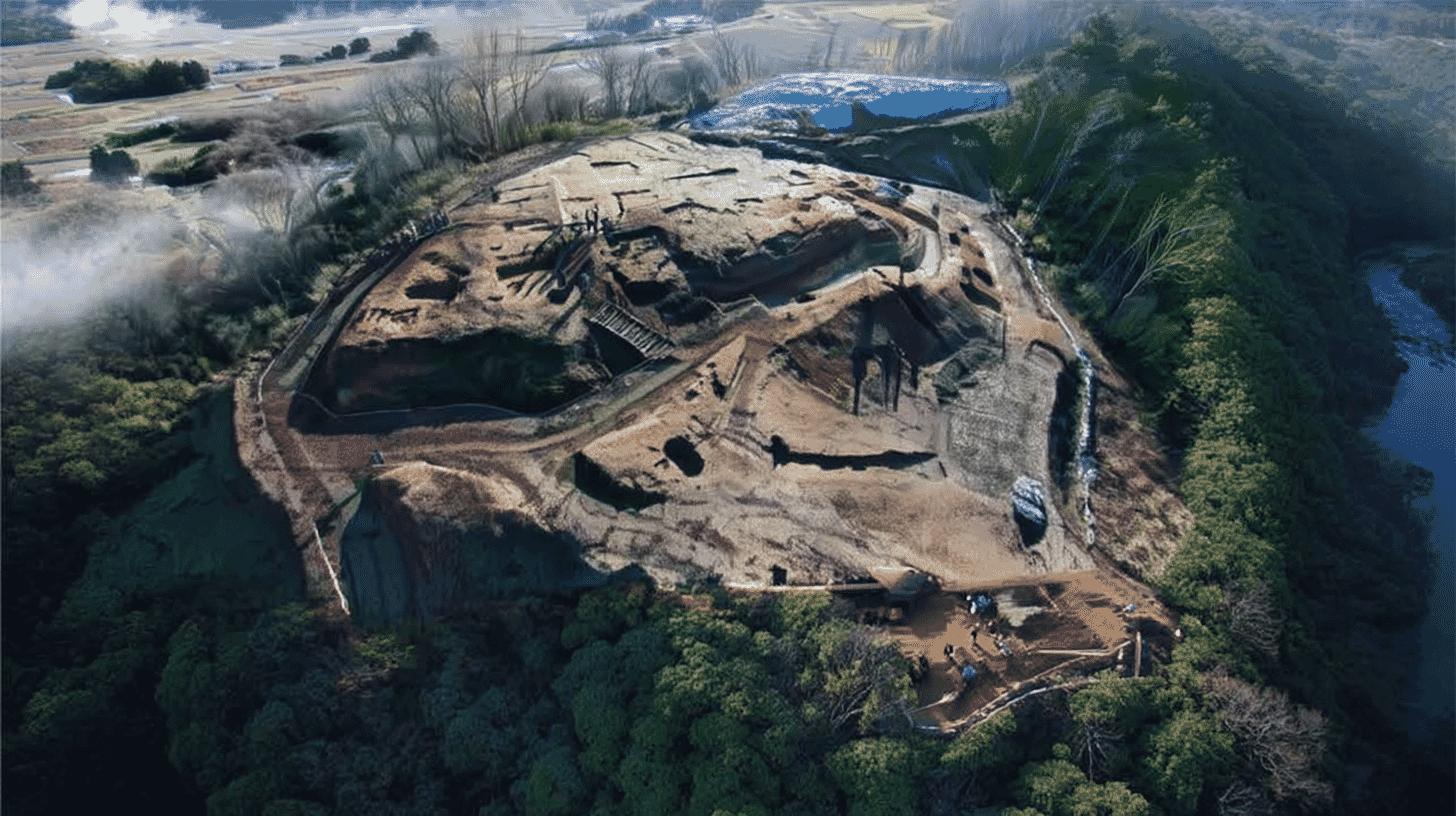
A Defended Settlement of the Late Fourth Century, Designated in 2017
Irinosawa Ruins (入の沢遺跡, Irinosawa Iseki) is a site of the later early Kofun period at Joono and Minegishi, Tsukidate, Kurihara City, Miyagi Prefecture, designated a national Historic Site in 2017. The Council for Cultural Affairs recommended the designation to the Minister of Education on 16 June that year, and it took effect through publication in the official gazette. It is the thirty-fifth Historic Site in Miyagi Prefecture.
Miyagi Prefecture records that it stands in the eastern part of the Tsukidate hills of the northwestern prefecture, on a spur 23 metres to 26 metres above the plain around it.
The period is the later early Kofun, the second half of the fourth century. It was a large settlement, but it did not last long.
A Great Ditch and a Timber Palisade
What marks this site is its defences.
Miyagi Prefecture writes: a large settlement of the later early Kofun period, of markedly high defensive character, enclosed by a great ditch 2 metres to 4 metres wide and 4 metres deep, measured from the ditch floor to the crest of the hill, with a timber palisade running parallel inside it.
A ditch was cut and a palisade set inside it, parallel to its line: a defence in two layers. The depth of 4 metres is taken from the floor of the ditch up to the crest of the hill.
To that is added the position on a spur 23 metres to 26 metres above the plain. Natural height and built defence work together.
Miyagi Prefecture calls it important as a site with almost no parallel in eastern Japan for the same period.
Grave Goods from Burned Houses
The character of the finds is unusual as well.
Miyagi Prefecture writes: bronze mirrors, ironwork, stone ornaments and earthenware of the kinds carried as grave goods by the large tumuli of the same period, tumuli closely connected with the Yamato court, were recovered in numbers from pit dwellings that appear to have been burned deliberately.
Objects of the sort placed in tombs came instead from dwellings, and those dwellings are held to have been burned on purpose.
Had the fire been accidental, such things would have been carried out. That the objects stayed while the buildings burned is what makes the site unusual.
Miyagi Prefecture also records that the site survives in very good condition. The burning is what preserved the finds and the features.
At the Northern Limit of Yamato Reach
Miyagi Prefecture places the site by geography.
The area lies at the northern edge of the distribution of large early Kofun tumuli, which is to say at the northern limit of Yamato reach, while the hills around and the country to the north carry sites of the Epi-Jomon culture.
The Epi-Jomon culture ran in the north alongside the Yayoi and Kofun periods of the main island. The site stands where two cultural spheres meet.
That a large, strongly defended settlement holding many objects closely tied to the Yamato court existed there for a short time is, in the prefecture's words, important for understanding Yamato policy towards the northeast in this period and its relations with the Epi-Jomon culture.
Defences, grave-quality finds, a short life and destruction by fire: four things come together in one site.
Closed to Visitors
Miyagi Prefecture is explicit about access: for reasons of safety, the site cannot currently be visited.
On approach it adds that for reasons of safety the entrance to the access road has been closed.
Designation as a Historic Site does not guarantee that a place can be visited, and this site is an instance of that. Check the current information from Miyagi Prefecture or Kurihara City before planning a trip.
The bronze mirrors, ironwork and other finds may be kept and displayed at another institution rather than on site. Seeing the objects means looking to the institution holding them.
Q&A
- When was the site designated?
- In 2017. The Council for Cultural Affairs recommended designation to the Minister of Education on 16 June that year, and it took effect through publication in the official gazette. It is the thirty-fifth Historic Site in Miyagi Prefecture, at Joono and Minegishi, Tsukidate, Kurihara City.
- What kind of site is it?
- Miyagi Prefecture records a large settlement of the later early Kofun period, of markedly high defensive character, enclosed by a great ditch 2 metres to 4 metres wide and 4 metres deep with a timber palisade running parallel inside it. It stands on a spur 23 metres to 26 metres above the plain.
- What was found there?
- Bronze mirrors, ironwork, stone ornaments and earthenware of the kinds carried as grave goods by large tumuli of the same period, recovered in numbers from pit dwellings that appear to have been burned deliberately. Objects of the sort placed in tombs came instead from dwellings.
- Why does the site matter?
- It lies at the northern limit of Yamato reach, with sites of the Epi-Jomon culture in the hills around and to the north. That a strongly defended settlement existed there briefly is held important for understanding Yamato policy towards the northeast and its relations with the Epi-Jomon culture.
- Can the site be visited?
- No. Miyagi Prefecture states that for reasons of safety the site cannot currently be visited and that the entrance to the access road has been closed. Check the current information from the prefecture or Kurihara City before planning a trip.
Basic Information
| Name | Irinosawa Ruins (入の沢遺跡, Irinosawa Iseki) |
|---|---|
| Location | Joono and Minegishi, Tsukidate, Kurihara City, Miyagi Prefecture |
| Designation | Historic Site (monuments) |
| Year Designated | Recommended by the Council for Cultural Affairs on 16 June 2017 and designated through publication in the official gazette |
| Quantity | The prefectural record gives no figure for quantity |
| Dimensions | Enclosed by a great ditch 2 metres to 4 metres wide and 4 metres deep, with a timber palisade running parallel inside it. It stands on a spur 23 metres to 26 metres above the plain around it. Later early Kofun period, second half of the 4th century |
| Owner | The Agency's owner field is blank |
| Public Access | Cannot currently be visited for reasons of safety; the entrance to the access road is closed |
References
- Miyagi Prefecture: designated cultural property, Historic Site, Irinosawa Ruins
- https://www.pref.miyagi.jp/soshiki/bunkazai/siseki-irinosawaiseki.html
- Miyagi Prefecture: recommendation for designation as a Historic Site
- https://www.pref.miyagi.jp/soshiki/bunkazai/sisekisiteitousinirinosawa.html
- Miyagi Prefecture: Irinosawa Ruins pamphlet
- https://www.pref.miyagi.jp/documents/4237/633332_1.pdf
- Comprehensive Database of Archaeological Site Reports: reports on Irinosawa Ruins
- https://sitereports.nabunken.go.jp/19032
Last verified: 2026.09.28