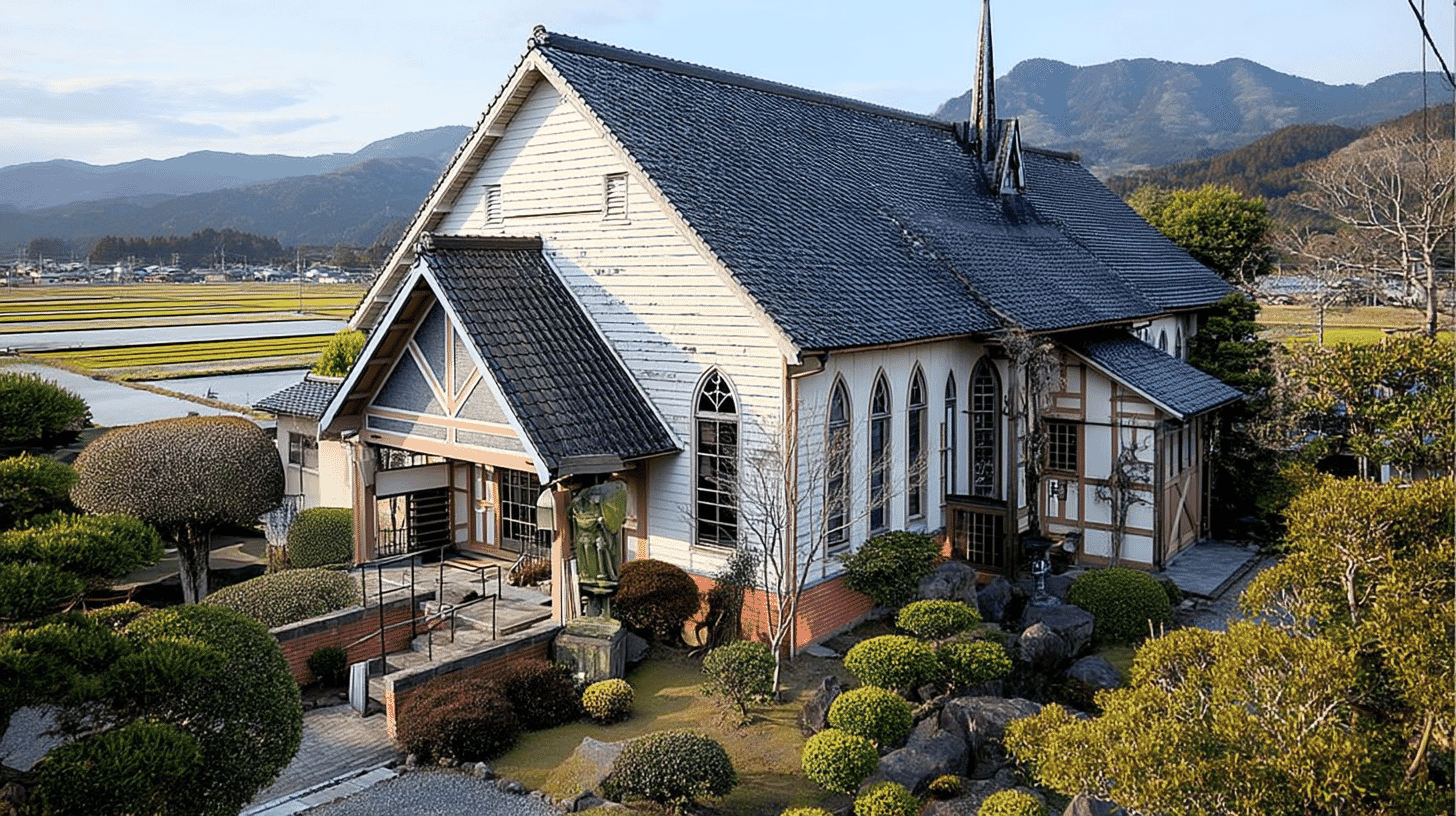
Myodoji Temple Main Hall: Where Gothic Architecture Meets Buddhist Faith
Standing in the quiet town of Yunomae in Kumamoto Prefecture, visitors often do a double-take when they first glimpse Myodoji Temple. With its distinctive pointed arch windows and steep Mansard roof, this building appears more like a European Gothic church than a Japanese Buddhist temple. Yet this remarkable structure is indeed a Jodo Shinshu (Pure Land Buddhism) temple—one of Japan's most unique examples of Western-style religious architecture and a Nationally Registered Tangible Cultural Property.
A Temple Born from Cultural Ambition
Myodoji Temple Main Hall was completed in 1926 (Taisho 15), during an era when Japan was actively absorbing Western influences while maintaining its traditional values. What makes this building particularly special is its origin story: it was designed by Fujioka Shingetsu, the eldest son of the 15th-generation head priest, who had studied at Ryukoku University in Kyoto.
Unlike many Western-style buildings of the Meiji and Taisho eras that were designed by professional architects or foreign advisors, Myodoji Temple represents a uniquely personal vision. Fujioka created this design independently, drawing from his academic knowledge and his desire to establish a "cultural palace" for the local community—a place where Buddhist faith could flourish within an architectural framework that embodied the progressive spirit of the times.
Architectural Features: East Meets West
The main hall's architectural elements create a fascinating dialogue between Japanese Buddhist tradition and European design sensibilities.
The building features a Mansard roof, a style originating in 17th-century French architecture, crowned with traditional Japanese roof tiles. The exterior walls employ "namkin shitami-bari" (weatherboard siding), painted white to create a striking contrast with the dark roof. A half-timbered entrance porch adds another layer of European influence, reminiscent of Tudor architecture.
Perhaps most striking are the pointed arch windows—classic Gothic elements that might seem more at home in a European cathedral. Inside, this Gothic influence continues with a series of pointed arches defining the boundary between the outer and inner sanctuaries, creating a rhythmic visual flow that draws worshippers toward the altar.
The construction employs wooden truss roof framing, a Western engineering technique that allows for the building's impressive 292 square meters of floor space. The foundation uses concrete with brick accents along the base, demonstrating the hybrid construction methods of the era.
Why Myodoji Temple Received Cultural Property Designation
On September 25, 1998, Myodoji Temple Main Hall was registered as a National Tangible Cultural Property. This designation recognizes several key aspects of the building's significance.
First, the temple represents an exceptionally rare example of Western-style religious architecture applied to a Buddhist temple—most "giyofu" (pseudo-Western) buildings of the era were secular structures like schools, government offices, or banks. Second, the building demonstrates remarkable architectural integrity, with each element—from the Mansard roof to the Gothic windows to the truss construction—working harmoniously together rather than appearing as mere decorative additions. Third, the temple documents an important moment in Japanese architectural history when traditional craftsmen and self-taught designers were experimenting with Western forms to express new cultural aspirations.
Highlights and Must-See Features
When visiting Myodoji Temple, take time to appreciate the exterior from different angles. The symmetrical facade presents an almost church-like appearance, yet the proportions and setting remain distinctly Japanese. The pointed arch windows are particularly photogenic, especially when the interior lighting creates a warm glow at dusk.
Inside, the arrangement of the worship space follows traditional Jodo Shinshu conventions despite the Western architectural shell. The progression from entrance to inner sanctuary, marked by those distinctive pointed arches, creates a contemplative journey that serves both aesthetic and spiritual purposes.
The building also maintains its connection to nearby Hasshouji Temple (Amida Hall), a National Important Cultural Property that Myodoji manages. This pairing of the traditional medieval Amida Hall with the modern Western-style main hall offers a compelling visual narrative of Japanese Buddhist architecture across the centuries.
Surrounding Area and Nearby Attractions
Yunomae Town, where Myodoji Temple is located, offers several attractions worth exploring.
The Kuma River Railway terminates at Yunomae Station, itself a Registered Tangible Cultural Property dating from 1924. The charming wooden station building is the only pre-war station structure remaining on the line, making the train journey to Myodoji Temple part of the cultural experience.
The Yunomae Manga Museum celebrates the town's connection to political cartoonist Nasu Ryosuke, featuring his satirical works and hosting annual cartoon competitions. The distinctive building, designed under Kumamoto's Art Polis program, adds another layer of architectural interest to the town.
For nature lovers, the Yokotani Observatory offers panoramic views of the Kuma Basin, especially spectacular during the sea-of-clouds phenomenon in early mornings. The area is also famous for firefly viewing in early summer, when local rice paddies come alive with bioluminescent displays.
Nearby hot springs, including the Yunomae Green Palace resort complex, provide relaxation after sightseeing. The region's acclaimed Kuma Shochu distilleries offer tastings of this distinctive local spirit, made from rice using traditional methods.
- 📍 Plan Your Visit to Kumamoto
- Find tours, activities & transport passes near Myodoji Temple Main Hall
- [ Kumamoto Castle & Mt. Aso Volcano Tours ]
Q&A
- Is Myodoji Temple still an active place of worship?
- Yes, Myodoji Temple remains an active Jodo Shinshu (Hongwanji branch) temple serving the local community. Visitors are welcome, but it is recommended to contact the temple in advance to confirm visiting hours and any ongoing services.
- How can I get to Myodoji Temple?
- The temple is located about 3 minutes by car from Yunomae Station on the Kuma River Railway. The station itself is accessible from Hitoyoshi, which connects to the JR Hisatsu Line. Alternatively, you can drive from the Hitoyoshi Interchange on the Kyushu Expressway, approximately 50 minutes to Yunomae Town.
- Is there an admission fee to visit?
- There is no admission fee to visit the temple grounds and view the exterior. For interior viewing, please contact the temple in advance.
- What is the best time of year to visit?
- The temple can be visited year-round. Spring (late March to April) offers cherry blossoms in the region, while autumn provides colorful foliage. Early summer (June) is ideal for combining a temple visit with firefly viewing in the surrounding rice fields.
- Are there English explanations available at the site?
- English signage at the temple is limited. It is recommended to research the temple's history beforehand or visit with a local guide. The nearby Yu-topia tourist information center at Yunomae Station may be able to provide assistance.
Basic Information
| Name | Myodoji Temple Main Hall (明導寺本堂) |
|---|---|
| Religious Affiliation | Jodo Shinshu Hongwanji-ha (Pure Land Buddhism) |
| Designer | Fujioka Shingetsu (eldest son of the 15th-generation head priest) |
| Year Completed | 1926 (Taisho 15) |
| Construction | Wooden single-story, tile roof, building area 292㎡ |
| Cultural Property Status | Nationally Registered Tangible Cultural Property (registered September 2, 1998) |
| Address | 1955 Kamisato, Yunomae-machi, Kuma-gun, Kumamoto Prefecture 868-0621, Japan |
| Phone | 0966-43-2181 |
| Visiting Hours | Please contact in advance |
| Admission | Free |
| Parking | Available |
| Access | 3 minutes by car from Yunomae Station (Kuma River Railway) |
References
- 明導寺本堂 | 人吉球磨ガイド
- https://hitoyoshikuma-guide.com/2019/03/29/myoudoujihondou/
- 明導寺本堂 | 文化遺産オンライン
- https://bunka.nii.ac.jp/heritages/detail/191809
- 明導寺本堂(みょうどうじほんどう) | 湯前町観光情報サイト ゆのまえかじり
- https://www.town.yunomae.lg.jp/kankou/kiji003923/index.html
- 明導寺本堂(みょうどうじほんどう) | 湯前町観光物産協会 湯〜とぴあ
- https://yunomaenet.com/明導寺本堂みょうどうじほんどう/
- 湯前町 - Wikipedia
- https://ja.wikipedia.org/wiki/湯前町
- くま川鉄道湯前駅本屋 | 文化遺産オンライン
- https://bunka.nii.ac.jp/heritages/detail/211267
Last verified: 2026.01.27
Nearby heritages
- Kumakawa Railway Yumae Station Bookstore
- 1760-3 Kamimakihara, Yunomae-machi, Kuma-gun, Kumamoto Prefecture
- Kumakawa Railway Takahashigawa Bridge
- Kumamoto Prefecture, Kuma District, Yunomae Town, Kamiaraikuchi to Umeki
- Shozen-in Kannon Hall
- Iwano, Minakami Village, Kuma District, Kumamoto Prefecture
- Ota Family Residence (Taragi Town, Kuma District, Kumamoto
- 447-1 Nakanihara, Taragi-cho, Kuma-gun, Kumamoto Prefecture
- Kumakawa Railway Hyakutaro Bridge
- Kumamoto Prefecture, Kuma District, Taragi Town, Oaza Taragi, Aza Shimoakasaka to Oaza Kurohiji, Aza Yamashita
- Hasshoji Temple Amida Hall
- Hasebaba, Yunomae Town, Kuma District, Kumamoto Prefecture
- Myodoji Seven Storied Stone Pagoda (Josenji Seven Storied
- Setoguchi Ward, Yunomae Town, Kuma District, Kumamoto Prefecture
- Myodoji Temple Nine Storied Stone Pagoda (Josenji Temple
- Setoguchi Ward, Yunomae Town, Kuma District, Kumamoto Prefecture
- Myodoji Temple Amida Hall
- Setoguchi Ward, Yunomae Town, Kuma District, Kumamoto Prefecture
- Kumakawa Railway Higashi Taragi Station Waiting Room and
- 41-3 Niharagawa, Kurohiji, Taragi-cho, Kuma-gun, Kumamoto Prefecture