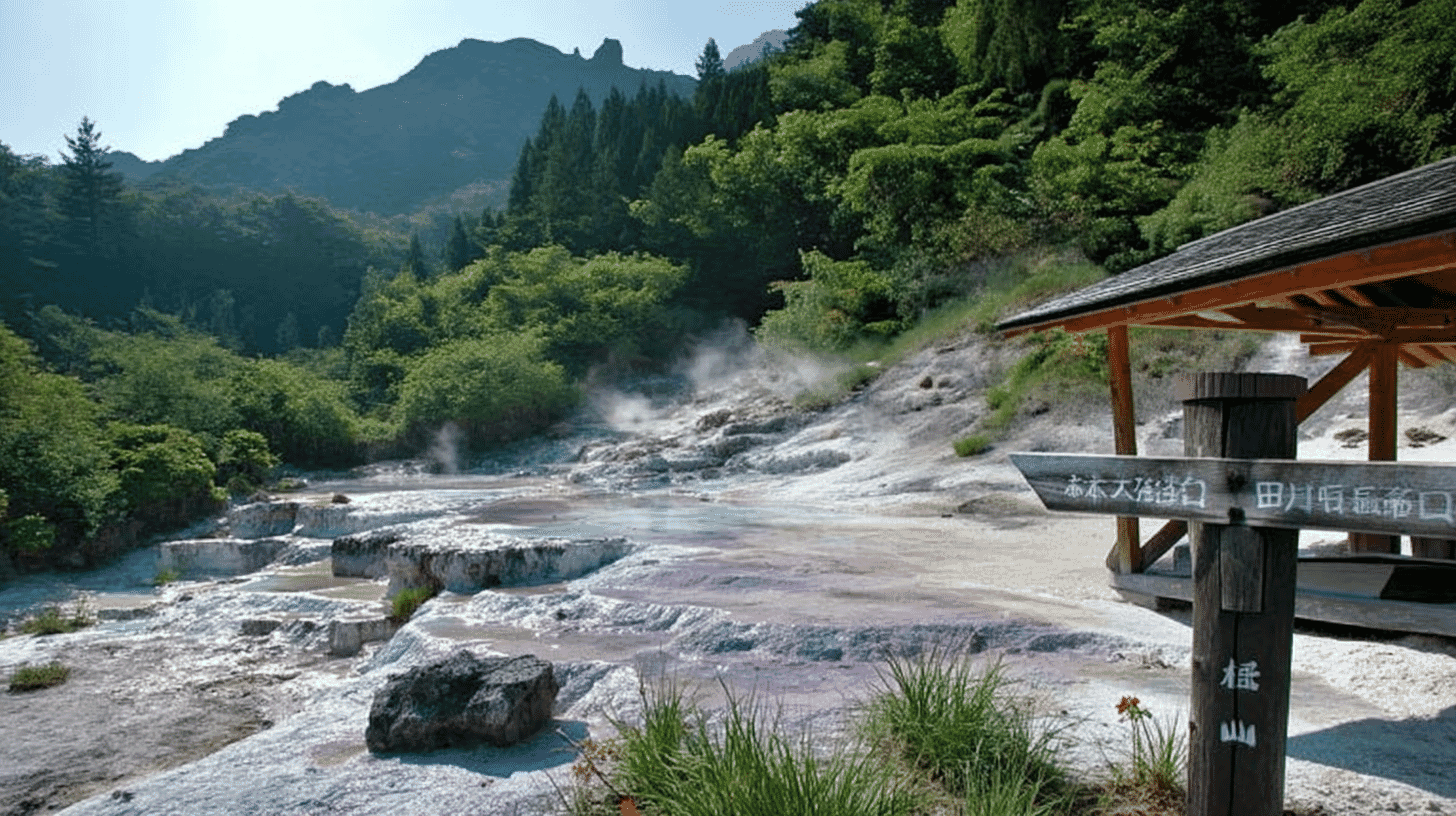
Colloidal Silica and Siliceous Sinter at Nakabusa Onsen: A Living Window into Earth's Ancient Past
Deep in the Japanese Alps of Nagano Prefecture, at an elevation of 1,462 meters, lies a remarkable geological phenomenon that has been designated as a Natural Monument of Japan since 1928. The Colloidal Silica and Siliceous Sinter at Nakabusa Onsen (中房温泉の膠状珪酸および珪華) represents one of the rarest examples in the world where the relationship between microorganisms and mineral precipitation can be observed in real-time, offering visitors a glimpse into processes that shaped Earth billions of years ago.
What is Colloidal Silica and Siliceous Sinter?
The hot springs at Nakabusa Onsen discharge water that reaches temperatures of up to 95°C (203°F), carrying dissolved silica from the underlying granite bedrock. As this mineral-rich water rises to the surface and cools, the silica precipitates out and gradually accumulates to form siliceous sinter—a layered, opaline deposit that can be up to two meters thick in some areas.
What makes Nakabusa truly exceptional is the presence of colloidal silica with a distinctive pale purple coloration. This occurs because heat-loving microorganisms called thermophilic bacteria thrive in the extreme conditions of the hot spring. As silica precipitates, it adheres to these primitive organisms, creating what scientists call a "biomat"—a slimy, gel-like layer that represents one of the oldest forms of life on Earth. The pale purple hue is direct evidence of this microbial activity influencing the mineral deposition process.
Why Was It Designated as a Natural Monument?
On October 4, 1928, this site was officially designated as a Natural Monument of Japan by the Agency for Cultural Affairs. The designation recognized several extraordinary characteristics that distinguish Nakabusa from other hot spring deposits worldwide.
The sinter deposits at Nakabusa cover an impressive area spanning approximately 100-150 meters from east to west and 40 meters from north to south, with the thickest accumulations reaching two meters. Over 30 different hot spring vents contribute to this formation, including notable ones named Shirataki-no-yu, Goza-no-yu, Taki-no-yu, Konabedachi, Mushiyu, Meshimushi-no-yu, Yakushi-no-yu, and the Shōdanjō and Daidanjō vents.
While siliceous sinter formation occurs at volcanic hot springs worldwide—from Yellowstone National Park in the United States to geothermal areas in New Zealand and Iceland—the active deposition of colloidal silica combined with clear evidence of microbial involvement in the precipitation process is exceptionally rare. Scientists consider Nakabusa one of the most important natural laboratories for studying how early Earth's ecosystems may have functioned when thermophilic bacteria dominated the planet billions of years ago.
Scientific Significance: A Portal to Primordial Earth
The thermophilic bacteria found at Nakabusa belong to some of the most ancient lineages of life on Earth. These heat-loving organisms flourished during our planet's early history when conditions were far hotter than today. By studying how these microbes interact with silica precipitation at Nakabusa, scientists gain insights into biosignature formation—the chemical traces that life leaves behind in rock formations.
This research has implications beyond understanding Earth's history. Siliceous hot spring deposits similar to those at Nakabusa have been identified on Mars, making such environments prime targets in the search for evidence of extraterrestrial life. The processes visible at Nakabusa today may help scientists recognize signs of ancient microbial life preserved in Martian rocks.
The Historic Nakabusa Onsen
The Natural Monument exists within the grounds of Nakabusa Onsen, a historic hot spring inn that has operated since 1821 during the Edo period. Originally established to extract alum—a crystallized mineral used in silk production—the site developed into a therapeutic bathing destination that has hosted notable guests including members of the Imperial family and the famous British missionary Walter Weston, who visited in 1912 and later praised the hot spring in his writings.
Today, Nakabusa Onsen is recognized as one of Japan's Top 100 Hot Springs (Nihon Hyakunameitō) and maintains membership in the prestigious Association for Protecting Japan's Secret Hot Springs (Nihon Hitō wo Mamoru Kai). Seven historic buildings on the property are registered as Tangible Cultural Properties of Japan, including the main building (Honkan Kiku), the temperature-controlled pool originally built for summer school programs in the Taishō era, and traditional storehouses.
Experiencing the Natural Monument
Visitors to Nakabusa Onsen can view the siliceous sinter formations as part of the "New Toji Plan" (新湯治プラン), a day-visit experience priced at 3,300 yen for adults and 2,200 yen for children. This package includes access to multiple hot spring baths, a light meal, the opportunity to cook eggs and sausages using geothermal heat (a unique "geothermal cooking" experience), and guided viewing of both the Natural Monument sinter deposits and the Registered Cultural Properties.
For overnight guests, the opportunity to observe these formations becomes even more special. The soft lighting of dawn or dusk highlights the subtle purple coloration of the biomat layers, while steam rising from multiple vents creates an ethereal atmosphere reminiscent of primordial Earth.
The Gateway to the Northern Alps
Beyond its geological treasures, Nakabusa Onsen serves as the primary trailhead for Mt. Tsubakurodake (燕岳, 2,763m), affectionately known as the "Queen of the Northern Alps" for its elegant granite formations and alpine meadows filled with Japanese dianthus flowers. The mountain is part of the famous Omote-Ginza (Front Silver Route) traversing course that leads to Mt. Yarigatake and beyond.
The combination of Natural Monument viewing, historic hot spring bathing, and world-class mountain access makes Nakabusa Onsen a uniquely rewarding destination for travelers seeking authentic Japanese cultural and natural experiences away from crowded tourist routes.
Surrounding Attractions
The Azumino area surrounding the approach to Nakabusa Onsen offers numerous complementary attractions for visitors.
- Daio Wasabi Farm - Japan's largest wasabi farm covering 15 hectares, famous for its picturesque water wheels and crystal-clear spring water. Free admission, approximately 40 minutes from Nakabusa Onsen.
- Hotaka Shrine - The main shrine of the Hotaka Shrine network, dedicated to the deity Hotaka-dake-no-mikoto. Located near JR Hotaka Station.
- Rokuzan Art Museum - A charming museum dedicated to sculptor Ogiwara Morie (pen name Rokuzan), considered the pioneer of modern Japanese sculpture.
- Azumino Winery - Local wineries offering tastings of wines made from grapes grown in the clear air of the Japanese Alps.
- Matsumoto Castle - One of Japan's five original National Treasure castles, approximately one hour from the area, featuring stunning black walls and alpine mountain backdrops.
Best Time to Visit
Nakabusa Onsen is accessible from late April to mid-November when the mountain road is open. Each season offers distinct experiences.
Spring (Late April–May): Fresh green foliage emerges as snow melts from lower elevations. The contrast between lingering snow on alpine peaks and new growth below creates striking scenery.
Summer (June–August): Peak mountaineering season. The trail to Mt. Tsubakurodake bustles with hikers, and the famous Kassengoya mountain hut serves its legendary watermelon to weary climbers.
Autumn (September–October): Perhaps the most spectacular season, when mountain slopes transform into tapestries of crimson, gold, and orange. Early October offers optimal foliage viewing with generally stable weather.
- 📍 Plan Your Visit to Nagano
- Find tours, activities & transport passes near Colloidal Silica and Sinter from Nakabusa Hot Springs
- [ Matsumoto Castle & Kamikochi Hiking Tours ]
Q&A
- Can visitors touch or collect samples of the siliceous sinter?
- No. As a designated Natural Monument of Japan, the sinter formations are strictly protected by law. Visitors may observe the formations from designated viewing areas but must not touch, step on, or remove any material. This protection ensures the continued natural formation processes and preservation for future generations.
- How do I reach Nakabusa Onsen from Tokyo?
- From Tokyo, take the JR Chuo Line limited express "Azusa" to Matsumoto Station (approximately 2.5 hours), then transfer to the JR Oito Line to Hotaka Station (approximately 30 minutes). From Hotaka Station, take the seasonal shuttle bus to Nakabusa Onsen (approximately 55 minutes, fare 1,700 yen). The bus operates from late April to mid-November. Outside this period, the mountain road is closed due to winter snow.
- Is it necessary to stay overnight to see the Natural Monument?
- No, day visitors can view the Natural Monument through the "Yubaranoyu" day-use facility or the New Toji Plan. However, overnight stays allow more time to appreciate the formations at different times of day and enjoy the full range of natural hot spring baths, some of which are exclusively available to overnight guests.
- What is the difference between siliceous sinter and travertine?
- Both are mineral deposits formed at hot springs, but they differ in composition. Siliceous sinter (like that at Nakabusa) is composed primarily of silica (SiO₂) and forms in springs with acidic to neutral pH and temperatures typically above 70°C. Travertine is composed of calcium carbonate (CaCite) and forms in carbonate-rich, alkaline springs. The microorganisms involved in their formation also differ significantly.
- Is the hot spring water safe to drink?
- Yes, Nakabusa Onsen has designated drinking fountains where visitors can sample the mineral-rich spring water. The water is said to have therapeutic properties and is one of the few hot springs in Japan where drinking the source water is encouraged. However, always use designated drinking facilities only.
Basic Information
| Official Name | Colloidal Silica and Siliceous Sinter at Nakabusa Onsen (中房温泉の膠状珪酸および珪華) |
|---|---|
| Designation | National Natural Monument of Japan |
| Designation Date | October 4, 1928 (Shōwa 3) |
| Location | Nakabusa Onsen, 7226 Hotaka Ariake, Azumino City, Nagano Prefecture 399-8301, Japan |
| Elevation | 1,462 meters above sea level |
| Hot Spring Temperature | Up to 95°C (203°F) |
| Sinter Deposit Area | Approximately 100-150m (E-W) × 40m (N-S), up to 2m thick |
| Number of Spring Vents | Over 30 |
| Day-Use Bath (Yubaranoyu) | 9:30–16:00, 950 yen (Closed December–April) |
| New Toji Day Plan | 3,300 yen (adults), 2,200 yen (children), includes Natural Monument viewing |
| Accommodation | From approximately 10,626 yen per person (rates vary by room type and season) |
| Access | Seasonal bus from JR Hotaka Station (approx. 55 min), late April to mid-November |
| Parking | Available (free for day visitors, reservation system for climbers) |
| Official Website | https://nakabusa.com/ |
References
- 中房温泉の膠状珪酸および珪華 - 文化遺産オンライン
- https://bunka.nii.ac.jp/heritages/detail/210170
- 中房温泉 - Wikipedia
- https://ja.wikipedia.org/wiki/中房温泉
- 中房温泉 公式Webサイト
- https://nakabusa.com/
- 天然記念物をつくる温泉 - 信州大学 大塚勉教授
- https://nakabusa.com/pdf/historyandnature_02.pdf
- 中房温泉の観光ガイド - NAVITIME Travel
- https://travel.navitime.com/ja/area/jp/spot/02304-on00045/
- 湯の華(温泉析出物)- 日本温泉協会
- https://www.spa.or.jp/onsen/5315/
- 中房温泉の膠状珪酸および珪華 - 八十二文化財団
- https://www.82bunka.or.jp/bunkazai/detail.php?no=1543
Last verified: 2026.01.14
Nearby heritages
- Nakabusa Onsen Large Hot Spring Pool
- 7226 Hodaka Ariake, Azumino City, Nagano Prefecture, etc.
- Nakabusa Onsen Mountain God Shrine
- 7226 Hodaka Ariake, Azumino City, Nagano Prefecture, etc.
- Nakabusa Onsen Tamura Yakushido
- 7226 Hodaka Ariake, Azumino City, Nagano Prefecture, etc.
- Nakabusa Onsen Former Yukaisho
- 7226 Hodaka Ariake, Azumino City, Nagano Prefecture, etc.
- Nakabusa Onsen Main Building Kiku
- 7226 Hodaka Ariake, Azumino City, Nagano Prefecture, etc.
- Nakabusa Onsen Itakura
- 7226 Hodaka Ariake, Azumino City, Nagano Prefecture, etc.
- Nakabusa Onsen Storehouse
- 7226 Hodaka Ariake, Azumino City, Nagano Prefecture, etc.
- Takase Valley Volcanic Cones and Spherical Limestone
- Omachi City Oaza Taira
- Matsuo-Ji Temple Main Hall
- Hodaka Ariake, Azumino City, Nagano Prefecture
- Araya Community Center
- 1402-1, Hodaka Ariake, Azumino City, Nagano Prefecture, and other locations