
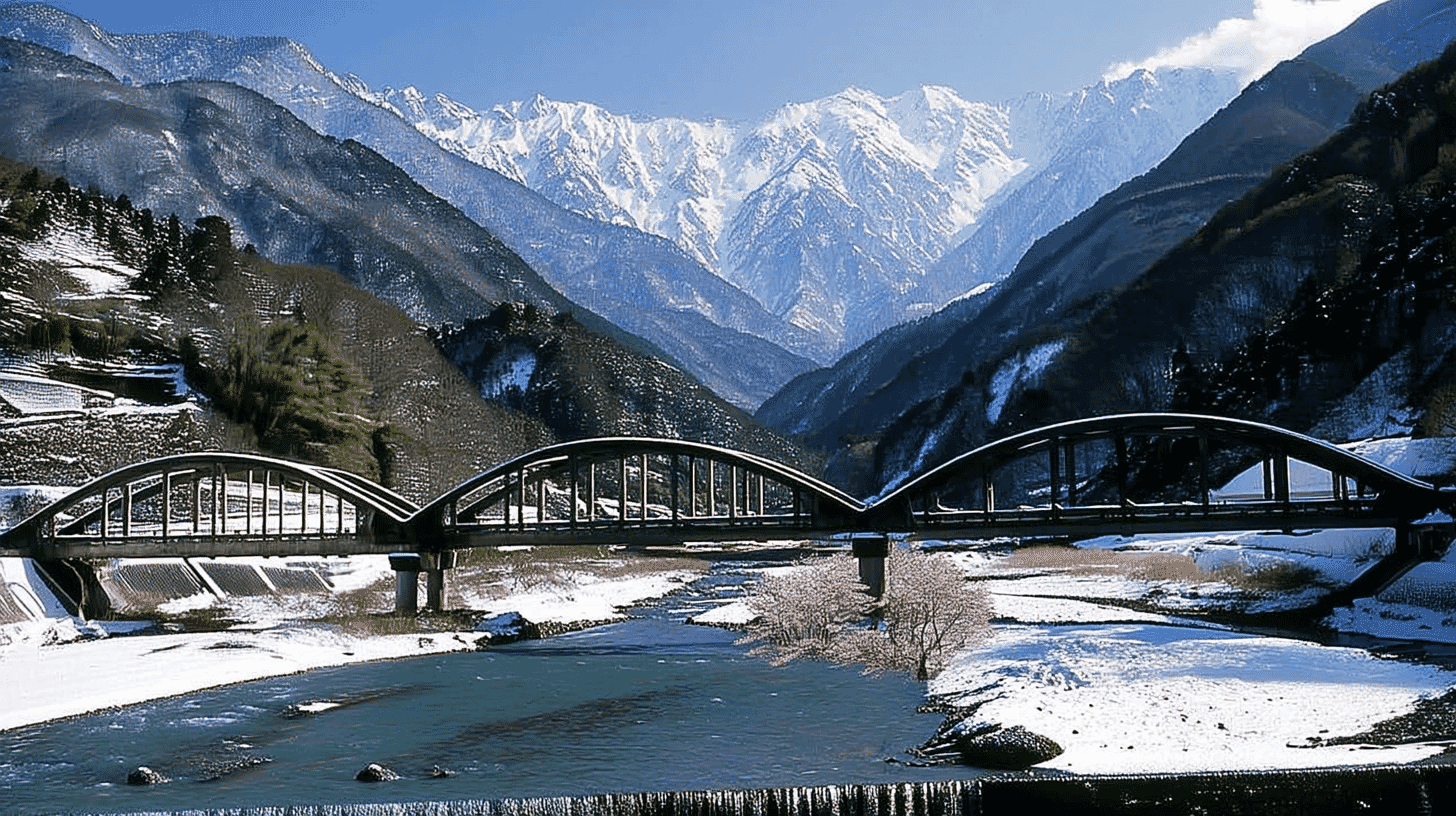
Koshibu Bridge: Where Engineering Excellence Meets Alpine Majesty
Nestled in the heart of Oshika Village in Nagano Prefecture, the Koshibu Bridge (小渋橋) stands as a remarkable testament to mid-20th century Japanese civil engineering. This three-arch reinforced concrete bridge, designated as a Registered Tangible Cultural Property in 2011, offers visitors a unique opportunity to witness the harmonious blend of structural innovation and natural splendor that defines Japan's approach to infrastructure.
What Makes Koshibu Bridge Special
Completed in 1957 during the Showa period, Koshibu Bridge is a prime example of the Lohse girder bridge design—a structural type where both the arch ribs and the stiffening girder share the load-bearing responsibilities. This sophisticated engineering approach was pioneered in Nagano Prefecture by the innovative engineer Takeshi Nakajima, who developed concrete Lohse girder bridges as an alternative to steel structures during a time of material scarcity.
Spanning 106 meters in length with a width of 5.5 meters, the bridge crosses the Koshibu River, a major tributary of the Tenryu River system. The three graceful arches create an elegant silhouette against the backdrop of the Southern Alps, making it one of the most photogenic spots in the region.
Cultural Heritage Significance
The bridge was registered as a National Registered Tangible Cultural Property on October 28, 2011, recognized for its exceptional technical achievement and scenic harmony. Among the many Lohse girder bridges constructed in Nagano Prefecture during the 1950s and 1960s, Koshibu Bridge stands out for its high level of completion in both engineering technique and landscape integration.
Nagano Prefecture boasts the highest concentration of concrete Lohse girder bridges in Japan, with approximately 30 examples—a legacy directly traceable to engineer Nakajima's pioneering work in the region during the 1930s. These bridges represent an important chapter in Japan's civil engineering history, demonstrating how local engineers adapted European structural concepts using locally available materials.
Highlights and Best Viewing Spots
The most celebrated view of Koshibu Bridge can be enjoyed from Onishi Park (大西公園), located in the center of Oshika Village. From this vantage point, photographers and visitors alike can capture the stunning collaboration between the bridge's elegant curves and the majestic Mount Akaishi (3,121m) rising in the background. This iconic view has become a symbol of the village and draws visitors throughout the year.
The best times to visit are during spring when cherry blossoms frame the bridge, and autumn when the surrounding mountains blaze with colorful foliage. Winter offers dramatic views of snow-capped peaks reflected in the clear waters below.
Exploring Oshika Village
Oshika Village itself is a treasure trove of cultural and natural attractions. Designated as one of "The Most Beautiful Villages in Japan," this remote mountain community offers visitors an authentic glimpse into traditional rural Japanese life. Key attractions include:
- Oshika Kabuki: A traditional village kabuki performance designated as a National Important Intangible Cultural Property—the first such designation for regional kabuki in Japan. Performances are held twice yearly in spring (May 3) and autumn (third Sunday of October).
- Median Tectonic Line Museum: An educational facility located directly on Japan's largest fault line, featuring geological specimens and interactive exhibits about the region's dramatic tectonic history.
- Kashio Onsen: A remarkable hot spring resort featuring naturally occurring salt water—a geological mystery in this landlocked mountain region.
- Matsushita House: A Important Cultural Property residence dating from 1820, offering insight into traditional mountain village architecture.
The Koshibu River: A Geological Wonder
The Koshibu River that flows beneath the bridge originates near the summit of Mount Akaishi in the Southern Alps. With an elevation drop of 2,000 meters from source to confluence with the Tenryu River, it is known as one of the most dynamic waterways in the region. The river's watershed crosses the Median Tectonic Line, Japan's largest fault system, making this area of tremendous geological significance.
Downstream, the Koshibu Dam—the first arch-type dam in the Tenryu River system—creates Lake Koshibu, adding another dimension to the scenic beauty of the area.
Access Information
Oshika Village's remote location contributes to its unspoiled charm but requires some planning to reach. The village has no train stations, with the nearest being Ina-Oshima Station on the JR Iida Line.
- By Public Transport: From Ina-Oshima Station, take the Ina Bus bound for Oshika (approximately 60 minutes). Alight at Shogakko-mae or Okawara bus stop, then walk about 7 minutes.
- By Car: From Matsukawa IC on the Chuo Expressway, take Route 59 (Matsukawa Inter Oshika Line) for approximately 40 minutes.
Note: Route 152 through Jizo Pass is closed during winter (mid-December to early April). Always check road conditions before traveling.
Planning Your Visit
A visit to Koshibu Bridge pairs wonderfully with exploring the broader attractions of Oshika Village and the South Alps region. Consider combining your bridge viewing with:
- A relaxing stay at one of the traditional ryokan inns in Kashio Onsen
- Hiking in the South Alps (summer months)
- Attending a Kabuki performance (May 3 or October)
- Visiting the Michi-no-Eki "Kabuki no Sato Oshika" roadside station for local specialties
- 📍 Plan Your Visit to Nagano
- Find tours, activities & transport passes near Kojibashi Bridge
- [ Matsumoto Castle & Kamikochi Hiking Tours ]
Q&A
- Why was Koshibu Bridge designated as a cultural property?
- Koshibu Bridge was registered as a Tangible Cultural Property in 2011 due to its exceptional technical achievement as a Lohse girder bridge and its remarkable integration with the surrounding Southern Alps landscape. Among similar bridges in Nagano Prefecture, it demonstrates the highest level of completion in both engineering and scenic harmony.
- What is the best season to visit Koshibu Bridge?
- Each season offers unique beauty. Spring (late April to early May) features cherry blossoms and peach blossoms. Summer provides lush greenery and clear alpine views. Autumn (October to November) brings spectacular fall colors. Winter offers dramatic views of snow-capped Mount Akaishi, though access may be limited due to road closures.
- Can I walk across Koshibu Bridge?
- Yes, Koshibu Bridge remains an active roadway and can be crossed on foot. However, please exercise caution as vehicles also use the bridge. The 5.5-meter width accommodates both vehicular and pedestrian traffic.
- What is a Lohse girder bridge?
- A Lohse girder bridge (ローゼ桁橋) is a type of arch bridge where both the curved arch ribs and the horizontal stiffening girder share the structural load. Named after German engineer Hermann Lohse (1815-1893), this design creates an elegant appearance while efficiently distributing forces. Nagano Prefecture has the highest concentration of concrete Lohse girder bridges in Japan.
- Are there other cultural properties near Koshibu Bridge?
- Yes, Oshika Village is rich in cultural heritage. Nearby sites include the Matsushita House (Important Cultural Property, built 1820), Fukutoku-ji Temple (dating to the Kamakura period), and Oshika Kabuki (National Important Intangible Cultural Property). The village is also home to the Median Tectonic Line Museum.
Basic Information
| Name | Koshibu Bridge (小渋橋 / Koshibu-bashi) |
|---|---|
| Location | Okawara 4760-1, Oshika Village, Shimoina District, Nagano Prefecture |
| Structure Type | Deck-type reinforced concrete three-arch Lohse girder bridge |
| Length | 106 meters |
| Width | 5.5 meters |
| Completion | 1957 (Showa 32) |
| Constructor | Nagano Prefecture |
| Cultural Property Status | National Registered Tangible Cultural Property (Registered October 28, 2011) |
| Owner | Oshika Village |
| River | Koshibu River (Tenryu River system) |
| Access | 60 minutes by bus from JR Ina-Oshima Station; 40 minutes by car from Matsukawa IC |
References
- Koshibu Bridge - Cultural Heritage Online (Agency for Cultural Affairs)
- https://bunka.nii.ac.jp/heritages/detail/174457
- Oshika Village Official Tourism Page
- http://www.vill.ooshika.nagano.jp/category/culture/sights/
- Oshika Village - The Most Beautiful Villages in Japan
- https://utsukushii-mura.jp/map/ooshika/
- Median Tectonic Line Museum - Access Information
- https://mtl-muse.com/info/access/access/
- RC Lohse Girder Bridges Designed by Takeshi Nakajima - JSCE Civil Engineering Heritage
- https://committees.jsce.or.jp/heritage/node/226
- Koshibu River - Wikipedia (Japanese)
- https://ja.wikipedia.org/wiki/小渋川
- Oshika Village Tourism Association - Access
- https://ooshika-kanko.com/access/
Last verified: 2026.01.14