
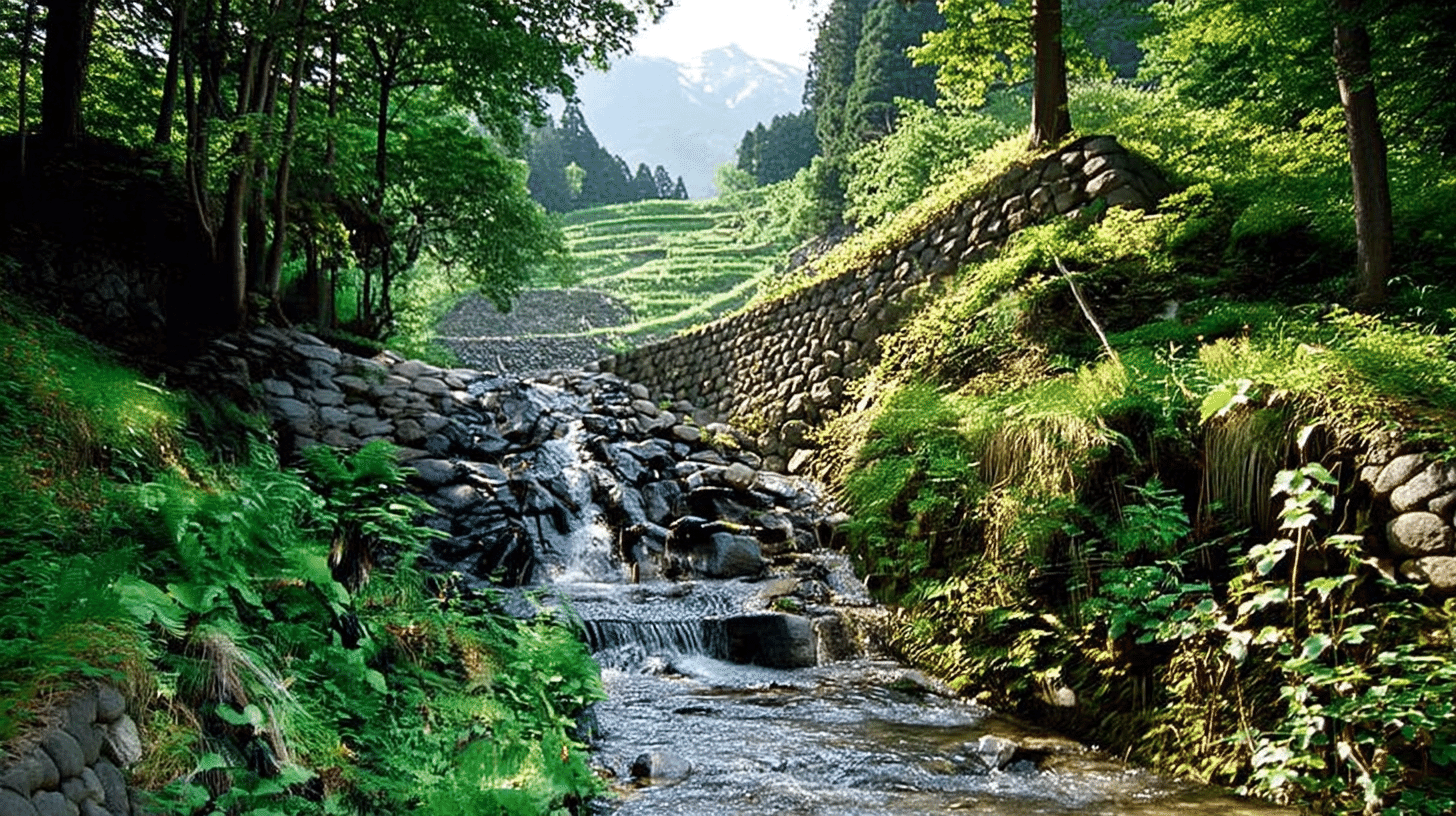
One Set of Waterway Works, a Registered Tangible Cultural Property since 2009
Yakushizawa Stone-Lined Waterway Works (薬師沢石張水路工, Yakushizawa Ishibari Suirokou) lie at Inaoka, Ogawa Village, Kamiminochi District, Nagano Prefecture, a Meiji-period structure entered on the register of tangible cultural properties on 8 January 2009. It is a registered property rather than a designated one.
The quantity is given as one place, not as a building or a unit but as a site.
The structure is stone waterway works with a total length of 38 metres. The date field reads Meiji, the year about 1886, with repairs in 1933 and 1954.
A Date Field Carrying Both Building and Two Repairs
Not only when it was made, but when it was mended, is set down.
The field reads Meiji, about 1886, repaired 1933 and 1954.
Built around 1886, it was worked on twice more, in 1933 and again in 1954. Two repair years stand together.
At the former Takahashi main house, dismantling repair returning the building to its finished state was written in the commentary. Its date field gives only the year of building.
At the Manpukuji main hall, the present covering was written into the structural field. That concerns material.
Here the date field itself carries the making and the mending. Being a work of engineering, it has been kept in use by being repaired, and the dates say so.
Thirty-Eight Metres Set Within About 350
The length registered and the distance the works cover are not the same.
The structural field gives a total length of 38 metres.
The commentary states that within about 350 metres, 3 dry stone structures and 1 mortared stone weir are set in sequence to ease the fall of the stream bed.
Four structures stand along 350 metres of the gully, and their stonework together comes to 38 metres. Between them is the natural bed.
The Kaei bridge at Nishinomiya is 6.0 metres long and the Wakato Bridge 627.3 metres. Those are the lengths of single structures.
Here the figure is the sum of 4 that stand apart. That the quantity is given as a place rather than a count follows from this.
Two Ways of Laying the Stone
Within one gully, the stone is laid in two manners.
The commentary gives 3 dry stone structures and 1 mortared stone weir.
Dry stone is laid without mortar, the stones holding by their own weight and fit; mortared stone has its joints packed and set.
Three are dry and 1 is mortared. It is the weir that takes the mortared work.
The Furukawa storehouse stands on a base of dressed stone. That is the footing of a building.
Here the structures themselves are of laid stone, and the manner of laying follows the purpose. The village records stones of 30 centimetres to 1 metre across, piled by hand.
Visiting
The works lie at Inaoka, Ogawa Village, Kamiminochi District, Nagano Prefecture, owned by the prefecture.
The Agency closes that they are flood-control works built in a district prone to landslide, close to a major tectonic line.
By the village's account, the stone-lined channels run to 28 structures across 4 gullies, with a total length of 221 metres. These works are the part in one of those gullies.
Three more sets of such works in the same village are registered as well.
The village records that local people keep them in good order and that they still serve to hold back the soil. A walking path runs beside the channel, closed in winter. Check before travelling.
Q&A
- When were the works registered?
- On 8 January 2009, as a registered tangible cultural property. They are registered rather than designated, and the quantity is given as one place.
- When were they built?
- The date field reads about 1886, with repairs in 1933 and 1954. Two repair years stand alongside the year of building.
- How long are they?
- A total length of 38 metres. The Agency notes that the 4 structures are set within about 350 metres, so the stonework is spread along the gully.
- What are they for?
- The Agency calls them flood-control works built in a district prone to landslide, made to protect the terraced fields and settlement around them.
- Are they still in use?
- The village records that local people keep them in good order and that they still serve their purpose.
Basic Information
| Name | Yakushizawa Stone-Lined Waterway Works (薬師沢石張水路工, Yakushizawa Ishibari Suirokou) |
|---|---|
| Location | Inaoka, Ogawa Village, Kamiminochi District, Nagano Prefecture |
| Designation | Registered tangible cultural property (structure, modern other); registered rather than designated; 3 more sets of such works in the same village are registered |
| Year Designated | 2009 (8 January), registered |
| Quantity | One place, counted as a site rather than as buildings or units |
| Dimensions | Stone waterway works, total length 38 metres. Built in a side gully of a river in the Shinano system, with 3 dry stone structures and 1 mortared stone weir set in sequence within about 350 metres to ease the fall of the stream bed. The date field reads Meiji, the year about 1886, with repairs in 1933 and 1954 |
| Owner | Nagano Prefecture |
| Public Access | A walking path runs beside the channel, closed in winter |
References
- Cultural Heritage Online: the Yakushizawa waterway works
- https://bunka.nii.ac.jp/heritages/detail/154095
- Ogawa Village: the Yakushizawa waterway works
- https://www.vill.ogawa.nagano.jp/kankou/docs/6606.html
- Agency for Cultural Affairs, National Cultural Properties Database
- https://kunishitei.bunka.go.jp/
- Nagano Prefecture: cultural properties
- https://www.pref.nagano.lg.jp/
Last verified: 2026.09.13