
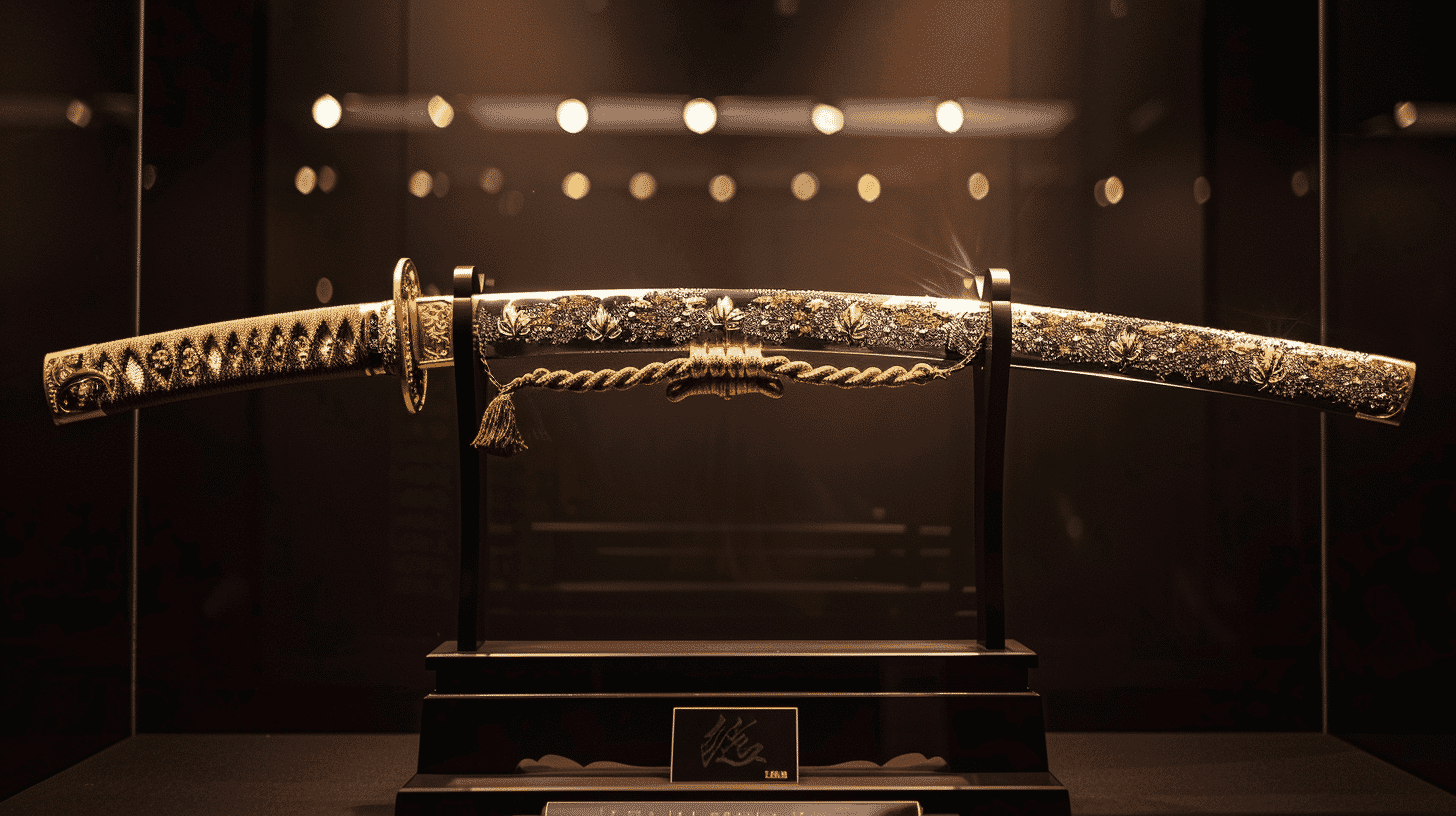
One Sword, National Treasure since 1956
Tachi Sword with Hyogo Chain Mounting and Wood-Sorrel Design on Dense Gold Ground (沃懸地酢漿紋兵庫鎖太刀, Ikakeji Katabami-mon Hyogogusari Tachi), the blade unsigned, is a Kamakura-period craft object owned by Kasuga Taisha in Nara Prefecture, made an Important Cultural Property on 28 June 1956 and designated a National Treasure on that same day of 1956. The quantity is one sword and the designation number 00192.
Both steps fall on one date, the third such case here after the Tenjukoku embroidery and the companion sword.
It measures 98.2 centimetres overall, with a scabbard of 79.1 centimetres and a hilt of 21.0 centimetres. The address field in the Agency's database is blank, the eleventh such case.
The Paired Swords Are Described in Different Ways
Kasuga Taisha holds a closely similar sword.
That one carries designation number 00193 and this one 00192. Both became Important Cultural Properties and National Treasures on 28 June 1956.
Their commentaries differ in kind. The one for 00193 calls it much the same as this sword and then lists only the differences. It has no description of its own.
The commentary here stands alone. It opens on the sword's own construction: a Hyogo chain sword of a type in favour during the Kamakura period, with three chains gathered and fixed to the hanger fittings.
Sofukuji Daiyuhoden and the temple's first gate shared one commentary between them, on equal terms.
Here one sword stands on its own and the other leans on it. Between a pair, the standing of the two accounts differs.
The Fittings Are Complete and the Cord Largely Survives
What survives is stated plainly.
Besides being older and finer than others of its kind, the record says, the mounting has its fittings complete, and the main part of the hanging cord remains as it was.
Complete: every fitting is still there.
Of the companion sword, 00193, the quail-grain hanging cord is recorded as fragmentary. Here the main part remains.
With the rhinoceros-horn knife, the scabbard was lost and only the rivets survived. With the Mikazuki Munechika, an appended scabbard had lost its hilt.
Here the reverse: completeness forms part of the assessment. Age and quality are joined by the fact that nothing is missing.
A Dropped Character and an Inconsistent Spelling
Two lapses appear in the commentary.
The first comes where the text turns to the remaining fittings, which it calls sumptuous, of gilt silver.
The phrase meaning the rest is written with one of its two characters missing. A dropped character appears here for the first time.
The second concerns the hanging cord. This record writes it one way and the record for 00193 another, the first character differing.
Both refer to the cord by which the sword is worn, and the characters are not the same. With the Tsurugaoka inkstone box, one record spelled the term for a silver rim two ways.
Here the disagreement falls between two records. This article treats both as the same term.
Seeing It
The sword belongs to Kasuga Taisha. The field for prefecture gives Nara and the address field is blank.
The chain is described: three chains are gathered and fixed to the hanger fittings, three strands bound together.
At the centre of the chain's face sits a silver fitting with the wood-sorrel design cut through it. Wood sorrel is a small plant, its leaves and flowers used as a pattern.
The scabbard carries the design on a gold ground, three pairs in three groups. On 00193 the same design is rendered in flat inlay; here it is the pattern itself. The presence of the term for flat inlay in the other title marks that difference.
It is a shrine holding, not kept on permanent display. Exhibition plans can change, so check before travelling.
Q&A
- When was the sword designated?
- It became an Important Cultural Property on 28 June 1956 and a National Treasure on the same day, the third such case met here.
- How does it differ from the companion sword?
- Their commentaries differ in kind. The companion's commentary lists only how it differs from this sword, while this one is written independently, from the sword's own construction.
- How much survives?
- The Agency records that the mounting has its fittings complete and that the main part of the hanging cord remains as it was. The companion sword's cord is recorded as fragmentary.
- Are there errors in the record?
- The phrase meaning the rest is written with one character missing, and the term for the hanging cord is written differently here and in the companion sword's record.
- How is it made?
- Three chains are gathered and fixed to the hanger fittings, with a silver fitting cut through with the wood-sorrel design at the centre of the chain. The scabbard carries the design on a gold ground.
Basic Information
| Name | Tachi Sword with Hyogo Chain Mounting and Wood-Sorrel Design on Dense Gold Ground (沃懸地酢漿紋兵庫鎖太刀), the blade unsigned; a companion sword at the same shrine is also a National Treasure |
|---|---|
| Location | The field for prefecture gives Nara; the address field is blank and the owner is given as Kasuga Taisha |
| Designation | National Treasure (craft), designation no. 00192; the earlier listing and the designation fall on one date |
| Year Designated | 1956 (28 June), Important Cultural Property and National Treasure |
| Quantity | 1 sword |
| Dimensions | 98.2 centimetres overall, with a scabbard of 79.1 centimetres and a hilt of 21.0 centimetres. The hilt is covered in white ray skin with a gilt silver rim; the scabbard carries the wood-sorrel design on a gold ground, 3 pairs in 3 groups. Three chains are gathered and fixed to the hanger fittings, with a pierced silver fitting at the centre. The period is Kamakura |
| Owner | Kasuga Taisha |
| Public Access | A shrine holding, not on permanent display |
References
- Agency for Cultural Affairs database: this sword
- https://kunishitei.bunka.go.jp/heritage/detail/201/483
- Agency for Cultural Affairs database: the companion sword
- https://kunishitei.bunka.go.jp/heritage/detail/201/484
- Kasuga Taisha: the treasure hall
- https://www.kasugataisha.or.jp/museum/
- Kasuga Taisha official site
- https://www.kasugataisha.or.jp/
Last verified: 2026.09.06