Himeshima Obsidian Quarries: A 20,000-Year Journey Through Japan's Prehistoric Trade Network
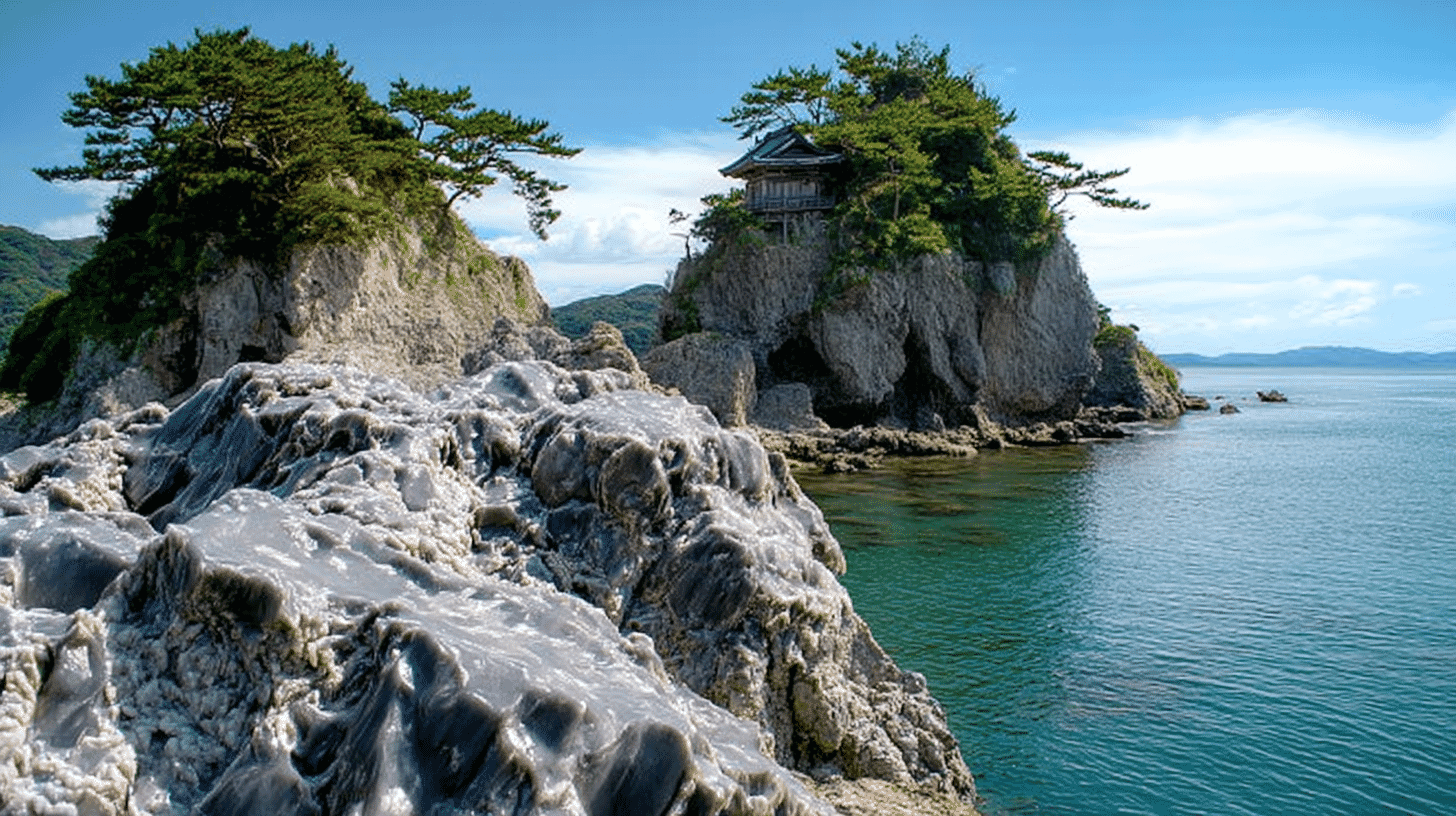
Rising dramatically from the turquoise waters of the Seto Inland Sea, the obsidian cliffs of Himeshima Island present one of Japan's most remarkable natural and archaeological treasures. Unlike the jet-black obsidian found elsewhere in the world, Himeshima's volcanic glass shimmers in ethereal shades of milky white and soft gray—a geological signature so distinctive that archaeologists can trace stone tools made from this material across an astonishing network spanning from Tanegashima Island in Kagoshima to Osaka, over 600 kilometers away.
What Is the Himeshima Obsidian Quarries?
The Himeshima Obsidian Quarries (姫島の黒曜石産地) refers to the exposed obsidian deposits located at Kannonzaki Cape on the northwestern coast of Himeshima Island in Oita Prefecture. Here, a spectacular cliff of volcanic glass rises 40 meters above the sea and extends 120 meters along the coastline, with deposits continuing beneath the water's surface. The site was designated as a National Natural Monument of Japan in 2007, recognizing both its geological significance and its crucial role in understanding prehistoric human activity in Japan.
Obsidian is a naturally occurring volcanic glass formed when lava rich in silica cools rapidly, preventing crystal formation. The resulting material is extremely hard and fractures into razor-sharp edges, making it ideal for crafting cutting tools. While most obsidian worldwide appears black, Himeshima's deposits display a characteristic milky white to grayish coloration with delicate speckles—a result of the unique cooling conditions and mineral composition of the Shiroyama Volcano that created them approximately 300,000 years ago.
Why Was It Designated a Natural Monument?
The Himeshima Obsidian Quarries received National Natural Monument status for several compelling reasons that highlight its dual importance in geology and archaeology.
From a geological perspective, the site offers an exceptionally rare opportunity to observe obsidian in its natural state. While Japan has approximately 60 obsidian sources, only a handful—including Hokkaido's Shirataki and Nagano's Kirigamine—allow visitors to see the volcanic glass exposed at the surface. Himeshima's coastal location creates an even more unique situation: the obsidian cliffs meet the sea, where waves continuously polish the volcanic glass, creating a landscape unlike any other in Japan.
The archaeological significance is equally profound. Himeshima was the sole obsidian source in the entire Seto Inland Sea region, making it a critical resource hub for prehistoric peoples. Stone tools crafted from Himeshima's distinctive gray obsidian have been discovered at archaeological sites throughout western Japan, from Shimane and Okayama Prefectures in the Chugoku region to Ehime and Kochi in Shikoku, and even as far south as Tanegashima Island in Kagoshima Prefecture. This distribution reveals a sophisticated maritime trade network that existed for over 20,000 years, from the Late Paleolithic period through the Yayoi era.
The distinctive coloration of Himeshima obsidian—so different from the typical black variety—allows archaeologists to easily identify its origin without chemical analysis, providing invaluable data about prehistoric exchange patterns and human mobility across ancient Japan.
The Volcanic Origins: Himeshima's Fiery Birth
Himeshima Island itself is a testament to volcanic forces. The island is actually a cluster of seven volcanoes that emerged from the sea approximately 300,000 years ago, creating a landscape that the Japanese Geopark Network recognized in 2013 as the Oita Himeshima Geopark.
The obsidian deposits are associated with the Shiroyama Volcano, which produced rhyolite lava rich in silica. When this viscous magma erupted and came into contact with seawater, it cooled rapidly under high pressure, preventing crystal formation and creating the glassy obsidian. The presence of garnet crystals within the obsidian—tiny red inclusions visible under magnification—adds another layer of geological interest, as garnets in obsidian are relatively uncommon.
Most of the Shiroyama lava cooled more slowly, becoming the pumice-like white rock that characterizes much of the Kannonzaki area. But where conditions were just right—particularly around the volcanic crater rim that now forms Kannonzaki Bay—the rapid cooling produced the obsidian that would become so valuable to ancient peoples.
Highlights and Attractions
A visit to the Himeshima Obsidian Quarries offers multiple layers of experience, from geological wonder to spiritual contemplation and scenic beauty.
The obsidian cliffs themselves are the main attraction, accessible via a walking path from the island's main road. As you approach Kannonzaki Cape, the cliffs gradually reveal themselves—walls of milky volcanic glass catching the light, with darker veins of pure obsidian running through the paler matrix. The transition from white pumice-like rock to glassy obsidian is gradual, allowing visitors to observe the geological processes that created these deposits.
Perched atop the obsidian cliffs sits Sennindo (千人堂), the "Hall of a Thousand People," one of the famous Seven Wonders of Himeshima. This tiny temple enshrines a golden statue of Bato Kannon (Horse-headed Kannon) and carries a charming legend: on New Year's Eve, it can shelter a thousand good people fleeing from debt collectors. The small wooden structure, weathered by sea winds, creates an evocative silhouette against the sunset sky.
The sunset views from Kannonzaki are considered the finest on the island. As the sun descends toward the Suo-nada Sea, the obsidian cliffs take on warm golden hues, and the silhouettes of distant Kyushu, Honshu, and Shikoku become visible on the horizon. Local fishermen have traditionally used Sennindo as a landmark for navigation, a practice connecting modern mariners with their prehistoric predecessors who surely also recognized this distinctive cape.
Below the cliffs, several sea caves have formed where waves have eroded softer rock. During the geo-cruise boat tours offered by the island's tourism association, visitors can observe these caves from the water, gaining a unique perspective on the obsidian deposits that extend below sea level.
The Seven Wonders of Himeshima
Sennindo is just one of the island's Seven Wonders (姫島七不思議), a collection of mysterious sites connected to local legends. These include Hyoshimizu, a naturally carbonated mineral spring said to have appeared when a legendary princess clapped her hands to summon water; the Amida Oysters, which grow in a sea cave in formations resembling Buddhist trinity statues; and Ukisu, a small reef whose torii gate supposedly never becomes submerged even during the highest storms. Exploring these sites offers a delightful framework for discovering the island's varied landscapes.
Practical Information for Visitors
Himeshima Island is accessible by ferry from Imi Port in Kunisaki City, Oita Prefecture. The journey takes approximately 20 minutes, with ferries departing roughly every 70-90 minutes throughout the day. The fare is around 570 yen for adults one way. Note that ferry reservations are not accepted—boarding is on a first-come, first-served basis.
The island measures only 7 kilometers from east to west, making it ideal for exploration by bicycle. Rental cycles are available near the ferry terminal, allowing visitors to cover all major attractions in a leisurely half-day. The obsidian site at Kannonzaki is located on the island's northwestern coast, approximately 4 kilometers from the ferry terminal.
Important: Collection of obsidian is strictly prohibited. The site is protected as a Natural Monument, and removing any material carries legal penalties. Please appreciate the obsidian only through observation and photography.
Best Times to Visit
Himeshima offers distinct attractions throughout the year. Late April through early June brings the migration of Asagi Madara butterflies, creating ethereal scenes as thousands of these chestnut tigers pause on the island during their journey north. The famous Himeshima Bon Odori festival takes place August 14-17, featuring the enchanting Kitsune Odori (Fox Dance), while the autumn Kuruma-ebi (tiger prawn) season from August through October offers culinary delights that have made the island famous across Japan.
For the obsidian site specifically, clear days offer the best visibility of the cliff formations, and afternoon visits allow you to experience the legendary Kannonzaki sunset. Winter visits, while quieter, offer excellent visibility and fewer crowds.
Surrounding Area
Himeshima is part of the broader Kunisaki Peninsula region, rich in cultural and natural heritage. The peninsula is famous for the Rokugo Manzan temple circuit, a collection of historic Buddhist temples carved into its volcanic peaks. Usa Jingu, one of Japan's most important Shinto shrines, lies within easy reach on the mainland. The Oita Prefectural History Museum in Usa City displays Himeshima obsidian artifacts, providing context for understanding the prehistoric significance of what you've seen on the island.
The nearby onsen (hot spring) towns of Beppu and Yufuin offer relaxation opportunities, while the broader Kunisaki Peninsula contains numerous archaeological sites where Himeshima obsidian tools have been discovered, creating opportunities for a themed journey tracing prehistoric trade routes.
- 📍 Plan Your Visit to Oita
- Find tours, activities & transport passes near Obsidian Production Area of Himeshima
- [ Beppu Hell Tour & Yufuin Onsen Hot Springs ]
Q&A
- Why is Himeshima obsidian white instead of black?
- The milky white to gray coloration results from the specific chemical composition of the Shiroyama Volcano's magma and the unique cooling conditions when lava met seawater. Microscopic gas bubbles and the degree of crystallization create this distinctive appearance. The obsidian also contains tiny garnet crystals, visible under magnification, which add to its unique character.
- Can I take obsidian samples as souvenirs?
- No. Collection of obsidian or any natural materials from the site is strictly prohibited. The Himeshima Obsidian Quarries is a protected National Natural Monument, and removing materials carries legal penalties. Please enjoy the site through observation and photography only.
- Is there an entrance fee to see the obsidian cliffs?
- No, the site is freely accessible. However, you will need to pay for the ferry to reach Himeshima Island (approximately 570 yen one way for adults from Imi Port).
- How long should I plan for visiting the obsidian site?
- The obsidian cliffs and Sennindo temple can be explored in about 30-60 minutes. However, we recommend spending a full half-day on Himeshima to also experience other attractions like the Seven Wonders, enjoy local seafood, and catch the famous Kannonzaki sunset.
- Where can I see Himeshima obsidian artifacts?
- Artifacts made from Himeshima obsidian are displayed at the Himeshima Village离島Center "Yahazu," the Oita Prefectural History Museum in Usa City, and the Oita City Historical Museum. These exhibits help visitors understand how prehistoric peoples used this valuable material.
Basic Information
| Official Name | Himeshima Obsidian Quarries (姫島の黒曜石産地) |
|---|---|
| Designation | National Natural Monument of Japan (designated July 26, 2007) |
| Location | Kannonzaki, Himeshima Village, Higashikunisaki District, Oita Prefecture |
| Geological Age | Approximately 300,000 years old (Late Pleistocene) |
| Cliff Dimensions | Height: approximately 40 meters; Width: approximately 120 meters |
| Access | 20 minutes by ferry from Imi Port (Kunisaki City) to Himeshima Port, then 4 km by bicycle or vehicle to Kannonzaki |
| Ferry Fare | Adults: approximately 570 yen (one way) |
| Related Recognition | Oita Himeshima Geopark (Japanese Geopark, certified 2013); "Oita Prefecture Stone" designation by Geological Society of Japan (2016) |
References
- Cultural Heritage Online - Himeshima Obsidian Quarries
- https://bunka.nii.ac.jp/heritages/detail/192762
- Himeshima Village Official Website - Natural Monuments
- https://www.himeshima.jp/kankou/spot/tennenkinenbutsu/
- Oita Himeshima Geopark Official Website
- https://www.himeshima.jp/geopark/english/
- Himeshima Village Official Website - Transportation Access
- https://www.himeshima.jp/access/
- Oita Heritage - Himeshima Obsidian Quarries
- http://oitaisan.com/heritage/姫島の黒曜石産地/
- Wikipedia - Himeshima Obsidian Quarries (Japanese)
- https://ja.wikipedia.org/wiki/姫島の黒曜石産地
Last verified: 2026.01.14
Nearby heritages
- Seaside Village Scenery of Himeshima Island in the Seto
- Himeshima Village, Higashikunisaki District, Oita Prefecture
- Kunimi Furusato Exhibition Hall Rest Area (Former Arinaga
- 536 Kibe, Kunisaki City, Oita Prefecture
- Kunimi Furusato Exhibition Hall (former Arinaga Residence)
- 536 Kibe, Kunisaki City, Oita Prefecture
- Kunimi Hometown Museum (former Main House of the Arinaga
- 536 Kibe, Kunisaki City, Oita Prefecture
- Kunimi Furusato Exhibition Hall Training Center (Former
- 536 Kibe, Kunisaki City, Oita Prefecture
- Kamezuka Tomb
- Oita City Oaza Sato
- Onizuka Tomb
- Kunisaki City
- Shigemitsu Family Main Building
- 1911 Mukouda, Kunisaki City, Oita Prefecture
- Iwatoji Temple Pagoda
- Iwatoji Temple, Kunisaki Town, Kunisaki City, Oita Prefecture
- Nagaki Family Treasure Pagoda
- 3037 Higashikatarai, Kunisaki-cho, Higashikunisaki City, Oita Prefecture