
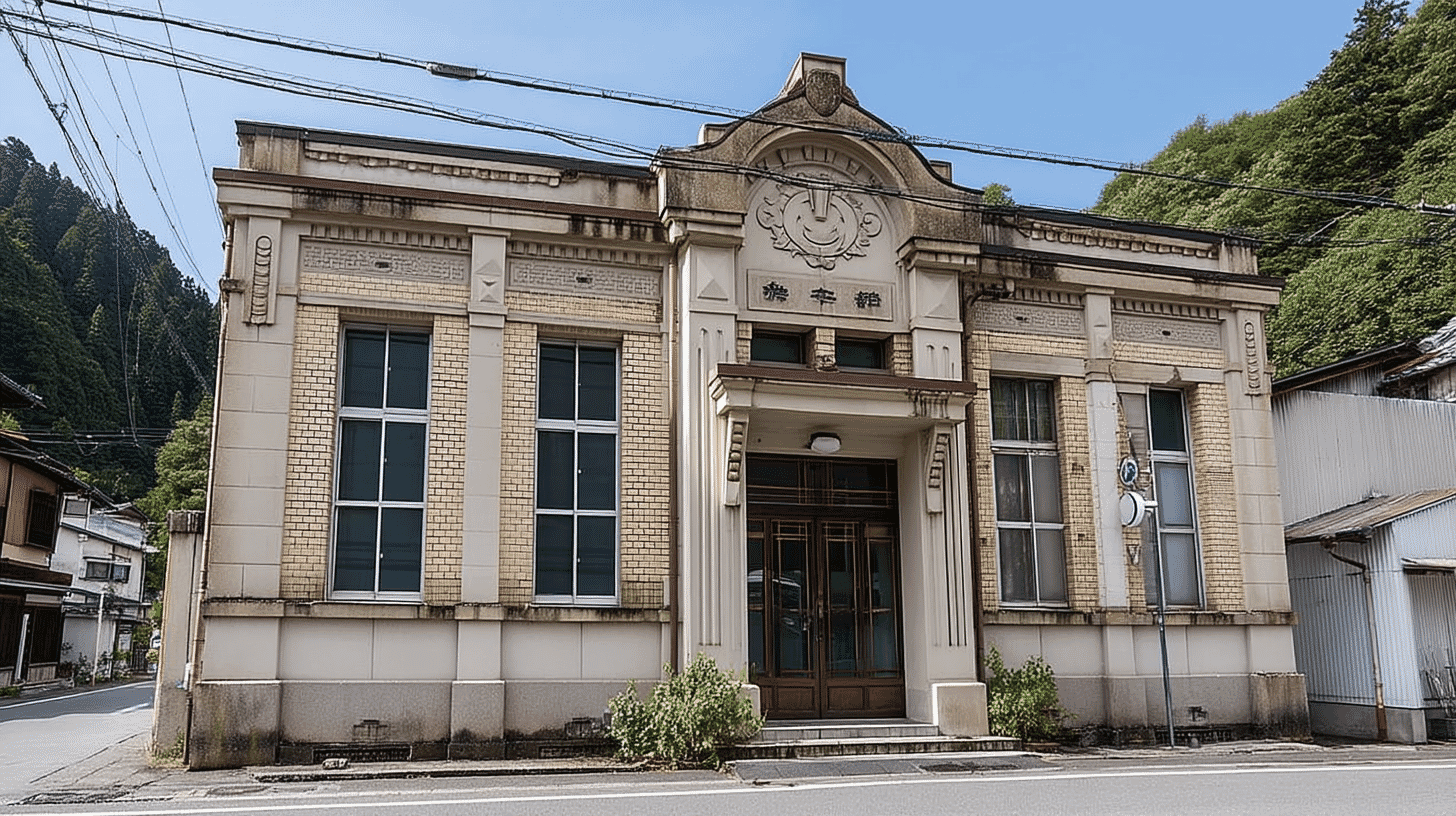
Former San'in Godo Bank Neu Branch: A Hidden Gem of Early Showa-Era Western Architecture
Tucked away in the mountainous southwest corner of Tottori Prefecture lies a remarkable architectural treasure that recently gained national recognition. The Former San'in Godo Bank Neu Branch, registered as a Tangible Cultural Property in March 2025, stands as an elegant testament to the Western architectural influences that swept through rural Japan during the early Showa period. This charming single-story wooden building, with its neoclassical facade and beautifully preserved interior, offers visitors a rare glimpse into the banking culture and architectural aspirations of 1920s Japan.
Historical Background: From Regional Bank to Cultural Heritage
The story of this distinguished building begins in 1927 (Showa 2) when it was constructed as the Neu Branch of the Unyo Jitsugyo Bank. The choice to build such an impressive Western-style structure in this small mountain town reflects the economic prosperity that the region enjoyed during this era, largely due to the flourishing tatara ironmaking industry that had made local iron merchants extremely wealthy.
The building's history mirrors the complex evolution of regional banking in Japan. In 1931, following a series of bank mergers, it became the Matsue Bank Neu Branch. A decade later, in 1941, it took on its most recognizable identity as the San'in Godo Bank Neu Branch, a name it retained until the branch relocated to a modern facility in 2018. Rather than being demolished, the historic structure was preserved by Hino Town, and in 1996, it was selected as one of Tottori Prefecture's "100 Notable Buildings." The culmination of these preservation efforts came on March 13, 2025, when the building was officially registered as a national Tangible Cultural Property.
Architectural Features: A Study in Early Showa Western Design
The Former San'in Godo Bank Neu Branch exemplifies the Western architectural vocabulary that Japanese architects adapted during the early 20th century. The building faces east onto the historic Izumo Highway, presenting a symmetrical facade that immediately commands attention.
The most striking exterior feature is the arrangement of grand pilasters—tall, flat columns embedded in the wall—that span the full height of the building in what architects call the "giant order" or "colossal order" style. These pilasters create a sense of monumentality and classical dignity that would have impressed customers entering to conduct their banking business.
The central portion of the facade rises to a triangular pediment, a hallmark of neoclassical architecture derived from ancient Greek temples. This pediment features decorative relief work that adds visual interest and sophistication to the design. Running along the eaves is an elegant cornice adorned with a distinctive pattern of semicircular relief ornaments, a characteristic decorative element of the period.
The windows are framed with carefully applied tile work, creating a pleasant contrast with the plastered walls. This combination of materials—tile, plaster, and decorative moldings—represents the typical approach of early Showa bank architecture, which sought to convey stability and trustworthiness through refined Western design elements.
The building itself is a single-story wooden structure with a hipped roof covered in sheet iron, measuring approximately 126 square meters in floor area. While the construction is traditional Japanese timber frame, the exterior presents an unmistakably Western appearance that would have set it apart from the surrounding traditional wooden structures of the post town.
Interior Highlights: Banking Hall Elegance
Step inside the former bank, and you'll discover an interior that retains much of its original character. The front portion of the building features a soaring vaulted ceiling with a decorative central medallion—a design choice that creates an impressive sense of height and grandeur within the relatively modest footprint.
While the bank's operational equipment has been removed, visitors can still appreciate the original bank counter and the substantial vault that once secured the deposits of local merchants and farmers. These elements provide tangible connections to the building's functional past and help visitors imagine the daily bustle of banking activities that once filled this space.
The building is available for interior photography with advance permission, allowing architecture enthusiasts and photographers to document this well-preserved example of early Showa banking architecture. Applications must be submitted at least 10 days in advance.
Why This Building Matters: Cultural Significance
The Former San'in Godo Bank Neu Branch holds significance on multiple levels. As an architectural artifact, it demonstrates how Western design principles were interpreted and adapted for Japanese regional contexts during a period of rapid modernization. The building represents the aspirations of rural communities to participate in the broader currents of national development while maintaining their local economic importance.
The structure also tells the story of regional banking in Japan, an industry that played a crucial role in financing local agriculture, industry, and commerce. Banks like this one served as economic anchors for their communities, and their imposing architecture was intended to inspire confidence in depositors during an era before deposit insurance.
Furthermore, the building's survival and protection reflect growing Japanese appreciation for preserving modern heritage alongside ancient temples and castles. The fact that a modest regional bank branch has been deemed worthy of national cultural property registration signals an expanding definition of what constitutes valuable architectural heritage.
Exploring Neu: A Historic Post Town on the Izumo Highway
The former bank stands within the historic townscape of Neu, a place whose unusual name carries deep historical significance. According to local legend, the name "Neu" (meaning "root rain") derives from an ancient prayer for rain at the local shrine during a devastating famine. The prayers were answered with blessed rains that began here and spread throughout the region, nourishing the roots of all growing things.
Neu flourished during the Edo period (1603-1868) as an important post station on the Izumo Highway, the vital route connecting the castle towns of Himeji and Matsue. The lords of Matsue Domain regularly passed through on their obligatory journeys to and from Edo (Tokyo), making Neu a bustling waypoint for travelers, merchants, and officials.
Walking through Neu today, visitors can still sense this historic atmosphere. Clear water channels run along the streets, the sound of flowing water providing a soothing backdrop to exploration. Traditional merchant houses and former rest stops for traveling feudal lords dot the streetscape, with the "Honjin Gate"—the entrance to where domain lords once stayed—standing as a designated cultural property.
The town also prospered through tatara ironmaking, the traditional Japanese method of producing high-quality steel. Wealthy iron merchants built substantial homes here, including the impressive Kondo Family Residence with its characteristic storehouses. The former "Demise Kondo" iron merchant's building now serves as a public facility called "Tatara no Gakko" (School of Tatara), where visitors can learn about this fascinating industrial heritage.
Nearby Attractions: Making the Most of Your Visit
A visit to the Former San'in Godo Bank Neu Branch can easily be combined with exploration of other notable sites in Hino Town and the surrounding area.
Mandarin Duck Observation
Hino Town is famous throughout Japan for its mandarin duck (oshidori) population. The mandarin duck is both the official bird of Tottori Prefecture and Hino Town, and during winter months (typically October through March), over 1,000 of these spectacularly colorful birds gather on the Hino River. A dedicated observation hut allows visitors to watch these beautiful creatures from remarkably close range—an experience difficult to find elsewhere in Japan. The observation facility is free to use and provides telescopes for detailed viewing.
Kamochi Shrine
Just a short drive from Neu is Kamochi Shrine, whose name literally means "money holding" or "wealthy." This auspicious name has made it a popular destination for those seeking good fortune in financial matters. The shrine is the only one in Japan with this propitious name, and visitors flock here to pray for prosperity, purchase lucky charms, and perhaps improve their chances in the lottery. The nearby Kamochi Terrace Hino complex offers local products, souvenirs, and a branch shrine for those who want to make a quick prayer.
Hino Town Historical Museum
Housed in the former Neu Public Hall—another elegant early 20th-century building—this museum presents the cultural and natural history of the region. The building itself, donated by the wealthy Kondo family, is worth seeing for its architecture alone.
Takiyama Park and Waterfall
For nature lovers, Takiyama Park offers forest walks and features a 50-meter waterfall at Takiyama Shrine. This spot is also famous for its connection to Lafcadio Hearn (Koizumi Yakumo), who wrote about the local legend of the "Ghost Waterfall" in his collection "Kottō" (Curios).
Local Cuisine
The Neu area is known for several local specialties. The town's soba (buckwheat noodle) restaurants have earned recognition, including Michelin listings, for their handmade noodles using locally milled flour. The regional champon (a hearty noodle soup) is another popular dish, with local restaurants serving steaming bowls that warm visitors during the cold mountain winters.
Practical Information for Visitors
Planning a visit to the Former San'in Godo Bank Neu Branch requires some preparation, as this is a relatively remote destination that rewards travelers who venture off the beaten path.
The building's exterior can be viewed at any time by walking along the Izumo Highway through Neu. For interior photography or special access, advance arrangements must be made with Hino Town at least 10 days before your intended visit.
The best times to visit are spring through autumn for comfortable weather and easy access, or winter if you wish to combine your trip with mandarin duck observation (peak viewing typically December through February). Note that this area receives significant snowfall in winter, so check road conditions if driving.
- 📍 Plan Your Visit to Tottori
- Find tours, activities & transport passes near Former Sanin Godo Bank Neu Branch
- [ Tottori Sand Dunes & Camel Riding Experience ]
Q&A
- Can I enter and photograph the interior of the former bank?
- Yes, interior photography is possible with advance permission. You must submit an application to Hino Town at least 10 days before your planned visit. While the bank's operational equipment has been removed, the original counter and vault remain, offering excellent photographic opportunities.
- When was the building designated as a cultural property?
- The Former San'in Godo Bank Neu Branch was officially registered as a national Tangible Cultural Property on March 13, 2025. Prior to this, it was selected as one of Tottori Prefecture's "100 Notable Buildings" in 1996.
- Is the building still used as a bank?
- No, banking operations ceased in 2018 when the San'in Godo Bank Neu Branch relocated to a modern facility at the nearby Kamochi Terrace Hino complex. The historic building is now preserved as a cultural heritage site owned by Hino Town.
- How do I get to Neu from major cities?
- By train, take the JR Hakubi Line to Neu Station (some Limited Express "Yakumo" services stop here). The former bank is about a 10-minute walk from the station. By car, it's approximately 15 minutes from Kofu IC on the Yonago Expressway or about 50 minutes from Niimi IC on the Chugoku Expressway. From Yonago Kitaro Airport, the drive takes about 60 minutes.
- What else can I see in the area?
- The area offers several attractions: the famous Kamochi Shrine for good fortune prayers, mandarin duck observation (winter months), historic post town streetscapes, the Hino Town Historical Museum, local tatara ironmaking heritage sites, and excellent soba restaurants. The region is also part of the Daisen-Oki National Park area.
Basic Information
| Official Name | Former San'in Godo Bank Neu Branch (旧山陰合同銀行根雨支店店舗) |
|---|---|
| Cultural Property Status | Registered Tangible Cultural Property (Building) |
| Registration Date | March 13, 2025 |
| Year Built | 1927 (Showa 2) |
| Structure | Single-story wooden building, hipped roof with sheet iron roofing |
| Floor Area | Approximately 126 m² |
| Architectural Style | Western neoclassical (Early Showa period) |
| Location | 466 Yashiki, Neu, Hino-cho, Hino-gun, Tottori Prefecture, Japan |
| Owner | Hino Town |
| Access (Train) | 10-minute walk from JR Hakubi Line Neu Station |
| Access (Car) | 15 min from Kofu IC (Yonago Expressway); 50 min from Niimi IC (Chugoku Expressway) |
| Interior Photography | By appointment only (apply at least 10 days in advance) |
| Contact | Hino Town Office, Industry Promotion Division / Tel: 0859-72-2101 |
References
- 旧山陰合同銀行根雨支店店舗 - 文化遺産オンライン
- https://bunka.nii.ac.jp/heritages/detail/607726
- 山陰合同銀行根雨支店 - Wikipedia
- https://ja.wikipedia.org/wiki/山陰合同銀行根雨支店
- 旧山陰合同銀行根雨支店 - とっとり旅の生情報
- https://www.tottori-guide.jp/fc/1623/1629/25990.html
- 日野町根雨エリア - たたらナビ
- https://www.tatara-navi.com/奥日野の旅/日野町根雨エリア/
- 日野町 (鳥取県) - Wikipedia
- https://ja.wikipedia.org/wiki/日野町_(鳥取県)
- 宿場町の風情が残る街「根雨宿」 - 山陰インバウンド機構
- https://www.sanin-tourism.com/articles/1115.html
- 観光ガイド - 日野町観光サイト
- http://www.town.hino.tottori.jp/dd.aspx?moduleid=3010&pfromid=45
- 金持神社 - とっとり旅
- https://www.tottori-guide.jp/tourism/tour/view/256
Last verified: 2026.01.28